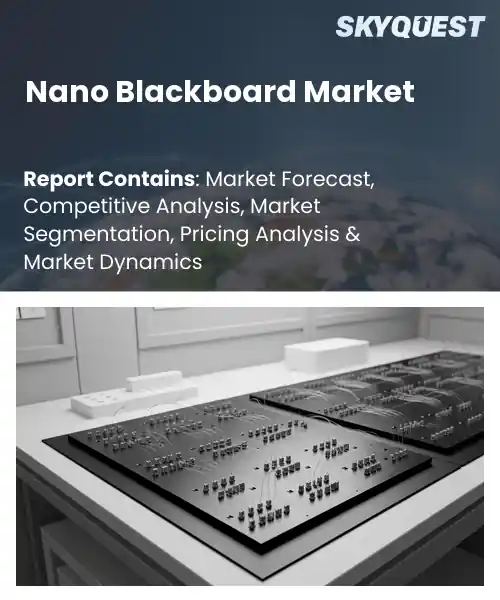
Nano Blackboard Market
Report ID: SQMIG45J2561
Report ID: SQMIG45J2561
[email protected]
USA +1 351-333-4748
Report ID:
SQMIG45J2561 |
Region:
Global |
Published Date: June, 2026
Pages:
157
|Tables:
172
|Figures:
79


Global Nano Blackboard Market size was valued at USD 487.6 Million in 2024 and is poised to grow from USD 543.19 Million in 2025 to USD 1288.34 Million by 2033, growing at a CAGR of 11.4% during the forecast period (2026-2033).
Nano blackboards are flexible display panels that embed nanoscale photonic structures to render high‑resolution visual output on curved or wearable surfaces. Their emergence addresses the demand for compact, adaptive interfaces in sectors ranging from augmented‑reality headsets to smart textiles, where traditional glass displays are impractical.
Over the past six years the market has expanded from niche research labs to pilots, underscoring its growing relevance. The most compelling growth factor for the global nano blackboard market is the surge in immersive education and remote collaboration platforms that demand lightweight, interactive surfaces. As institutions shift toward learning, nano blackboards enable annotation on panels, reducing latency and power consumption compared with LCDs. This capability drives manufacturers to integrate the technology into conference room furniture, allowing participants to edit schematics instantly, which in turn fuels demand for production lines. Consequently, venture capital flows into startups developing nanolithography, while large electronics firms partner to embed nano blackboards in tablets, expanding market reach across academia, corporate training, and design studios.
How is AI-driven personalization influencing the nano blackboard market?
AI‑driven personalization is reshaping the nano blackboard industry by making each display adapt to the user’s learning style, content preferences and interaction patterns. Machine‑learning algorithms analyze how learners engage with visual cues, adjusting contrast, layout and annotation tools in real time. This creates more intuitive interfaces that reduce cognitive load and boost retention. Vendors are embedding adaptive software into the nanostructured surface, allowing the board to suggest relevant resources or reformat information on the fly. The result is a more responsive educational environment that aligns closely with individual needs, driving higher adoption across schools and corporate training programs.
Nano Dimension in January 2026, unveiled an AI‑enabled design suite that customizes nano blackboard layouts for each user, accelerating deployment and improving operational efficiency.
Market snapshot - (2026-2033)
Global Market Size
USD 487.6 Million
Largest Segment
Fastest Growth
Growth Rate
11.4% CAGR
To get more insights on this market click here to Request a Free Sample Report
Global nano blackboard market is segmented by product type, application, mounting type, surface type, end user, sales channel and region. Based on product type, no specific sub-segments were identified. Based on application, no specific sub-segments were identified. Based on mounting type, no specific sub-segments were identified. Based on surface type, no specific sub-segments were identified. Based on end user, no specific sub-segments were identified. Based on sales channel, no specific sub-segments were identified. Based on region, the market is segmented into North America, Europe, Asia Pacific, Latin America and Middle East & Africa.
Graphene-coated segment dominates with large nano blackboard market share because its superior electrical conductivity and mechanical resilience enable ultra‑high contrast display with minimal power consumption. Designers favor this material for its ability to sustain repeated erasing cycles without degradation, meeting the durability expectations of high‑traffic educational settings. The seamless integration with touch‑sensing layers also simplifies system architecture, reducing component count and enhancing reliability, which reinforces its preference among manufacturers and end users alike throughout the product lifecycle.
As per nano blackboard market forecast, silver-nanoparticle segment is witnessing the strongest growth momentum as advances in nanoparticle synthesis lower fabrication complexity and unlock vibrant color rendering. This capability attracts adopters seeking immersive visual experiences, especially in interactive museum displays and laboratory training. The expanding design toolkit accelerates market diversification and opens new revenue streams for innovators.
As per nano blackboard market outlook, wall-mounted segment dominates because it aligns with conventional classroom infrastructure, offering stable installation that integrates seamlessly with existing power and mounting fixtures. Educators and facilities managers value the permanence and safety of fixed units, which reduces accidental displacement and ensures consistent viewing angles. The familiar form factor also simplifies training and maintenance procedures, reinforcing confidence among institutional buyers and sustaining its primacy in the market throughout operational cycles.
On the other hand, portable segment is emerging as the key high‑growth area as researchers demand flexible equipment that can be repositioned for multidisciplinary experiments. Lightweight design and battery‑powered operation enable rapid deployment across laboratory benches, fostering collaborative workflows. This mobility drives new use cases, encouraging broader institutional investment and propelling overall market expansion.
To get detailed segments analysis, Request a Free Sample Report
North America maintains a decisive advantage through a confluence of deep research expertise, expansive innovation ecosystems, and mature commercialization pathways. The region benefits from a longstanding tradition of university‑driven breakthroughs that seamlessly transition into venture‑backed enterprises. Robust intellectual‑property frameworks and proactive regulatory support foster confidence among investors and manufacturers. Integrated supply chains enable rapid prototyping and scaling, while a sizable base of tech‑savvy educational institutions drives early adoption. Collaborative networks between academia, industry, and government further accelerate product refinement, ensuring that North American firms consistently set performance benchmarks and shape global standards for nano blackboard technologies.
As per nano blackboard market regional forecast, United States thrives on a dense concentration of research universities and world‑leading technology firms that channel breakthroughs into commercial products. Strong venture capital activity fuels rapid startup growth, while established corporations leverage extensive R&D budgets to enhance material performance. The market benefits from close ties with digital learning platforms, facilitating seamless integration into classrooms. A proactive policy environment encourages innovation, and a large pool of early‑adopter institutions drives iterative improvement, positioning the United States as a continual source of cutting‑edge nano blackboard solutions.
As per nano blackboard market regional outlook, Canada is shaped by generous government research funding and a collaborative academic landscape that prioritizes sustainable technology development. Strategic partnerships with United States firms enable cross‑border knowledge transfer, while emerging Canadian startups focus on niche applications for eco‑friendly educational tools. Provincial initiatives promote adoption within schools and research facilities, creating a supportive ecosystem for product testing and refinement. The emphasis on green innovation and strong ties to indigenous scientific expertise reinforce Canada’s role as an incubator for advanced nano blackboard technologies.
Europe’s momentum stems from coordinated research programs, deep integration of sustainability goals, and a highly interconnected industrial base. The European Union’s collaborative funding mechanisms empower multi‑national projects that blend material science with digital pedagogy. Strong engineering traditions across member states ensure high‑quality manufacturing, while harmonized standards streamline market entry. Educational reform agendas prioritize interactive learning tools, creating demand across universities and vocational institutions. Additionally, a vibrant ecosystem of specialized suppliers and design firms accelerates product iteration, positioning Europe as a hub for innovative, environmentally conscious nano blackboard solutions that resonate with both academia and industry.
Germany leverages the nation’s engineering excellence and precision manufacturing heritage. Leading research institutes collaborate closely with industrial partners to develop high‑performance nanomaterials tailored for educational contexts. Robust supply chains and a reputation for quality attract institutional buyers seeking reliable, long‑lasting solutions. Government incentives encourage joint ventures between academia and industry, fostering a pipeline of continuous improvement and reinforcing Germany’s position as a dominant force within the European nano blackboard sector.
United Kingdom accelerates rapidly due to a dynamic startup environment and strong university‑industry linkages. Government innovation schemes support early‑stage companies, while leading universities provide cutting‑edge research and talent pipelines. The market benefits from a keen focus on digital transformation in education, prompting swift adoption across schools and higher‑learning establishments. Collaborative clusters in key technology hubs enable rapid prototyping and scaling, propelling the United Kingdom to the forefront of Europe’s fastest‑growing nano blackboard landscape.
France emerges from strategic national policies that champion green technology and modernized curricula. Collaborative consortia involving research laboratories, manufacturers, and educational bodies drive the development of environmentally responsible nano blackboard products. Targeted investment programs nurture emerging firms, while pilot projects within French schools demonstrate practical benefits. This supportive framework positions France as an emerging player, steadily expanding its influence within the broader European market for advanced educational surfaces.
Asia Pacific advances through a combination of high‑tech manufacturing capacity, aggressive government support, and expansive educational demand. The region’s expertise in electronics and materials processing enables cost‑effective production of sophisticated nano blackboard components. National initiatives promote smart classroom ecosystems, encouraging integration of nanomaterial surfaces with interactive platforms. A youthful population drives widespread adoption across primary, secondary, and tertiary institutions. Cross‑border collaborations among research institutes, tech giants, and startup ecosystems accelerate innovation cycles, while strong intellectual‑property protections bolster confidence among investors, collectively elevating Asia Pacific’s stature in the global nano blackboard arena.
Japan is propelled by world‑class materials research and a culture of precision engineering. Major corporations invest heavily in nanotechnology laboratories, translating scientific insights into durable educational surfaces. Close coordination with advanced learning platforms facilitates seamless incorporation into classroom environments. Government programs emphasize STEM education, encouraging schools to adopt cutting‑edge tools. This blend of technical expertise, corporate commitment, and policy backing consolidates Japan’s role as a leading innovator in the Asia Pacific nano blackboard landscape.
South Korea benefits from a highly connected digital infrastructure and a robust semiconductor industry that supplies advanced nanomaterials. Aggressive public and private investment drives rapid product development and market penetration. Educational institutions embrace smart learning technologies, creating strong demand for nano blackboard solutions that integrate with interactive curricula. Collaborative ecosystems linking universities, research centers, and agile startups foster continuous innovation, positioning South Korea as a dynamic contributor to the region’s expanding nano blackboard market.
To know more about the market opportunities by region and country, click here to
Buy The Complete Report
Increasing Demand for Smart Education
Advancements in Nanomaterial Production Techniques
High Cost of Nano Blackboard Manufacturing
Regulatory Uncertainty Across Global Markets
Request Free Customization of this report to help us to meet your business objectives.
The competitive landscape of the global nano blackboard industry is shaped by rapid entry of hard‑tech nanotech ventures, driving firms to secure strategic partnerships, accelerate product innovation, and pursue large‑scale funding rounds; for example, MIT.nano’s START.nano program has attracted new entrants while OLIX’s $250 million equity raise underscores aggressive capital deployment to scale nano‑enabled platforms, intensifying rivalry over technology leadership and market share.
SkyQuest’s ABIRAW (Advanced Business Intelligence, Research & Analysis Wing) is our Business Information Services team that Collects, Collates, Correlates, and Analyses the Data collected by means of Primary Exploratory Research backed by robust Secondary Desk research.
As per SkyQuest analysis the global nano blackboard market growth driven primarily by the rising demand for smart education that pushes institutions toward interactive, lightweight displays. A second strong catalyst is the rapid advancement of nanomaterial production techniques which improve durability, visual clarity and lower lead times. North America remains the dominant region, benefiting from deep research ecosystems and early‑adopter institutions, while the wall‑mounted segment continues to lead because it fits existing classroom infrastructure with stable installation. However, the high cost of manufacturing nano‑scale coatings and specialized installation remains a key restraint that could temper growth in cost‑sensitive markets. The global nano blackboard market trend driven by the increasing adoption of advanced teaching aids, rising investments in modern educational infrastructure, and growing demand for durable, low-maintenance writing surfaces.
| Report Metric | Details |
|---|---|
| Market size value in 2024 | USD 487.6 Million |
| Market size value in 2033 | USD 1288.34 Million |
| Growth Rate | 11.4% |
| Base year | 2024 |
| Forecast period | (2026-2033) |
| Forecast Unit (Value) | USD Million |
| Segments covered |
|
| Regions covered | North America (US, Canada), Europe (Germany, France, United Kingdom, Italy, Spain, Rest of Europe), Asia Pacific (China, India, Japan, Rest of Asia-Pacific), Latin America (Brazil, Rest of Latin America), Middle East & Africa (South Africa, GCC Countries, Rest of MEA) |
| Companies covered |
|
| Customization scope | Free report customization with purchase. Customization includes:-
|
To get a free trial access to our platform which is a one stop solution for all your data requirements for quicker decision making. This platform allows you to compare markets, competitors who are prominent in the market, and mega trends that are influencing the dynamics in the market. Also, get access to detailed SkyQuest exclusive matrix.
Table Of Content
Executive Summary
Market overview
Parent Market Analysis
Market overview
Market size
KEY MARKET INSIGHTS
COVID IMPACT
MARKET DYNAMICS & OUTLOOK
Market Size by Region
KEY COMPANY PROFILES
Methodology
For the Nano Blackboard Market, our research methodology involved a mixture of primary and secondary data sources. Key steps involved in the research process are listed below:
1. Information Procurement: This stage involved the procurement of Market data or related information via primary and secondary sources. The various secondary sources used included various company websites, annual reports, trade databases, and paid databases such as Hoover's, Bloomberg Business, Factiva, and Avention. Our team did 45 primary interactions Globally which included several stakeholders such as manufacturers, customers, key opinion leaders, etc. Overall, information procurement was one of the most extensive stages in our research process.
2. Information Analysis: This step involved triangulation of data through bottom-up and top-down approaches to estimate and validate the total size and future estimate of the Nano Blackboard Market.
3. Report Formulation: The final step entailed the placement of data points in appropriate Market spaces in an attempt to deduce viable conclusions.
4. Validation & Publishing: Validation is the most important step in the process. Validation & re-validation via an intricately designed process helped us finalize data points to be used for final calculations. The final Market estimates and forecasts were then aligned and sent to our panel of industry experts for validation of data. Once the validation was done the report was sent to our Quality Assurance team to ensure adherence to style guides, consistency & design.
Analyst Support
Customization Options
With the given market data, our dedicated team of analysts can offer you the following customization options are available for the Nano Blackboard Market:
Product Analysis: Product matrix, which offers a detailed comparison of the product portfolio of companies.
Regional Analysis: Further analysis of the Nano Blackboard Market for additional countries.
Competitive Analysis: Detailed analysis and profiling of additional Market players & comparative analysis of competitive products.
Go to Market Strategy: Find the high-growth channels to invest your marketing efforts and increase your customer base.
Innovation Mapping: Identify racial solutions and innovation, connected to deep ecosystems of innovators, start-ups, academics, and strategic partners.
Category Intelligence: Customized intelligence that is relevant to their supply Markets will enable them to make smarter sourcing decisions and improve their category management.
Public Company Transcript Analysis: To improve the investment performance by generating new alpha and making better-informed decisions.
Social Media Listening: To analyze the conversations and trends happening not just around your brand, but around your industry as a whole, and use those insights to make better Marketing decisions.
REQUEST FOR SAMPLE
 REQUEST FREE CUSTOMIZATION
Global Nano Blackboard Market size was valued at USD 487.6 Million in 2024 and is poised to grow from USD 543.19 Million in 2025 to USD 1288.34 Million by 2033, growing at a CAGR of 11.4% during the forecast period (2026-2033).
The competitive landscape of the Global Nano Blackboard market is shaped by rapid entry of hard‑tech nanotech ventures, driving firms to secure strategic partnerships, accelerate product innovation, and pursue large‑scale funding rounds; for example, MIT.nano’s START.nano program has attracted new entrants while OLIX’s $250 million equity raise underscores aggressive capital deployment to scale nano‑enabled platforms, intensifying rivalry over technology leadership and market share. 'Merck KGaA', 'Thermo Fisher Scientific Inc.', 'Avantor, Inc.', 'NanoHybrids Inc.', 'US Research Nanomaterials, Inc.', 'Nanografi Nano Technology', 'SkySpring Nanomaterials, Inc.', 'Nanocs Inc.', 'American Elements Corporation', 'Nanoshel LLC', 'Strem Chemicals, Inc.', 'Hongwu International Group Ltd.', 'PlasmaChem GmbH', 'NanoAmor Inc.', 'Advanced Nano Products Co., Ltd.', 'EPRUI Nanoparticles & Microspheres Co. Ltd.', 'Graphenea S.A.', 'ACS Material LLC', 'Sigma-Aldrich Corporation', 'NanoLab, Inc.'
The growing emphasis on interactive and technology‑enabled learning environments is prompting educators to seek innovative tools that enhance student engagement, and nano blackboards provide a tactile yet digital interface that aligns with these pedagogical goals, thereby stimulating institutional adoption and fostering market expansion as schools and universities integrate these solutions into curricula and campus infrastructure. These devices also support collaborative projects, allowing real‑time annotation and cross‑disciplinary interaction, which further reinforces their value proposition and encourages broader diffusion across educational institutions worldwide.
Sustainable Materials Integration: The industry is increasingly aligning with sustainability goals, prompting manufacturers to replace traditional polymer matrices with bio‑derived or recyclable nanocomposites. This shift reduces environmental impact and appeals to eco‑conscious educational institutions and corporate training centers. Suppliers are collaborating with green material innovators to develop low‑VOC, energy‑efficient production processes, while regulators encourage greener product portfolios. Consequently, product roadmaps now prioritize life‑cycle assessments, driving broader market acceptance and opening new channels in regions with strong sustainability mandates and fostering long‑term stakeholder confidence globally.
Why does North America Dominate the Global Nano Blackboard Market? |@12


Want to customize this report? This report can be personalized according to your needs. Our analysts and industry experts will work directly with you to understand your requirements and provide you with customized data in a short amount of time. We offer $1000 worth of FREE customization at the time of purchase.
Feedback From Our Clients


 USA (+1) 351-333-4748

