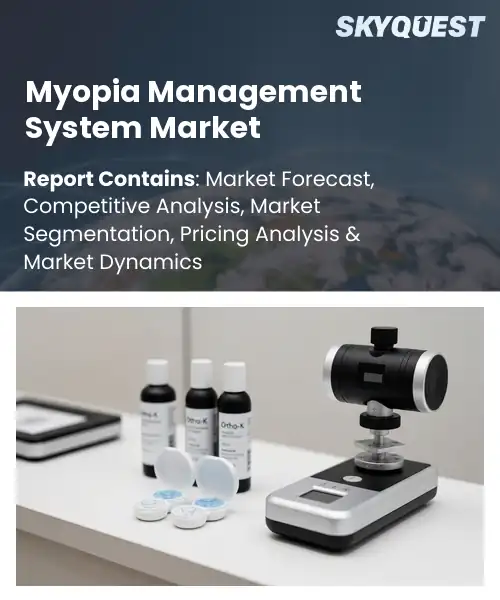
Myopia Management System Market
Report ID: SQMIG35A4248
Report ID: SQMIG35A4248
[email protected]
USA +1 351-333-4748
Report ID:
SQMIG35A4248 |
Region:
Global |
Published Date: July, 2026
Pages:
157
|Tables:
117
|Figures:
77


Global Myopia Management System Market size was valued at USD 2.96 Billion in 2024 and is poised to grow from USD 3.22 Billion in 2025 to USD 6.27 Billion by 2033, growing at a CAGR of 8.7% during the forecast period (2026-2033).
The primary driver of myopia management system market is the rise in myopia prevalence, especially among children in urban Asia. Over the past two decades, epidemiological surveys have recorded rates climbing from 10% to over 30% in countries such as China, Singapore, and South Korea, creating a public‑health concern. This surge has spurred demand for interventions that can slow axial elongation rather than merely correct vision, prompting manufacturers to develop orthokeratology lenses, atropine eye drops, and peripheral‑defocus designs. As governments recognize the socioeconomic burden of vision impairment, they have begun funding screening programs and endorsing intervention strategies, legitimizing the market. A second key factor shaping the market is the convergence of health platforms with myopia control technologies, which expands access and creates treatment pathways. Wearable devices that monitor daily near‑work feed algorithms that recommend lens or drug regimens, enabling clinicians to adjust therapy in time; for instance, a Tokyo clinic integrated a dashboard that reduced axial growth by 0.12 mm. This integration lowers barriers for practitioners, stimulates investment in services, and invites insurers to reimburse programs. Consequently, manufacturers are launching bundled solutions that combine smart glasses, cloud analytics, and tele‑consultations, unlocking revenue streams while addressing unmet need for scalable myopia management.
How is AI enhancing patient outcomes in the Myopia Management System market?
AI is reshaping the Myopia Management System market by turning large volumes of clinical data into actionable insights. Machine learning models analyze retinal scans and biometric measurements to predict progression risk, allowing clinicians to intervene earlier. Real time analytics embedded in diagnostic devices guide the selection of orthokeratology lenses, contact lenses or low dose atropine regimens that best match each patient’s profile. Integration with electronic health records enables continuous monitoring and automatic adjustment of treatment plans as children grow. This data driven approach improves visual outcomes, reduces the need for repeat visits and supports the market’s shift toward personalized, outcome focused care.ZEISS, January 2025, launched an AI driven platform integrated with its MEL 90 Excimer Laser that customizes ablation profiles to each patient’s corneal data. The system improves precision, shortens recovery and lowers retreatment rates, driving stronger adoption of advanced myopia management solutions across clinical settings worldwide and long term patient satisfaction.
Market snapshot - (2026-2033)
Global Market Size
USD 2.96 Billion
Largest Segment
Soft Contact Lenses
Fastest Growth
Pharmaceutical Therapy
Growth Rate
8.7% CAGR
To get more insights on this market click here to Request a Free Sample Report
Global myopia management system market is segmented by product type, patient group, application, end user and region. Based on product type, the market is segmented into Orthokeratology Lenses, Soft Contact Lenses, Spectacle Lenses and Pharmaceutical Therapy. Based on patient group, the market is segmented into Children, Adolescents and Adults. Based on application, the market is segmented into Myopia Control and Myopia Progression Monitoring. Based on end user, the market is segmented into Hospitals, Ophthalmology Clinics and Optical Centers. Based on region, the market is segmented into North America, Europe, Asia Pacific, Latin America and Middle East & Africa.
Orthokeratology lenses segment dominates because they provide a non‑surgical, reversible method to reshape corneal curvature overnight, delivering immediate visual correction while slowing axial elongation. Clinicians favor them for patients seeking spectacle independence and parents value the dual benefit of vision clarity and myopia control. Their proven efficacy, coupled with growing consumer awareness of nighttime wear convenience, drives widespread adoption across optical practices and reinforces market leadership.
However, soft contact lenses segment is witnessing the strongest growth momentum because manufacturers are integrating high‑additivity myopia‑control designs and advanced material science that enhance comfort and oxygen permeability. These innovations attract first‑time wearers and expand usage in routine check‑ups, fueling rapid market expansion and creating new commercial pathways for device and service providers.
Children group dominates because early onset myopia presents the highest risk of progressive eye elongation, prompting clinicians to prioritize intervention at this age. Parents and schools are increasingly vigilant, leading to routine screening programs that funnel young patients toward corrective solutions. The urgency to prevent long‑term visual impairment fuels demand for dedicated devices, educational tools, and treatment protocols tailored specifically for this demographic.
Meanwhile, adolescents group emerges as the key high‑growth area because peer influence and academic pressure increase screen time, accelerating myopia progression. Digital health platforms and wearable monitors are being adapted for this age, offering engaging feedback and compliance incentives. This synergy drives rapid adoption, expanding market reach and attracting investment in adolescent‑focused solutions.
To get detailed segments analysis, Request a Free Sample Report
Asia Pacific dominates the global Myopia Management System market due to a confluence of demographic, clinical, and technological factors. The region experiences a substantial demand for early vision correction driven by lifestyle changes that intensify near‑work activities. Robust healthcare ecosystems equipped with specialist ophthalmology networks enable widespread adoption of advanced management solutions. Government health initiatives prioritize preventive eye care, fostering public awareness and encouraging routine screenings. Industry players benefit from strong research and development ecosystems, particularly in semiconductor and optics sectors, accelerating innovation of precision devices. Collaborative partnerships between academic institutions, clinics, and technology firms create an environment where cutting‑edge treatments are rapidly translated into practice, reinforcing the region’s leadership.
Myopia Management System Market in Japan is propelled by a high level of clinical expertise and a cultural emphasis on preventive health. Leading ophthalmic societies actively disseminate best practices, while insurance frameworks facilitate patient access to comprehensive treatment plans. Domestic manufacturers integrate sophisticated optical engineering with locally driven research, ensuring a pipeline of tailored solutions. Public education campaigns further reinforce early detection, sustaining demand across both urban and suburban settings.
Myopia Management System Market in South Korea thrives on a synergy between cutting‑edge manufacturing capabilities and a proactive public health outlook. Strong governmental support for vision health programs encourages routine eye examinations, while private clinics adopt the latest therapeutic technologies. Collaboration between electronic component producers and medical device developers fuels rapid innovation in personalized correction tools. Consumer awareness of long‑term ocular health drives acceptance of multifocal and orthokeratology interventions, reinforcing market momentum.
The rapid expansion of the Myopia Management System market in North America is underpinned by heightened consumer awareness, strong clinical adoption, and a dynamic innovation ecosystem. Eye care professionals increasingly prioritize early intervention strategies, supported by extensive continuing‑education resources that disseminate the latest evidence‑based practices. Robust reimbursement structures and private insurance coverage reduce financial barriers for patients seeking comprehensive management. Technology firms based in the region accelerate product development through investments in digital imaging, data analytics, and tele‑health platforms, enabling scalable delivery of personalized care. Collaborative research initiatives between academic centers and industry pioneers further propel the introduction of next‑generation therapeutic modalities, cementing the region’s role as a growth engine.
Myopia Management System Market in the United States is amplified by a large network of specialized eye care clinics that integrate multidisciplinary approaches. Strong emphasis on evidence‑based guidelines drives adoption of advanced treatment protocols. Private insurers increasingly recognize the long‑term cost benefits of early myopia control, expanding coverage options. Tech startups collaborate with academic researchers to introduce AI‑enhanced diagnostics, fostering a climate of continual innovation and patient‑centric solutions.
Myopia Management System Market in Canada benefits from a universal healthcare framework that emphasizes preventive services. Provincial health authorities promote routine vision screening in schools, raising early detection rates. Eye care professionals adopt comprehensive management regimens supported by clinical guidelines endorsed by national ophthalmology societies. Partnerships between Canadian research institutions and device manufacturers accelerate the development of regionally adapted solutions, while public awareness campaigns highlight the importance of managing myopia from a young age.
Europe is strengthening its position in the Myopia Management System market through coordinated policy initiatives, robust research networks, and a focus on sustainable healthcare delivery. Regional health agencies prioritize vision health within broader preventive strategies, resulting in standardized screening programs across member states. Collaborative research consortia pool expertise from leading academic centers, driving the generation of high‑quality clinical evidence that informs practice guidelines. Manufacturers benefit from a mature regulatory environment that balances safety with market entry efficiency, encouraging the launch of innovative optical devices. Additionally, patient advocacy groups increase public understanding of myopia risks, fostering demand for early intervention and reinforcing Europe’s reputation as a hub for evidence‑driven eye care solutions.
Myopia Management System Market in Germany is characterized by a strong emphasis on scientific rigor and integrated care pathways. National health insurers support reimbursement for comprehensive myopia control programs, encouraging widespread clinical uptake. Collaborative efforts between university hospitals and precision optics firms accelerate the development of customized therapeutic lenses. Patient education initiatives coordinated by professional societies raise awareness of long‑term ocular health, driving acceptance of preventive treatment modalities across diverse demographic groups.
Myopia Management System Market in the United Kingdom benefits from a National Health Service framework that increasingly incorporates preventive eye care into primary health services. Clinical guidelines issued by ophthalmology colleges promote early detection and multidisciplinary management. Partnerships between research institutions and technology innovators facilitate the rapid translation of novel diagnostic tools into practice. Public health campaigns in schools and community centers highlight the importance of myopia management, reinforcing market growth and patient access.
Myopia Management System Market in France is driven by a concerted public health approach that integrates vision screening into routine pediatric assessments. Health insurance schemes provide coverage for evidence‑based myopia control interventions, reducing out‑of‑pocket expenses. Collaborative projects between French research laboratories and optical manufacturers yield advanced lens technologies tailored to local patient needs. Advocacy by ophthalmic societies educates families about the benefits of early intervention, supporting sustained demand for comprehensive management solutions.
To know more about the market opportunities by region and country, click here to
Buy The Complete Report
Rising Prevalence of Myopia
Adoption Of Orthokeratology Devices
High Cost Of Treatment
Limited Access In Rural Areas
Request Free Customization of this report to help us to meet your business objectives.
The market is dominated by a handful of established optics giants whose aggressive product roll‑outs and collaborative R&D intensify competition; the drive to capture a rapidly expanding pediatric myopia segment pushes firms to innovate. CooperVision and Johnson & Johnson have each launched next‑generation myopia‑control contact lenses, while Essilor and Bausch & Lomb are co‑developing advanced defocus lens platforms, illustrating a clear focus on technology partnerships and accelerated product pipelines.
Top Player’s Company Profile
Recent Developments
SkyQuest’s ABIRAW (Advanced Business Intelligence, Research & Analysis Wing) is our Business Information Services team that Collects, Collates, Correlates, and Analyses the Data collected by means of Primary Exploratory Research backed by robust Secondary Desk research. As per SkyQuest analysis, the global myopia management system market is being propelled primarily by the rapid rise in myopia prevalence, especially among children in urban Asia, which fuels strong demand for corrective and control solutions. A second catalyst is the growing adoption of orthokeratology devices that offer overnight vision correction while slowing axial elongation, encouraging clinicians to expand their product offerings. However, high treatment costs remain a significant restraint, limiting uptake in price‑sensitive regions and slowing broader market penetration. Asia Pacific dominates the market thanks to its large patient base and supportive public‑health initiatives, and within the product landscape orthokeratology lenses hold the largest share, driving overall growth.
| Report Metric | Details |
|---|---|
| Market size value in 2024 | USD 2.96 Billion |
| Market size value in 2033 | USD 6.27 Billion |
| Growth Rate | 8.7% |
| Base year | 2024 |
| Forecast period | (2026-2033) |
| Forecast Unit (Value) | USD Billion |
| Segments covered |
|
| Regions covered | North America (US, Canada), Europe (Germany, France, United Kingdom, Italy, Spain, Rest of Europe), Asia Pacific (China, India, Japan, Rest of Asia-Pacific), Latin America (Brazil, Rest of Latin America), Middle East & Africa (South Africa, GCC Countries, Rest of MEA) |
| Companies covered |
|
| Customization scope | Free report customization with purchase. Customization includes:-
|
To get a free trial access to our platform which is a one stop solution for all your data requirements for quicker decision making. This platform allows you to compare markets, competitors who are prominent in the market, and mega trends that are influencing the dynamics in the market. Also, get access to detailed SkyQuest exclusive matrix.
Table Of Content
Executive Summary
Market overview
Parent Market Analysis
Market overview
Market size
KEY MARKET INSIGHTS
COVID IMPACT
MARKET DYNAMICS & OUTLOOK
Market Size by Region
KEY COMPANY PROFILES
Methodology
For the Myopia Management System Market, our research methodology involved a mixture of primary and secondary data sources. Key steps involved in the research process are listed below:
1. Information Procurement: This stage involved the procurement of Market data or related information via primary and secondary sources. The various secondary sources used included various company websites, annual reports, trade databases, and paid databases such as Hoover's, Bloomberg Business, Factiva, and Avention. Our team did 45 primary interactions Globally which included several stakeholders such as manufacturers, customers, key opinion leaders, etc. Overall, information procurement was one of the most extensive stages in our research process.
2. Information Analysis: This step involved triangulation of data through bottom-up and top-down approaches to estimate and validate the total size and future estimate of the Myopia Management System Market.
3. Report Formulation: The final step entailed the placement of data points in appropriate Market spaces in an attempt to deduce viable conclusions.
4. Validation & Publishing: Validation is the most important step in the process. Validation & re-validation via an intricately designed process helped us finalize data points to be used for final calculations. The final Market estimates and forecasts were then aligned and sent to our panel of industry experts for validation of data. Once the validation was done the report was sent to our Quality Assurance team to ensure adherence to style guides, consistency & design.
Analyst Support
Customization Options
With the given market data, our dedicated team of analysts can offer you the following customization options are available for the Myopia Management System Market:
Product Analysis: Product matrix, which offers a detailed comparison of the product portfolio of companies.
Regional Analysis: Further analysis of the Myopia Management System Market for additional countries.
Competitive Analysis: Detailed analysis and profiling of additional Market players & comparative analysis of competitive products.
Go to Market Strategy: Find the high-growth channels to invest your marketing efforts and increase your customer base.
Innovation Mapping: Identify racial solutions and innovation, connected to deep ecosystems of innovators, start-ups, academics, and strategic partners.
Category Intelligence: Customized intelligence that is relevant to their supply Markets will enable them to make smarter sourcing decisions and improve their category management.
Public Company Transcript Analysis: To improve the investment performance by generating new alpha and making better-informed decisions.
Social Media Listening: To analyze the conversations and trends happening not just around your brand, but around your industry as a whole, and use those insights to make better Marketing decisions.
REQUEST FOR SAMPLE
 REQUEST FREE CUSTOMIZATION


Want to customize this report? This report can be personalized according to your needs. Our analysts and industry experts will work directly with you to understand your requirements and provide you with customized data in a short amount of time. We offer $1000 worth of FREE customization at the time of purchase.
Feedback From Our Clients


 USA (+1) 351-333-4748

