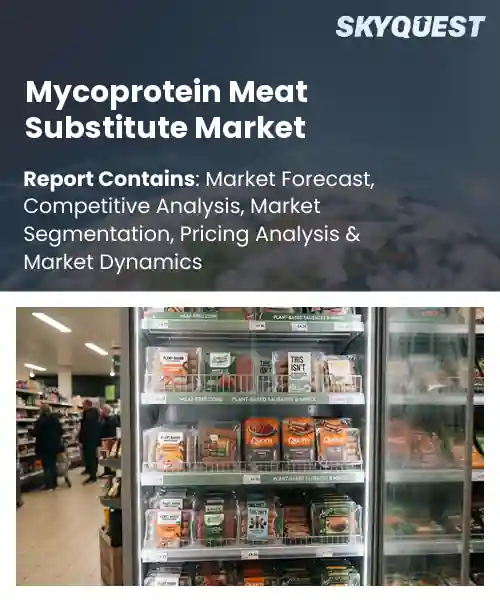
Mycoprotein Meat Substitute Market
Report ID: SQMIG30I3280
Report ID: SQMIG30I3280
[email protected]
USA +1 351-333-4748
Report ID:
SQMIG30I3280 |
Region:
Global |
Published Date: September, 2026
Pages:
157
|Tables:
152
|Figures:
78


Global Mycoprotein Meat Substitute Market size was valued at USD 4.29 Billion in 2024 and is poised to grow from USD 4.51 Billion in 2025 to USD 6.67 Billion by 2033, growing at a CAGR of 5.02% during the forecast period (2026-2033).
Building on that shift, the primary growth driver is the convergence of consumer health trends with sustainability mandates, which compels manufacturers to adopt mycoprotein as a scalable solution. As governments impose carbon‑taxes and retailers demand lower‑impact ingredients, companies such as Kellogg’s and Nestlé are reformulating snack lines, expanding distribution channels and reducing reliance on animal‑derived inputs. This regulatory pressure spurs investment in large‑scale bioreactors, lowering unit costs and enabling entry into emerging markets where protein scarcity is acute. Consequently, novel applications from plant‑based sausages in Brazil to protein‑rich dairy alternatives in Japan show how policy incentives translate into product diversification and revenue growth.
How is AI-driven automation influencing product development in the mycoprotein meat substitute market?
AI-driven automation is reshaping product development in the mycoprotein meat‑substitute market by linking data‑rich fermentation with rapid formulation cycles. Machine‑learning models now screen fungal strains for yield, flavor precursors and texture, while sensor‑based control loops adjust temperature, pH and oxygen in real time. This reduces the need for lengthy lab experiments and speeds up scale‑up, allowing companies to iterate new textures such as chicken‑like strips or burger‑ready crumbles within weeks. The market, buoyed by consumer demand for sustainable protein, is seeing startups and incumbents alike embed digital twins and robotic handling to cut waste and improve consistency, making product launches more agile and cost‑effective.Quorn announced in March 2024, an AI‑driven automation platform that streamlines strain optimization and batch monitoring, cutting development cycles and supporting faster rollout of new mycoprotein products. The system integrates real‑time analytics with robotic sampling, letting the company refine texture and flavor on the fly, accelerating market entry and reinforcing its leadership in sustainable protein.
Market snapshot - (2026-2033)
Global Market Size
USD 4.29 Billion
Largest Segment
Meat-Free Burgers
Fastest Growth
Meat-Free Nuggets
Growth Rate
5.02% CAGR
To get more insights on this market click here to Request a Free Sample Report
Global mycoprotein meat substitute market is segmented by product type, form, source, application, end-use industry and region. Based on product type, the market is segmented into Meat-Free Mince, Meat-Free Burgers, Meat-Free Nuggets, Meat-Free Sausages, Meat-Free Fillets and Others. Based on form, the market is segmented into Frozen, Chilled, Shelf-Stable and Others. Based on source, the market is segmented into Fusarium-Based, Other Fungal Sources, Blended Sources and Others. Based on application, the market is segmented into Retail, Foodservice, Ready Meals and Others. Based on end-use industry, the market is segmented into Food and Beverage, Restaurants and Foodservice, Retail, Institutional Catering and Others. Based on region, the market is segmented into North America, Europe, Asia Pacific, Latin America and Middle East & Africa.
Meat-Free Burgers segment dominates because it aligns closely with mainstream consumer habits, offering a direct plant based analogue to a universally loved protein format. Its familiar shape, cooking simplicity, and ability to deliver comparable texture and flavor encourage trial among flexitarians and vegetarians alike. Brand portfolios prioritize burgers to capture shelf visibility, and retailers allocate premium shelf space, reinforcing its market leadership through strong demand loops and social media buzz.
However, Meat-Free Sausages are witnessing the strongest growth momentum because snack centric lifestyles and on the go consumption are fueling demand for portable protein. Innovative flavor profiles and collaborations with convenience brands expand usage occasions, accelerating market expansion and opening new channels for mycoprotein applications and driving consumer loyalty across multiple retail formats.
Frozen form dominates because it offers extended shelf life while preserving the fibrous texture essential to mycoprotein products. This convenience enables bulk purchasing for both households and foodservice operators, reducing waste concerns and simplifying logistics. The ability to stock inventory without refrigeration constraints aligns with supply chain efficiency goals, making frozen mycoprotein a preferred choice across distribution channels and supports consistent product performance for culinary applications.
Meanwhile, Shelf Stable format emerges as the most rapidly expanding area because urban consumers seek ready to eat protein that can endure fluctuating storage conditions. Advances in aseptic processing preserve mycoprotein’s mouthfeel without refrigeration, unlocking new retail placements such as convenience aisles and vending. This growth widens market reach and fuels innovation pipelines for longer life mycoprotein offerings.
To get detailed segments analysis, Request a Free Sample Report
Europe leads the global mycoprotein meat substitute market through a confluence of robust research ecosystems, strong consumer openness to sustainable protein, and supportive policy frameworks. Extensive public funding for food innovation fuels continuous product development, while well‑established food manufacturing clusters enable rapid scale‑up. Consumers across the region demonstrate heightened environmental awareness, translating into willingness to experiment with novel protein sources. Retail channels are highly integrated, offering premium shelf space for alternative proteins. Moreover, collaborative networks among universities, startups, and multinational food companies accelerate knowledge transfer and market entry. The region’s emphasis on circular economy principles also encourages the use of agricultural residues in mycoprotein production, reducing waste and enhancing sustainability credentials. Additionally, strong culinary heritage promotes creative incorporation of mycoprotein into traditional dishes, further broadening consumer exposure.
Mycoprotein Meat Substitute Market in Germany benefits from an advanced bioprocessing landscape and a consumer base that values health and environmental stewardship. Leading research institutes collaborate closely with food manufacturers to refine fermentation techniques, while retailers allocate dedicated aisles for alternative proteins. Culinary innovators experiment with local flavors, making mycoprotein products appealing to traditional German palettes. This synergy of science, distribution, and gastronomy sustains steady demand growth through strategic partnerships nationwide.
Mycoprotein Meat Substitute Market in the United Kingdom thrives on a culture of culinary experimentation and progressive regulatory support for plant‑based innovations. Academic laboratories work hand‑in‑hand with startups to enhance protein yields, while major supermarket chains champion shelf‑space allocation for mycoprotein ranges. Public campaigns emphasize reduced meat consumption for climate mitigation, resonating with environmentally conscious shoppers. This convergence of research, retail endorsement, and consumer advocacy fuels a robust market overall trajectory.
Mycoprotein Meat Substitute Market in France is propelled by a tradition of gastronomic innovation and incentives for sustainable food systems. Collaborative projects between agritech research centers and food processors focus on optimizing fungal fermentation, while boutique retailers showcase mycoprotein offerings alongside French delicacies. Consumer narratives highlight ethical eating and biodiversity preservation, aligning with national culinary values. This blend of scientific ambition, refined retail presentation, and cultural resonance sustains expanding market acceptance.
The rapid expansion of the mycoprotein meat substitute market in North America is driven by a convergence of health‑focused consumer trends, strong venture capital backing for food tech, and an evolving regulatory landscape that encourages alternative protein development. Consumers increasingly prioritize plant‑derived nutrition without compromising taste, prompting retailers to allocate prominent shelf space and launch dedicated brand campaigns. Biotech incubators and university labs collaborate closely with start‑ups to accelerate strain improvement and production efficiency. Moreover, consumer education initiatives highlight the environmental benefits of fungal protein, reinforcing purchase intent. The presence of well‑established distribution networks ensures rapid product rollout across urban and suburban markets, further cementing mycoprotein’s foothold. This ecosystem of demand, capital, and innovation creates a fertile environment for sustained market growth.
Mycoprotein Meat Substitute Market in the United States thrives on an innovation ecosystem and a consumer base eager for novel protein experiences. Leading biotechnology firms partner with major food processors to refine fermentation scale, while grocery chains dedicate shelves to mycoprotein lines. Influencer and media campaigns amplify awareness of health and sustainability advantages, driving trial among demographics. This combination of advanced R&D, retail commitment, and curiosity sustains strong market momentum.
Mycoprotein Meat Substitute Market in Canada benefits from an emphasis on food security and stewardship within policy. Research alliances between governmental labs and private firms accelerate strain optimization, while retailers prioritize shelf space for locally produced mycoprotein items. Consumer education programs highlight the reduced ecological footprint of fungal protein, encouraging purchase among shoppers. This alignment of policy support, innovation, and market readiness drives expansion of mycoprotein adoption across Canadian households.
Asia Pacific is strengthening its position in the mycoprotein meat substitute market through rapid technology adoption, growing consumer openness to alternative proteins, and supportive government initiatives aimed at food sustainability. The region’s strong manufacturing base allows efficient scale‑up of fermentation processes, while culinary traditions encourage creative integration of mycoprotein into familiar dishes. Public awareness campaigns connect the health benefits of fungal protein with the desire for low‑carbon diets, enhancing consumer perception. Partnerships between local biotech firms and multinational food companies accelerate knowledge transfer and market entry. This combination of production capability, cultural adaptability, and policy encouragement propels Asia Pacific toward a more prominent global role. In addition, investment in research parks focused on cellular agriculture provides a collaborative environment for startups to experiment with novel fungal strains. Consumer tasting events hosted in urban centers further normalize mycoprotein as a versatile ingredient, bridging the gap between traditional cuisine and sustainability goals.
Mycoprotein Meat Substitute Market in Japan is energized by a cultural appreciation for foods and a palate. Research institutes collaborate with food manufacturers to refine texture and flavor profiles that complement Japanese cuisine, while retail chains allocate shelf space for mycoprotein alongside soy‑based alternatives. Guidelines promoting protein diversification support product development, and festivals showcase mycoprotein dishes to diners. This alignment of scientific expertise, retail strategy, and cultural relevance drives traction.
Mycoprotein Meat Substitute Market in South Korea is propelled by accelerated adoption of food production and a demographic eager for innovative diets. Universities partner with biotech firms to enhance fungal strain efficiency, while convenience‑store chains introduce mycoprotein snacks that align with lifestyles. Government programs encouraging protein diversification provide funding and regulatory clarity, fostering market entry. The blend of scientific advancement, distribution convenience, and consumer curiosity fuels acceptance across Korean households.
To know more about the market opportunities by region and country, click here to
Buy The Complete Report
Rising Health Consciousness
Advancements In Fermentation Technology
High Production Cost Structure
Regulatory Approval Uncertainty
Request Free Customization of this report to help us to meet your business objectives.
The mycoprotein segment is shaped by intense rivalry among established players and fast‑moving newcomers, driving M&A, strategic partnerships, and technology upgrades. Quorn’s parent Marlow Foods recently acquired a niche fungal‑culture startup to broaden its product line, while Motif FoodWorks partnered with a global restaurant chain to co‑develop mycoprotein‑based menu items. These actions intensify competition and accelerate innovation across the market.
Top Player’s Company Profile
Recent Developments
SkyQuest’s ABIRAW (Advanced Business Intelligence, Research & Analysis Wing) is our Business Information Services team that Collects, Collates, Correlates, and Analyses the Data collected by means of Primary Exploratory Research backed by robust Secondary Desk research. As per SkyQuest analysis, the global mycoprotein meat‑substitute market is being propelled primarily by rising health consciousness, as consumers seek low‑fat, high‑fiber protein alternatives that mimic meat texture, while advancements in fermentation technology serve as a second catalyst that lowers costs and speeds product rollout. Europe emerges as the dominant region, thanks to strong research ecosystems, supportive policies and consumer openness to sustainable foods. Within product categories, meat‑free burgers lead the market, offering familiar formats that drive trial and shelf visibility. However, the high production‑cost structure remains a key restraint, keeping prices premium and limiting adoption in price‑sensitive markets today.
| Report Metric | Details |
|---|---|
| Market size value in 2024 | USD 4.29 Billion |
| Market size value in 2033 | USD 6.67 Billion |
| Growth Rate | 5.02% |
| Base year | 2024 |
| Forecast period | (2026-2033) |
| Forecast Unit (Value) | USD Billion |
| Segments covered |
|
| Regions covered | North America (US, Canada), Europe (Germany, France, United Kingdom, Italy, Spain, Rest of Europe), Asia Pacific (China, India, Japan, Rest of Asia-Pacific), Latin America (Brazil, Rest of Latin America), Middle East & Africa (South Africa, GCC Countries, Rest of MEA) |
| Companies covered |
|
| Customization scope | Free report customization with purchase. Customization includes:-
|
To get a free trial access to our platform which is a one stop solution for all your data requirements for quicker decision making. This platform allows you to compare markets, competitors who are prominent in the market, and mega trends that are influencing the dynamics in the market. Also, get access to detailed SkyQuest exclusive matrix.
Table Of Content
Executive Summary
Market overview
Parent Market Analysis
Market overview
Market size
KEY MARKET INSIGHTS
COVID IMPACT
MARKET DYNAMICS & OUTLOOK
Market Size by Region
KEY COMPANY PROFILES
Methodology
For the Mycoprotein Meat Substitute Market, our research methodology involved a mixture of primary and secondary data sources. Key steps involved in the research process are listed below:
1. Information Procurement: This stage involved the procurement of Market data or related information via primary and secondary sources. The various secondary sources used included various company websites, annual reports, trade databases, and paid databases such as Hoover's, Bloomberg Business, Factiva, and Avention. Our team did 45 primary interactions Globally which included several stakeholders such as manufacturers, customers, key opinion leaders, etc. Overall, information procurement was one of the most extensive stages in our research process.
2. Information Analysis: This step involved triangulation of data through bottom-up and top-down approaches to estimate and validate the total size and future estimate of the Mycoprotein Meat Substitute Market.
3. Report Formulation: The final step entailed the placement of data points in appropriate Market spaces in an attempt to deduce viable conclusions.
4. Validation & Publishing: Validation is the most important step in the process. Validation & re-validation via an intricately designed process helped us finalize data points to be used for final calculations. The final Market estimates and forecasts were then aligned and sent to our panel of industry experts for validation of data. Once the validation was done the report was sent to our Quality Assurance team to ensure adherence to style guides, consistency & design.
Analyst Support
Customization Options
With the given market data, our dedicated team of analysts can offer you the following customization options are available for the Mycoprotein Meat Substitute Market:
Product Analysis: Product matrix, which offers a detailed comparison of the product portfolio of companies.
Regional Analysis: Further analysis of the Mycoprotein Meat Substitute Market for additional countries.
Competitive Analysis: Detailed analysis and profiling of additional Market players & comparative analysis of competitive products.
Go to Market Strategy: Find the high-growth channels to invest your marketing efforts and increase your customer base.
Innovation Mapping: Identify racial solutions and innovation, connected to deep ecosystems of innovators, start-ups, academics, and strategic partners.
Category Intelligence: Customized intelligence that is relevant to their supply Markets will enable them to make smarter sourcing decisions and improve their category management.
Public Company Transcript Analysis: To improve the investment performance by generating new alpha and making better-informed decisions.
Social Media Listening: To analyze the conversations and trends happening not just around your brand, but around your industry as a whole, and use those insights to make better Marketing decisions.
REQUEST FOR SAMPLE
 REQUEST FREE CUSTOMIZATION


Want to customize this report? This report can be personalized according to your needs. Our analysts and industry experts will work directly with you to understand your requirements and provide you with customized data in a short amount of time. We offer $1000 worth of FREE customization at the time of purchase.
Feedback From Our Clients


 USA (+1) 351-333-4748

