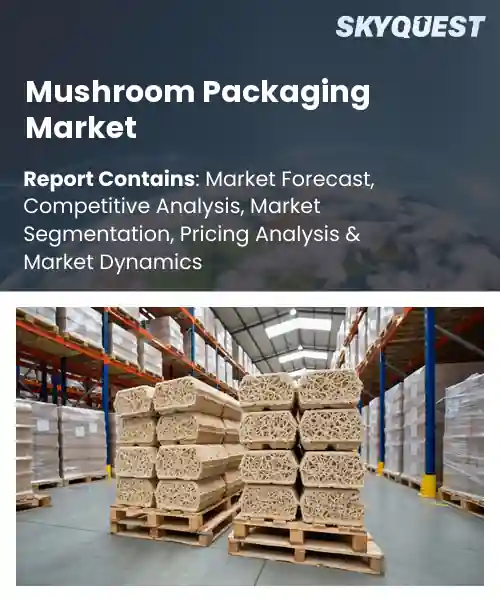
Mushroom Packaging Market
Report ID: SQMIG30I2845
Report ID: SQMIG30I2845
[email protected]
USA +1 351-333-4748
Report ID:
SQMIG30I2845 |
Region:
Global |
Published Date: February, 2026
Pages:
157
|Tables:
120
|Figures:
77


Global Mushroom Packaging Market size was valued at USD 66.3 Million in 2024 and is poised to grow from USD 71.07 Million in 2025 to USD 123.96 Million by 2033, growing at a CAGR of 7.2% during the forecast period (2026-2033).
Rising sustainability mandates, increase in mushroom consumption, innovations in packaging technologies, and growing consumer preference for ecofriendly packaging solutions are anticipated to drive the demand for mushroom packaging going forward. Technological advancements in bio-based materials are also playing an important role in shaping the global mushroom packaging market. Technological advancements are not only improving the properties and costs of bio-based materials but also playing a pivotal role in shaping the global mushroom packaging market.
As startups are scaling up their technologies for mycelium molding and compostable film production, manufacturers are now able to provide packaging solutions with cushioning and moisture management properties similar to plastics. This not only reduces waste due to bruise-related losses but also encourages supermarkets and grocery stores to opt for these solutions to meet their sustainability goals and reduce waste generation. Highly perishable nature of mushrooms and their sensitivity to moisture and pressure make packaging a critical component in reducing spoilage and maintaining quality across the supply chain. The convergence of sustainability mandates and shifting consumer preferences toward ecofriendly goods is expected to primarily drive mushroom packaging market growth.
On the contrary, high costs associated with premium sustainable packaging materials, lack of standardization, limited large-scale production capabilities, and risks related to contamination or inconsistent material performance are anticipated to slow down mushroom packaging market penetration in the long run.
How is Automation Improving Production Efficiency in the Mushroom Packaging Market?
Automation is also contributing towards improving the efficiency of production in the mushroom packaging industry by making it more standardized and less labor-intensive. It helps in making various production stages more standardized by removing various inconsistencies in different stages of production. Some of the important automation techniques used in the mushroom packaging industry include automation in trimming and sorting, robotics-based tray packing, conveyer-based drying and molding, and vision-based quality assurance. It helps in making the material more standardized and makes it more commercially viable for mushroom-based compostable packages.
Market snapshot - 2026-2033
Global Market Size
USD 66.3 Million
Largest Segment
Composite mushroom packaging
Fastest Growth
Pure mycelium-based packaging
Growth Rate
7.2% CAGR
To get more insights on this market click here to Request a Free Sample Report
The mushroom packaging market is segmented by material, packaging type, distribution channel, application, and region. Based on material, the market is segmented into pure mycelium-based packaging and composite mushroom packaging. Based on packaging type, the market is segmented into cushioning, bracing, and void fill. Based on distribution channel, the market is segmented into direct sales, distributors & wholesalers, online retail, and Retail stores. Based on application, the market is segmented into furniture, pharmaceutical, cosmetics, food and beverage, and others. Based on region, the market is segmented into North America, Europe, Asia Pacific, Latin America, and Middle East & Africa.
The composite mushroom packaging segment is slated to lead the global mushroom packaging market revenue generation in the future. Its blended structure delivers the mechanical reliability and manufacturability required by demanding shippers, which is helping this segment hold sway over others. The hybrid approach compensates for the variability of pure mycelium, allows for the integration of existing molding equipment, and provides for the control of stiffness and moisture resistance, making it a procurement driver. These advantages reduce the perceived risk for large volume buyers, creating a steady market pull for the hybrid.
However, pure mycelium-based packaging are expected to be in the fastest growth phase, mainly because of advancements in cultivation and forming technologies that increase consistency and cost efficiency. Increasing brand support for fully biodegradable products and certifications are key growth drivers in trial usage, which in turn opens up premium/niche products to drive further innovation.
The cushioning segment accounts for the highest global mushroom packaging market share. Cushioning addresses the core protection needs across diverse product types, offering predictable energy absorption and repeatable molding characteristics which help its dominance. The flexibility of the design enables tailored structures for cells and surface finish for sensitive electronics and fragile glass containers, while the ability to work with automated packing processes reduces handling complexity for procurement by logistics-focused customers and makes cushioning the default protection option for mushroom packaging applications.
However, void fill is witnessing the strongest growth momentum as per this mushroom packaging industry analysis. Increased volume in ecommerce and the need for lightweight and material-efficient solutions provide further business potential for this segment. Advances in molding and recyclable materials make void fill an attractive option for automated packing and return solutions, increasing its use across brands and providing further opportunities for supplier specialization in speeding up market expansion.
To get detailed segments analysis, Request a Free Sample Report
High demand for sustainable solutions, advanced research ecosystems, and mature manufacturing and distribution networks are supporting the dominance of North America. In addition, many corporations have established sustainability goals that drive demand for compostable and bio-based products; retailers have developed procurement standards that create predictable demand signals for compostable and bio-based product categories, encouraging investments in scaling up production and developing quality assurance programs. Established funding sources and pilot plant capabilities enable ongoing refinement of materials and processing designs; increased consumer awareness and brand value incentives will drive increased use of these materials in the market. Collaborations among materials developers, converters, and waste management companies minimize technical and operational risks to adopters.
United States Mushroom Packaging Market
Concentrated research activity, collaborative supply chain development, and receptive consumer markets prioritizing sustainability help boost the sales of mushroom packaging in the United States. Initial commercialization trials among food and consumer brands have helped in confirming the performance characteristics, thus helping in the adoption of procurement activities. Investment opportunities and corporate sustainability strategies can assist in the development of pilot activities through partnerships.
Canada Mushroom Packaging Market
Environmental policy signals, cooperative industry networks, and innovation hubs exploring fungal applications boost mushroom packaging adoption in Canada. Collaborations among industry players working with material scientists and waste management experts facilitate trial activities for new uses for fungi-based packaging materials. Regional purchasing initiatives and consumer behaviors provide an encouraging environment for incremental adoption and commercialization. Companies and brand owners undertake trial activities that highlight composability and recycling options for their products.
Harmonization of sustainability agendas among retailers and manufacturers is bolstering the sales of mushroom packaging across Europe. High density of packaging converters who are keen on working with these materials, and the presence of research clusters further boosts commercialization of novel materials in the long run. High adoption of circular approach in terms of policies and procurement strategies, and this collaboration of design houses, material specialists, and waste management means that these materials will be tested.
Germany is a testbed for these materials, and they are tested on an industrial scale. United Kingdom is seeing dynamic growth in the use of these materials due to innovative brands and the support for testing these materials. France is in a stage of development, where regional programs are being implemented to bring agriculture suppliers and material experts together.
Germany Mushroom Packaging Market
Robust industrial base, established materials research centers, and corporate sustainability agendas are shaping sales of mushroom packaging across Germany. Designers, material suppliers, and agriculture companies collaborate and provide feedstock sourcing strategies, meeting the requirements of a circular economy concept. In addition, public procurement agendas and industry consortiums drive the adoption of mushroom packaging innovations, making Germany a viable option for scaling up mushroom-based packaging innovations.
United Kingdom Mushroom Packaging Market
Rapid brand led experimentation, vibrant start up ecosystems, and strong interest from sustainable retail initiatives are supporting steady mushroom packaging demand in the country. Collaborations between converters, pack designers, and waste management operators facilitate practical testing and commercialization. Consumer awareness and retail interest create a supportive commercial environment to drive further adoption of mushroom packaging across the United Kingdom.
France Mushroom Packaging Market
Regional innovation programs, collaborations between agricultural suppliers and material researchers, and supportive design communities are bolstering the production of novel mushroom packaging solutions. Trials are usually centered on sustainable feedstock sourcing and its connection to the composting circuit. Small and medium-sized packaging converters and brands are testing the use of the products, and public and private programs are promoting technological development across France.
The focus of technological development, the interest in the region from high-value consumer goods and electronics producers, and the stronger relationships between biomass providers and innovators of materials offer new opportunities in the region. In the Asia Pacific, there is a focus on precise processing, quality, and integration with automated manufacturing systems to fulfill performance and aesthetic requirements. There is interaction between research and industry players to use fungal materials for different types of packaging.
Countries in this region place significant emphasis on cultural values related to design and preservation of products, which facilitates the application of fungal materials among high-end companies. In addition, policy incentives and industry clusters related to the bio-based economy enhance commercialization routes for fungal packaging materials and facilitate their integration with existing packaging infrastructures.
Japan Mushroom Packaging Market
High emphasis on material performance, meticulous quality standards, and design led packaging traditions are expected to drive mushroom packaging sales in Japan. Research institutions and manufacturers work together to develop better processing methods that guarantee conformity with the production lines. Involvement by high-end food producers and consumer electronics companies accelerates the testing and development process. Inclusion in recycling and composting routines aids the development of believable end-of-life stories for fungal-based packaging materials at home.
South Korea Mushroom Packaging Market
High industry interest in sustainable alternatives driven by competitive manufacturing and brand focus on waste reduction support mushroom packaging adoption in the country. Partnerships bring material innovation and companies in the electronics and cosmetics industry seeking high-quality presentation and sustainable credentials. Innovation programs and growing consumer interest in sustainable solutions provide opportunities for market demonstration and development across South Korea through 2033.
To know more about the market opportunities by region and country, click here to
Buy The Complete Report
Rising Demand For Sustainable Packaging
Innovation in Manufacturing Processes
Limited Raw Material Availability
Regulatory and Standardization Gaps
Request Free Customization of this report to help us to meet your business objectives.
Competition in the global mushroom packaging market is intensifying as established biomaterials firms and recent entrants pursue commercialization through strategic partnerships, targeted acquisitions, and scale-up funding. Companies such as Ecovative have formed brand cooperatives and retailer collaborations while startups like Magical Mushroom Company and Mushroom Material pursue commercial contracts and seed financing to win supply agreements and manufacturing scale.
Sustainable Material Adoption
Circular Manufacturing Collaboration
SkyQuest’s ABIRAW (Advanced Business Intelligence, Research & Analysis Wing) is our Business Information Services team that Collects, Collates, Correlates, and Analyses the Data collected by means of Primary Exploratory Research backed by robust Secondary Desk research.
As per SkyQuest analysis, rising sustainability mandates and increasing consumer preference for ecofriendly packaging are anticipated to drive the demand for mushroom packaging going forward. However, high costs of bio-based materials and lack of standardization are slated to slow down the adoption of mushroom packaging in the future. North America is slated to spearhead the demand for mushroom packaging owing to strong regulatory pressure on single-use plastics and the presence of a well-established sustainable packaging ecosystem. Development of advanced mycelium-based materials and integration of automated production technologies are anticipated to be key trends driving the mushroom packaging industry across the study period.
| Report Metric | Details |
|---|---|
| Market size value in 2024 | USD 66.3 Million |
| Market size value in 2033 | USD 123.96 Million |
| Growth Rate | 7.2% |
| Base year | 2024 |
| Forecast period | 2026-2033 |
| Forecast Unit (Value) | USD Million |
| Segments covered |
|
| Regions covered | North America (US, Canada), Europe (Germany, France, United Kingdom, Italy, Spain, Rest of Europe), Asia Pacific (China, India, Japan, Rest of Asia-Pacific), Latin America (Brazil, Rest of Latin America), Middle East & Africa (South Africa, GCC Countries, Rest of MEA) |
| Companies covered |
|
| Customization scope | Free report customization with purchase. Customization includes:-
|
To get a free trial access to our platform which is a one stop solution for all your data requirements for quicker decision making. This platform allows you to compare markets, competitors who are prominent in the market, and mega trends that are influencing the dynamics in the market. Also, get access to detailed SkyQuest exclusive matrix.
Table Of Content
Executive Summary
Market overview
Parent Market Analysis
Market overview
Market size
KEY MARKET INSIGHTS
COVID IMPACT
MARKET DYNAMICS & OUTLOOK
Market Size by Region
KEY COMPANY PROFILES
Methodology
For the Mushroom Packaging Market, our research methodology involved a mixture of primary and secondary data sources. Key steps involved in the research process are listed below:
1. Information Procurement: This stage involved the procurement of Market data or related information via primary and secondary sources. The various secondary sources used included various company websites, annual reports, trade databases, and paid databases such as Hoover's, Bloomberg Business, Factiva, and Avention. Our team did 45 primary interactions Globally which included several stakeholders such as manufacturers, customers, key opinion leaders, etc. Overall, information procurement was one of the most extensive stages in our research process.
2. Information Analysis: This step involved triangulation of data through bottom-up and top-down approaches to estimate and validate the total size and future estimate of the Mushroom Packaging Market.
3. Report Formulation: The final step entailed the placement of data points in appropriate Market spaces in an attempt to deduce viable conclusions.
4. Validation & Publishing: Validation is the most important step in the process. Validation & re-validation via an intricately designed process helped us finalize data points to be used for final calculations. The final Market estimates and forecasts were then aligned and sent to our panel of industry experts for validation of data. Once the validation was done the report was sent to our Quality Assurance team to ensure adherence to style guides, consistency & design.
Analyst Support
Customization Options
With the given market data, our dedicated team of analysts can offer you the following customization options are available for the Mushroom Packaging Market:
Product Analysis: Product matrix, which offers a detailed comparison of the product portfolio of companies.
Regional Analysis: Further analysis of the Mushroom Packaging Market for additional countries.
Competitive Analysis: Detailed analysis and profiling of additional Market players & comparative analysis of competitive products.
Go to Market Strategy: Find the high-growth channels to invest your marketing efforts and increase your customer base.
Innovation Mapping: Identify racial solutions and innovation, connected to deep ecosystems of innovators, start-ups, academics, and strategic partners.
Category Intelligence: Customized intelligence that is relevant to their supply Markets will enable them to make smarter sourcing decisions and improve their category management.
Public Company Transcript Analysis: To improve the investment performance by generating new alpha and making better-informed decisions.
Social Media Listening: To analyze the conversations and trends happening not just around your brand, but around your industry as a whole, and use those insights to make better Marketing decisions.
REQUEST FOR SAMPLE
 REQUEST FREE CUSTOMIZATION
Global Mushroom Packaging Market size was valued at USD 66.3 Million in 2024 and is poised to grow from USD 71.07 Million in 2025 to USD 123.96 Million by 2033, growing at a CAGR of 7.2% during the forecast period (2026-2033).
Ecovative Design LLC, Fungi Solutions, Grown Bio BV, Magical Mushroom Co., Mushroom Material, Tandem Repeat, Shroom Labs, Paradise Packaging, Grounded Packaging, MycoWorks, Mogu, Mycelium Materials, Ecological Mycelium, TemperPack, Packsize International LLC, GECKO Materials, Rhize, Polybiom, Mycelia, The Mycelium Project
The key driver of the Mushroom Packaging Market is the growing demand for sustainable and biodegradable packaging solutions. Increasing environmental concerns, strict regulations on plastic use, and rising adoption of eco-friendly alternatives are significantly driving the use of mycelium-based packaging materials.
A key market trend in the Mushroom Packaging Market is the rising adoption of mycelium-based, compostable packaging as a sustainable alternative to plastic and foam materials. Additionally, increasing focus on scalable production technologies and circular economy practices is expanding its use across multiple industries.
North America accounted for the largest share in the Mushroom Packaging Market, driven by strong environmental regulations, high adoption of sustainable packaging solutions, and increasing demand from industries such as electronics, food, and consumer goods.


Want to customize this report? This report can be personalized according to your needs. Our analysts and industry experts will work directly with you to understand your requirements and provide you with customized data in a short amount of time. We offer $1000 worth of FREE customization at the time of purchase.
Feedback From Our Clients


 USA (+1) 351-333-4748

