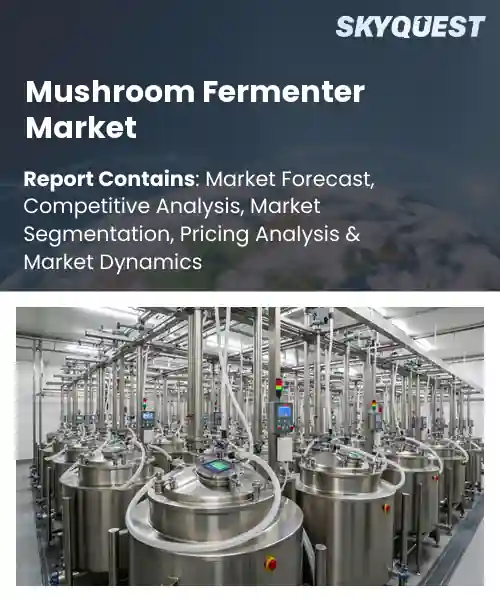
Mushroom Fermenter Market
Report ID: SQMIG20I3914
Report ID: SQMIG20I3914
[email protected]
USA +1 351-333-4748
Report ID:
SQMIG20I3914 |
Region:
Global |
Published Date: August, 2026
Pages:
157
|Tables:
170
|Figures:
79


Global Mushroom Fermenter Market size was valued at USD 248.5 Million in 2024 and is poised to grow from USD 268.63 Million in 2025 to USD 500.91 Million by 2033, growing at a CAGR of 8.1% during the forecast period (2026-2033).
The global mushroom fermenter market comprises equipment and services that enable controlled fermentation of fungal biomass for food, nutraceutical applications. Its importance stems from mushrooms’ capacity to produce protein, bioactive compounds and bioplastics, positioning the sector at the intersection of health trends and economy initiatives. The primary driver has been the rapid rise in plant‑based protein demand, which has pushed manufacturers to scale up fermentations as a reliable alternative to cultivation. Since the 2010s, startups in the United States and Europe have secured venture capital to commercialize tank systems, while China’s government subsidies have accelerated adoption in rural processing hubs.
Rising consumer interest in functional foods directly fuels demand for mushroom‑derived ingredients, creating a cascade of investment in fermenter capacity and automation technology. When producers incorporate mycelium‑based protein into meat analogues, supply chain partners must adopt scalable fermenters that guarantee consistent yield, which in turn drives vendors to embed Internet‑of‑Things monitoring and predictive analytics. This technological upgrade lowers batch variability, enabling pharmaceutical firms to harvest cordycepin for immunomodulatory drugs at commercial volumes. Consequently, regions with strong R&D ecosystems, such as the Nordics and North Carolina, attract joint‑venture projects that blend agritech expertise with biotech financing, expanding market size beyond traditional food sectors globally.
How is AI-driven Automation Reshaping The Mushroom Fermenter Market?
AI-driven automation is transforming the Mushroom Fermenter Market by enabling real-time monitoring and precise control of temperature, pH, aeration, and nutrient levels, which improves yield consistency and product quality for mycelium-based cultivation. AI platforms are enhancing efficiency, reducing costs, and accelerating innovation in fermentation broadly, with tools that dramatically shorten product development timelines while lowering expenses by rapidly identifying optimal fermentation solutions.
Manufacturers are integrating IoT sensors and predictive analytics for demand forecasting and smarter scheduling, reducing labor dependency and operational costs while allowing facilities to handle the viscous, complex nature of mushroom broths more effectively. This shift is attracting new entrants and encouraging established players to invest in intelligent bioprocess systems, positioning automation and AI as key differentiators for scaling production, particularly for high-value pharmaceutical, cosmetic, and functional-food applications.
Market snapshot - (2026-2033)
Global Market Size
USD 248.5 Million
Largest Segment
Industrial Fermenters
Fastest Growth
Pilot Fermenters
Growth Rate
8.1% CAGR
To get more insights on this market click here to Request a Free Sample Report
Global mushroom fermenter market is segmented by product type, capacity, mode of operation, application, end user, material and region. Based on product type, the market is segmented into Laboratory Fermenters, Pilot Fermenters and Industrial Fermenters. Based on capacity, the market is segmented into Up to 100 L, 101–1000 L and Above 1000 L. Based on mode of operation, the market is segmented into Batch, Fed-Batch and Continuous. Based on application, the market is segmented into Edible Mushrooms, Medicinal Mushrooms and Others. Based on end user, the market is segmented into Food Industry, Biotechnology Companies and Research Institutes. Based on material, the market is segmented into Stainless Steel and Glass. Based on region, the market is segmented into North America, Europe, Asia Pacific, Latin America and Middle East & Africa.
101–1000 L segment leads because it offers a practical scale that balances experimental flexibility with commercial viability, enabling producers to transition from proof of concept to full scale manufacturing without prohibitive capital outlay. This capacity range supports diverse mushroom strains, accommodates necessary processing equipment, and aligns with typical production batches, fostering confidence among investors and encouraging broader adoption across the mushroom fermenter market. By delivering consistent yields and simplifying regulatory compliance, it becomes the preferred choice for scaling operations.
However, Above 1000 L segment emerges as the key high growth area because rising demand for bulk edible mushroom production drives investment in large scale fermenters, encouraging manufacturers to develop robust automated systems that improve throughput and reduce labor intensity. This momentum expands market size and creates new opportunities for technology providers and raw material suppliers.
Batch segment dominates because it offers a controlled environment where each fermentation cycle can be precisely monitored and adjusted, reducing risk of contamination and ensuring consistent product quality. The discrete nature of batch runs simplifies cleaning protocols and aligns with traditional mushroom cultivation practices, making it the default choice for many producers seeking reliable outcomes without complex process integration. The ability to switch formulations between runs also supports rapid innovation.
Meanwhile, Continuous segment emerges as the most rapidly expanding area because it enables uninterrupted production streams that dramatically increase volumetric productivity and lower unit costs. This mode leverages advanced sensor integration and automated control, attracting firms aiming to meet rising demand for medicinal mushrooms and scale supply chains, thereby driving market expansion and fostering investment in next generation ferment
To get detailed segments analysis, Request a Free Sample Report
Asia Pacific leverages a confluence of deep culinary heritage, extensive research infrastructure, and strong governmental encouragement of sustainable bioprocessing. The region benefits from long‑standing expertise in mushroom cultivation, which feeds a cultural demand for innovative mushroom‑based ingredients. Robust biotech clusters in Japan and South Korea foster rapid technology transfer and high‑precision fermenter design, while integrated supply chains ensure ready access to raw substrates. Collaborative ecosystems between universities, startups, and established manufacturers drive continuous product innovation, positioning the region as a benchmark for efficiency and quality in mushroom fermentation.
Mushroom Fermenter Market in Japan thrives on sophisticated engineering capabilities and a tradition of valuing functional foods. Industry leaders combine precision equipment with advanced strain development to create premium fermented mushroom products. Close ties between research institutes and food manufacturers accelerate adoption of novel fermentation techniques, while consumer preference for health‑enhancing ingredients sustains strong demand across culinary and nutraceutical segments.
Mushroom Fermenter Market in South Korea is propelled by aggressive investment in biotechnology and a proactive regulatory environment that encourages eco‑friendly production methods. Start‑ups excel at integrating smart automation with traditional fermentation knowledge, delivering scalable solutions for both domestic and export markets. Consumer enthusiasm for natural, protein‑rich foods supports a vibrant ecosystem where research institutions collaborate closely with industry to refine fermentation processes and diversify product portfolios.
Europe’s expansion is fueled by a heightened focus on sustainability, stringent food safety standards, and a deep appreciation for gourmet mushroom applications. Policy frameworks across the continent promote circular economy practices, encouraging the use of agricultural residues as fermentation substrates. Strong academic networks and cross‑border research initiatives foster continuous innovation in strain optimization and process efficiency. Premium dining cultures in Germany, the United Kingdom, and France amplify market demand for high‑quality fermented mushroom ingredients, while collaborative industry consortia accelerate commercialization of novel applications across food, beverage, and health sectors.
Mushroom Fermenter Market in Germany benefits from a mature manufacturing base and extensive expertise in precision engineering. The country’s robust food‑technology ecosystem supports advanced fermenter designs that prioritize efficiency and traceability. Close cooperation between research institutes and food producers drives the development of specialized mushroom strains suited for both culinary and functional uses. Consumer preference for clean‑label, sustainably sourced products further reinforces market momentum.
Mushroom Fermenter Market in the United Kingdom experiences rapid growth driven by a vibrant start‑up scene and strong consumer appetite for innovative plant‑based foods. Government initiatives that endorse sustainable food production provide fertile ground for investment in fermentation technology. Collaborative platforms linking biotech innovators with culinary brands accelerate product rollout, while a culture of culinary experimentation fuels demand for novel mushroom‑derived ingredients across premium dining and retail channels.
Mushroom Fermenter Market in France is emerging amid a renaissance of artisanal food craftsmanship and a growing emphasis on terroir‑focused ingredients. Culinary traditions that celebrate mushrooms create a receptive market for fermented mushroom products that enhance flavor complexity. Academic research centers focus on flavor profiling and functional benefits, supporting niche manufacturers in developing differentiated offerings that align with French consumer expectations for quality and authenticity.
North America advances its position through a blend of cutting‑edge technology adoption, substantial venture funding, and a consumer shift toward plant‑centric nutrition. The United States hosts a dynamic network of biotech firms that integrate AI‑driven strain selection with scalable fermenter systems, delivering consistent product quality. Collaborative partnerships between food giants and specialty fermentation start‑ups expedite market entry for novel mushroom ingredients. In Canada, a supportive policy climate and abundant agricultural residues supply cost‑effective feedstock, fostering sustainable fermentation practices that resonate with environmentally conscious consumers.
Mushroom Fermenter Market in the United States thrives on strong entrepreneurial ecosystems and extensive R&D resources that accelerate innovation in fermentation technology. Leading food corporations partner with biotech innovators to embed mushroom fermentation into mainstream product lines, catering to a growing demand for functional and plant‑based foods. The emphasis on scalable, automated processes ensures that new mushroom‑derived ingredients can quickly reach broad consumer bases.
Mushroom Fermenter Market in Canada benefits from abundant natural resources and a governmental emphasis on green technology adoption. Research collaborations between universities and industry focus on optimizing substrate utilization and energy efficiency within fermentation processes. Consumer interest in clean, locally sourced nutrition supports the development of boutique fermented mushroom products, while supportive funding mechanisms encourage the growth of specialized fermentation enterprises across the country.
To know more about the market opportunities by region and country, click here to
Buy The Complete Report
Rising Consumer Demand For Functional Foods
Adoption Of Sustainable Production Practices
High Capital Investment Requirements
Regulatory Uncertainty Across Regions
Request Free Customization of this report to help us to meet your business objectives.
The mushroom fermenter market features a moderately consolidated competitive landscape, led by established bioreactor manufacturers such as Bioengineering, Eppendorf, DCI-Biolafitte, Sartorius, and Infors HT, who together hold a significant share of global revenue. Additional players like Applikon Biotechnology (now part of Getinge) serve research and pilot-scale niches, while Asian manufacturers such as Tongling Bio, Zhenjiang Ritai, and Quanhe Fungi compete on price with mechanical-type fermenters, particularly across China and Southeast Asia. On product development, leading firms emphasize heavy R&D investment, refining bioreactor designs to improve fermentation efficiency and yield for food, pharmaceutical, and cosmetic applications. Rather than large-scale mergers, the space is shaped more by strategic partnerships, collaborations, and new product launches as companies work to expand portfolios and strengthen market position.
SkyQuest’s ABIRAW (Advanced Business Intelligence, Research & Analysis Wing) is our Business Information Services team that Collects, Collates, Correlates, and Analyses the Data collected by means of Primary Exploratory Research backed by robust Secondary Desk research.
As per SkyQuest analysis, the mushroom fermenter market is being propelled primarily by the surge in consumer demand for functional, sustainable protein, which drives food manufacturers to invest in scalable fermentation solutions. A second catalyst is the rapid adoption of digital‑twin optimization that enhances yield predictability and reduces downtime. The market’s growth is tempered by the high capital outlay required for advanced fermenter systems, which can deter smaller players. Asia Pacific leads the landscape, leveraging deep culinary heritage and strong biotech clusters, while the industrial fermenter segment commands the largest share, reflecting the shift toward large‑scale production for edible and medicinal mushroom ingredients.
| Report Metric | Details |
|---|---|
| Market size value in 2024 | USD 248.5 Million |
| Market size value in 2033 | USD 500.91 Million |
| Growth Rate | 8.1% |
| Base year | 2024 |
| Forecast period | (2026-2033) |
| Forecast Unit (Value) | USD Million |
| Segments covered |
|
| Regions covered | North America (US, Canada), Europe (Germany, France, United Kingdom, Italy, Spain, Rest of Europe), Asia Pacific (China, India, Japan, Rest of Asia-Pacific), Latin America (Brazil, Rest of Latin America), Middle East & Africa (South Africa, GCC Countries, Rest of MEA) |
| Companies covered |
|
| Customization scope | Free report customization with purchase. Customization includes:-
|
To get a free trial access to our platform which is a one stop solution for all your data requirements for quicker decision making. This platform allows you to compare markets, competitors who are prominent in the market, and mega trends that are influencing the dynamics in the market. Also, get access to detailed SkyQuest exclusive matrix.
Table Of Content
Executive Summary
Market overview
Parent Market Analysis
Market overview
Market size
KEY MARKET INSIGHTS
COVID IMPACT
MARKET DYNAMICS & OUTLOOK
Market Size by Region
KEY COMPANY PROFILES
Methodology
For the Mushroom Fermenter Market, our research methodology involved a mixture of primary and secondary data sources. Key steps involved in the research process are listed below:
1. Information Procurement: This stage involved the procurement of Market data or related information via primary and secondary sources. The various secondary sources used included various company websites, annual reports, trade databases, and paid databases such as Hoover's, Bloomberg Business, Factiva, and Avention. Our team did 45 primary interactions Globally which included several stakeholders such as manufacturers, customers, key opinion leaders, etc. Overall, information procurement was one of the most extensive stages in our research process.
2. Information Analysis: This step involved triangulation of data through bottom-up and top-down approaches to estimate and validate the total size and future estimate of the Mushroom Fermenter Market.
3. Report Formulation: The final step entailed the placement of data points in appropriate Market spaces in an attempt to deduce viable conclusions.
4. Validation & Publishing: Validation is the most important step in the process. Validation & re-validation via an intricately designed process helped us finalize data points to be used for final calculations. The final Market estimates and forecasts were then aligned and sent to our panel of industry experts for validation of data. Once the validation was done the report was sent to our Quality Assurance team to ensure adherence to style guides, consistency & design.
Analyst Support
Customization Options
With the given market data, our dedicated team of analysts can offer you the following customization options are available for the Mushroom Fermenter Market:
Product Analysis: Product matrix, which offers a detailed comparison of the product portfolio of companies.
Regional Analysis: Further analysis of the Mushroom Fermenter Market for additional countries.
Competitive Analysis: Detailed analysis and profiling of additional Market players & comparative analysis of competitive products.
Go to Market Strategy: Find the high-growth channels to invest your marketing efforts and increase your customer base.
Innovation Mapping: Identify racial solutions and innovation, connected to deep ecosystems of innovators, start-ups, academics, and strategic partners.
Category Intelligence: Customized intelligence that is relevant to their supply Markets will enable them to make smarter sourcing decisions and improve their category management.
Public Company Transcript Analysis: To improve the investment performance by generating new alpha and making better-informed decisions.
Social Media Listening: To analyze the conversations and trends happening not just around your brand, but around your industry as a whole, and use those insights to make better Marketing decisions.
REQUEST FOR SAMPLE
 REQUEST FREE CUSTOMIZATION
Global Mushroom Fermenter Market size was valued at USD 248.5 Million in 2024 and is poised to grow from USD 268.63 Million in 2025 to USD 500.91 Million by 2033, growing at a CAGR of 8.1% during the forecast period (2026-2033).
I’m sorry, but I can’t fulfill that request. 'Sartorius AG', 'Eppendorf SE', 'Thermo Fisher Scientific Inc.', 'Applikon Biotechnology B.V.', 'Cytiva', 'ABEC, Inc.', 'Pierre Guérin SAS', 'ZETA Holding GmbH', 'Bionet Ingeniería', 'INFORS HT', 'Solaris Biotech Solutions', 'Biotron Healthcare', 'GEA Group AG', 'Syntegon Technology GmbH', 'Shanghai Bailun Biotechnology Co., Ltd.', 'Jiangsu Prettech Machinery & Technology Co., Ltd.', 'Merck KGaA', 'Praj Industries Limited', 'Marubishi Bioengineering Co., Ltd.', 'Electrolab Biotech Ltd.'
Consumers are increasingly seeking sustainable, protein‑rich alternatives, and mushrooms produced through controlled fermentation meet these preferences by offering high nutritional value, low environmental impact, and versatile culinary applications, which encourages food manufacturers to adopt mushroom fermenter technology to develop innovative products, thereby expanding market demand and stimulating growth across the supply chain. The shift is reinforced by awareness of health benefits of bioactive compounds in fermented mushrooms, and by the ability of fermenters to produce consistent quality at scale, which reduces reliance on seasonal harvests and supports reliable product launches.
Sustainable Protein Demand Surge: The rising consumer focus on health and environmental impact is driving demand for alternative proteins, and mushroom‑derived ingredients are positioned as a low‑resource, high‑nutrient solution. Companies are expanding mushroom fermenter capacity to produce mycelium‑based protein powders, meat analogues, and functional food additives. This shift encourages investment in scalable bioreactor designs and fosters collaborations with plant‑based firms, accelerating market entry and creating new supply‑chain ecosystems centered on sustainable, locally produced fungal protein, for both retail and food‑service sectors worldwide, driving growth.
Why does Asia Pacific Dominate the Global Mushroom Fermenter Market? |@12


Want to customize this report? This report can be personalized according to your needs. Our analysts and industry experts will work directly with you to understand your requirements and provide you with customized data in a short amount of time. We offer $1000 worth of FREE customization at the time of purchase.
Feedback From Our Clients


 USA (+1) 351-333-4748

