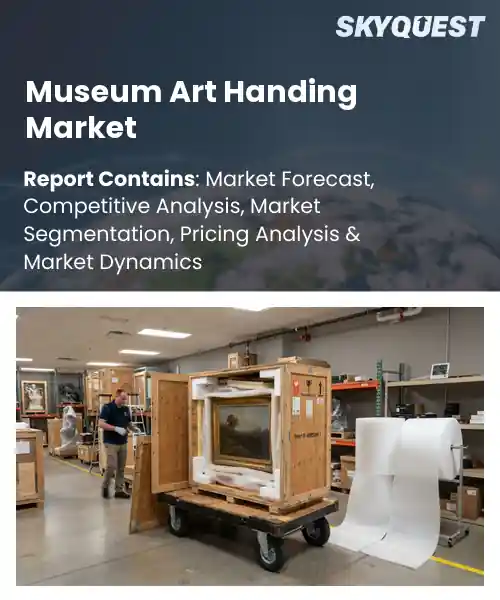
Museum Art Handing Market
Report ID: SQMIG20N2059
Report ID: SQMIG20N2059
[email protected]
USA +1 351-333-4748
Report ID:
SQMIG20N2059 |
Region:
Global |
Published Date: August, 2026
Pages:
157
|Tables:
96
|Figures:
76


Global Museum Art Handing Market size was valued at USD 4.28 Billion in 2024 and is poised to grow from USD 4.55 Billion in 2025 to USD 7.42 Billion by 2033, growing at a CAGR of 6.3% during the forecast period (2026-2033).
At core of Global Museum Art Handling Market lies the imperative to preserve cultural assets while ensuring safe display, a driver that has shaped the industry since early 1900s. Museums moved from static exhibitions to spaces, demanding climate‑control, vibration‑dampening, and transport solutions. This shift is illustrated by Metropolitan Museum of Art’s 2006 relocation of the Egyptian Collection, which required crates and micro‑climate pallets to curb humidity fluctuations. The market’s significance stems from its role in heritage protection, influencing insurance premiums, and enabling cross‑border loans that expand audiences. Consequently, demand for handling equipment and expertise has surged alongside exhibition programs worldwide. The dominant growth factor for the Global Museum Art Handling Market is the rise of touring exhibitions, which creates a cascade of logistical requirements and revenue streams. When an institution such as the Louvre loans a masterpiece to a museum in Asia, the need for temperature‑regulated containers, shock‑absorbing crates, and on‑site monitoring systems intensifies, prompting distributors to innovate and expand capacity. This demand fuels investment in sensor technology that alerts curators to micro‑climate deviations, reducing conservation costs and insurance claims. As a result, firms that combine data analytics with packaging gain market share, while economies benefit from increased cultural tourism.
How is AI-driven automation improving safety and efficiency in the museum art handling market?
AI driven automation is reshaping museum art handling by embedding sensors, robotics and predictive analytics into every stage of movement and storage. Intelligent cameras monitor handling zones, instantly flagging unsafe motions and protecting fragile works. Robotic lifts and guided carts reduce manual lifting, lowering injury risk while ensuring precise placement. Real time climate monitoring linked to AI adjusts temperature and humidity without human intervention, preserving delicate media. Data platforms aggregate condition reports, enabling curators to schedule maintenance before wear becomes visible. Together these tools create a safer workplace, streamline workflows and free staff to focus on conservation and visitor engagement.In April 2026 UBS introduced an AI powered art logistics platform that automates pallet selection, route optimization and environmental controls for museum shipments. The system reduces handling errors and speeds transit, helping institutions move collections with greater confidence and supporting the market’s growth while also lowering operational costs for staff and insurers.
Market snapshot - (2026-2033)
Global Market Size
USD 4.28 Billion
Largest Segment
Packing & Crating
Fastest Growth
Collection Management
Growth Rate
6.3% CAGR
To get more insights on this market click here to Request a Free Sample Report
Global museum art handing market is segmented by service type, artwork type, end user and region. Based on service type, the market is segmented into Packing & Crating, Transportation, Installation & Deinstallation, Storage and Collection Management. Based on artwork type, the market is segmented into Paintings, Sculptures, Antiquities & Artifacts, Contemporary Art and Others. Based on end user, the market is segmented into Museums, Art Galleries, Auction Houses, Private Collectors and Others. Based on region, the market is segmented into North America, Europe, Asia Pacific, Latin America and Middle East & Africa.
Packing & Crating segment dominates because museums prioritize protection of valuable objects during every transition, and this process directly mitigates risk of damage, theft, or environmental exposure. The diverse range of artworks, from delicate canvases to fragile antiquities, requires tailored crates, protective padding, and expert handling, which elevates the importance of this service in the overall workflow. Consequently, institutions allocate resources to ensure packaging meets rigorous conservation standards, reinforcing the centrality of this activity in the museum art handling ecosystem.
However, Installation & Deinstallation segment is witnessing the strongest growth momentum because curators increasingly demand precise positioning and safe removal of artworks for rotating exhibitions, and emerging technologies such as laser mapping and modular display systems simplify complex maneuvers. This acceleration broadens scope and creates new revenue streams, driving market expansion.
Paintings segment dominates because traditional two dimensional works remain core to museum collections, offering historical depth and broad visitor appeal, which drives sustained investment in their preservation and movement. The fragile nature of canvas, wood panels, and delicate varnishes necessitates specialized handling protocols, climate control, and expert conservators, reinforcing the critical role of painting logistics within the museum art handling ecosystem. Consequently, institutions prioritize resources for painting care to safeguard cultural heritage.
Meanwhile, Contemporary Art segment emerges as the fastest growing area because artists experiment with unconventional materials and scale, prompting museums to adopt innovative packaging, climate neutral transport, and flexible installation techniques. Rising collector interest and exhibition cycles amplify demand for services, propelling market expansion and creating new opportunities for technology driven handling solutions.
To get detailed segments analysis, Request a Free Sample Report
North America benefits from a mature network of world‑class museums that prioritize stewardship of cultural assets. Robust public and private funding streams support sophisticated conservation laboratories and advanced handling technologies. A culture of interdisciplinary collaboration links museums with leading universities, fostering continual innovation in preservation methods. Regulatory frameworks encourage best practices while protecting collections from environmental risk. The region also attracts top talent, creating a deep pool of expertise that reinforces high standards of care. Together, these factors generate a resilient ecosystem that consistently sets benchmarks for museum art handling worldwide.
Museum Art Handing Market in the United States thrives on extensive institutional resources and a long tradition of curatorial excellence. Prominent museums invest heavily in specialized training programs and cutting‑edge equipment, ensuring precise care for diverse collections. Collaborative research initiatives with academic partners drive methodological advancements, while strong donor engagement sustains ambitious preservation projects. This environment promotes a proactive approach to risk management and reinforces the United States as a global leader in museum art handling practice.
Museum Art Handing Market in Canada is shaped by a supportive public policy landscape that emphasizes cultural heritage protection. National and provincial funding mechanisms enable museums to adopt innovative handling protocols and modern storage solutions. Collaborative networks among Indigenous galleries and mainstream institutions foster inclusive conservation perspectives. Emphasis on sustainable practices and climate‑responsive design further enhances the care of artworks. These strengths collectively position Canada as a key contributor to the high‑quality handling standards observed across North America.
Europe’s expansion is propelled by deep cultural heritage values embedded in its museum ecosystem. Strong governmental commitment and grant structures empower institutions to modernize handling facilities and adopt interdisciplinary conservation research. Cross‑border collaborations among museums encourage sharing of best practices and harmonization of standards, while a vibrant network of specialized service providers fuels technological diffusion. Growing visitor engagement underscores the importance of preserving artworks for public enjoyment, prompting institutions to invest in refined handling techniques. Together, these dynamics create a fertile environment that accelerates the evolution of museum art handling across the continent.
Museum Art Handing Market in Germany rests on a foundation of rigorous scientific methodology and substantial institutional funding. Premier museums maintain dedicated conservation labs equipped with precision tools, while close ties with technical universities drive research into novel preservation materials. National cultural policies incentivize continual skill development, ensuring staff remain adept at handling complex works. This systematic approach underpins Germany’s role as a dominant force shaping European standards for museum art handling.
Museum Art Handing Market in the United Kingdom experiences accelerated growth through dynamic public‑private partnerships and a thriving heritage tourism sector. Leading museums prioritize investment in state‑of‑the‑art handling equipment and immersive training initiatives. Collaborative projects with research institutes generate innovative handling frameworks that are rapidly adopted across the sector. A strong emphasis on accessibility and educational outreach further raises the profile of careful artwork management, positioning the United Kingdom as a fast‑moving catalyst for market expansion.
Museum Art Handing Market in France emerges as an evolving segment driven by a renewed focus on cultural preservation and artistic innovation. Institutions benefit from generous cultural subsidies that enable the acquisition of specialized handling tools and the development of bespoke conservation protocols. Partnerships with avant‑garde art schools infuse fresh perspectives into handling practices, while a commitment to sustainable museum operations encourages environmentally conscious techniques. These elements collectively nurture an emerging market that increasingly influences European museum art handling discourse.
Asia Pacific advances its position through a blend of rapid museum development and heightened reverence for artistic legacy. Nations are channeling resources into constructing purpose‑built facilities that incorporate climate‑controlled environments and precision handling systems. Engagement with international conservation experts accelerates knowledge transfer, while regional forums promote the exchange of best practices. Growing cultural tourism creates a compelling imperative for meticulous handling, encouraging institutions to adopt globally recognized standards. This concerted effort enhances the region’s credibility and situates it as an emerging authority in museum art handling.
Museum Art Handing Market in Japan reflects a meticulous dedication to craftsmanship and technological integration. Leading museums combine traditional conservation philosophies with cutting‑edge robotic handling aids, ensuring delicate artworks receive consistent, low‑stress treatment. Partnerships with engineering firms drive the creation of customized storage solutions calibrated to local climate conditions. A strong culture of continuous improvement fosters regular skill refinement among handlers, reinforcing Japan’s reputation for precision and care in the museum sector.
Museum Art Handing Market in South Korea benefits from vigorous government backing and a burgeoning contemporary art scene. Institutional investments prioritize advanced handling equipment and specialized training curricula, elevating professional expertise. Collaborative ties with global conservation institutions accelerate adoption of best‑practice protocols, while active public outreach programs underscore the importance of safeguarding cultural assets. These strategic initiatives collectively enhance South Korea’s growing influence within the Asia Pacific museum art handling landscape.
To know more about the market opportunities by region and country, click here to
Buy The Complete Report
Increasing Digital Engagement Platforms
Growing Demand for Sustainable Practices
High Costs of Specialized Equipment
Regulatory Compliance Complexities
Request Free Customization of this report to help us to meet your business objectives.
The competitive landscape is shaped by a wave of tech‑driven entrants leveraging partnerships, acquisitions and innovative platforms to streamline museum logistics, improve visitor interaction and modernize collection handling, while legacy institutions adopt digital cataloguing and AI‑based condition monitoring to stay ahead of emerging rivals. Recent M&A activity includes larger museum service firms acquiring niche AR providers, and strategic alliances between hardware manufacturers and software startups to integrate RFID tracking into exhibition workflows, intensifying competition on service breadth and technological depth.
Top Player’s Company Profile
Recent Developments
SkyQuest’s ABIRAW (Advanced Business Intelligence, Research & Analysis Wing) is our Business Information Services team that Collects, Collates, Correlates, and Analyses the Data collected by means of Primary Exploratory Research backed by robust Secondary Desk research. As per SkyQuest analysis, the Global Museum Art Handling market is projected to grow to $7.42 billion by 2033, driven primarily by the rise of touring exhibitions that create extensive logistics demand, while the high cost of specialized equipment restrains smaller institutions. North America remains the dominating region thanks to its mature museum network and funding, and the packing & crating segment leads the market because protection during transit is critical. A second driver comes from AI‑driven automation, which enhances safety, reduces errors and cuts operating costs, further accelerating adoption of advanced handling solutions across the sector. These trends are prompting firms to invest in sensor‑enabled crates and real‑time monitoring platforms, boosting overall market momentum.
| Report Metric | Details |
|---|---|
| Market size value in 2024 | USD 4.28 Billion |
| Market size value in 2033 | USD 7.42 Billion |
| Growth Rate | 6.3% |
| Base year | 2024 |
| Forecast period | (2026-2033) |
| Forecast Unit (Value) | USD Billion |
| Segments covered |
|
| Regions covered | North America (US, Canada), Europe (Germany, France, United Kingdom, Italy, Spain, Rest of Europe), Asia Pacific (China, India, Japan, Rest of Asia-Pacific), Latin America (Brazil, Rest of Latin America), Middle East & Africa (South Africa, GCC Countries, Rest of MEA) |
| Companies covered |
|
| Customization scope | Free report customization with purchase. Customization includes:-
|
To get a free trial access to our platform which is a one stop solution for all your data requirements for quicker decision making. This platform allows you to compare markets, competitors who are prominent in the market, and mega trends that are influencing the dynamics in the market. Also, get access to detailed SkyQuest exclusive matrix.
Table Of Content
Executive Summary
Market overview
Parent Market Analysis
Market overview
Market size
KEY MARKET INSIGHTS
COVID IMPACT
MARKET DYNAMICS & OUTLOOK
Market Size by Region
KEY COMPANY PROFILES
Methodology
For the Museum Art Handing Market, our research methodology involved a mixture of primary and secondary data sources. Key steps involved in the research process are listed below:
1. Information Procurement: This stage involved the procurement of Market data or related information via primary and secondary sources. The various secondary sources used included various company websites, annual reports, trade databases, and paid databases such as Hoover's, Bloomberg Business, Factiva, and Avention. Our team did 45 primary interactions Globally which included several stakeholders such as manufacturers, customers, key opinion leaders, etc. Overall, information procurement was one of the most extensive stages in our research process.
2. Information Analysis: This step involved triangulation of data through bottom-up and top-down approaches to estimate and validate the total size and future estimate of the Museum Art Handing Market.
3. Report Formulation: The final step entailed the placement of data points in appropriate Market spaces in an attempt to deduce viable conclusions.
4. Validation & Publishing: Validation is the most important step in the process. Validation & re-validation via an intricately designed process helped us finalize data points to be used for final calculations. The final Market estimates and forecasts were then aligned and sent to our panel of industry experts for validation of data. Once the validation was done the report was sent to our Quality Assurance team to ensure adherence to style guides, consistency & design.
Analyst Support
Customization Options
With the given market data, our dedicated team of analysts can offer you the following customization options are available for the Museum Art Handing Market:
Product Analysis: Product matrix, which offers a detailed comparison of the product portfolio of companies.
Regional Analysis: Further analysis of the Museum Art Handing Market for additional countries.
Competitive Analysis: Detailed analysis and profiling of additional Market players & comparative analysis of competitive products.
Go to Market Strategy: Find the high-growth channels to invest your marketing efforts and increase your customer base.
Innovation Mapping: Identify racial solutions and innovation, connected to deep ecosystems of innovators, start-ups, academics, and strategic partners.
Category Intelligence: Customized intelligence that is relevant to their supply Markets will enable them to make smarter sourcing decisions and improve their category management.
Public Company Transcript Analysis: To improve the investment performance by generating new alpha and making better-informed decisions.
Social Media Listening: To analyze the conversations and trends happening not just around your brand, but around your industry as a whole, and use those insights to make better Marketing decisions.
REQUEST FOR SAMPLE
 REQUEST FREE CUSTOMIZATION


Want to customize this report? This report can be personalized according to your needs. Our analysts and industry experts will work directly with you to understand your requirements and provide you with customized data in a short amount of time. We offer $1000 worth of FREE customization at the time of purchase.
Feedback From Our Clients


 USA (+1) 351-333-4748

