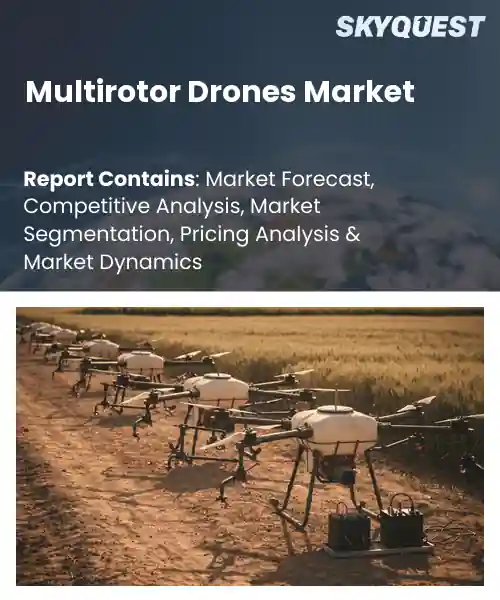
Multirotor Drones Market
Report ID: SQMIG20A2547
Report ID: SQMIG20A2547
[email protected]
USA +1 351-333-4748
Report ID:
SQMIG20A2547 |
Region:
Global |
Published Date: February, 2026
Pages:
157
|Tables:
200
|Figures:
80


Global Multirotor Drones Market size was valued at USD 1.96 Billion in 2024 and is poised to grow from USD 2.22 Billion in 2025 to USD 6.13 Billion by 2033, growing at a CAGR of 13.5% during the forecast period (2026-2033).
Rise in commercial drone applications, rapid technological maturation, regulatory adaptation, and expansion of drone-as-a-service models are forecasted to bolster the demand for multirotor drones in the long run.
The increasing use of multi-rotor drones in agriculture, utilities, logistics, construction, and emergency services is expected to be the key factor in determining the multi-rotor drones market growth through 2033. In addition, improvements in battery power density, brushless motors, and sophisticated flight control software are also expected to increase the use of multi-rotor drones in the future. Agricultural companies are increasingly using multispectral payloads for precision spraying, while the use of drones for transmission line inspection by utilities indicates the maturity of the platform from a hobbyist product to a critical infrastructure component. Simultaneously, investments in drone-as-a-service networks and pilot training programs reduce operational friction, lower costs, and improve mission efficiency, which enhances the appeal of multirotor drones across multiple sectors.
On the contrary, stringent airspace regulations in certain regions, high initial acquisition and maintenance costs, limited battery endurance, cybersecurity risks, and concerns regarding privacy and safety are forecasted to decelerate multirotor drones market penetration through 2033.
How is AI Enhancing Operational Efficiency of Multirotor Drones?
AI is improving operational efficiency in the multirotor drones market by enabling smarter autonomy, faster onboard data processing, and predictive maintenance. AI-based path planning that reduces manual piloting, and advanced analytics that convert aerial imagery into clear maintenance insights are also improving the appeal of multirotor drones. Automated inspection routines and autonomous mapping workflows are helping organizations complete missions faster and with greater accuracy.
In May 2025, Skydio launched an X10 firmware update and Connect 5G update, which improved autonomous cellular flight and enhanced obstacle avoidance. This update allows for extended remote inspection with limited human interaction, which will fuel the growth of the market.
Market snapshot - 2026-2033
Global Market Size
USD 1.96 Billion
Largest Segment
Multirotor
Fastest Growth
Multirotor
Growth Rate
13.5% CAGR
To get more insights on this market click here to Request a Free Sample Report
Global multirotor drones market is segmented by drone type, payload type, durability grade, camera quality, payload capacity, application, end use, and region. Based on drone type, the market is segmented into multirotor and fixed-wing. Based on payload type, the market is segmented into camera and imaging, control systems, tracking systems, and others. Based on durability grade, the market is segmented into consumer grade, professional grade, and industrial grade. Based on payload capacity, the market is segmented into lightweight (under 500g), midweight (500g-2kg), and heavyweight (over 2kg). Based on application, the market is segmented into mapping and surveying, surveillance and inspection, aerial photography, delivery and logistics, precision agriculture, and entertainment and sports. Based on camera quality, the market is segmented into basic (below 10mp), standard (10-20mp), and advanced (over 20mp). Based on end use, the market is segmented into commercial, military, and government. Based on region, the market is segmented into North America, Europe, Asia Pacific, Latin America, and Middle East & Africa.
The professional grade segment is forecasted to lead the global multirotor drones market revenue generation in the future. Better flight stability, longer endurance, and enhanced safety features of professional drones are expected to help this segment hold sway over others. Increasing adoption across construction, real estate, media, and public safety sectors further reinforces the high share of this segment.
The demand for industrial grade drones is slated to rise at a robust CAGR in the long run. Regulatory advancements enabling beyond visual line of sight operations are expected to drive up the demand for industrial grade multirotor drones. Use of these drones is high in utilities, oil & gas, agriculture, defense, and emergency response applications.
The surveillance and inspection segment is slated to account for a massive chunk of the global multirotor drones market share in the future. Rising reliance of organizations on real-time monitoring, transmission line inspections, bridge assessments, and industrial site surveillance is helping this segment hold sway over others. Stable hovering, high-resolution imaging, and thermal sensing capabilities of multirotor drones are making them a preferred choice in this segment.
The delivery & logistics segment is forecasted to expand at a high CAGR as per this multirotor drones industry analysis. Growing demand for faster last-mile delivery solutions and e-commerce boom are slated to help this segment generate new business scope over the coming years.
To get detailed segments analysis, Request a Free Sample Report
Regulatory experimentation and expansive commercial adoption of multirotor drones are helping Asia Pacific emerge as the dominant region. The presence of robust industrial ecosystems focused on avionics, sensors, and energy system innovation is also creating a new business scope for multirotor drone manufacturers. Rapidly increasing adoption of drones in logistics, agriculture, infrastructure inspection, and media sectors is also bolstering the dominance of this region. The government's partnership with private companies helps to facilitate airspace integration through pilot testing and operational maturity at a community level. Because of the strong concentration of talent within engineering and research institutions in the region, the Asia-Pacific is slated continue to dominate multirotor drone production and demand.
Robust electronics manufacturing expertise and collaborative research between corporations and technical institutions are helping govern multirotor drone demand in the country. Japan’s high population density and unique industrial needs drive the adoption of drones in inspection and logistics testing applications. Multirotor drone manufacturers in the country are focused on enhancing compactness and robustness of their offerings, while service providers focus on inspection, content creation, and business applications.
Extensive semiconductor expertise, material science knowledge, and robotics expertise are shaping the multirotor drones industry in South Korea. Private sector investment and consumer electronics supply chains support rapid prototyping and commercialization. Companies in South Korea prioritize high-precision navigation and miniaturization, while service innovators develop solutions for logistics, inspection, and smart city applications.
Presence of a mature technology ecosystem and evolving regulatory frameworks that act in favor of multirotor drones adoption are making North America a highly opportune market. Robust venture capital funding availability and government support for innovation are also creating new business scope for multirotor drone companies. Increasing collaboration between operators, regulators, and academia are also driving revenue generation. Integration of drone technology into logistics networks and emergency response systems will provide many more practical ways for deploying drone technology in North America. High military and defense spending is also a key factor boosting sales of multirotor drones across the study period and beyond.
Presence of a dense ecosystem of manufacturers, software developers, and service providers makes the United States a leading market in North America. Faster commercialization of novel multirotor drones and early adoption of the same by end users is also setting this country apart from the rest of the world. High demand from the energy, agriculture, media, and rescue services sectors propels the development of enterprise-grade multirotor drone solutions. A highly developed services market offers training, maintenance, and integration services, which also bolsters its dominance.
Demand for multirotor drones that are suited to cold climate and harsh conditions is expected to be high in Canada. The use of multi-rotor drones in natural resource management, surveying, and rescue missions is also expected to remain high. Research facilities and testing infrastructure enable the adaptation of various technologies to operate remotely and in difficult environments. Local firms are involved in the provision of turn-key solutions, maintenance networks, and training services for operators.
Presence of robust aerospace expertise and evolving regulatory frameworks are primary factors shaping the adoption of multirotor drones in European countries. Established engineering companies as well as specialized manufacturers provide access to advanced components needed for building multirotor drones. Cross border collaboration on standards and certification helps create larger operational markets and smoother supply chains across the region. Extensive research and development activities conducted by universities and research institutions are enabling use of advanced sensor fusion, autonomous systems, and energy-efficient technologies in the production of drones. Demand for modular multirotor drones is expected to be high across all of Europe through 2033.
Robust engineering and manufacturing capabilities in Germany make it a key market for multirotor drone manufacturers in Europe. Demand for multirotor drones that emphasize reliability, precision, and integration is expected to be high in the country. Research and development partnerships between research organizations and established manufacturers drive advances in avionics, sensors, and automation. Service companies stress compliance, safety procedures, and customized solutions for the regulated industrial sector.
The high level of investment in autonomy and systems integration research, together with a strong service sector, is influencing the demand for multirotor drones in the United Kingdom. Collaborations between start-ups and service providers or research institutions make it easy to conduct proof-of-concept projects. Emphasis on safety infrastructure, training, and tailored commercial solutions make it possible to achieve large-scale adoption. Use of multirotor drones is high in media production, infrastructure inspection, and maritime applications.
Presence of a deep-rooted aerospace heritage and specialized component suppliers are helping govern demand for multirotor drones across France. Use of multirotor drones is expected to be high for agricultural, infrastructure inspection, and mapping applications. An active start-up ecosystem in the country is also broadening the scope for innovation in autonomous drones. A focus on certification, training, and environmentally responsible deployment encourages service-oriented business models and large-scale commercial adoption across various industries.
To know more about the market opportunities by region and country, click here to
Buy The Complete Report
Advancements In Battery Technology
Technological improvements in batteries are providing fast charging and increased energy density, which is helping to improve the functionality of multirotor drones. Technological improvements in batteries also increase the energy-to-weight ratio, which helps system designers balance the trade-off between weight and range, an important consideration in the development of specialized commercial applications. Hence, as battery advancements improve operational capabilities of drones, their adoption is expected to rise.
Integration With Advanced Sensors
Integration of higher-resolution imaging systems and precise sensing technologies with multirotor drones is also improving their application scope. Use of multirotor drones for tasks such as inspection, surveying, and environmental monitoring is also creating new business scope. Improved onboard perception reduces the need for human intervention and allows for more autonomous operation, which is also expected to bolster the global multirotor drones market outlook through 2033 and beyond.
Regulatory Complexity and Compliance
A fragmented regulatory environment and changing airspace rules for multirotor drones are expected to hamper their adoption. Increased complexity of gaining operational approval from regulatory bodies can also hinder sales of multirotor drones. Variations in national and regional requirements introduce extra administrative complexity and specialized expertise, which adds to the barriers of entry for smaller players and hinders commercialization potential across the study period and beyond.
Privacy And Data Security Concerns
The growing concern for the collection, storage, and transmission of visual and sensor data leads to a certain level of reluctance on the part of the end users and the regulatory bodies, resulting in more conservative data handling requirements. The misuse of data or the breach of privacy can cause organizations to restrict the use of multi-rotor services in sensitive environments, thus reducing the demand for some applications. Moreover, the concern for cybersecurity risks leads to more conservative strategies for adoption.
Request Free Customization of this report to help us to meet your business objectives.
Competitive landscape in the global multirotor drone market is shaped by consolidation, defense entrants and autonomy-led differentiation. Recent M&A and integrations, for example Anduril’s acquisition of Area-I, together with major IP disputes such as the Textron verdict against DJI, are changing competitive positioning. Companies now prioritize targeted acquisitions, AI/autonomy integration and specialized industrial payload strategies to win contracts and scale service offerings.
Airflight ApS: With headquarters in Denmark, the firm is working on the development of electric heavy-lift multi-rotor flying cranes for wind farm maintenance, telecom, construction, and ship supply. In recent years, the firm, founded in 2019, has furthered the AF200 prototype with a 200 kg payload, moved towards commercialization trials, received government innovation grant funding, and integrated large-scale additive manufacturing to minimize weight and maximize endurance as it prepares for industrial lifting applications.
Innovative Unmanned Systems: The company, based in India, is gaining recognition for its design and manufacturing of India-made multirotor UAS. The company supports Make in India supply chains and service models. The 2020-founded startup also launched its IUS-01 multirotor platform, engaged with a state incubator program for early-stage support, and is moving toward small-series manufacturing and regional partnerships to capture inspection and surveying contracts.
SkyQuest’s ABIRAW (Advanced Business Intelligence, Research & Analysis Wing) is our Business Information Services team that Collects, Collates, Correlates, and Analyses the Data collected by means of Primary Exploratory Research backed by robust Secondary Desk research.
As per SkyQuest analysis, rapid technological maturation and expanding commercial adoption across industries are slated to boost the demand for multirotor drones over the coming years. However, stringent airspace regulations in certain regions, high acquisition and maintenance costs, battery endurance limitations, and cybersecurity concerns are slated to slow down the adoption of multirotor drones in the future. Asia Pacific is projected to spearhead the demand for multirotor drones owing to supportive regulatory frameworks and strong presence of leading drone manufacturers. Establishment of clear beyond visual line of sight (BVLOS) regulations and expansion of drone-as-a-service models are predicted to be key trends driving the multirotor drones industry through 2033.
| Report Metric | Details |
|---|---|
| Market size value in 2024 | USD 1.96 Billion |
| Market size value in 2033 | USD 6.13 Billion |
| Growth Rate | 13.5% |
| Base year | 2024 |
| Forecast period | 2026-2033 |
| Forecast Unit (Value) | USD Billion |
| Segments covered |
|
| Regions covered | North America (US, Canada), Europe (Germany, France, United Kingdom, Italy, Spain, Rest of Europe), Asia Pacific (China, India, Japan, Rest of Asia-Pacific), Latin America (Brazil, Rest of Latin America), Middle East & Africa (South Africa, GCC Countries, Rest of MEA) |
| Companies covered | |
| Customization scope | Free report customization with purchase. Customization includes:-
|
To get a free trial access to our platform which is a one stop solution for all your data requirements for quicker decision making. This platform allows you to compare markets, competitors who are prominent in the market, and mega trends that are influencing the dynamics in the market. Also, get access to detailed SkyQuest exclusive matrix.
Table Of Content
Executive Summary
Market overview
Parent Market Analysis
Market overview
Market size
KEY MARKET INSIGHTS
COVID IMPACT
MARKET DYNAMICS & OUTLOOK
Market Size by Region
KEY COMPANY PROFILES
Methodology
For the Multirotor Drones Market, our research methodology involved a mixture of primary and secondary data sources. Key steps involved in the research process are listed below:
1. Information Procurement: This stage involved the procurement of Market data or related information via primary and secondary sources. The various secondary sources used included various company websites, annual reports, trade databases, and paid databases such as Hoover's, Bloomberg Business, Factiva, and Avention. Our team did 45 primary interactions Globally which included several stakeholders such as manufacturers, customers, key opinion leaders, etc. Overall, information procurement was one of the most extensive stages in our research process.
2. Information Analysis: This step involved triangulation of data through bottom-up and top-down approaches to estimate and validate the total size and future estimate of the Multirotor Drones Market.
3. Report Formulation: The final step entailed the placement of data points in appropriate Market spaces in an attempt to deduce viable conclusions.
4. Validation & Publishing: Validation is the most important step in the process. Validation & re-validation via an intricately designed process helped us finalize data points to be used for final calculations. The final Market estimates and forecasts were then aligned and sent to our panel of industry experts for validation of data. Once the validation was done the report was sent to our Quality Assurance team to ensure adherence to style guides, consistency & design.
Analyst Support
Customization Options
With the given market data, our dedicated team of analysts can offer you the following customization options are available for the Multirotor Drones Market:
Product Analysis: Product matrix, which offers a detailed comparison of the product portfolio of companies.
Regional Analysis: Further analysis of the Multirotor Drones Market for additional countries.
Competitive Analysis: Detailed analysis and profiling of additional Market players & comparative analysis of competitive products.
Go to Market Strategy: Find the high-growth channels to invest your marketing efforts and increase your customer base.
Innovation Mapping: Identify racial solutions and innovation, connected to deep ecosystems of innovators, start-ups, academics, and strategic partners.
Category Intelligence: Customized intelligence that is relevant to their supply Markets will enable them to make smarter sourcing decisions and improve their category management.
Public Company Transcript Analysis: To improve the investment performance by generating new alpha and making better-informed decisions.
Social Media Listening: To analyze the conversations and trends happening not just around your brand, but around your industry as a whole, and use those insights to make better Marketing decisions.
REQUEST FOR SAMPLE
 REQUEST FREE CUSTOMIZATION
Global Multirotor Drones Market size was valued at USD 1.96 Billion in 2024 and is poised to grow from USD 2.22 Billion in 2025 to USD 6.13 Billion by 2033, growing at a CAGR of 13.5% during the forecast period (2026-2033).
Competitive landscape in the global multirotor drone market is shaped by consolidation, defense entrants and autonomy-led differentiation. Recent M&A and integrations, for example Anduril’s acquisition of Area-I, together with major IP disputes such as the Textron verdict against DJI, are changing competitive positioning. Companies now prioritize targeted acquisitions, AI/autonomy integration and specialized industrial payload strategies to win contracts and scale service offerings. 'DJI', 'Parrot', 'Yuneec', 'Autel Robotics', 'Skydio', 'Insitu', 'senseFly', 'Aeryon Labs', '3D Robotics', 'Wingtra', 'Flyability', 'Voxel, Inc.', 'Delair', 'Quantum Systems', 'EHang', 'Flir Systems', 'Skyfront', 'GardaWorld', 'GDU', 'SPS Stealth Drone'
Improved energy density and faster charging capabilities extend operational endurance and reduce turnaround time for multirotor platforms, enabling service providers to undertake longer missions and expand coverage areas without frequent interruptions. Better battery technology also reduces weight relative to stored energy, allowing designers to balance payload and flight time more effectively, which supports development of specialized commercial applications. Together these advances lower operational constraints, increase mission reliability, and make multirotor solutions more attractive to businesses seeking practical, repeatable aerial services.
Asia Pacific Dominates the Global Multirotor Drones Market


Want to customize this report? This report can be personalized according to your needs. Our analysts and industry experts will work directly with you to understand your requirements and provide you with customized data in a short amount of time. We offer $1000 worth of FREE customization at the time of purchase.
Feedback From Our Clients


 USA (+1) 351-333-4748

