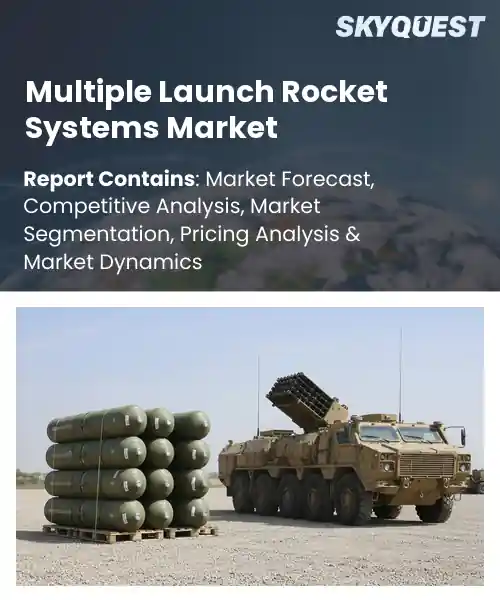
Multiple Launch Rocket Systems Market
Report ID: SQMIG20A2727
Report ID: SQMIG20A2727
[email protected]
USA +1 351-333-4748
Report ID:
SQMIG20A2727 |
Region:
Global |
Published Date: July, 2026
Pages:
157
|Tables:
144
|Figures:
78


Global Multiple Launch Rocket Systems Market size was valued at USD 1.0 Billion in 2024 and is poised to grow from USD 1.08 Billion in 2025 to USD 1.93 Billion by 2033, growing at a CAGR of 7.6% during the forecast period (2026-2033).
The global Multiple Launch Rocket Systems (MLRS) market is about platforms that can spit out a salvo of rockets, giving rapid fire over a big, wide area. People still track it because it ends up shaping battlefield dynamics, like suppressing enemy air defenses and helping combined‑arms operations click together in practice. Right now the big push is clearly the growing demand for precision-guided munitions; those are meant to cut collateral damage, but still keep the strike power where it matters.
Moreover, there is the other major factor for the Multiple Launch Rocket Systems (MLRS) market growth is the guidance plus digital fire‑control technologies. These tools take what used to be more “area saturation” type weapons and turn them into precision strike assets, which sounds simple but changes everything. Militaries are adopting newer command structures, and the ability to launch GPS‑oriented rockets from mobile launchers means faster reaction time, and better target discrimination. That’s why procurement programs keep showing up, like Ukraine getting U.S. HIMARS, and India upgrading Pinaka with guided munitions. In the meantime this tech convergence tends to shrink logistical footprints; it also opens export doors for countries that want more firepower, and it even fuels projects where AI‑driven targeting algorithms are built in. So, manufacturers are seeing fuller order books and they start leaning into modular designs that promises scalability across different operational doctrines.
AI is boosting targeting precision in MLRS by blending sensor inputs, real‑time mapping, plus predictive algorithms, and then it just keeps refining the outcome. Machine‑learning models chew through terrain, weather, and even enemy movement patterns to estimate better impact points, which in turn helps reduce collateral damage and improves hit probability. There are also integrated AI processors on the launch units, so the system can make on‑the‑fly trajectory adjustments, meaning each rocket can correct its path mid‑flight. This ends up turning classic area‑saturation tactics into something more like pinpoint strikes, and it makes the whole setup more adaptable on fast shifting battlefields. And since forces are chasing quicker decision cycles, AI‑driven guidance tends to shorten the time from target acquisition to impact, boosting overall combat effectiveness, and it lines up with the market trend toward smarter , networked munitions.
Market snapshot - (2026-2033)
Global Market Size
USD 1.0 Billion
Largest Segment
Wheeled MLRS
Fastest Growth
Tracked MLRS
Growth Rate
7.6% CAGR
To get more insights on this market click here to Request a Free Sample Report
The global multiple launch rocket systems market is segmented by launch vehicle type, caliber range, range, payload, end user and region. Based on launch vehicle type, the market is segmented into Wheeled MLRS, and Tracked MLRS. Based on caliber range, the market is segmented into 70–180 mm, 180–300 mm and > 300 mm. Based on range, the market is segmented into Short Range (up to 70 km), Medium Range (70–150 km) and Long Range (> 150 km). Based on payload, the market is segmented into High Explosive, Guided Precision Rockets, Thermite / Incendiary and Smoke. Based on end user, the market is segmented into Army, Navy (Shipboard) and Special Forces. Based on region, the market is segmented into North America, Europe, Asia Pacific, Latin America and Middle East & Africa.
As per the multiple launch rocket systems market analysis, the 70–180 Mm caliber range segment dominates because it lines up with most of the tactical requirements, giving that rough balance between lethality and platform mobility. The “moderate” size makes it easier to integrate on both wheeled and tracked launchers, so it tends to cut the logistical burden and lets units redeploy more quickly. This adaptability meets armed forces’ need for flexible fire support, and it helps explain why it stays in the market leadership position.
Meanwhile, the 180 to 300 mm caliber range segment is showing the strongest growth momentum, basically because newer threat environments push for extended reach and bigger payload capacity. With ongoing development of precision guided rockets in this band, the operational value widens, and that encourages forces to update inventories, which then feeds demand that accelerates the overall market expansion.
According to the multiple launch rocket systems market forecast, the wheeled MLRS segment takes the lead because army logistics favor strategic mobility and fast redeployment across all terrain. The lighter chassis makes air transport realistic, and road movement happens faster, which matches expeditionary doctrines that often prefer speed over heavy armor. So, manufacturers end up prioritizing modular design and easier maintenance, and that reinforces wheeled systems as the preferred option for land based forces. These preferences also make supply chains and training programs less complicated, and that locks in wheeled platforms as a reference point for army procurement decisions, even when budgets tighten.
On the other hand, the tracked MLRS segment is coming forward as the high-growth area, since modern combat theaters need better off-road performance and stronger survivability in rough places. Improvements in suspension systems and armor integration raise operational endurance, so forces lean toward tracked solutions for contested zones, and that is what tends to enhance the multiple launch rocket systems market penetration.
To get detailed segments analysis, Request a Free Sample Report
As per the multiple launch rocket systems market regional forecast, North America’s dominance in the market is mostly because of a solid defense industrial base, plus a lot of back and forth integration of advanced technologies, and then of course sustained government investment to modernize arsenals. The United States leads, by running extensive research programs, pushing cooperation between prime contractors and the armed forces, and there’s this overall culture of quick prototyping, which just helps speed up fielding new capabilities. Canada shows up with strategic partnerships, strong attention on interoperability with NATO rules, and a focus on domestic development, which pairs well with allied supply chains. Also both countries sit on deep talent pools and keep doing joint exercises that check how systems perform across different operating scenarios, and that basically locks in their market advantage more and more.
United States Multiple Launch Rocket Systems Market
The Multiple Launch Rocket Systems market outlook in the United States is shaped by defense procurement strategies that sit very close to research institutions, so ideas can move fast from concept to actual fielded product. Industry leaders take advantage of extensive supply chains and a culture of innovation to deliver modular, high‑precision rockets that track with changing combat needs. The whole ecosystem encourages private‑sector funding and joint ventures , to boost system reliability and give forces more operational flexibility.
Canada Multiple Launch Rocket Systems Market
The Multiple Launch Rocket Systems sector engagement in Canada is often framed around interoperability with allied forces , and a clear commitment to building technology at home. Collaborative programs with nearby partners concentrate on modular design and easy integration into existing artillery platforms. Canadian firms lean toward cost‑effective solutions while still meeting strict performance criteria, so they can field adaptable rocket systems quickly. That path supports national defense goals and also strengthens the wider regional capability blueprint in general.
Europe’s rapid expansion of the Multiple Launch Rocket Systems industry happens because several modernization initiatives are happening at the same time. There are strong cooperative arrangements among major defense nations and a higher emphasis on precision strike capabilities. Integrated procurement programs across the region help spread development costs and push standardization , which makes adoption of advanced rocket technologies faster. Germany brings a well known industrial foundation for producing high‑performance systems, while the United Kingdom tends to speed up acquisition cycles and brings in more experimental engineering methods , which keeps market momentum going. France adds newer design concepts that lean into modularity and possible export demand. Taken together, these factors create a favorable environment for ongoing innovation, cross‑border interoperability, and a resilient supply chain, so Europe starts looking like a fast growing hub for multiple launch rocket solutions.
Germany Multiple Launch Rocket Systems Market
The Multiple Launch Rocket Systems Market presence in Germany is supported by a long engineering tradition and a manufacturing ecosystem that can handle production at scale. German defense firms blend strict testing procedures with materials expertise, delivering rockets that aim for exceptional accuracy and reliability. Coordination with NATO partners keeps compatibility smooth , and it supports joint training exercises too. This setup helps Germany maintain a leading position in shaping European standards and moving launch capabilities forward.
United Kingdom Multiple Launch Rocket Systems Market
The Multiple Launch Rocket Systems Market development in the United Kingdom is driven by an acquisition strategy that focuses on fast fielding of adaptable rocket solutions. British industry mixes deep know how with engineering discipline, so development cycles stay shorter and system responsiveness increases. Partnership with allied research institutions also helps bring innovation into guidance and propulsion technologies. That focus on speed and flexibility keeps the United Kingdom functioning like a catalyst for market energy across Europe.
France Multiple Launch Rocket Systems Market
The Multiple Launch Rocket Systems Market activity in France is starting to show momentum through a focus on modular design concepts that match both domestic defense needs, and export potential as well. French manufacturers pair electronics with launch architectures, so systems can be adapted to multiple mission profiles. Cooperation with European research networks speeds up integration of materials and munition technologies. Overall, this direction supports France’s ambition to become a visible contributor in the continental landscape of rocket systems.
Asia Pacific is tightening up its stance in the Multiple Launch Rocket Systems market, via a mix of strategic defense modernization, boosting home-grown manufacturing skill, and putting more weight on regional security partnerships. In the region, countries are pushing research that blends advanced guidance, propulsion, and materials science, so the systems can go farther and hit with better accuracy. Local defense companies working with bigger global technology partners also helps with technology transfer and speeds up the crafting of customized solutions for different operational environments. On top of that, more export ambitions and regular involvement in multinational exercises are making the region look like a new type of hub, for more advanced rocket-launch platforms. Japan and South Korea, in particular, are doubling down on joint development programs that fold in artificial intelligence and networked targeting, so their launch systems become more lethal, faster to respond, and generally more effective overall.
Japan Multiple Launch Rocket Systems Market
In Japan, Multiple Launch Rocket Systems market momentum is mainly about stitching together high precision guidance with launch platforms, to support the country’s maritime and island defense priorities, not just theory but practical deployment. Japanese manufacturers lean on advanced robotics and sensor fusion, to get cleaner target acquisition and quicker reload cycles. There is also collaboration with domestic research institutes, and that seems to speed up the adoption of next level propulsion technologies. All of this, basically, frames Japan as a major contributor to the wider regional rocket systems capability.
South Korea Multiple Launch Rocket Systems Market
South Korea’s Multiple Launch Rocket Systems market direction leans toward prototyping and integration with artillery networks, to strengthen force projection. Korean firms blend electronic warfare suites with high-velocity rocket motors, offering systems that can deliver precise strikes over a range of terrain types. With government support and cooperation with research centers, they can refine guidance algorithms and survivability features in a way that keeps evolving. This overall approach helps lock in South Korea’s position as one of the stronger players in the Asia Pacific rocket systems arena.
To know more about the market opportunities by region and country, click here to
Buy The Complete Report
Growing Adoption Of Multi‑Payload Capability
Integration Of Advanced Guidance Systems
High Development Cost Barriers
Regulatory And Export Control Constraints
Request Free Customization of this report to help us to meet your business objectives.
The competitive landscape is shaped by intense rivalry among established launch providers and emerging innovators, which pushes rapid tech upgrades and also strategic collaborations. Like SpaceX’s Starship development, plus its partnership with NASA, seems to accelerate reusable heavy-lift capabilities, while Blue Origin’s acquisition of Rocket Lab’s propulsion assets shows a consolidation move meant to boost payload flexibility. Then Relativity Space’s fully 3D-printed Terran rockets, in turn, provide a tech-forward differentiation that pressures rivals into accelerating cost reduction and multi payload launch cycles, more or less.
Top Player’s Company Profile
Recent Developments in the Multiple Launch Rocket Systems Market
SkyQuest’s ABIRAW (Advanced Business Intelligence, Research & Analysis Wing) is our Business Information Services team that Collects, Collates, Correlates, and Analyses the Data collected by means of Primary Exploratory Research backed by robust Secondary Desk research.
As per SkyQuest analysis, the market is being propelled mainly by the integration of advanced guidance systems that turn area saturation rockets into precise strike weapons, and also theres another driver from the adoption of multi payload capability which lets operators send several independent warheads in a single salvo, improving efficiency. High development cost barriers work as a restraint, which keeps smaller firms from entering, as much. North America still leads the regional picture, largely because of its strong defense industrial base and continued government investment. In the product mix, wheeled MLRS dominates the segment landscape, since it gives strategic mobility and simpler maintenance, which fits army logistics priorities.
| Report Metric | Details |
|---|---|
| Market size value in 2024 | USD 1.0 Billion |
| Market size value in 2033 | USD 1.93 Billion |
| Growth Rate | 7.6% |
| Base year | 2024 |
| Forecast period | (2026-2033) |
| Forecast Unit (Value) | USD Billion |
| Segments covered |
|
| Regions covered | North America (US, Canada), Europe (Germany, France, United Kingdom, Italy, Spain, Rest of Europe), Asia Pacific (China, India, Japan, Rest of Asia-Pacific), Latin America (Brazil, Rest of Latin America), Middle East & Africa (South Africa, GCC Countries, Rest of MEA) |
| Companies covered |
|
| Customization scope | Free report customization with purchase. Customization includes:-
|
To get a free trial access to our platform which is a one stop solution for all your data requirements for quicker decision making. This platform allows you to compare markets, competitors who are prominent in the market, and mega trends that are influencing the dynamics in the market. Also, get access to detailed SkyQuest exclusive matrix.
Table Of Content
Executive Summary
Market overview
Parent Market Analysis
Market overview
Market size
KEY MARKET INSIGHTS
COVID IMPACT
MARKET DYNAMICS & OUTLOOK
Market Size by Region
KEY COMPANY PROFILES
Methodology
For the Multiple Launch Rocket Systems Market, our research methodology involved a mixture of primary and secondary data sources. Key steps involved in the research process are listed below:
1. Information Procurement: This stage involved the procurement of Market data or related information via primary and secondary sources. The various secondary sources used included various company websites, annual reports, trade databases, and paid databases such as Hoover's, Bloomberg Business, Factiva, and Avention. Our team did 45 primary interactions Globally which included several stakeholders such as manufacturers, customers, key opinion leaders, etc. Overall, information procurement was one of the most extensive stages in our research process.
2. Information Analysis: This step involved triangulation of data through bottom-up and top-down approaches to estimate and validate the total size and future estimate of the Multiple Launch Rocket Systems Market.
3. Report Formulation: The final step entailed the placement of data points in appropriate Market spaces in an attempt to deduce viable conclusions.
4. Validation & Publishing: Validation is the most important step in the process. Validation & re-validation via an intricately designed process helped us finalize data points to be used for final calculations. The final Market estimates and forecasts were then aligned and sent to our panel of industry experts for validation of data. Once the validation was done the report was sent to our Quality Assurance team to ensure adherence to style guides, consistency & design.
Analyst Support
Customization Options
With the given market data, our dedicated team of analysts can offer you the following customization options are available for the Multiple Launch Rocket Systems Market:
Product Analysis: Product matrix, which offers a detailed comparison of the product portfolio of companies.
Regional Analysis: Further analysis of the Multiple Launch Rocket Systems Market for additional countries.
Competitive Analysis: Detailed analysis and profiling of additional Market players & comparative analysis of competitive products.
Go to Market Strategy: Find the high-growth channels to invest your marketing efforts and increase your customer base.
Innovation Mapping: Identify racial solutions and innovation, connected to deep ecosystems of innovators, start-ups, academics, and strategic partners.
Category Intelligence: Customized intelligence that is relevant to their supply Markets will enable them to make smarter sourcing decisions and improve their category management.
Public Company Transcript Analysis: To improve the investment performance by generating new alpha and making better-informed decisions.
Social Media Listening: To analyze the conversations and trends happening not just around your brand, but around your industry as a whole, and use those insights to make better Marketing decisions.
REQUEST FOR SAMPLE
 REQUEST FREE CUSTOMIZATION
Global Multiple Launch Rocket Systems Market size was valued at USD 1.0 Billion in 2024 and is poised to grow from USD 1.08 Billion in 2025 to USD 1.93 Billion by 2033, growing at a CAGR of 7.6% during the forecast period (2026-2033).
The competitive landscape is shaped by intense rivalry among established launch providers and emerging innovators, driving rapid technology upgrades and strategic collaborations; SpaceX’s Starship development and its partnership with NASA accelerate reusable heavy‑lift capabilities, while Blue Origin’s acquisition of Rocket Lab’s propulsion assets illustrates consolidation aimed at expanding payload‑flexibility, and Relativity Space’s fully 3D‑printed Terran rockets exemplify tech‑centric differentiation that pressures rivals to accelerate cost‑reduction and multi‑payload launch cycles. 'Lockheed Martin Corporation', 'BAE Systems plc', 'Hanwha Aerospace Co. Ltd.', 'Roketsan A.Ş.', 'Elbit Systems Ltd.', 'Rheinmetall AG', 'Raytheon Technologies (RTX)', 'General Dynamics Corporation', 'Thales S.A.', 'Leonardo S.p.A.', 'L3Harris Technologies', 'MBDA Systems', 'Nexter Systems (KNDS)', 'Saab AB', 'Diehl Defence GmbH', 'Norinco Group (China North Industries)', 'Tata Advanced Systems Limited', 'Solar Industries India', 'Avibras Indústria Aeroespacial S.A.', 'Arnold Defense & Electronics'
Manufacturers are developing rockets capable of delivering several independent payloads to distinct orbits within a single launch, allowing operators to maximize vehicle utilization and lower per‑mission expenses. This capability encourages customers to consolidate missions, enhances resource efficiency, and shortens overall program timelines, thereby stimulating demand for versatile launch platforms that support multiple payload configurations. Operators value such flexibility because it aligns with evolving mission profiles that require timely deployment of satellite constellations and experimental units, driving interest in modular rocket architectures that can be reconfigured for diverse customer needs.
Advanced Modular Architecture: Manufacturers are shifting toward highly modular launch vehicle designs that allow rapid reconfiguration of propulsion, payload, and avionics packages. This flexibility shortens development cycles, enables cost‑effective integration of emerging technologies, and supports a broader range of mission profiles from low‑Earth‑orbit constellations to deep‑space probes. By standardizing interfaces and employing plug‑and‑play components, suppliers can serve diverse customers while minimizing inventory complexity, fostering collaborative ecosystems, and accelerating the introduction of next‑generation capabilities across the global market for both government and commercial operators worldwide.
Why does North America Dominate the Global Multiple Launch Rocket Systems Market? |@12


Want to customize this report? This report can be personalized according to your needs. Our analysts and industry experts will work directly with you to understand your requirements and provide you with customized data in a short amount of time. We offer $1000 worth of FREE customization at the time of purchase.
Feedback From Our Clients


 USA (+1) 351-333-4748

