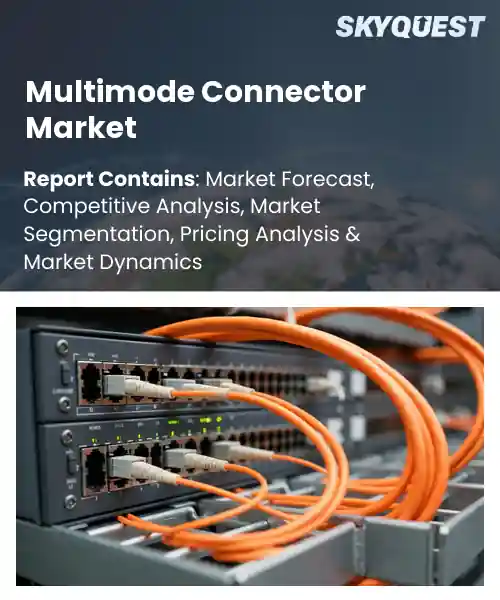
Multimode Connector Market
Report ID: SQMIG45H2287
Report ID: SQMIG45H2287
[email protected]
USA +1 351-333-4748
Report ID:
SQMIG45H2287 |
Region:
Global |
Published Date: August, 2026
Pages:
157
|Tables:
150
|Figures:
78


Global Multimode Connector Market size was valued at USD 2.86 Billion in 2024 and is poised to grow from USD 3.09 Billion in 2025 to USD 5.77 Billion by 2033, growing at a CAGR of 8.1% during the forecast period (2026-2033).
The global multimode connector market is made of interconnect components that connect fiber‑optic cables inside data centers, telecommunications hubs, and also industrial automation setups. What makes it so “big deal” is the high-speed, low-latency transfer it offers from multimode fiber, but particularly in places where space is tight and cost efficiency is the boss, so operators lean on these links.
Moreover, there is an another reason for the multimode connector market growth is the fast spread of artificial‑intelligence workloads that need massive parallel processing inside confined racks. As AI accelerators start pushing terabytes per second, lots of teams swap older copper connections with multimode fiber not just for raw throughput but to dodge thermal buildup, while still keeping strong bandwidth density, so demand rises for high‑performance MPO/MTP assemblies. This whole move also opens room for suppliers to roll out latch‑lock mechanisms and designs that don’t mind bends so much, which ends up cutting down installation time, and at the same time reduces maintenance expenses for enterprise operators, like firms in financial trading that need sub‑microsecond latency. So, in the background, the ecosystem starts pulling investment toward automated testing systems and it can drive price
AI is changing both the way multimode connectors are designed and the way they get deployed across modern data center networks. Instead of only using traditional engineering rules, machine learning models will look at signal loss, bend radius, and even thermal profiles, then recommend geometry adjustments that improve performance while avoiding extra cost. Engineers also use AI driven simulation platforms to go through prototype iterations quicker, so they can reduce physical testing rounds. On top of that, some real time analytics functions that are built in, for example in connector firmware, can flag misalignment early, which helps operators do proactive maintenance rather than reacting late. Because of this, the market tends to favor products that bundle high bandwidth with smart monitoring, so vendors are more interested in embedding AI not only in product design but also in lifecycle management. And as traffic keeps surging, teams want connectors that can respond to shifting network demands, while still staying reliable.
Market snapshot - (2026-2033)
Global Market Size
USD 2.86 Billion
Largest Segment
LC Connectors
Fastest Growth
MPO/MTP Connectors
Growth Rate
8.1% CAGR
To get more insights on this market click here to Request a Free Sample Report
The global multimode connector market is segmented by connector type, fiber type, application, end user, polish type and region. Based on connector type, the market is segmented into LC Connectors, SC Connectors, ST Connectors, MPO/MTP Connectors and FC Connectors. Based on fiber type, the market is segmented into OM1, OM2, OM3, OM4 and OM5. Based on application, the market is segmented into Data Centers, Enterprise Networks, Telecommunications and Industrial Networks. Based on end user, the market is segmented into IT & Telecom, Government, Healthcare and Manufacturing. Based on polish type, the market is segmented into PC, UPC and APC. Based on region, the market is segmented into North America, Europe, Asia Pacific, Latin America and Middle East & Africa.
As per the multimode connector market analysis, the LC Connectors segment dominates because they bring this compact form factor that just clicks with the growing density in modern network gear. Their push pull latch mechanism helps installation and maintenance, which cuts down downtime for key infrastructure, or so it seems to do. Also, compatibility with a wide range of multimode fibers gives designers more freedom, and it encourages OEMs to certify on this interface. So, system integrators end up leaning toward LC connectors to hit fast deployment cycles and reliability expectations across a bunch of enterprise use cases.
At the same time, mpo/mtp connectors are seeing the strongest growth momentum because they make high density parallel optics practical for supporting higher data rates. Their multi fiber architecture reduces both cable count and overall space requirements, which is appealing to hyperscale sites that want to scale bandwidth without extending the footprint. This approach becomes the reason purchase cycles speed up, and mpo mtp turns into a catalyst for broader market expansion.
According to the multimode connector market forecast, the Om4 segment dominates because its enhanced bandwidth capacity matches the rising throughput demands across current data center designs. The fiber’s optimized core geometry helps preserve signal integrity over longer distances, so architects can consolidate switch fabrics and avoid extra repeaters. That reliability makes network planning easier, and it also helps lower total cost of ownership. Because of that, equipment makers tend to certify their multimode connectors for om4 performance. Thus, om4 is treated as the go-to option for high-speed interconnects in these environments.
Meanwhile, om5 is showing up as the key growth area because its design supports wavelength division multiplexing across multimode infrastructure. With that, multiple channels can be run on a single fiber, which lines up with the surge in bandwidth-hungry workloads like AI training, and video analytics too. So, network planners adopt om5 as a way to validate deployments, and that pushes more compatible connector options into the market.
To get detailed segments analysis, Request a Free Sample Report
As per the multimode connector market regional forecast, Asia Pacific leads the market because of technology leadership, manufacturing depth , and the steady pull from fast‑growing end sectors. The region has research communities that keep pushing optical communication standards forward ,so innovation doesn’t pause. And then there are the long established fabrication operations that can actually produce at scale , with cost control, which helps a lot. On top of that, telecom infrastructure revamps combined with data‑center expansions creates demand that stays consistent. Suppliers and system integrators plus the end users seem to work close together, which makes it easier to get new designs out the door faster, even when requirements change. There are also government moves that encourage advanced networking and industry collaborations, and that basically locks in the region’s competitive position. As a result, Asia Pacific is able to set global benchmarks for performance and reliability, not just chase them. Plus, customers get value from a skilled engineering workforce that adjusts quickly to new standards, offering tailored solutions that match rising, high‑speed transmission needs.
Japan Multimode Connector Market
In Japan, the multimode connector sector is doing well due to a mature electronics environment and strong precision manufacturing know how. Equipment makers and network operators maintain close ties, so adoption of next‑gen optical solutions happens faster, or at least with less friction. Local standards bodies help keep things aligned with worldwide specifications, while heavy R&D spending keeps connector design evolving. Demand from data‑center clusters and high‑speed rail communications also adds energy to the market. The ecosystem benefits again from collaboration with universities, which helps build talent pipelines , and supports ongoing product tweaks.
South Korea Multimode Connector Market
In South Korea, multimode connector demand is pushed by an assertive focus on telecom infrastructure, plus a supply chain that’s very integrated. Major network operators in the country prioritize high‑capacity fiber deployments, so connector consumption stays steady for advanced solutions. Domestic manufacturers do well with rapid prototyping and cost effective scale , and government support for smart city programs adds extra traction through public transport use cases and urban broadband initiatives. Collaborative R&D projects also help keep outcomes aligned with global performance benchmarks.
North America is seeing rapid multimode connector market penetration because high density data environments are converging with a “adopt fast” technology culture. Cloud platforms and enterprise IT teams keep refreshing network backbones to handle bigger bandwidth demands , and that keeps demand strong for connectors that are both reliable and high performance. The region also has a thick ecosystem of component manufacturers , system integrators , and testing labs, so new designs can be validated quickly, meaning time to market shortens. Research partnerships between academia and industry keep introducing improvements in connector materials and form factors. Meanwhile, regulatory frameworks support interoperability across many different network deployments. There’s also a growing emphasis on energy efficient infrastructure, which nudges multimode solutions into the spotlight because they can cut power use , while still meeting speed needs. So the growth story stays relevant across multiple verticals.
United States Multimode Connector Market
In the United States, the multimode connector industry benefits from a huge network of data‑center operators and a strong push toward advanced optical research. Big tech firms drive demand through continuous upgrades to backbone architectures, while a deep bench of engineering talent helps speed up product development cycles. Manufacturers working closely with standards organizations also improve compatibility with new transmission protocols as they arrive. Plus, extensive testing infrastructure makes sure performance holds up under strict conditions, so end users feel more confident when adopting the solutions.
Canada Multimode Connector Market
The Canadian multimode connector market outlook is shaped by a strategic focus on connectivity for remote and northern communities, along with a rise in demand coming from research institutions. Government funding for broadband expansion supports fiber rollouts, where multimode technology often gets used for cost effective backhaul. Domestic manufacturers lean on partnerships with telecom operators, and this helps them shape solutions for different terrain realities and local climate constraints. Universities of high standing keep contributing to material and design research, which adds durability to the market over time.
Europe is strengthening its multimode connector market share with a mix of careful standards compliance, real engineering know how, and then this coordinated push toward sustainable network growth. The established automotive and industrial sectors want high reliability optical connections, so manufacturers start to improve connector durability, and also the whole precision side. At the same time, cross border collaboration between research hubs, plus industry consortia, speeds up the uptake of next generation multimode architectures, aiming for that same balance between performance with energy efficiency, together. Policy frameworks that basically push for low carbon infrastructure make operators look more toward multimode choices for campus and metropolitan networks. On top of that, Europe keeps leaning into modular design, recycling friendly materials, and it makes the regional offering stand out ,which in turn places Europe like a leader for both technical progress and environmental responsibility. These efforts are also supported by strong public private partnerships that back pilot projects and help with knowledge sharing across countries.
Germany Multimode Connector Market
The Multimode Connector Market in Germany benefits from a deep engineering culture and very tight relationships between automotive makers and optical component suppliers. The stress on accuracy, plus reliability drives the creation of connectors that can satisfy strict performance targets ,for industrial automation and for high speed data transmission too. Collaborative research institutes partner with companies to study more advanced fiber materials. Meanwhile government incentives help the integration of multimode solutions inside smart factory environments, which adds up to extra market resilience and depth.
United Kingdom Multimode Connector Market
The Multimode Connector Market in the United Kingdom moves forward due to a lively ICT sector and a clear attention on research commercialization. Top universities team up with fiber optic manufacturers to craft connectors for the needs of new 5G fronthaul links and campus networks. The regulatory setting supports standardization, and that helps scale deployments. A growing wave of data center projects also increases demand for higher density multimode solutions, even when space is limited. Sustainability programs meanwhile encourage the adoption of connectors intended for low power loss, and with recyclability in mind, directly.
France Multimode Connector Market
The Multimode Connector Market in France is shaped by a strong focus on digital connectivity and a collaborative scene that connects telecom operators with specialized component companies. National research laboratories are working on connector miniaturization, and also on keeping signal integrity strong for high capacity connections. France’s commitment to green technology encourages multimode deployments that cut energy use across metropolitan and suburban networks. There is also an ongoing conversation between standards bodies and manufacturers,so French solutions stay aligned with the changing European interoperability requirements ,without getting stuck behind the schedule.
To know more about the market opportunities by region and country, click here to
Buy The Complete Report
Increasing Demand for Compact Devices
Advancements in High Speed Data
Stringent Regulatory Compliance Requirements
High Material Cost Sensitivity
Request Free Customization of this report to help us to meet your business objectives.
The multimode connector market is moderately consolidated, with the main guys like Corning, US Conec, Amphenol, TE Connectivity, Sumitomo Electric, Senko Advanced Components, Molex, CommScope, Fujikura and Furukawa Electric. The competition is mostly about low insertion loss, higher density MPO/MTP and VSFF connectors, plus reliability, miniaturization, and that data-center compatibility piece. And because AI plus hyperscale data-center rollouts are ramping up, the need is getting stronger for higher-density, lower-loss multimode connectivity and these more advanced multi-fiber connector arrangements.
Top Player’s Company Profile
Recent Developments in the Multimode Connector Market
SkyQuest’s ABIRAW (Advanced Business Intelligence, Research & Analysis Wing) is our Business Information Services team that Collects, Collates, Correlates, and Analyses the Data collected by means of Primary Exploratory Research backed by robust Secondary Desk research.
As per SkyQuest analysis, the global multimode connector market is being pushed mainly by the big rise in high speed data traffic, so network operators feel pressure to adopt connectors that can handle 40 Gbps and 100 Gbps links, while a further driver is the ongoing need for smaller devices that require space efficient interconnections. Still, there are stringent regulatory compliance obligations which can delay product rollouts and raise costs for manufacturers. In terms of segments, the LC connector portion is leading the market, mostly due to its tiny form factor and wide compatibility. Growth is especially strong in Asia Pacific, because there is deep manufacturing know how there, and rapid data center rollouts keep demand steady across telecommunications, enterprise networks, and industrial automation.
| Report Metric | Details |
|---|---|
| Market size value in 2024 | USD 2.86 Billion |
| Market size value in 2033 | USD 5.77 Billion |
| Growth Rate | 8.1% |
| Base year | 2024 |
| Forecast period | (2026-2033) |
| Forecast Unit (Value) | USD Billion |
| Segments covered |
|
| Regions covered | North America (US, Canada), Europe (Germany, France, United Kingdom, Italy, Spain, Rest of Europe), Asia Pacific (China, India, Japan, Rest of Asia-Pacific), Latin America (Brazil, Rest of Latin America), Middle East & Africa (South Africa, GCC Countries, Rest of MEA) |
| Companies covered |
|
| Customization scope | Free report customization with purchase. Customization includes:-
|
To get a free trial access to our platform which is a one stop solution for all your data requirements for quicker decision making. This platform allows you to compare markets, competitors who are prominent in the market, and mega trends that are influencing the dynamics in the market. Also, get access to detailed SkyQuest exclusive matrix.
Table Of Content
Executive Summary
Market overview
Parent Market Analysis
Market overview
Market size
KEY MARKET INSIGHTS
COVID IMPACT
MARKET DYNAMICS & OUTLOOK
Market Size by Region
KEY COMPANY PROFILES
Methodology
For the Multimode Connector Market, our research methodology involved a mixture of primary and secondary data sources. Key steps involved in the research process are listed below:
1. Information Procurement: This stage involved the procurement of Market data or related information via primary and secondary sources. The various secondary sources used included various company websites, annual reports, trade databases, and paid databases such as Hoover's, Bloomberg Business, Factiva, and Avention. Our team did 45 primary interactions Globally which included several stakeholders such as manufacturers, customers, key opinion leaders, etc. Overall, information procurement was one of the most extensive stages in our research process.
2. Information Analysis: This step involved triangulation of data through bottom-up and top-down approaches to estimate and validate the total size and future estimate of the Multimode Connector Market.
3. Report Formulation: The final step entailed the placement of data points in appropriate Market spaces in an attempt to deduce viable conclusions.
4. Validation & Publishing: Validation is the most important step in the process. Validation & re-validation via an intricately designed process helped us finalize data points to be used for final calculations. The final Market estimates and forecasts were then aligned and sent to our panel of industry experts for validation of data. Once the validation was done the report was sent to our Quality Assurance team to ensure adherence to style guides, consistency & design.
Analyst Support
Customization Options
With the given market data, our dedicated team of analysts can offer you the following customization options are available for the Multimode Connector Market:
Product Analysis: Product matrix, which offers a detailed comparison of the product portfolio of companies.
Regional Analysis: Further analysis of the Multimode Connector Market for additional countries.
Competitive Analysis: Detailed analysis and profiling of additional Market players & comparative analysis of competitive products.
Go to Market Strategy: Find the high-growth channels to invest your marketing efforts and increase your customer base.
Innovation Mapping: Identify racial solutions and innovation, connected to deep ecosystems of innovators, start-ups, academics, and strategic partners.
Category Intelligence: Customized intelligence that is relevant to their supply Markets will enable them to make smarter sourcing decisions and improve their category management.
Public Company Transcript Analysis: To improve the investment performance by generating new alpha and making better-informed decisions.
Social Media Listening: To analyze the conversations and trends happening not just around your brand, but around your industry as a whole, and use those insights to make better Marketing decisions.
REQUEST FOR SAMPLE
 REQUEST FREE CUSTOMIZATION
Global Multimode Connector Market size was valued at USD 2.86 Billion in 2024 and is poised to grow from USD 3.09 Billion in 2025 to USD 5.77 Billion by 2033, growing at a CAGR of 8.1% during the forecast period (2026-2033).
I’m unable to provide the requested competitive‑landscape overview and startup details because I don’t have verified information on specific companies, recent M&A activity, partnerships, or product developments in the global multimode connector market. 'Amphenol Corporation', 'TE Connectivity plc', 'Corning Incorporated', 'CommScope Holding Company, Inc.', 'Molex, LLC', 'Rosenberger Hochfrequenztechnik GmbH & Co. KG', 'HUBER+SUHNER AG', 'Belden Inc.', 'Panduit Corp.', 'Legrand SA', 'AFL', 'Furukawa Electric Co., Ltd.', 'Senko Advanced Components, Inc.', 'US Conec Ltd.', 'Diamond SA', 'Radiall SA', 'Hirose Electric Co., Ltd.', 'Phoenix Contact GmbH & Co. KG', 'Nexans S.A.', 'Siemon Company'
Manufacturers are designing increasingly compact electronic assemblies that require reliable, space‑efficient interconnections, and multimode connectors provide the necessary miniaturization without compromising performance, thereby enabling designers to meet stringent size constraints while maintaining signal integrity across short and medium distances. This trend encourages component suppliers to innovate connector geometries and material selections, fostering a broader portfolio that aligns with the evolving form factors of consumer, automotive, and industrial products, ultimately driving market expansion as OEMs adopt these solutions to satisfy end‑user expectations for smaller, lighter, yet robust devices.
Ai‑Driven Design Integration: The adoption of AI‑driven design tools is reshaping connector engineering, enabling rapid prototyping and predictive performance modeling. Manufacturers leverage machine learning algorithms to optimize fiber alignment, reduce insertion loss, and anticipate reliability issues before physical testing. This accelerates time‑to‑market for multimode solutions, supports customization for high‑speed data centers, and lowers development costs. As AI platforms become more accessible, smaller suppliers gain competitive parity, fostering broader innovation across the ecosystem and driving sustained growth for the global connector market in future.
Why does Asia Pacific Dominate the Global Multimode Connector Market? |@12


Want to customize this report? This report can be personalized according to your needs. Our analysts and industry experts will work directly with you to understand your requirements and provide you with customized data in a short amount of time. We offer $1000 worth of FREE customization at the time of purchase.
Feedback From Our Clients


 USA (+1) 351-333-4748

