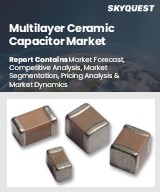
Multilayer Ceramic Capacitor Market
Report ID: SQMIG45K2181
Report ID: SQMIG45K2181
[email protected]
USA +1 351-333-4748
Report ID:
SQMIG45K2181 |
Region:
Global |
Published Date: December, 2025
Pages:
189
|Tables:
124
|Figures:
72


Global Multilayer Ceramic Capacitor Market size was valued at USD 14.59 Billion in 2024 and is poised to grow from USD 15.54 Billion in 2025 to USD 25.72 Billion by 2033, growing at a CAGR of 6.5% during the forecast period (2026–2033).
Growing demand for compact and high-performance electronic devices in consumer electronics, automotive, and industrial applications is steering the global multilayer ceramic capacitor market growth. High capacitance and miniaturization remain significantly favorable for the continued adoption of MLCC technology.
While consumer electronics such as smartphones, tablets, and laptops are extremely popular and, in some instances, required to be diminutive but powerful, manufacturers are pushed towards more advanced multilayer ceramic capacitor (MLCC) designs in which size and capacitance can both be used together. In the automotive market, continued adoption of Advanced Driver Assistance Systems (ADAS), electric powertrains, and more infotainment systems are leveraging higher reliability capacitors. Further, as 5G infrastructure expands and IoT is adopted, MLCCs with enhanced frequency characteristics will be more frequent in network equipment and the numerous smart appliances. Beyond consumer and automotive electronics, MLCC's are used in medical, industrial automation, and aerospace which should enable market growth all the way through 2032 as per multilayer ceramic capacitor market forecast.
On the downside, the MLCC market also faces issues regarding supply chain disruptions, raw-material shortages, production processes that are becoming increasingly complex with less reliability and technological limitations on ultra-small MLCC manufacturing. Commodity challenges such as price volatility may also limit the multilayer ceramic capacitor market penetration in cost-sensitive applications.
How Are Manufacturers Addressing Miniaturization Trends in Electronics?
As electronic devices continue to shrink in size while requiring more power storage, MLCC manufacturers are working hard to produce ultra-small, high-capacitance components, all while ensuring reliability, according to multilayer ceramic capacitor market statistics. Attributed to new materials, layer-stacking, and precision manufacturing, these capacitors can now be made smaller and fit into devices that get smaller over time - e.g., smartphones, wearables, and IoT sensors - enabling designers to save board space and preserve board-level functionality. As a result, next-generation electronic systems throughout multiple industries rely heavily on MLCCs.
Market snapshot - 2026-2033
Global Market Size
USD 13.7 billion
Largest Segment
General capacitor
Fastest Growth
Mega cap
Growth Rate
6.5% CAGR
To get more insights on this market click here to Request a Free Sample Report
Global Multilayer Ceramic Capacitor Market is segmented by Type, Rated Voltage Range, Case Size, Dielectric Type, End-use and region. Based on Type, the market is segmented into General Capacitor, Array, Serial Construction, Mega Cap and Others. Based on Rated Voltage Range, the market is segmented into Low Range (up to 50 v), Mid Range (100 v - 630 v) and High Range (1000 v & above). Based on Case Size, the market is segmented into Less Than 0603 Inches, 0603-1206 Inches and More Than 1206 Inches. Based on Dielectric Type, the market is segmented into X7R, X5R, C0G, Y5V and Others. Based on End-use, the market is segmented into Electronics, Automotive, Industrial, Telecommunication, Data transmission and Others. Based on region, the market is segmented into North America, Europe, Asia Pacific, Latin America and Middle East & Africa.
There is no doubt the general capacitor category will lead the multilayer ceramic capacitor market in terms of revenue share, as per multilayer ceramic capacitor market industry analysis. General capacitors have very broad ranges of voltage and capacitance, they are very cost effective, and they are available in standard specifications and volumes to ensure manufacturers can use these in the consumer electronics and automotive end markets. General capacitors are the priority of manufacturers when considering volume demands in the mass-market. Thus, they are the significant revenue drivers for the multilayer capacitor market.
That said, there's a reason mega caps and arrays are expected to grow, reflecting the high-volume demand for capacitance and integration of advanced electronics systems. Rising investments in electronics R&D and growing adoption of advanced systems are predicted to boost sales of multilayer ceramic capacitors in the long run.
The electronics industry will have the biggest multilayer ceramic capacitors market share, because with the explosion of smartphone, laptop, and wearable production, and consumption, demand for capacitors will continue as there will be sustained demand from a high-volume usage in motherboards, battery systems, power circuits, display modules used in consumer electronics.
Whereas the automotive industry is expected to grow the fastest with the new demand for MLCCs due to increased usage in EVs, ADAS, and infotainment systems. High emphasis on electrification and adoption of advanced infotainment systems are also estimated to create new opportunities via this segment.
To get detailed segments analysis, Request a Free Sample Report
As per multilayer ceramic capacitor market regional outlook, the MLCC demand is being supported by North America’s strong electronics manufacturing base and expanding EV adoption. With high levels of R&D investment, consumers want advanced devices, and greater focus to diversify use in aerospace and medical technologies, North America offers a mature landscape for innovation and differentiation. With large OEMs and suppliers of components fiercely supporting MLCC incorporation to meet increased performance needs, demand will be steadily ramped up.
The US leads global MLCC use, mainly from advanced industries including defense, automotive and telecommunications. Tail end demand for high reliability capacitors, like those deployed in satellites, electric vehicles and 5G infrastructure, are helping offer steady exposure for the market. Between the influence of government-led innovation in MLCCs and a technology-driven, youthful consumer base, US manufacturers and designers remain highly focused on MLCC incorporation.
The Canadian component market is influenced by its budding tech sector, investment in electrification processes, and increasing levels of automation to its industrial systems. With these new products entered domestic production, there are higher expectations for efficiency and compactness from electronics. Partnerships with US-based suppliers of components and proximity to supply chains will ultimately increase MLCC expanded use in Canadian sectors.
Asia Pacific has always been the global hub for electronics manufacturing with low labor costs, established supply chain companies, and the greatest availability of available and skilled labor. Rapid urbanization of Asia Pacific countries and rapid growth of mature consumer electronics are compelling MLCC companies to look for place and innovation. While speculation is being stoked by some governments, for example Japan, China, and South Korea, manufacturers' decisions are driven by real strong US dollar demand.
Japan is the heavyweight in the high-end segment of MLCC production. Japanese manufacturers in the MLCC space offer the most important work in miniaturize and reliability. Japan can be considered a critical market for suppliers given the automotive electronics, robotics and the roll-out of 5G networks. The combination of domestic consumption and export demand makes Japan a region for development and manufacturing and a region for innovation for multilayer ceramic capacitor market penetration.
The imported memory chips, smartphones, and displays that South Korean firms produce is an MLCC factory. Korean major electronics firms, such as Samsung and LG, layer MLCCs into what they produce. The Korean government is supporting its technology industry, there is strong global export expansion, and local EV production is starting to rise. This will keep the industry's demand for advanced multilayer ceramic capacitors.
As electric vehicles progress, 5G technologies begin to permeate, and increasing demand in renewable energy systems creates a significant market for MLCCs in Europe. The march towards smarter, industrial automation continues to gain momentum, and as it progresses, continues to grow the market for small reliable capacitors. Given the EU's initiatives towards sustainability of electronics, the MLCC thermoplastic suppliers are faced with the challenge of innovation and investment in alternative materials.
In the UK, increases in EV related manufacturing and infrastructure, aerospace technology, and industrial electronics are influencing the pattern of MLCC use. Developments based on unique research and development innovations with the government backed investments in clean energy, smart infrastructure and the evident rise of MLCC use. Also, local startup support and large global OEMs of electronics able to see the quality reputation for local design and manufacturing can also stimulate isolated instances of MLCC production activities in their UK facilities.
As per multilayer ceramic capacitor market trends, Germany’s established engineering quality and strength in automotive applications make it a strong market for demand for MLCC. The increasing use of electrification in EVs, the need for precision and robustness as applications mature in stability, and the diversity of IoT innovation creates new markets for advanced capacitors. The consideration of high-performance use of machinery and awareness of energy efficiency in manufacturing processes is contributing to a strong MLCC market, with continual support from government, academia, and industry collaborations.
Areas of higher demand for MLCCs in France are currently in the aerospace, healthcare, and telecom sectors. The two national projects surrounding digital transformation and electric mobility have caused demand to spike. French manufacturers are integrating MLCCs into smart grids, as well as continuing to manufacture advanced electronics. Partnerships with other companies in Europe create significant growth in the production and application of MLCCs in France.
To know more about the market opportunities by region and country, click here to
Buy The Complete Report
Miniaturization of Electronic Devices
Growth of Electric Vehicles (EVs)
Raw Material Prices
Supply Chain Issues
Request Free Customization of this report to help us to meet your business objectives.
Multilayer ceramic capacitor makers need to keep focusing on innovation for applications in high temperature and high frequency environments to remain competitive. There continues to be ample opportunity in the areas of customization, miniaturization, and performance improvement as the electronics industry shifts their multilayer ceramic capacitor market strategies in response to new technologies.
Several start-up companies are entering the MLCC space with a focus on smaller form factor applications, improving reliability and using sustainable materials. They are leveraging innovative production processes and breakthrough ceramic development to disrupt the conventional capacitor production model.
SkyQuest’s ABIRAW (Advanced Business Intelligence, Research & Analysis Wing) is our Business Information Services team that Collects, Collates, Correlates, and Analyses the Data collected by means of Primary Exploratory Research backed by robust Secondary Desk research.
As per SkyQuest analysis, the multilayer ceramic capacitor market continues to perform well due to increasing demand for compact electronics, automotive systems, and high-frequency telecommunication devices. Rising demand from electric vehicles and 5G infrastructure is also increasing demand for multilayer ceramic capacitors (MLCCs) but there are still some supplies chain issues like raw material costs. Asia-Pacific is projected to lead to the growth of the market, driven by strong demand inside and outside the region and robust semi-conductor and electronics manufacturing. Innovation in miniaturization, high-capacitance and dielectric materials are expected to unveil long-term opportunities in this developing component sector.
| Report Metric | Details |
|---|---|
| Market size value in 2024 | USD 14.59 Billion |
| Market size value in 2033 | USD 25.72 Billion |
| Growth Rate | 6.5% |
| Base year | 2024 |
| Forecast period | 2026-2033 |
| Forecast Unit (Value) | USD Billion |
| Segments covered |
|
| Regions covered | North America (US, Canada), Europe (Germany, France, United Kingdom, Italy, Spain, Rest of Europe), Asia Pacific (China, India, Japan, Rest of Asia-Pacific), Latin America (Brazil, Rest of Latin America), Middle East & Africa (South Africa, GCC Countries, Rest of MEA) |
| Companies covered |
|
| Customization scope | Free report customization with purchase. Customization includes:-
|
To get a free trial access to our platform which is a one stop solution for all your data requirements for quicker decision making. This platform allows you to compare markets, competitors who are prominent in the market, and mega trends that are influencing the dynamics in the market. Also, get access to detailed SkyQuest exclusive matrix.
Table Of Content
Executive Summary
Market overview
Parent Market Analysis
Market overview
Market size
KEY MARKET INSIGHTS
COVID IMPACT
MARKET DYNAMICS & OUTLOOK
Market Size by Region
KEY COMPANY PROFILES
Methodology
For the Multilayer Ceramic Capacitor Market, our research methodology involved a mixture of primary and secondary data sources. Key steps involved in the research process are listed below:
1. Information Procurement: This stage involved the procurement of Market data or related information via primary and secondary sources. The various secondary sources used included various company websites, annual reports, trade databases, and paid databases such as Hoover's, Bloomberg Business, Factiva, and Avention. Our team did 45 primary interactions Globally which included several stakeholders such as manufacturers, customers, key opinion leaders, etc. Overall, information procurement was one of the most extensive stages in our research process.
2. Information Analysis: This step involved triangulation of data through bottom-up and top-down approaches to estimate and validate the total size and future estimate of the Multilayer Ceramic Capacitor Market.
3. Report Formulation: The final step entailed the placement of data points in appropriate Market spaces in an attempt to deduce viable conclusions.
4. Validation & Publishing: Validation is the most important step in the process. Validation & re-validation via an intricately designed process helped us finalize data points to be used for final calculations. The final Market estimates and forecasts were then aligned and sent to our panel of industry experts for validation of data. Once the validation was done the report was sent to our Quality Assurance team to ensure adherence to style guides, consistency & design.
Analyst Support
Customization Options
With the given market data, our dedicated team of analysts can offer you the following customization options are available for the Multilayer Ceramic Capacitor Market:
Product Analysis: Product matrix, which offers a detailed comparison of the product portfolio of companies.
Regional Analysis: Further analysis of the Multilayer Ceramic Capacitor Market for additional countries.
Competitive Analysis: Detailed analysis and profiling of additional Market players & comparative analysis of competitive products.
Go to Market Strategy: Find the high-growth channels to invest your marketing efforts and increase your customer base.
Innovation Mapping: Identify racial solutions and innovation, connected to deep ecosystems of innovators, start-ups, academics, and strategic partners.
Category Intelligence: Customized intelligence that is relevant to their supply Markets will enable them to make smarter sourcing decisions and improve their category management.
Public Company Transcript Analysis: To improve the investment performance by generating new alpha and making better-informed decisions.
Social Media Listening: To analyze the conversations and trends happening not just around your brand, but around your industry as a whole, and use those insights to make better Marketing decisions.
REQUEST FOR SAMPLE
 REQUEST FREE CUSTOMIZATION


Want to customize this report? This report can be personalized according to your needs. Our analysts and industry experts will work directly with you to understand your requirements and provide you with customized data in a short amount of time. We offer $1000 worth of FREE customization at the time of purchase.
Feedback From Our Clients


 USA (+1) 351-333-4748

