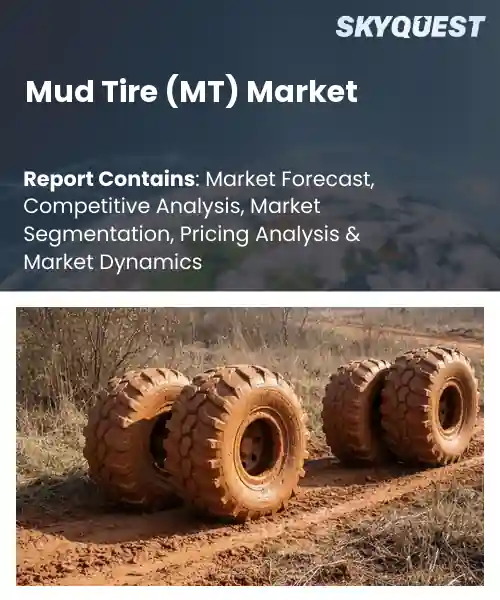
Mud Tire (MT) Market
Report ID: SQMIG25B2039
Report ID: SQMIG25B2039
[email protected]
USA +1 351-333-4748
Report ID:
SQMIG25B2039 |
Region:
Global |
Published Date: July, 2026
Pages:
157
|Tables:
173
|Figures:
79


Global Mud Tire (Mt) Market size was valued at USD 4.15 Billion in 2024 and is poised to grow from USD 4.35 Billion in 2025 to USD 6.33 Billion by 2033, growing at a CAGR of 4.8% during the forecast period (2026-2033).
The global mud‑tire market is about specialized tires meant to get the best traction on soft, wet, or uneven ground, and they matter a lot for construction, agriculture, and even recreational vehicle users. The whole point is simple, when normal tires start slipping in rain‑soaked quarries or in fields, productivity can drop fast, so mud tires help keep work moving, with less hassle.
On top of that, as the infrastructure base keeps expanding, one of the major factors driving mud‑tire market growth is the increasing need for dependable operation across changing weather. That pushes owners to lean toward durability, not just the lowest price. When heavy machines are used in soil that’s saturated or muddy, downtime risk goes up, so operators tend to select tires with self‑cleaning tread and reinforced sidewalls, sometimes people ignore it until the losses pile up. This choice can lower maintenance expense and also stretch the tires service life. There are examples, like a mining fleet in Brazil that switched to mud tires and then saw better haulage efficiency, and in Kenya, tractors that used tough compounds kept their planting routines running even through monsoons. Cases like these show that climate pressure opens market space, so manufacturers are speeding up work on stronger polymers plus improved design layouts.
AI-driven predictive maintenance is slowly turning mud tires from something that is pay for only after trouble begins, into a more proactive asset. Sensors tucked into the tire track things like temperature, pressure, vibration, and tread wear patterns, then machine‑learning models interpret that signal and flag early failure risks. That means operators can plan tire replacements before a puncture turns into an actual stop, so the machines stay on site longer and the surprise downtime gets reduced. It also helps adjust inflation levels in a way that fits the terrain, which can extend tread life and keep traction stable when conditions flip from dry patches to muddy ground. And once tire health data is linked into fleet management platforms, managers can see performance across many machines at once, making budgeting decisions more grounded and project timelines more reliable. In the end, this is reshaping procurement, buyers are starting to favor smarter tire solutions that promise a lower total cost of ownership, even if the initial purchase price feels higher.
Market snapshot - (2026-2033)
Global Market Size
USD 4.15 Billion
Largest Segment
Radial Mud Tires
Fastest Growth
Radial Mud Tires
Growth Rate
4.8% CAGR
To get more insights on this market click here to Request a Free Sample Report
The global mud tire (mt) market is segmented by tire design type, section width, rim diameter, vehicle type, propulsion type, sales channel and region. Based on tire design type, the market is segmented into Radial Mud Tires and Bias Mud Tires. Based on section width, the market is segmented into Less than 10.5 Inches, 10.5 to 12.5 Inches and More than 12.5 Inches. Based on rim diameter, the market is segmented into 15 Inches, 16 Inches, 17 Inches, 18 Inches, 20 Inches and Above 20 Inches. Based on vehicle type, the market is segmented into Pickup Trucks, SUVs, Crossovers, Light Commercial Trucks and Off-the-Road Vehicles. Based on propulsion type, the market is segmented into Internal Combustion Engine Vehicles and Electric Off-Road Vehicles. Based on sales channel, the market is segmented into Original Equipment Manufacturer and Aftermarket. Based on region, the market is segmented into North America, Europe, Asia Pacific, Latin America and Middle East & Africa.
As per the mud tire (mt) market analysis, the Radial mud tires segment dominates since they give that superior on road comfort thing , but still manage to keep an aggressive grip off road so it matches what most buyers expect from a versatile setup. Also their construction helps with heat shedding and tread steadiness, so it ends up with less wear when conditions are muddy and demanding. Manufacturers often push radial tech to satisfy durability and fuel efficiency needs, and that focus just keeps reinforcing its leadership inside product lines. It even sways buying decisions, both for brand new builds and those replacement cycles people do later.
On the other hand, the bias mud tires segment is seeing the strongest growth momentum , because newer tread pattern engineering delivers good self cleaning performance for harsh off road situations. That trait clicks with adventure minded drivers , and also with commercial operators who want grip without compromises. Because of that, adoption rates climb, and companies keep investing in innovation, which then expands the total market opportunity overall.
According to the mud tire (mt) market forecast, the Pickup trucks drive the market since they are the main application for mud tires , mixing high ground clearance with regular exposure to rough terrains. People like the idea that they can switch from work duties to recreational off road adventures , so OEMs are more likely to fit new models with tougher tire selections. This established demand steers production priorities , and it keeps steady orders moving in both original equipment and aftermarket sales.
Meanwhile , off-the-road vehicles are turning into the key high growth lane , because construction and mining fleets are growing to make sites more accessible. These operations lean on large deep tread tires that can take on extreme mud , and also rock hazards. So manufacturers are making more purpose built designs. And with more infrastructure investment, that pull keeps strengthening, opening up new opportunities in the market too.
To get detailed segments analysis, Request a Free Sample Report
As per the mud tire (mt) market regional forecast, Asia Pacific leans on a wide agricultural spread and this broad mix of difficult terrains, and it ends up creating steady need for top shelf off road solutions. There’s also a mature manufacturing setup with advanced rubber processing know how which helps teams move fast on product development, and keep production costs under control. Local automotive and heavy‑equipment manufacturers then push for rugged tire designs , so OEM partnerships stay strong. And then you’ve got infrastructure builds and mining work adding even more pressure for durable mud handling capabilities. On top of that, regional trade routes help move products efficiently across these emerging markets, so the area stays competitive and keeps its momentum in the mud tire space.
Japan Mud Tire (MT) Market
The Mud Tire (MT) sector in Japan benefits from a technical engineering culture that values precision and durability. Local producers for off‑road vehicles weave specialized tires into agricultural machines and construction equipment, which keeps demand fairly steady. There’s a clear emphasis on environmental results and newer tread compounds, and that lines up with regulatory expectations. Meanwhile a well‑built supply chain keeps things available quickly for both original equipment and aftermarket groups.
South Korea Mud Tire (MT) Market
The Mud Tire (MT) industry in South Korea is supported by a lively heavy‑industry landscape and a strong drive toward technological upgrades. Local firms put money into research, aiming to improve traction and boost wear resistance, for the country’s large mining and construction runs. When mud tires get integrated into export‑ready equipment platforms, it naturally expands the market reach, and ongoing teamwork between tire makers and equipment builders helps growth stay active in both home and overseas uses.
North America is seeing faster mud tire (mt) market penetration because construction activity keeps rolling, agriculture covers large areas, and off‑road recreation culture stays strong. Major tire manufacturers tap into advanced R&D centers to develop tread patterns and compound formulations that can handle the hardest performance expectations. Plus, distribution networks are solid, and aftermarket support is well developed, so adoption happens quickly across many users. Add in environmental stewardship efforts that push longer lasting, more fuel‑efficient tire solutions, and it has big equipment OEMs that keep integrating advanced mud tire technology into new vehicle platforms, without much delay.
United States Mud Tire (MT) Market
The Mud Tire (MT) Market in the United States is mainly supported by big farming organizations and large land development projects that demand dependable grip in soft and uneven ground. Domestic tire producers work closely with equipment manufacturers to tune solutions for different climatic conditions, not just one scenario. A strong aftermarket network then makes replacement and specialty products easier to obtain. And, the outdoor recreation lifestyle also keeps demand alive for high‑performance mud tires among off‑road fans.
Canada Mud Tire (MT) Market
The Mud Tire (MT) Market in Canada highlights the country’s wide natural resources sector plus seasonal agricultural needs. Companies focus on delivering tires that still perform well in colder, moisture heavy environments, with a strong attention to durability and safety. Tire suppliers partnering with forestry or mining equipment vendors helps deepen market penetration, and a well organized distribution system keeps products available in remote regions where the terrain challenges show up fast and often.
Europe keeps strengthening its mud tire (mt) market share by mixing, strict performance yardsticks, tougher environmental rules, and a long standing respect for engineering craftsmanship. Tire makers tend to push sustainable material usage plus advanced tread patterns that can cope with all ground, from the alpine slopes down to low land farming areas. Then there are the joint research drives, industry groups with universities in the same room, so innovation keeps moving without much pause.
Germany Mud Tire (MT) Market
In Germany, the Mud Tire (MT) market stands on a deep engineering legacy and a big heavy equipment manufacturing footprint. The whole sector leans into careful tire build quality, because construction and farming users want demanding safety and performance benchmarks met every time. Because German machinery producers are closely aligned, mud tires can be tuned for efficiency and durability, not just fitted and forgotten. And the export mindset is strong, so its reach doesn’t stop at domestic demand.
United Kingdom Mud Tire (MT) Market
The United Kingdom Mud Tire (MT) market gains traction from a patchwork landscape—extensive farmland, plus coastal construction areas. Companies usually focus on compound engineering, trying to balance bite, tread life, and that slightly unpredictable weather pattern. Working with off road vehicle specialists helps shape solutions for both commercial fleets and hobby or recreational riders. Add to that, a dependable distribution route, and the market access feels smoother across the region.
France Mud Tire (MT) Market
France’s Mud Tire (MT) market is basically pulled forward by active agriculture and continuous infrastructure work. Tire manufacturers concentrate on traction for soft ground, while still sticking to environmental requirements. Partnerships with French equipment makers also help mud tire tech slot neatly into many machinery types. Finally, a well developed aftermarket keeps supply steady and support available for the end users, even when demand shifts.
To know more about the market opportunities by region and country, click here to
Buy The Complete Report
Drivers
Expanding Off‑Road Construction Projects
Increasing Adoption of Mud‑Tread Technology
Restraints
High Initial Cost of Mud Tires
Limited Availability of Specialized Service Centers
Request Free Customization of this report to help us to meet your business objectives.
The competitive landscape is shaped by old tire giants expanding their mud‑terrain lineups while, also making partnerships with off‑road vehicle makers and putting money into lighter tread mixtures; Goodyear just rolled out a high‑traction MT line, co‑developed with a well known 4×4 brand, while Falken pushed faster product rollouts via a joint venture with a big aftermarket distributor, so it highlights that mergers and tech‑driven collaborations are major market drivers or something like that.
Top Player’s Company Profile
Recent Developments in the Mud Tire (MT) Market
SkyQuest’s ABIRAW (Advanced Business Intelligence, Research & Analysis Wing) is our Business Information Services team that Collects, Collates, Correlates, and Analyses the Data collected by means of Primary Exploratory Research backed by robust Secondary Desk research.
As per SkyQuest analysis, the global mud tire market is projected to keep growing. The main push is coming from off-road construction projects that need durable traction in muddy terrain, and then there’s a second catalyst, which is the growing adoption of AI enabled predictive maintenance systems. That helps by lowering total ownership cost and also improving reliability. Still, the growth isn’t fully smooth because specialized mud tires can come with a high upfront price, and that slows down price sensitive buyers, especially in emerging economies where budgets are tighter. Asia Pacific is leading overall, mainly due to its large agricultural base, a strong manufacturing ecosystem, and steady demand for heavy equipment. Radial mud tires remain the dominant product category, since they give superior comfort and tread stability across both OEM and aftermarket channels.
| Report Metric | Details |
|---|---|
| Market size value in 2024 | USD 4.15 Billion |
| Market size value in 2033 | USD 6.33 Billion |
| Growth Rate | 4.8% |
| Base year | 2024 |
| Forecast period | (2026-2033) |
| Forecast Unit (Value) | USD Billion |
| Segments covered |
|
| Regions covered | North America (US, Canada), Europe (Germany, France, United Kingdom, Italy, Spain, Rest of Europe), Asia Pacific (China, India, Japan, Rest of Asia-Pacific), Latin America (Brazil, Rest of Latin America), Middle East & Africa (South Africa, GCC Countries, Rest of MEA) |
| Companies covered |
|
| Customization scope | Free report customization with purchase. Customization includes:-
|
To get a free trial access to our platform which is a one stop solution for all your data requirements for quicker decision making. This platform allows you to compare markets, competitors who are prominent in the market, and mega trends that are influencing the dynamics in the market. Also, get access to detailed SkyQuest exclusive matrix.
Table Of Content
Executive Summary
Market overview
Parent Market Analysis
Market overview
Market size
KEY MARKET INSIGHTS
COVID IMPACT
MARKET DYNAMICS & OUTLOOK
Market Size by Region
KEY COMPANY PROFILES
Methodology
For the Mud Tire (MT) Market, our research methodology involved a mixture of primary and secondary data sources. Key steps involved in the research process are listed below:
1. Information Procurement: This stage involved the procurement of Market data or related information via primary and secondary sources. The various secondary sources used included various company websites, annual reports, trade databases, and paid databases such as Hoover's, Bloomberg Business, Factiva, and Avention. Our team did 45 primary interactions Globally which included several stakeholders such as manufacturers, customers, key opinion leaders, etc. Overall, information procurement was one of the most extensive stages in our research process.
2. Information Analysis: This step involved triangulation of data through bottom-up and top-down approaches to estimate and validate the total size and future estimate of the Mud Tire (MT) Market.
3. Report Formulation: The final step entailed the placement of data points in appropriate Market spaces in an attempt to deduce viable conclusions.
4. Validation & Publishing: Validation is the most important step in the process. Validation & re-validation via an intricately designed process helped us finalize data points to be used for final calculations. The final Market estimates and forecasts were then aligned and sent to our panel of industry experts for validation of data. Once the validation was done the report was sent to our Quality Assurance team to ensure adherence to style guides, consistency & design.
Analyst Support
Customization Options
With the given market data, our dedicated team of analysts can offer you the following customization options are available for the Mud Tire (MT) Market:
Product Analysis: Product matrix, which offers a detailed comparison of the product portfolio of companies.
Regional Analysis: Further analysis of the Mud Tire (MT) Market for additional countries.
Competitive Analysis: Detailed analysis and profiling of additional Market players & comparative analysis of competitive products.
Go to Market Strategy: Find the high-growth channels to invest your marketing efforts and increase your customer base.
Innovation Mapping: Identify racial solutions and innovation, connected to deep ecosystems of innovators, start-ups, academics, and strategic partners.
Category Intelligence: Customized intelligence that is relevant to their supply Markets will enable them to make smarter sourcing decisions and improve their category management.
Public Company Transcript Analysis: To improve the investment performance by generating new alpha and making better-informed decisions.
Social Media Listening: To analyze the conversations and trends happening not just around your brand, but around your industry as a whole, and use those insights to make better Marketing decisions.
REQUEST FOR SAMPLE
 REQUEST FREE CUSTOMIZATION
Global Mud Tire (Mt) Market size was valued at USD 4.15 Billion in 2024 and is poised to grow from USD 4.35 Billion in 2025 to USD 6.33 Billion by 2033, growing at a CAGR of 4.8% during the forecast period (2026-2033).
The competitive landscape is shaped by established tire manufacturers expanding mud‑terrain portfolios while forging partnerships with off‑road vehicle makers and investing in lightweight tread compounds; Goodyear recently launched a high‑traction MT line co‑developed with a leading 4×4 brand, and Falken accelerated product rollout through a joint venture with a major aftermarket distributor, underscoring M&A and tech‑focused collaborations as key market drivers. 'The Goodyear Tire & Rubber Company', 'Compagnie Générale des Établissements Michelin', 'Bridgestone Corporation', 'Continental AG', 'The Yokohama Rubber Co., Ltd.', 'Toyo Tire Corporation', 'Hankook Tire & Technology Co., Ltd.', 'Kumho Tire Co., Inc.', 'Pirelli & C. S.p.A.', 'Sumitomo Rubber Industries, Ltd.', 'Maxxis International', 'Nokian Tyres plc', 'Cooper Tire & Rubber Company', 'Giti Tire Pte. Ltd.', 'Sailun Group Co., Ltd.', 'Linglong Tire Co., Ltd.', 'Zhongce Rubber Group Co., Ltd.', 'Atturo Tyre', 'Federal Corporation', 'Nitto Tire U.S.A. Inc.'
The surge in off‑road construction activities, such as mining, quarrying, and infrastructure development in remote areas, creates a persistent need for durable tires capable of navigating uneven, muddy terrains. Manufacturers respond by introducing advanced mud‑tread designs that enhance traction and longevity, encouraging contractors to select specialized tires for increased operational efficiency. This alignment between project requirements and product innovation fuels market expansion as users prioritize reliability and reduced downtime in challenging environments. Moreover, the ability of these tires to maintain performance under weather conditions solidifies their proposition for managers seeking dependable solutions.
Off-Road Vehicle Demand Surge: Rising popularity of recreational off‑road activities and expansion of construction projects in remote regions are driving robust demand for mud tires. Consumers seek enhanced traction and durability for challenging terrains, prompting manufacturers to introduce versatile designs that balance performance and comfort. This trend is further reinforced by growing interest in adventure tourism, where reliable mud‑treaded tires become essential for safety and mobility, expanding the market beyond traditional agricultural and mining applications and supporting broader economic development in emerging regions globally.
Why does Asia Pacific Dominate the Global Mud Tire (MT) Market? |@12


Want to customize this report? This report can be personalized according to your needs. Our analysts and industry experts will work directly with you to understand your requirements and provide you with customized data in a short amount of time. We offer $1000 worth of FREE customization at the time of purchase.
Feedback From Our Clients


 USA (+1) 351-333-4748

