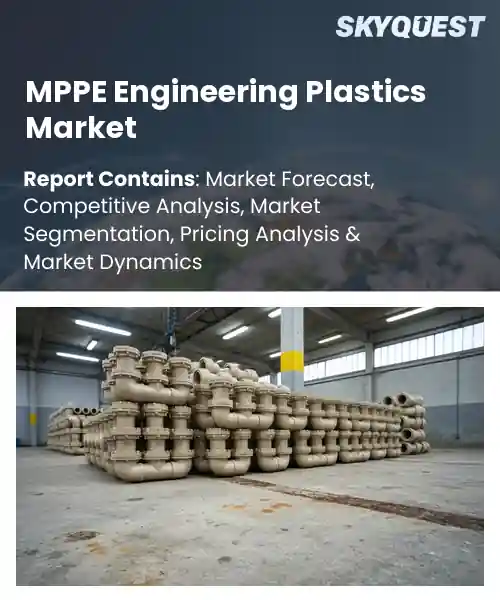
MPPE Engineering Plastics Market
Report ID: SQMIG15E3301
Report ID: SQMIG15E3301
[email protected]
USA +1 351-333-4748
Report ID:
SQMIG15E3301 |
Region:
Global |
Published Date: February, 2026
Pages:
157
|Tables:
119
|Figures:
77


Global MPPE Engineering Plastics Market size was valued at USD 1.4 Billion in 2024 and is poised to grow from USD 1.51 Billion in 2025 to USD 2.78 Billion by 2033, growing at a CAGR of 7.9% during the forecast period (2026-2033).
The global market is experiencing gradual growth, caused by the increase in demand for high-performance polymers in various industrial sectors. MPPE (Modified Polyphenylene Ether) engineering plastics are prized for their use as advanced manufacturing products due to their exceptional thermal stability, chemical resistance, dimensional stability, and good mechanical properties. These materials can be found in automotive parts, electrical and electronic products, industrial equipment, and consumer products where durability and heat-resistance are critical. The increased emphasis on using lightweight materials in the automotive industry to improve fuel economy and reduce vehicle emissions helps the market continue to grow.
Equally important is the rapid increase in demand for MPPE engineering plastics due to the continued rise of the electronics industry and the growing number of hybrid and electric vehicles will drive the demand for MPPE engineering plastics due to their ability to tolerate extreme heat levels and provide reliable electrical insulation. Manufacturers are also focusing on producing specialty grades of MPPE engineering plastics to comply with stringent safety and performance requirements across different industries; for example, flame retardant and glass fiber reinforced, respectively.
How is AI Enhancing Product Development in the MPPE Engineering Plastics Market?
AI is reshaping product development in the MPPE engineering plastics industry by accelerating material discovery and compressing experimental cycles. Key aspects are AI driven formulation optimization that screens additives and polymer blends, predictive modeling of thermal and mechanical behavior, and virtual prototyping using digital twins to validate parts before tooling. In a market that prizes heat resistance and dimensional stability for automotive and electronics, these tools let engineers explore bespoke grades faster. Examples include generative models proposing novel compositions and machine learning systems predicting processing windows, which make research and development more exploratory and reduce costly iteration.
Market snapshot - (2026-2033)
Global Market Size
USD 1.4 Billion
Largest Segment
Polyamide
Fastest Growth
Polycarbonate
Growth Rate
7.9% CAGR
To get more insights on this market click here to Request a Free Sample Report
Global MPPE engineering plastics market is segmented into product type, formulation type, application, end-user industry and region. Based on product type, the market is segmented into polycarbonate, polyamide, polyethylene terephthalate, and others. Based on formulation type, the market is segmented into reinforced plastics and unreinforced plastics. Based on application, the market is segmented into structural components, packaging solutions, consumer goods and others. Based on end-user industry, the market is segmented into automotive, electrical & electronics, construction and others. Based on region, the market is segmented into North America, Europe, Asia Pacific, Latin America and Middle East & Africa.
As per MPPE engineering plastics market outlook, polycarbonate segment leads because its intrinsic combination of high impact resistance, optical clarity and thermal stability enables designers to replace heavier materials in demanding structural applications within the market. These properties provide designers with a way to create parts that are less likely to fail and provide longer service lives, thus encouraging OEMs to specify polycarbonate for load bearing and safety critical parts. This increased use has led to a wider range of products being developed using polycarbonate by manufacturers and engineering companies. As per MPPE engineering plastics market analysis, the fastest growing product in the market is polyamide because of its superior chemical resistance, fatigue performance and ability to be engineered and molded into many types of parts. As low moisture-absorption grades are developed, the application range for polyamide will continue to expand, providing engineers and manufacturers with new design options and accelerating the demand for polyamide in industries where durable, high-performance products are needed.
The reinforced plastics market leads the segment with large MPPE engineering plastics market share in the amount of structural component strength, from increased rigidity, strength, and dimensional stability from the addition of either glass or mineral reinforcements to each level of the segment. All of these factors will enable reduced weight and thinner walls while meeting demanding mechanical specifications, driving designer interest and use by the masses.
As per MPPE engineering plastics market forecast, unreinforced plastics have been the most rapidly increasing segment in MPPC engineering plastics as manufacturers continue to search for lightweight, cost-effective alternatives using lightweight, high-performance unmodified grade all-grade resins. The rapid improvement of resin chemistry and processing technology has reduced variability in the products produced while increasing the range of temperatures that can be used in the design and manufacture of the parts and products. New opportunities have been created through the opening of these applications, including lower-cost, higher-volume production methods.
To get detailed segments analysis, Request a Free Sample Report
As per MPPE engineering plastics industry analysis, the MPPE engineering plastics market is dominated by the Asia Pacific region (APAC) due to its concentrated manufacturing capabilities, extensive supplier networks, and applications focused on demand from key industries. The combination of significant automotive and electronic cluster operations in the region that depend on high-performance polymers for lightweighting and thermal stability creates a significant regional advantage. One of the advantages of these established supply chains is that they provide integrated value chains, which lower lead times and support the efficient scale-up of specialty grades. The combination of competitive production costs, as well as targeted innovation programs, encourages local development and customization of formulations.
In Japan, the MPPE engineering plastics market benefits from advanced materials research, precision manufacturing capabilities, and close ties with leading automotive and electronics manufacturers. The local companies produce and develop high-quality products that are intended to meet demanding thermal and mechanical applications by producing and developing specialty formulations. There is also an emphasis on material reliability to support the safe use of MPPE engineering plastics in safety-critical applications. This has led to strong relationships between compounders and equipment manufacturers, which drive incremental innovation for custom solutions designed to meet the needs of sophisticated domestic supply chain ecosystems.
MPPE engineering plastics market in South Korea is driven by an export-oriented electronics and automotive manufacturing base, intensive application development, and agile compounder networks. Products made with these materials are continually developed to meet changing demands such as increased thermal management or miniaturization, which results in customised polymer grades and close cooperation between component manufacturers and polymer compounders. Although South Korea's government is providing assistance to accelerate product qualification and develop competitive application-specific offerings to the domestic and international supply chain ecosystems through collaboration between polymer material suppliers and design teams.
There is significant MPPE engineering plastics market growth for multi-purpose plastic engineering (MPPE) in Europe as a result of regulatory pressures for food production efficiency, increasing expectation for sustainability in manufacturing processes, and the continued growth of the automotive and industrial sectors requiring advanced levels of engineered products, as well as an emphasis on recyclable materials with long-lasting life cycles. This growth has resulted in many opportunities for companies in the MPPE engineering plastics market to work collaboratively with research institutions and manufacturers to create custom grades of materials by leveraging their research and development capabilities based on their deep technical expertise.
The MPPE engineering plastics market in Germany is primarily driven by its extensive industrial and automotive manufacturing base, its breadth and depth of engineering expertise across multiple disciplines, and the strong relationships established between polymer material suppliers and OEMs. In addition, the emphasis placed on precision engineering and durability is driving increasing demand for specialized formulated polymers. The established infrastructure for testing and certification supports rapid qualification of critical components in the marketplace and allows for localized relationships between compounders and research centers to develop custom solutions that meet advanced performance and sustainability requirements for both the industrial and mobility sectors.
As per MPPE engineering plastics market forecast, the market in the UK is primarily benefiting from its robust engineering services industry, niche boutiques that create custom polymers and lighter-weight but higher-performance components for the automotive and aerospace industries. The emphasis placed on designing performance and collaborating with technology consultants has enabled rapid prototyping and application testing.
MPPE engineering plastic market in France has many exciting new developments, collaborative research partnerships, and an increasing rate of use of the plastic in mobility and renewable Energy uses. Engineers and compounders are focused on developing materials with high acclamations for functional performance and being recyclable; during this phase of accelerated development, they also have quick access to receiving evaluation for their advanced componentry products. In order to facilitate the development from prototype through production, the creation of an ecosystem of incubators and specialized converters will improve design efficility and product development process. The emphasis of meeting requirements for sustainability when developing new application specific polymer materials, the capacity of the French manufacturing sector to meet these operational goals will grow.
As per MPPE engineering plastics market outlook, the rise of advanced manufacturing investments combined with application-specific development coupled with increased cooperation between material suppliers and original equipment manufacturers are enabling North America to solidify its foothold in the market. With the intense focus on innovating greater durability and thermal resistance in high-performance polymers using research and development along with the rigorous qualification of these materials provides North America with regional competitive advantages. The increasing use of strategic partnerships between Compounders, Processors and End Users to achieve technology readiness will yield advancements in implementation cycles for new technologies. The increased emphasis ever towards sustainability along with localized supply continuity will strengthen North America’s regional resilience. Newer service-based business models coupled with specialized processing knowledge will allow Material Suppliers to provide complete engineered solutions for their customers in strategic industries such as mobility, aerospace, and industrial equipment. The partnership between material suppliers and university research centers creates a highly skilled technical workforce which results in greater material development innovation and more efficient processing practices.
There is a high concentration of resources available for the market in the United States due to several original equipment manufacturers (OEMs), testing/qualification pathwaysand the ability to engineer complex parts. Durability, thermal management, and part consolidation are the major driving factors of demand for customized polymer grades. Material suppliers, processors and end-users working together shorten the time it takes to develop new applications, while manufacturers’ investment in U.S.-based processing capabilities and circular materials programs build supply chain credibility and support the expansion of these products to mobility and aerospace platforms.
Accessibility to raw material sources, a well-qualified engineering workforce and diverse relationships with regional OEMs and processors play a big part in the ability of the MPPE Engineering Market in Canada to compete effectively. Due to the regional suppliers’ emphasis on sustainable materials and advanced composites, regional compounders are well-positioned to serve niche markets for mobility and industrial applications. Additionally, pilot facilities and collaboration with academic institutions are enabling the commercialization of grades, while the emphasis on reliable supply chains and eco-friendly end products is prompting manufacturers to adopt MPPE materials that contribute to durability and overall product lifecycle.
To know more about the market opportunities by region and country, click here to
Buy The Complete Report
Growing Automotive Applications
Increasingly, automotive manufacturers are utilizing MPPE (modified polyphenylene ether) engineering plastics to achieve lightweight design, structural integrity and thermal stability which improves fuel economy and provides a foundation for electrification platforms. MPPE offers a unique combination of stiffness, impact strength and processing flexibility allowing automotive engineers to eliminate heavy metal parts and replace complex, multi-part assemblies with a single component. As automotive manufacturers are moving towards standardized high-performance polymers, suppliers enjoying extended development time will result in stable demand and lead to further investment in customized grades. The ongoing use of high-performance polymers in powertrain, interior, and exterior automotive components support MPPE engineering plastics market growth through an increase in the number and depth of applications.
Increased Demand for Medical Devices
Medical device manufacturers have been moving towards MPPE engineering plastics. MPPE helps reduce the complexity of assembling medical devices and increases reliability due to their ability to survive multiple sterilization cycles, retain dimensional stability after repeated temperature changes and having the capabilities of creating intricate, miniature products with precision molding. Medical device manufacturing suppliers are looking for materials that will guarantee patients' safety and offer designers more options, leading to accelerated qualification and adoption of MPPE materials in manufacturing. As clinical applications continue to expand and diversify, the proven performance characteristics of MPPE will allow for greater procurement efforts and ensure long-term market demand for highly specialized polymer grades.
High Raw Material Volatility
Manufacturers cannot produce MPPE at a consistent level, which leads to longer lead times and less responsiveness to the demands of customers due to fluctuations in feedstock supplies and issues with supply chains for petrochemicals. Suppliers are creating more complex procurement processes as they work with alternative sources of supply and manage risks to their contracts, thereby redirecting resources away from designing new products. Unpredictable input conditions also make it difficult for processors to plan and expand capacity, leading to some processors being hesitant to make large investments. Operational pressures can negatively impact overall market momentum by limiting throughput, increasing potential cost risks for buyers, and delaying adoption of products more broadly.
Stricter Environmental Regulations
Increasing levels of scrutiny regarding the end-of-life management of MPPE Engineering Plastics, along with evolving levels of environmental regulation, are creating increased levels of compliance for producers and downstream users. Through requirements for recyclability and reporting, as well as additional levels of extended producer responsibility, producers are having to reformulate their products and adapt their production and recycling processes to accommodate these new requirements. The additional levels of time and cost result in longer product development cycles. Smaller manufacturers may find the administrative and technical requirements to comply with evolving environmental laws especially difficult, causing them to slow down new product introduction and making it more difficult for buyers to transition from traditional materials to tested and proven circular materials.
Request Free Customization of this report to help us to meet your business objectives.
Market competition in MPPE engineering plastics globally is highly concentrated and driven by technology differentiation (e.g., Asahi Kasei’s XYRON mPPE rollout for telecommunications, Asahi Kasei's use of mPPE to develop 3D printing filament) and by forming partnerships to supply, together with significant moves within their strategic portfolios that alter supplier power (e.g., SABIC's historical acquisition strategy and its recent specialty asset restructuring).
Circular Economy Adoption: Closed loop product strategies becoming increasingly widespread and thus raising the demand for high-quality MPPE grades that promote reuse, reparability, and being made with recycled content as a good-quality option for recycled materials. Manufacturers are partnering with recovery companies to create traceable materials streams and design products that are easy to disassemble and still meet required engineering performance specifications.
Integration of Additive Manufacturing with Additives: As more companies are using additive manufacturing to produce parts industrially, suppliers are developing new MPPE formulations to utilize in layer processing, have dimensional stability, and provide functionality. Suppliers are focusing on developing MPPE grades able to produce complex geometry with the least amount of assembly, and integrated functionality while still maintaining mechanical/thermal properties.
SkyQuest’s ABIRAW (Advanced Business Intelligence, Research & Analysis Wing) is our Business Information Services team that Collects, Collates, Correlates, and Analyses the Data collected by means of Primary Exploratory Research backed by robust Secondary Desk research.
As per SkyQuest analysis, the global MPPE engineering plastics market continues to be heavily driven by the demand for lightweight, and enhanced thermal performance. Electrification and stricter safety and emissions requirements provide significant secondary growth drivers. Growth remains concentrated in the Asia-Pacific region where dense manufacturing clusters and local supply chains support growth; furthermore, reinforced plastics remain the leading segment within the overall Market due to the benefits of glass & mineral fillers for providing stiffness and thermal stability needed for structural parts. In addition, raw material price volatility remains a major restraint on the continued development of new supply chains; thus, affecting both the supply of MPPEs/products and the cost of future investment and long-term planning due to the uncertainty surrounding supply chain development despite clear application opportunities in both automotive and electronics.
| Report Metric | Details |
|---|---|
| Market size value in 2024 | USD 1.4 Billion |
| Market size value in 2033 | USD 2.78 Billion |
| Growth Rate | 7.9% |
| Base year | 2024 |
| Forecast period | (2026-2033) |
| Forecast Unit (Value) | USD Billion |
| Segments covered |
|
| Regions covered | North America (US, Canada), Europe (Germany, France, United Kingdom, Italy, Spain, Rest of Europe), Asia Pacific (China, India, Japan, Rest of Asia-Pacific), Latin America (Brazil, Rest of Latin America), Middle East & Africa (South Africa, GCC Countries, Rest of MEA) |
| Companies covered |
|
| Customization scope | Free report customization with purchase. Customization includes:-
|
To get a free trial access to our platform which is a one stop solution for all your data requirements for quicker decision making. This platform allows you to compare markets, competitors who are prominent in the market, and mega trends that are influencing the dynamics in the market. Also, get access to detailed SkyQuest exclusive matrix.
Table Of Content
Executive Summary
Market overview
Parent Market Analysis
Market overview
Market size
KEY MARKET INSIGHTS
COVID IMPACT
MARKET DYNAMICS & OUTLOOK
Market Size by Region
KEY COMPANY PROFILES
Methodology
For the MPPE Engineering Plastics Market, our research methodology involved a mixture of primary and secondary data sources. Key steps involved in the research process are listed below:
1. Information Procurement: This stage involved the procurement of Market data or related information via primary and secondary sources. The various secondary sources used included various company websites, annual reports, trade databases, and paid databases such as Hoover's, Bloomberg Business, Factiva, and Avention. Our team did 45 primary interactions Globally which included several stakeholders such as manufacturers, customers, key opinion leaders, etc. Overall, information procurement was one of the most extensive stages in our research process.
2. Information Analysis: This step involved triangulation of data through bottom-up and top-down approaches to estimate and validate the total size and future estimate of the MPPE Engineering Plastics Market.
3. Report Formulation: The final step entailed the placement of data points in appropriate Market spaces in an attempt to deduce viable conclusions.
4. Validation & Publishing: Validation is the most important step in the process. Validation & re-validation via an intricately designed process helped us finalize data points to be used for final calculations. The final Market estimates and forecasts were then aligned and sent to our panel of industry experts for validation of data. Once the validation was done the report was sent to our Quality Assurance team to ensure adherence to style guides, consistency & design.
Analyst Support
Customization Options
With the given market data, our dedicated team of analysts can offer you the following customization options are available for the MPPE Engineering Plastics Market:
Product Analysis: Product matrix, which offers a detailed comparison of the product portfolio of companies.
Regional Analysis: Further analysis of the MPPE Engineering Plastics Market for additional countries.
Competitive Analysis: Detailed analysis and profiling of additional Market players & comparative analysis of competitive products.
Go to Market Strategy: Find the high-growth channels to invest your marketing efforts and increase your customer base.
Innovation Mapping: Identify racial solutions and innovation, connected to deep ecosystems of innovators, start-ups, academics, and strategic partners.
Category Intelligence: Customized intelligence that is relevant to their supply Markets will enable them to make smarter sourcing decisions and improve their category management.
Public Company Transcript Analysis: To improve the investment performance by generating new alpha and making better-informed decisions.
Social Media Listening: To analyze the conversations and trends happening not just around your brand, but around your industry as a whole, and use those insights to make better Marketing decisions.
REQUEST FOR SAMPLE
 REQUEST FREE CUSTOMIZATION
Global Mppe Engineering Plastics Market size was valued at USD 1.4 Billion in 2024 and is poised to grow from USD 1.51 Billion in 2025 to USD 2.78 Billion by 2033, growing at a CAGR of 7.9% during the forecast period (2026-2033).
Competition in the global mPPE engineering plastics market is highly concentrated and driven by technology differentiation, supply partnerships and strategic portfolio moves that alter supplier power. Asahi Kasei’s XYRON mPPE grade rollouts for telecoms and its expansion into mPPE 3D printing filaments exemplify product innovation, while SABIC’s historical acquisitions and recent specialty asset restructuring show consolidation and divestiture shaping competitive positioning. 'BASF SE', 'DuPont de Nemours, Inc.', 'SABIC', 'Covestro AG', 'Celanese Corporation', 'RTP Company', 'Solvay S.A.', 'Mitsubishi Chemical Corporation', 'LANXESS AG', 'Eastman Chemical Company', 'Teijin Limited', 'Arkema S.A.', 'LyondellBasell Industries N.V.', 'Huntsman Corporation', 'Evonik Industries AG', 'Polyscope Polymers', 'Asahi Kasei Corporation', 'Borealis AG', 'INEOS Group', 'Kraton Corporation'
Automotive manufacturers increasingly specify MPPE engineering plastics for lightweighting, structural integrity, and thermal stability, which enhances fuel efficiency and supports electrification platforms. The material’s combination of stiffness, impact resistance, and processing versatility enables designers to replace heavier metals and multi-component assemblies, simplifying production and reducing part counts. Suppliers benefit from longer development cycles as automakers standardize on high-performance polymers, creating stable demand and encouraging investment in tailored grades. This sustained adoption across powertrain, interior, and exterior components directly supports market expansion through broader application penetration.
Circular Economy Adoption: Growing emphasis on closed-loop product strategies is driving demand for MPPE grades that support reuse, reparability and high-quality recyclate incorporation. Manufacturers are partnering with recovery firms to ensure traceable material streams and to design parts for disassembly while maintaining engineering performance. Brand owners prioritize polymers that can meet life-cycle expectations and enable product-as-a-service business models, prompting suppliers to develop formulations optimized for multiple reuse cycles, consistent properties, and compatibility with existing processing platforms to secure long-term material sourcing.
Why does Asia Pacific Dominate the Global MPPE Engineering Plastics Market? |@12


Want to customize this report? This report can be personalized according to your needs. Our analysts and industry experts will work directly with you to understand your requirements and provide you with customized data in a short amount of time. We offer $1000 worth of FREE customization at the time of purchase.
Feedback From Our Clients


 USA (+1) 351-333-4748

