Moulding Maize Starch Market
Report ID: SQMIG30I2887
Report ID: SQMIG30I2887
[email protected]
USA +1 351-333-4748
Report ID:
SQMIG30I2887 |
Region:
Global |
Published Date: March, 2026
Pages:
157
|Tables:
117
|Figures:
77


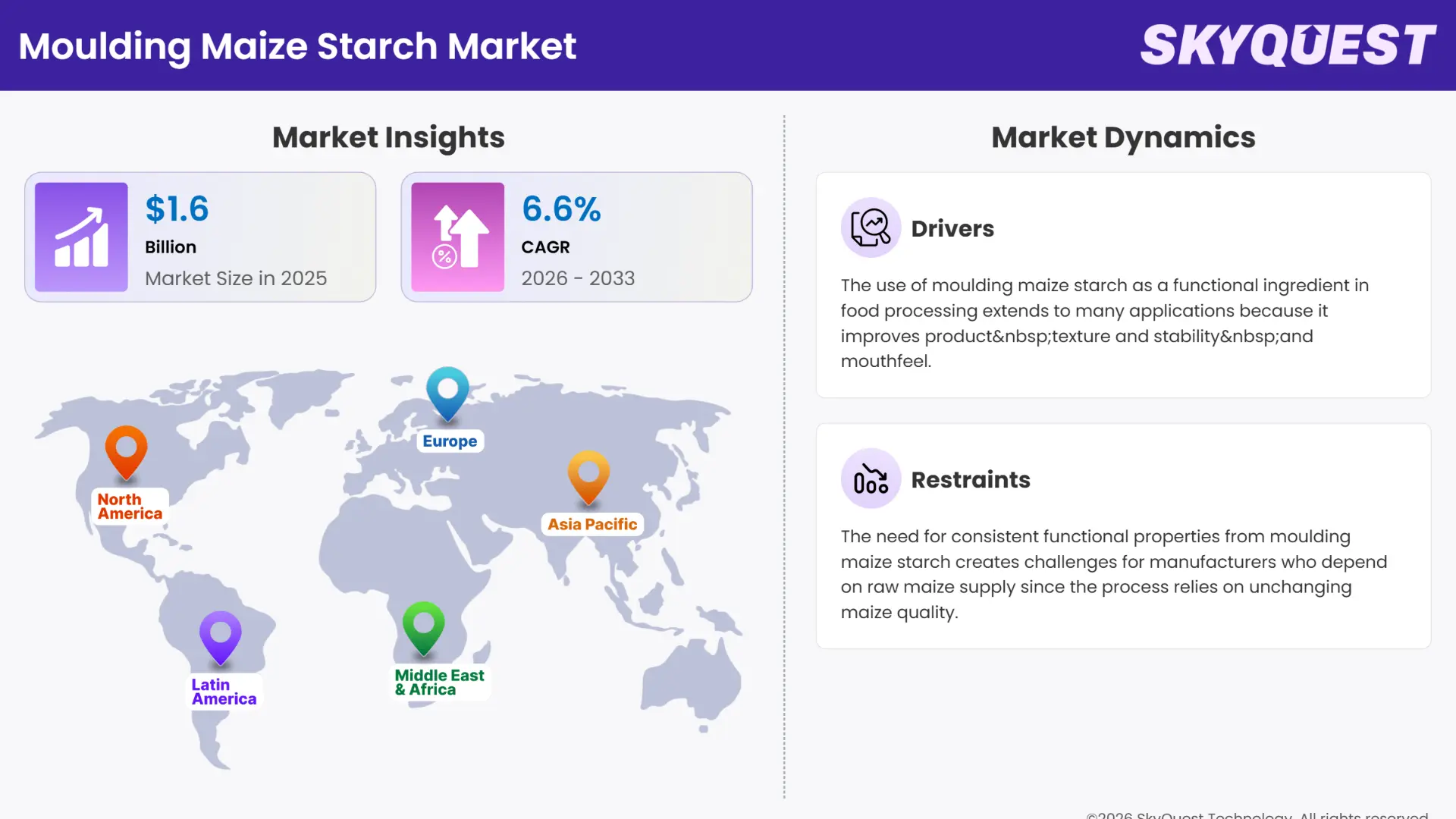
Global Moulding Maize Starch Market size was valued at USD 1.5 Billion in 2024 and is poised to grow from USD 1.6 Billion in 2025 to USD 2.67 Billion by 2033, growing at a CAGR of 6.6% during the forecast period (2026-2033).
Key Takeaways: Market Trends & Insights
The global moulding maize starch market growth is driven because two main factors drive its growth through increasing environmental regulations and community demand for eco-friendly materials. The market includes thermoplastic maize starch formulations which manufacturers process through injection and extrusion and compression moulding methods to produce compostable cutlery and packaging trays and seedling pots. The replacement of petroleum-based single-use plastics with alternative materials leads to reduced emissions throughout their product lifecycle which helps retailers and foodservice chains to establish circular economy practices for their supply chain operations.
European and North American and Asian manufacturing facilities developed from pilot projects to full commercial operations through advanced materials which included modified starches and polymer blends that improved heat resistance and mechanical strength of their products.
In addition, the global moulding maize starch market penetration depends on cost parity which manufacturers achieve through their process optimization and their ability to produce products at lower costs when their production volume increases. The production decrease leads to lower costs which enables brand owners to switch from traditional trays and cutlery to compostable alternatives without incurring substantial price differences which results in increased availability of bio-based SKUs from retailers.
The combination of PLA-starch blends and hydrophobic coatings creates materials that maintain their performance in both moisture resistance and mechanical durability which serves as suitable substitutes for traditional plastics used in chilled food packaging and takeaway containers. The technical and economic developments lead to increased maize processing requirements which result in bioplastic production facilities receiving investments and regulatory frameworks acquiring support from authorities worldwide.
How is AI Enhancing Production Efficiency in the Moulding Maize Starch Market?
The moulding maize starch market outlook changes from AI which improves its operational performance by linking data-driven process control with material science through its current system. The project uses three advanced techniques which include machine learning-based recipe creation and computer vision-based quality inspection and equipment maintenance which predicts future breakdowns. The present-day market demands biodegradable molded components while companies need dependable performance at reduced waste and energy consumption rates. Digital twins and sensors enable plants to optimize extrusion and drying processes through real-time adjustments which result in faster product development times and better production outcomes. The project uses visual systems to identify surface defects before packaging while the algorithms recommend formula changes which enable strength and compostabilityrequirements to be achieved.
To get more insights on this market click here to Request a Free Sample Report
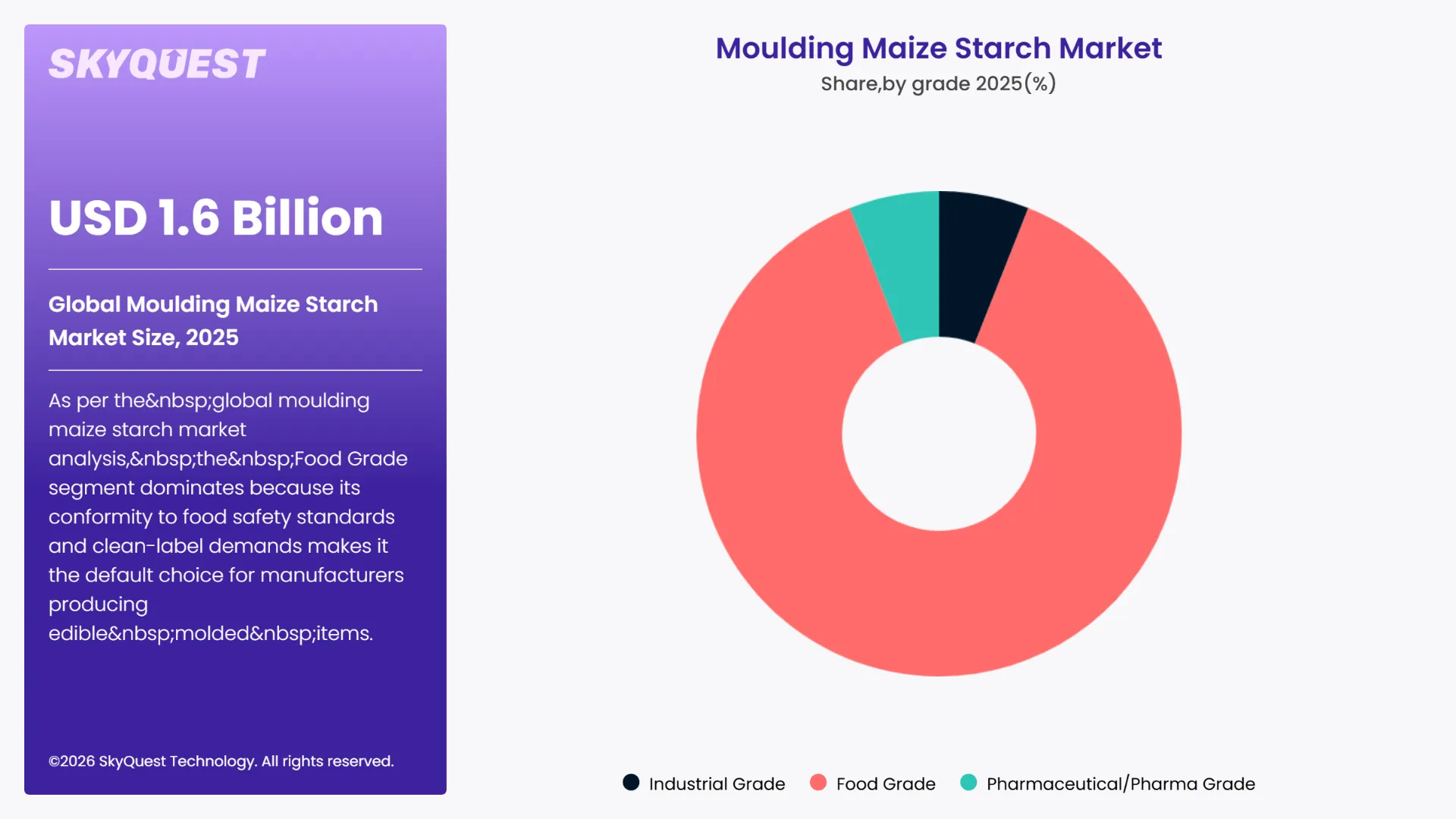
The global moulding maize starch market is segmented based on grade, functional properties, application industry, physical form, and region. By grade, the market is categorized into industrial grade, food grade, and pharmaceutical (pharma) grade. In terms of functional properties, it includes binding and adhesion agents, thickening and gelling agents, and anti-caking or mould release agents. Based on application industry, the market covers confectionery, paper and corrugated board manufacturing, textile sizing, and foundry and metallurgy. By physical form, the market is divided into powdered starch and modified or pregelatinized starch. Regionally, the market is analyzed across North America, Europe, Asia Pacific, Latin America, and the Middle East & Africa.
As per the global moulding maize starch market analysis, the Food Grade segment dominates because its conformity to food safety standards and clean-label demands makes it the default choice for manufacturers producing edible molded items. The product provides two benefits through its custom purity and stable functional performance which results in fast regulatory approval and reduced product reformulation needs. Food grade maize starch becomes the preferred choice because it fulfills consumer safety requirements and enables manufacturers to demonstrate product reliability while complying with regulations at an affordable price.
However, the Pharmaceutical/Pharma Grade market experiences its most rapid expansion because producers demand high purity starch used in manufacturing tablet binders and capsule coatings and controlled-release drug delivery systems. The increasing focus on safe excipient use together with pharmaceutical industry modernization and new formulation technologies will lead to higher excipient adoption rates and the development of new excipient applications which will drive suppliers to establish validated supply chains that produce specialized ingredient grades.
According to the global moulding maize starch market forecast, the binding and adhesion agent segment leads because manufacturers use its properties to create products which achieve reliable interparticle cohesion and surface adhesion properties which determine their molded part integrity and production yield. The product improves green strength and adhesion to tooling which reduces failures through cracking and rejects and cycle variability while it enables better process control and consistent finishing of downstream products. Manufacturers use binding functionality as their main processing method which helps them decrease scrap products while using complex geometries to increase their manufacturing capability.
Whereas the Anti-caking/Mould Release Agent segment is predicted to have the largest moulding maize starch market share because processors need better methods for demolding which requires less lubricant and produces better surface finishes during automated manufacturing. The industry adopts modified starches which offer effective product release capabilities because they develop new methods for high-speed production that meet environmental manufacturing standards.
To get detailed segments analysis, Request a Free Sample Report
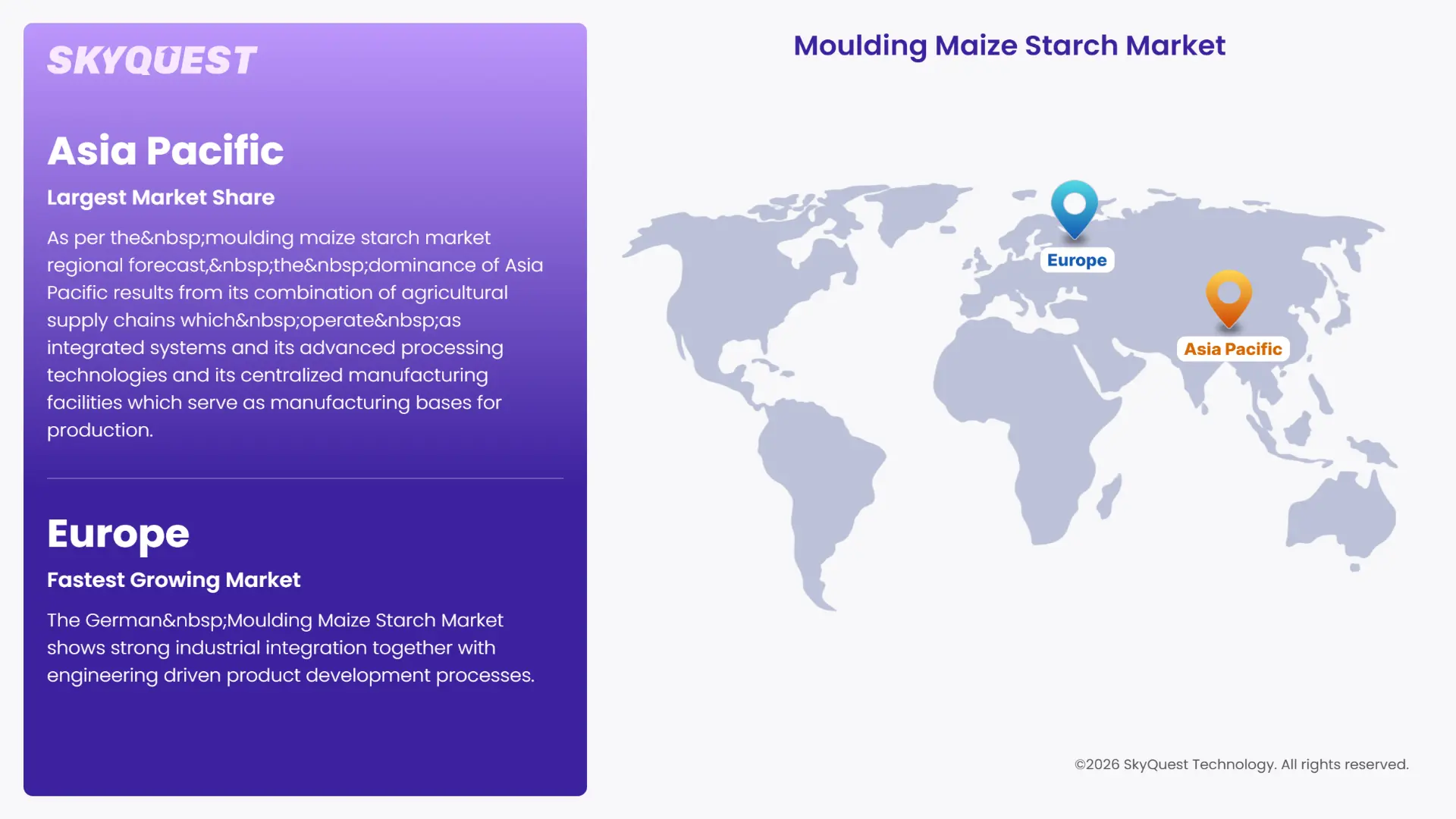
As per the moulding maize starch market regional forecast, the dominance of Asia Pacific results from its combination of agricultural supply chains which operate as integrated systems and its advanced processing technologies and its centralized manufacturing facilities which serve as manufacturing bases for production. Starch processing facilities receive continuous raw material supplies from multiple countries which produce maize feedstock while the region's cost structure together with its logistic benefits enables processors to operateat larger processing capacities. The existing polymer modification and moulding technical skills permit the transformation of native starch into specific application grades. The production capacity remains steady because different sectors which include packaging and consumer goods and industrial components show strong demand for the products.
The Japanese Moulding Maize Starch industry sees benefits from advanced materials engineering together with strict quality requirements which precision industries need. Manufacturers need to achieve performance consistency and maintain thermal stability while they want to control rheological behaviour during moulding processes which are demanding. Material scientists and processing equipment suppliers establish partnerships to create starch modifications which fulfill specific requirements. The ongoing development of materials and processing methods results from automotive components and electronics housings which need biodegradable materials together with safe materials for their performance requirements.
The Moulding Maize Starch sector in South Korea operates within an active manufacturing environment while consumers and industries rapidly adopt sustainable materials for their products. Local producers direct their efforts toward performance optimization by enhancing tensile strength and dimensional stability for both injection and compression molding methods. Starch processors and polymer compounders form strategic partnerships to create composite formulations which meet environmental targets and strengthen supply chain resilience. The packaging innovation and compact electronics market sectors drive demand for environmentally friendly materials which strengthen market momentum.
The European market expands quickly because three factors exist which include regulatory requirements for circular economy practices and increasing consumer demand for bio-based products and the region's sustainable product design expertise. The two main drivers of starch-based alternatives to conventional packaging plastics and single use items create demand for solutions which fulfillcompostability or recycling requirements. European manufacturers together with converters possess comprehensive knowledge of precision molding and value chain integration which allows efficient incorporation of maize starch derivatives into their production systems. Cross border collaboration among research institutions, material suppliers and brand owners accelerates innovation, while local demand for premium, environmentally responsible solutions reinforce investment in scale up and formulation refinement across the region.
The German Moulding Maize Starch Market shows strong industrial integration together with engineering driven product development processes. The automotive and specialty packaging industries need highly efficient starch modifications which require thorough quality control procedures from local producers. German processors need to achieve reproducibility for their products while they require certification to meet environmental controls which allows their products to be used in technical applications. Research institutions and machinery manufacturers work together with companies to improve their processes which makes it possible to produce large quantitiesfrom pilot testing while meeting the market's circular economy requirements.
The United Kingdom Moulding Maize Starch Market is growing due to rising demand for sustainable packaging solutions and branded consumer products which want to create unique market positions. The innovators create blends which achieve both aesthetic and functional product requirements while preserving their biodegradability features. The market benefits from agile converters and close ties to design studios which prioritize material storytelling and lifecycle credentials. Starch suppliers together with formulation specialists form partnerships which enable them to develop new products through rapid prototyping which supports market entry, which makes the United Kingdom a commercial adoption incubator.
The French Moulding Maize Starch Market shows rapid expansion because the country has strong support for bio-based industries through its active investment and policy backing. French manufacturers and brand owners choose to use certified materials from local sources which support their circular value chains and sustainability narratives. Starch based formulations which meet packaging demands and food contact compliance requirements create demand because they provide necessary performance characteristics and regulatory assurance. Research hubs and industrial partners create strong networks which help new grades reach commercialization, while artisan markets and specialty markets create various application paths which increase market growth.
The market position of North America improves through its coordinated efforts which span feedstock sourcing activities and technology development work and commercial partnerships that focus on scalable and high-performance solutions. The close relationship between maize producers and processing companies enables them to test yield enhancement methods and functional modification methods which produce starch qualities suitable for molding. Research investment in specific applications enables bio-based materials to transition from research stage into actual packaging and durable product manufacturing. Brand owners and converters work together to test whether their products perform the same functions as standard plastic but also demonstrate environmental benefits through their extended product lifespan. North America maintains its competitive edge in specialized high-margin applications because cross-border supply chain advantages and a vibrant private sector innovation system work together to strengthen its industrial capabilities.
The United States Moulding Maize Starch Market utilizes its extensive agricultural supply networks and its strong private research capabilities to create better materials for molding uses. The industry works to enhance existing equipment by developing better moldingmaterials which possess superior mechanical features and enhanced processability. The consumer brand partnerships with starch processors and compounders work to create scalable methods which enable brands to meet their sustainability targets while maintaining budget limits. The market operates through packaging innovations which create demand for bio-based materials in specific product categories from durable goods manufacturers.
The Canadian Moulding Maize Starch Market obtains its advantages from both agricultural supply networks and a platform for collaborative research which enables development of new materials. The local producers focus on verifying feedstock origins and using sustainable methods which match buyer requirements for complete supply chain visibility. The project focuses on two main areas which include finding better functional capabilities which thermoplastic materials for thermoforming and injection molding and creating composite materials that combine starch with renewable polymer materials. The strategic partnerships with converters and academic institutions help businesses minimize their risk of commercializing new products while creating access points to packaging solutions and specialty products which need regional environmental credentials.
To know more about the market opportunities by region and country, click here to
Buy The Complete Report
Rising Demand from Food Industry
The use of moulding maize starch as a functional ingredient in food processing extends to many applications because it improves product texture and stability and mouthfeel. The ability to create convenience products and dairy analogues and baked goods through thickening and binding and film-forming without changing flavor profiles enables product innovation and brand differentiation. Moulding maize starch serves as a plant-based ingredient that produces dependable results, which leads to its increasing adoption throughout all product categories and supply chains.
Growth in Biodegradable Packaging
Growing interest in biodegradable packaging and compostable packaging solutions creates opportunities for markets that want to use moulding maize starch as renewable polymer materials or base material components which produce moldable products and protective barriers that can decompose in nature. Maize starch serves as the main material choice for packaging film manufacturers and molded tray producers because its natural origins enable successful extrusion and thermoplastic production which helps them reduce their need for fossil-based plastic materials. Formulators select moulding maize starch as their main sustainable product development ingredient because they need eco-friendly material claims and customers expect products to demonstrateenvironmental protection and circular economic benefits.
Variability in Raw Material Quality
The need for consistent functional properties from moulding maize starch creates challenges for manufacturers who depend on raw maize supply since the process relies on unchanging maize quality. The processors need to maintain their product performance, but they require more blending and pretreatment and quality control, which leads to higher operational complexity that stops cautious customers from adopting their solution. The presence of feedstock quality uncertainty decreases trust in starch-based solutions, which leads to slower market adoption of sustainable materials in essential applications.
High Processing and Conversion Costs
Producers who want to use moulding maize starch at commercial scale must invest in special molding equipment and need to undergo conditioning processes, which together with energy-heavy processing, create a high entry difficulty for producers who want to start using this material. The cost burden of starch-based formulations makes it difficult to compete against established synthetic polymers because the high costs prevent manufacturers from making the switch to starch-based materials. Mid-sized and smaller enterprises will postpone their investment decisions until they can see actual cost savings, which causes a slowdown in commercialization and prevents starch-based molding solutions from becoming widespread in all end-user industries.
Request Free Customization of this report to help us to meet your business objectives.
The global moulding maize starch market experiences competition between established companies with secure feedstock access and new companies that use proprietary processing methods to win packaging and single-use moulding contracts. The M&A and partnerships and material innovation activities at Novamont and Corn Next demonstrate how market positions depend on drivers that stem from regulatory requirements and supply contracts.
Biodegradable Application Expansion: Manufacturers are using moulding maize starch to create biodegradable components needed for single-use products because consumers and regulators now prefer sustainable materials. The trend promotes starch producers and polymer formulators to establish partnerships which will enhance performance in moulded applications, while brand owners require circular messaging. The investment in processing improvements and design for composability solutions has led to increased adoption of these products in multiple sectors, which includes packaging, disposable items, and agricultural accessories. The transition provides businesses with product differentiation benefits and supply chain resilience advantages when they implement eco-focused materials into their manufacturing processes.
Sustainable Packaging Demand: Package converters now select moulding maize starch as their preferred material because it functions as a renewable resource which helps them meet sustainability targets and fulfill customer demand for environmentally friendly products. The packaging material enables product redesign through its thermoforming and molding capabilities which reduce plastic usage while preserving product quality. Material scientists and brand teams collaborate to accelerate product development and barrier solution creation which establishes closed loop supply systems. The market adopts products because of their lifecycle stewardship features, which help brands stand out from competitors and match the new purchasing patterns found throughout supply chains.
SkyQuest’s ABIRAW (Advanced Business Intelligence, Research & Analysis Wing) is our Business Information Services team that Collects, Collates, Correlates, and Analyses the Data collected by means of Primary Exploratory Research backed by robust Secondary Desk research.
As per SkyQuest analysis, the moulding maize starch market expands through two main forces: increasing regulatory demands and changing consumer preferences for sustainable circular materials, which benefits biodegradable packaging. The presence of different milling capacities affects the adoption, because it creates challenges for achieving stable performance and increases the difficulty of the processing work. The market finds its main base in Asia Pacific because the region offers complete supply chain systems and vast processing capabilities together with centralized production facilities. The food grade segment leads the market because it meets safety standards, which enables brand owners to enter the market faster with products that serve both edible goods and packaging requirements. The speed of commercial adoption for conventional plastic substitutes will depend on how fast companies develop new formulations and achieve production cost savings.
| Report Metric | Details |
|---|---|
| Market size value in 2024 | USD 1.5 Billion |
| Market size value in 2033 | USD 2.67 Billion |
| Growth Rate | 6.6% |
| Base year | 2024 |
| Forecast period | 2026-2033 |
| Forecast Unit (Value) | USD Billion |
| Segments covered |
|
| Regions covered | North America (US, Canada), Europe (Germany, France, United Kingdom, Italy, Spain, Rest of Europe), Asia Pacific (China, India, Japan, Rest of Asia-Pacific), Latin America (Brazil, Rest of Latin America), Middle East & Africa (South Africa, GCC Countries, Rest of MEA) |
| Companies covered |
|
| Customization scope | Free report customization with purchase. Customization includes:-
|
To get a free trial access to our platform which is a one stop solution for all your data requirements for quicker decision making. This platform allows you to compare markets, competitors who are prominent in the market, and mega trends that are influencing the dynamics in the market. Also, get access to detailed SkyQuest exclusive matrix.
Table Of Content
Executive Summary
Market overview
Parent Market Analysis
Market overview
Market size
KEY MARKET INSIGHTS
COVID IMPACT
MARKET DYNAMICS & OUTLOOK
Market Size by Region
KEY COMPANY PROFILES
Methodology
For the Moulding Maize Starch Market, our research methodology involved a mixture of primary and secondary data sources. Key steps involved in the research process are listed below:
1. Information Procurement: This stage involved the procurement of Market data or related information via primary and secondary sources. The various secondary sources used included various company websites, annual reports, trade databases, and paid databases such as Hoover's, Bloomberg Business, Factiva, and Avention. Our team did 45 primary interactions Globally which included several stakeholders such as manufacturers, customers, key opinion leaders, etc. Overall, information procurement was one of the most extensive stages in our research process.
2. Information Analysis: This step involved triangulation of data through bottom-up and top-down approaches to estimate and validate the total size and future estimate of the Moulding Maize Starch Market.
3. Report Formulation: The final step entailed the placement of data points in appropriate Market spaces in an attempt to deduce viable conclusions.
4. Validation & Publishing: Validation is the most important step in the process. Validation & re-validation via an intricately designed process helped us finalize data points to be used for final calculations. The final Market estimates and forecasts were then aligned and sent to our panel of industry experts for validation of data. Once the validation was done the report was sent to our Quality Assurance team to ensure adherence to style guides, consistency & design.
Analyst Support
Customization Options
With the given market data, our dedicated team of analysts can offer you the following customization options are available for the Moulding Maize Starch Market:
Product Analysis: Product matrix, which offers a detailed comparison of the product portfolio of companies.
Regional Analysis: Further analysis of the Moulding Maize Starch Market for additional countries.
Competitive Analysis: Detailed analysis and profiling of additional Market players & comparative analysis of competitive products.
Go to Market Strategy: Find the high-growth channels to invest your marketing efforts and increase your customer base.
Innovation Mapping: Identify racial solutions and innovation, connected to deep ecosystems of innovators, start-ups, academics, and strategic partners.
Category Intelligence: Customized intelligence that is relevant to their supply Markets will enable them to make smarter sourcing decisions and improve their category management.
Public Company Transcript Analysis: To improve the investment performance by generating new alpha and making better-informed decisions.
Social Media Listening: To analyze the conversations and trends happening not just around your brand, but around your industry as a whole, and use those insights to make better Marketing decisions.
REQUEST FOR SAMPLE
 REQUEST FREE CUSTOMIZATION
Global Moulding Maize Starch Market size was valued at USD 1.5 Billion in 2024 and is poised to grow from USD 1.6 Billion in 2025 to USD 2.67 Billion by 2033, growing at a CAGR of 6.6% during the forecast period (2026-2033).
Competition in the global moulding maize starch market centers on feedstock-secure incumbents and agile entrants that leverage proprietary processing and formulation to win packaging and single-use moulding contracts. Drivers tied to regulation and supply agreements push concrete tactics: Novamont’s Mater-Bi expansion and technology consolidation, and Corn Next’s enzyme-fermentation patent plus ADM feedstock partnership show M&A, partnerships, and material innovation shaping market positions. 'Cargill Inc.', 'Archer Daniels Midland Company', 'Ingredion Incorporated', 'Tate & Lyle PLC', 'Roquette Frères', 'Bunge Limited', 'Grain Processing Corporation', 'National Starch and Chemical Company', 'Gulfstream Private Equity', 'Emsland Group', 'Tereos SCA', 'Novidon Starch B.V.', 'Cargill Starches', 'HMTX Industries', 'Tereos Starch & Sweeteners', 'SAMPAIO', 'Pannonia Bio Zrt.', 'Lantmännen', 'Beneo GmbH', 'The Andersons, Inc.'
The expanding use of moulding maize starch in food processing as a functional ingredient enhances product texture, stability and mouthfeel, which encourages food manufacturers to specify it for a wider range of applications. Its versatility as a thickening, binding and film-forming agent enables formulation of convenience, dairy analogues and baked goods without altering flavor profiles, supporting product innovation and brand differentiation. As manufacturers seek reliable, plant-based ingredients that deliver consistent performance, demand for moulding maize starch grows across supply chains and product lines.
Biodegradable Application Expansion: Manufacturers are leveraging moulding maize starch to develop biodegradable components for single-use products, driven by rising consumer and regulatory preference for sustainable materials. This trend is encouraging partnerships between starch producers and polymer formulators to improve performance in molded applications, while brand owners seek circular messaging. Investment in processing adaptations and design for compostability is widening adoption across packaging, disposable items, and agricultural accessories. The shift offers product differentiation and supply chain resilience as companies integrate eco-focused materials into manufacturing.
Asia Pacific Dominate the Global Moulding Maize Starch Market?
Clostridium butyricum is a beneficial probiotic bacterium widely used in dietary supplements, animal nutrition, and functional foods. It supports gut health by promoting beneficial intestinal microflora and improving digestive function.
The healthcare, dietary supplement, functional food, and animal feed industries are among the primary users of Clostridium butyricum products due to their probiotic and digestive health benefits.


Want to customize this report? This report can be personalized according to your needs. Our analysts and industry experts will work directly with you to understand your requirements and provide you with customized data in a short amount of time. We offer $1000 worth of FREE customization at the time of purchase.
Feedback From Our Clients


 USA (+1) 351-333-4748

