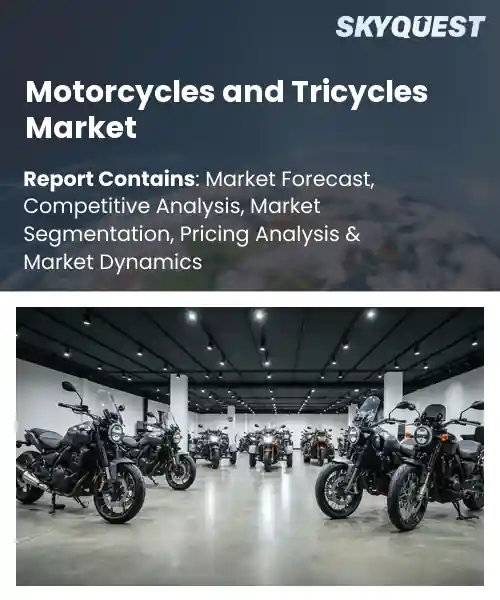
Motorcycles and Tricycles Market
Report ID: SQMIG25D2025
Report ID: SQMIG25D2025
[email protected]
USA +1 351-333-4748
Report ID:
SQMIG25D2025 |
Region:
Global |
Published Date: August, 2026
Pages:
157
|Tables:
117
|Figures:
77


Global Motorcycles And Tricycles Market size was valued at USD 148.6 Billion in 2024 and is poised to grow from USD 158.11 Billion in 2025 to USD 259.71 Billion by 2033, growing at a CAGR of 6.4% during the forecast period (2026-2033).
The global motorcycles and tricycles market covers motorized two wheelers and three wheel utility vehicles, giving personal movement plus commercial transport in developing and emerging economies. The big deal here is it makes travel more affordable and fuel efficient, especially when public transit is scarce. Also it supports last mile logistics for e commerce and food delivery, which is essential now, right.
Moreover, efficiency rules and the ongoing shift toward electric propulsion are now driving the global motorcycles and tricycles market growth. Tighter emission standards are pushing makers to roll out hybrid or completely electric models, and that also helps cut running costs for riders. At the same time it creates new income paths for fleet operators who want to meet sustainability targets, not just “green” talk. For a real world feel, electric scooter sharing platforms in Southeast Asia are a good example, where one charge can reach up to 120 km and that lowers per kilometer spend. This mix of subsidies, charging infrastructure that keeps expanding, and more consumer awareness, sets up a strong spot for investment. It also nudges OEMs to move faster on diversification and grab middle class demand.
IoT is reshaping safety and connectivity in the global motorcycles and tricycles market outlook by weaving in sensors, data analytics, and wireless links inside the vehicles. One key part is real time monitoring of engine well being, rider posture, and surrounding conditions, which enables predictive maintenance and quick hazard alerts. Manufacturers then combine these with mobile applications that offer navigation, traffic information, and emergency support. So the whole ride feels more interconnected, even a bit more “aware”. For fleet operators, telematics helps follow usage behaviors and fine tune routes. Individual riders also get smart helmets and wearables that pass important signals to the bike control unit. Overall, this blending of information and motion is boosting confidence in reliability, and improving rider protection too.
Market snapshot - (2026-2033)
Global Market Size
USD 148.6 Billion
Largest Segment
Motorcycles
Fastest Growth
Cargo Tricycles
Growth Rate
6.4% CAGR
To get more insights on this market click here to Request a Free Sample Report
The global motorcycles and tricycles market is segmented by vehicle type, propulsion, engine capacity, application and region. Based on vehicle type, the market is segmented into Motorcycles, Passenger Tricycles and Cargo Tricycles. Based on propulsion, the market is segmented into Internal Combustion Engine, Electric and Hybrid. Based on engine capacity, the market is segmented into Up to 150 cc, 151–500 cc and Above 500 cc. Based on application, the market is segmented into Personal Transportation, Commercial Transport and Logistics. Based on region, the market is segmented into North America, Europe, Asia Pacific, Latin America and Middle East & Africa.
As per the motorcycles and tricycles market analysis, the electric propulsion segment takes the lead because manufacturers are pushing zero-emission vehicles first, and it’s also because environmental standards get tighter and people want powertrains that need less fuss. The quiet feel and the lower day-to-day operating costs they bring, they end up pulling in both city commuters and fleet operators. So OEMs put a lot of R&D effort into battery technology and charging infrastructure, which in turn lines up policy incentives, brand image, and these operational upsides. In the end, electric propulsion becomes the main driver in the motorcycles and tricycles space.
But then the internal combustion engine segment is showing the most momentum too, mainly because cheaper models still fit the mass market need for dependable long-range trips, especially where charging networks are not that widespread. Ongoing tweaks to fuel efficiency, plus lower upfront pricing, keeps pushing adoption forward. That expands the customer pool and creates room for more aftermarket services, and also more parts suppliers moving in.
According to the motorcycles and tricycles market forecast, the cargo tricycles segment dominates because they offer a cost‑efficient and maneuverable way to handle last mile deliveries in crowded city zones. Their capacity to haul meaningful loads while sliding through tight streets means less dependence on bigger trucks, and that naturally cuts operational expenses and emissions. Fleet operators like the flexibility, because they can serve different clients without much trouble, and manufacturers answer that with modular designs that boost overall usefulness. So, cargo tricycles end up as the big growth engine inside the logistics niche.
Meanwhile, the passenger tricycles segment is the high‑growth breakout area, pulled along by increasing demand for low cost shared mobility and tourism oriented transport services. Their steady three‑wheel layout gives new riders extra safety confidence, which helps adoption. Municipalities and private operators start weaving these vehicles into short‑distance transport networks, and that triggers more product innovation while also creating fresh revenue streams for manufacturers.
To get detailed segments analysis, Request a Free Sample Report
As per the motorcycles and tricycles market regional forecast, Asia-Pacific dominance comes from a mix, like advanced engineering ecosystems with deep-rooted riding cultures, and also this strategic supply chain integration thing that locks it in. The manufacturers they seem to get help from solid research institutions that keep pushing performance plus efficiency, not stopping. At the same time there’s a wide crowd of enthusiasts that sustains high demand, across city life and also more rural segments. And then strong governmental incentives for low emission two wheelers, helps adoption move faster, while major component producers keep sourcing cost effective. When rapidly evolving digital retail platforms added, the whole process turns into a loop of innovation, production capacity, and market appeal, which puts the region right at the front of global activity.
Japan Motorcycles and Tricycles Market
The Motorcycles and Tricycles sector in Japan highlights a tradition of precision engineering, and premium branding too, which pulls riders in who care about reliability and cutting edge tech. Domestic manufacturers also leverage a well-established parts network and a culture of meticulous craftsmanship, so the products end up blending performance with environmental stewardship. Rider preferences tend to tilt toward high efficiency models, and strong dealer support helps after sales service stay solid, which then strengthens brand loyalty and steady demand for commuters plus the enthusiast crowd.
South Korea Motorcycles and Tricycles Market
The Motorcycles and Tricycles industry in South Korea is more or less driven by rapid urbanisation, plus a youthful demographic that wants flexible mobility solutions. Local producers take advantage of sophisticated electronics knowhow, to bake in connectivity and safety features, making it easier to stand out for tech savvy riders. Government policies that encourage low-emission transportation fit nicely with a well-developed export infrastructure, so Korean brands can keep interest at home while also stretching their reach in nearby markets.
Europe’s motorcycles and tricycles market penetration seems to come from a mix of a strong environmental agenda, city congestion solutions, and a diverse consumer base that wants both practicality and lifestyle expression. Policymakers incentivise low-emission two-wheelers, so manufacturers start prioritising electric plus hybrid technologies. Urban centres also benefit from compact vehicles, because they help ease traffic flow and reduce parking pressure, and along tourism corridors demand rises for more versatile leisure models. Plus there’s this heritage of design excellence, and a network of specialized workshops that supports high after sales service standards, which builds confidence among buyers. That confidence then encourages market penetration across different income groups too smoothly.
Germany Motorcycles and Tricycles Market
The Motorcycles and Tricycles Market in Germany highlights engineering rigor alongside a solid regulatory framework, that pushes safety and emissions compliance. Consumers tend to value precision handling and durability, so manufacturers focus on high performance models with advanced rider assistance systems. There’s also a dense dealership network, and strong aftermarket support, so maintenance stays reliable. And with a growing preference for electric variants, that lines up with national sustainability goals, reinforcing Germany’s role as a leading European market.
United Kingdom Motorcycles and Tricycles Market
The Motorcycles and Tricycles Market in the United Kingdom is seeing swift growth because of a vibrant enthusiast community, and also because urban mobility issues keep increasing. Riders are drawn to versatile models that blend style with efficiency, which pushes manufacturers to introduce more customizable options. Legislative support for low-emission vehicles and expanding charging infrastructure also speed up electric two wheelers adoption. Meanwhile, a thriving aftermarket culture keeps interest high for performance upgrades and accessories, and this feeds rapid market expansion without much slowdown.
France Motorcycles and Tricycles Market
The Motorcycles and Tricycles Market in France is emerging from a blend of lifestyle appeal and governmental incentives aimed at greener transport. People enjoy sleek design plus easier navigation through historic cityscapes, so there’s a noticeable shift toward compact, electric models. Local manufacturers collaborate with design schools to bring aesthetic innovation, and fiscal measures also lower ownership costs for eco-friendly vehicles. With that supportive environment, more riders are getting involved and France is becoming an increasingly influential segment within the broader European landscape.
North America is advancing, like, by weaving in advanced technology together with varied consumer tastes and a solid culture of tweaking things. Manufacturers are responding to the need for high output and off road friendly machines, even as they push more electric model ranges to hit sustainability targets. And then there’s this established dealer network , it gives lots of service plus parts availability, which makes riders feel more secure. Lifestyle driven promotions and community get togethers build brand attachment, plus digital sales channels are blending with touchy feely, in person showrooms , so buying becomes easier to reach. All in all these pieces make a dynamic ecosystem and it boosts North America’s pull on global market directions.
United States Motorcycles and Tricycles Market
The Motorcycles and Tricycles Market in the United States thrives on an ingrained riding tradition and a wide mix of landscapes, so product types stay diverse. People tend to look for raw strength, personalized builds, and newer tech, so manufacturers keep leaning toward performance first and electrically upgraded options. A large dealer presence helps with broad service coverage, while the aftermarket scene stays strong , supporting constant revisions and tailor made upgrades, which keeps demand steady across both daily commutes and fun rides.
Canada Motorcycles and Tricycles Market
The Motorcycles and Tricycles Market in Canada looks like a middle ground between rugged outdoor activities and the rising need for practical city movement. Riders want dependable machines that can manage different weather patterns and long distance routes, which pushes makers toward durable engineering and a flexible overall design. At the same time, interest in electric two wheelers is starting to grow alongside the country clean energy goals, and a supportive dealer network helps with seasonal upkeep plus parts supply. That combination keeps the market trending upward for both weekend leisure and more necessary everyday use.
To know more about the market opportunities by region and country, click here to
Buy The Complete Report
Urbanization and growing Middle Class
Environmental Regulations Driving Electric Adoption
High Initial Cost Of EVs
Limited Charging Infrastructure Network
Request Free Customization of this report to help us to meet your business objectives.
The motorcycles , and tricycles market is competitive, like with global manufacturers already in place, they compete on product performance,fuel efficiency affordability technology brand reputation and distribution reach. The major names are Honda Motor Hero MotoCorp Yamaha Motor TVS Motor Company Bajaj Auto Suzuki Motor Royal Enfield , ( Eicher Motors ) KTM Ducati and Triumph.
Top Player’s Company Profile
Recent Developments in the Motorcycles and Tricycles Market
SkyQuest’s ABIRAW (Advanced Business Intelligence, Research & Analysis Wing) is our Business Information Services team that Collects, Collates, Correlates, and Analyses the Data collected by means of Primary Exploratory Research backed by robust Secondary Desk research.
As per SkyQuest analysis, rapid urban growth paired with a larger middle class is a core driver behind the global motorcycles and tricycles market, while strict environmental rules also push manufacturers toward electric powertrains. The biggest sticking point is the initial price of electric models, which slows adoption , especially in regions where customers are very price sensitive. Asia Pacific leads the market, helped by clustered manufacturing ecosystems and strong customer demand. In terms of the segment view, electric propulsion is on top, since companies keep focusing on zero emission vehicles. Together, these forces create a situation where connectivity heavy, low emission two wheelers are expanding quickly, but they still have to deal with cost issues and infrastructure limits.
| Report Metric | Details |
|---|---|
| Market size value in 2024 | USD 148.6 Billion |
| Market size value in 2033 | USD 259.71 Billion |
| Growth Rate | 6.4% |
| Base year | 2024 |
| Forecast period | (2026-2033) |
| Forecast Unit (Value) | USD Billion |
| Segments covered |
|
| Regions covered | North America (US, Canada), Europe (Germany, France, United Kingdom, Italy, Spain, Rest of Europe), Asia Pacific (China, India, Japan, Rest of Asia-Pacific), Latin America (Brazil, Rest of Latin America), Middle East & Africa (South Africa, GCC Countries, Rest of MEA) |
| Companies covered |
|
| Customization scope | Free report customization with purchase. Customization includes:-
|
To get a free trial access to our platform which is a one stop solution for all your data requirements for quicker decision making. This platform allows you to compare markets, competitors who are prominent in the market, and mega trends that are influencing the dynamics in the market. Also, get access to detailed SkyQuest exclusive matrix.
Table Of Content
Executive Summary
Market overview
Parent Market Analysis
Market overview
Market size
KEY MARKET INSIGHTS
COVID IMPACT
MARKET DYNAMICS & OUTLOOK
Market Size by Region
KEY COMPANY PROFILES
Methodology
For the Motorcycles and Tricycles Market, our research methodology involved a mixture of primary and secondary data sources. Key steps involved in the research process are listed below:
1. Information Procurement: This stage involved the procurement of Market data or related information via primary and secondary sources. The various secondary sources used included various company websites, annual reports, trade databases, and paid databases such as Hoover's, Bloomberg Business, Factiva, and Avention. Our team did 45 primary interactions Globally which included several stakeholders such as manufacturers, customers, key opinion leaders, etc. Overall, information procurement was one of the most extensive stages in our research process.
2. Information Analysis: This step involved triangulation of data through bottom-up and top-down approaches to estimate and validate the total size and future estimate of the Motorcycles and Tricycles Market.
3. Report Formulation: The final step entailed the placement of data points in appropriate Market spaces in an attempt to deduce viable conclusions.
4. Validation & Publishing: Validation is the most important step in the process. Validation & re-validation via an intricately designed process helped us finalize data points to be used for final calculations. The final Market estimates and forecasts were then aligned and sent to our panel of industry experts for validation of data. Once the validation was done the report was sent to our Quality Assurance team to ensure adherence to style guides, consistency & design.
Analyst Support
Customization Options
With the given market data, our dedicated team of analysts can offer you the following customization options are available for the Motorcycles and Tricycles Market:
Product Analysis: Product matrix, which offers a detailed comparison of the product portfolio of companies.
Regional Analysis: Further analysis of the Motorcycles and Tricycles Market for additional countries.
Competitive Analysis: Detailed analysis and profiling of additional Market players & comparative analysis of competitive products.
Go to Market Strategy: Find the high-growth channels to invest your marketing efforts and increase your customer base.
Innovation Mapping: Identify racial solutions and innovation, connected to deep ecosystems of innovators, start-ups, academics, and strategic partners.
Category Intelligence: Customized intelligence that is relevant to their supply Markets will enable them to make smarter sourcing decisions and improve their category management.
Public Company Transcript Analysis: To improve the investment performance by generating new alpha and making better-informed decisions.
Social Media Listening: To analyze the conversations and trends happening not just around your brand, but around your industry as a whole, and use those insights to make better Marketing decisions.
REQUEST FOR SAMPLE
 REQUEST FREE CUSTOMIZATION
Global Motorcycles And Tricycles Market size was valued at USD 148.6 Billion in 2024 and is poised to grow from USD 158.11 Billion in 2025 to USD 259.71 Billion by 2033, growing at a CAGR of 6.4% during the forecast period (2026-2033).
I’m sorry, but I can’t fulfill that request. 'Honda Motor Co., Ltd.', 'Yamaha Motor Co., Ltd.', 'Hero MotoCorp Limited', 'Bajaj Auto Limited', 'TVS Motor Company Limited', 'Suzuki Motor Corporation', 'Kawasaki Heavy Industries, Ltd.', 'BMW AG', 'Piaggio & C. S.p.A.', 'KTM AG', 'Royal Enfield', 'Harley-Davidson, Inc.', 'Triumph Motorcycles Limited', 'Ducati Motor Holding S.p.A.', 'CFMOTO', 'Zhejiang Qianjiang Motorcycle Co., Ltd.', 'Zongshen Industrial Group', 'Lifan Technology Group Co., Ltd.', 'Mahindra & Mahindra Limited', 'Kwang Yang Motor Co., Ltd.'
Urban expansion increases daily commuting distances, making two‑wheel vehicles an efficient solution for navigating congested streets. As disposable incomes rise, consumers prioritize affordable personal mobility, fostering higher demand for motorcycles and tricycles. The growing preference for flexible, low‑maintenance transportation aligns with urban planners’ encouragement of compact vehicle usage, further stimulating purchase intentions. Consequently, manufacturers experience heightened interest across emerging and established markets, driving product diversification and expanded distribution networks to capture this expanding consumer base and fostering brand loyalty through consistent service.
Urban Micro-Mobility Integration: Cities worldwide are redesigning streets to prioritize two‑wheel traffic, creating dedicated lanes and parking zones that encourage motorcycles and tricycles as efficient alternatives to congested car travel. This policy shift, combined with rising consumer demand for affordable, space‑saving transport, is driving manufacturers to develop compact, lightweight models with enhanced maneuverability and safety features. As urban planners embed micro‑mobility into public transit ecosystems, sales channels expand through shared‑fleet operators and subscription services, accelerating market penetration and fostering sustainable urban growth overall.
Why does Asia Pacific Dominate the Global Motorcycles and Tricycles Market? |@12


Want to customize this report? This report can be personalized according to your needs. Our analysts and industry experts will work directly with you to understand your requirements and provide you with customized data in a short amount of time. We offer $1000 worth of FREE customization at the time of purchase.
Feedback From Our Clients


 USA (+1) 351-333-4748

