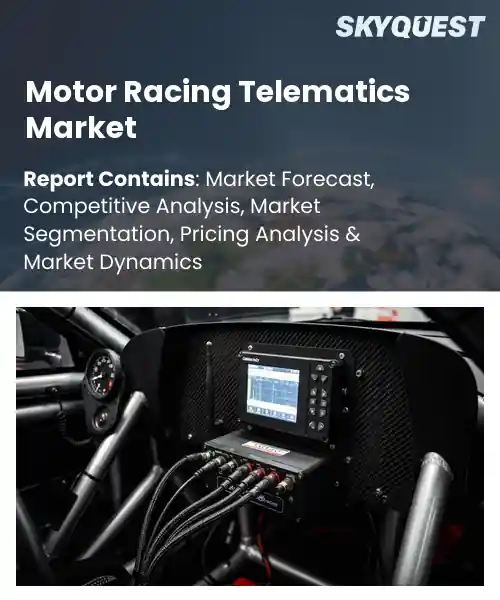
Motor Racing Telematics Market
Report ID: SQMIG45I2349
Report ID: SQMIG45I2349
[email protected]
USA +1 351-333-4748
Report ID:
SQMIG45I2349 |
Region:
Global |
Published Date: February, 2026
Pages:
157
|Tables:
180
|Figures:
79


Global Motor Racing Telematics Market size was valued at USD 4.10 Billion in 2024 and is poised to grow from USD 4.49 Billion in 2025 to USD 9.20 Billion by 2033, growing at a CAGR of 9.4% during the forecast period (2026-2033).
Growing demand for performance optimization in motorsports, increasing adoption of real-time vehicle data analytics, rising emphasis on driver safety monitoring, advancements in sensor and telemetry technologies, and expanding integration of machine learning in race strategy are driving demand for motor racing telematics.
Increasing use of advanced analytics and machine learning is further helping teams convert raw telemetry data into actionable insights that improve vehicle reliability, optimize pit strategies, and enhance driver performance. Additionally, processed racing data is increasingly used by broadcasters and esports platforms to create immersive fan experiences while automotive OEMs adopt race-derived telematics technologies for road vehicle development and aftermarket services. Growing demand for high-performance data analysis in motorsports around the world coupled with the need for real-time insights to enhance race strategy is expected to primarily drive motor racing telematics market growth. Proper use of motor racing telematics can influence race outcomes, sponsorship value, and technology transfer to road vehicles in the future.
On the contrary, high costs associated with advanced telemetry systems, strict regulatory restrictions in professional racing leagues, and cybersecurity risks related to real-time data transmission are predicted to hamper motor racing telematics market penetration over the coming years.
How is AI Enhancing Performance Analytics In Motor Racing Telematics?
Motor racing telematics involves collecting precise vehicle and driver information and transmitting it to engineers to analyze. AI is also useful in analyzing vehicle and driver information collected in motor racing telematics. It helps eliminate noise in signals, identify anomalies, and learn patterns of driver behavior. Currently, in motor racing, edge computing and cloud-based machine learning are being utilized to convert collected raw data into useful information. These technologies are helpful in making vehicle setup and testing easier and are also beneficial to small racing teams that previously could not afford such technologies.
Market snapshot - (2026-2033)
Global Market Size
USD 4.1 Billion
Largest Segment
Motor Racing Telematics
Fastest Growth
Remote Location System
Growth Rate
9.4% CAGR
To get more insights on this market click here to Request a Free Sample Report
Global motor racing telematics market is segmented by type, application types, vehicle type, technology type, end user, deployment type, and region. Based on type, the market is segmented into motor racing telematics and remote location system. Based on application types, the market is segmented into fleet management, insurance telematics, vehicle tracking, driver behavior monitoring and maintenance, and diagnostics. Based on vehicle type, the market is segmented into passenger cars, motorcycles, commercial vehicles, heavy-duty trucks, and fleet vehicles. Based on technology type, the market is segmented into GPS-based telematics, cellular network telematics, satellite telematics, integrated telematics systems, and hardware-based solutions. Based on end user, the market is segmented into Individual consumers, logistics companies, insurance firms, government and public sector, and ride-hailing services. Based on deployment type, the market is segmented into cloud-based telematics, on-premises telematics, hybrid deployment, embedded telematics, and mobile telematics solutions. Based on region, the market is segmented into North America, Europe, Asia Pacific, Latin America, and Middle East & Africa.
The satellite telematics segment is forecasted to account for the highest global motor racing telematics market share in the future. The ability of this segment to offer reliable, high fidelity location and telemetry coverage critical for monitoring high speed race vehicles beyond line of sight is helping this segment maintain its dominance. Its ability to transmit large volumes of positional and sensor data under extreme conditions enables teams to perform real time strategy adjustments and safety interventions. The dependability and resilience of satellite links reduce data gaps and support consistent performance benchmarking across racing scenarios.
However, GPS based telematics is witnessing the strongest growth momentum as per this motor racing telematics market analysis. Compact receivers and closer integration with trackside infrastructure delivers precise positioning for vehicle dynamics analysis, which creates new opportunities via this segment. Rising demand from private teams and feeder series for affordable lap timing, combined with advances in GNSS augmentation and sensor fusion, is accelerating deployment for coaching, setup optimization, and commercial services.
The driver behavior monitoring segment is anticipated to lead the global motor racing telematics market revenue generation through 2033. The ability of this solution to provide actionable insights which relate physiological input and vehicle telemetry data to on-track performance and safety is solidifying this solution’s dominance. By converting this complex sensor data into driver profile data, fatigue data, and decision pattern data, teams can optimize their strategy and minimize risks. The direct causal relationship between behavioral information and lap time gains creates a strong investment in custom analytics solutions, bringing driver, engineer, and technology closer together.
Meanwhile, maintenance and diagnostics is growing as a most rapidly expanding segment, driven by predictive algorithms and increasing sensor sophistication that reduce unscheduled failures and help to optimize component life cycles. The growing demand for increased reliability improvements from teams, together with integration into telemetry data for root cause analysis, is driving new services and tools and creating aftermarket business models.
To get detailed segments analysis, Request a Free Sample Report
Robust motorsports heritage, established racing teams and premier circuit networks, and a mature supplier ecosystem are helping this region maintain its dominant stance in terms of motor racing telematics adoption. Rising collaboration between R&D centers, motorsport organisations, and telematics specialists at all levels provides tailored solutions to vehicle performance, reliability of telemetry, and race strategy. Manufacturers and software companies are also developing links with universities to access research capabilities and testing facilities to refine prediction of cells and real-time telemetry stacks. The large number of racing formats and events per calendar year provides live development and benchmarking opportunities for ongoing improvement of services for all forms of racing within an individual series.
Presence of a robust engineering talent pool and close ties between racing teams and automotive manufacturers shape motor racing telematics demand in Germany. Working with technical universities helps to drive the development of sophisticated sensors and analysis capabilities. The culture of precision engineering and performance validation helps to ensure the reliability of telematics products, and therefore, the country is well suited for the development of prototypes and the commercialization of technology used in motor racing.
A longstanding motorsport heritage and a vibrant ecosystem of data analytics firms and race engineering consultancies are helping boost motor racing telematics sales in the United Kingdom. Proximity to iconic racing tracks such as Silverstone and championships creates a fertile testing ground for telematics products. Integration with simulation centers and driver training facilities helps speed up development of telematics products. The culture of investment and networks helps in commercializing and exporting performance telematics products.
Established culture of motorsport engineering and a cluster of boutique telematics specialists are helping shape motor racing telematics demand in the country. Working closely with racing teams and endurance racing series helps deliver robust telemetry products for different track conditions. Relationships with manufacturers and testing facilities allow for fine-tuning telemetry products for different conditions. A culture for craftsmanship and racing helps fine-tune race-oriented telematics products for both prototype and customer racing cars across France.
Expanding commercial racing ecosystems, strong media interest in live vehicle data, and a vibrant startup culture are supporting steady demand for motor racing telematics in North America. The combination of both traditional racing series such as NASCAR, IndyCar and grassroots events provides many different types of testing environments while teams and promoters look for right telemetry data to give them an advantage over their competitors in creating excitement for the fans. In addition, academia and the private sector have been working together to provide the best possible analytics and simulation processes that allow for rapid development of hardware/software stacks specific to various racing series formats as well as to satisfy consumer demands when using race vehicles.
Increasing organization of professional motorsports series, extensive track infrastructure, and an aftermarket culture are shaping demand for motor racing telematics across the United States. The need for real-time data feed, which satisfies the interests of racing broadcasters, has fostered the development of telematics technology. Strong working relationships with automotive technology providers and academia facilitate the development of telematics solutions. A competitive market environment promotes the further development and availability of telematics solutions to the professional and club racing segments.
Growing club racing scene, strong driver development programs, and technical partnerships with research centers are creating an opportune setting for motor racing telematics vendors in the country. The varied weather conditions and variety of tracks help to provide good real-world testing for telematics devices and algorithms. Companies are working on providing hardy products and data collection for endurance and rally racing. Collaboration with companies and manufacturers on both sides of the border helps create high demand for motor racing telematics across Canada.
Concentrated investment in sensor manufacturing, semiconductor integration, and high performance software development create new business scope for motor racing telematics companies in this region. With a long history of working with electronic control systems, regional automotive producers and industrial technology suppliers can provide compact, dependable telemetry solutions specifically designed for racing applications. Countries with emerging motorsport cultures (circuit racing, rally, karting, etc.) are expected to develop many diverse tracks that provide ample opportunities to support the fast development of data analytical models through iterative and localized development. The rising popularity of electric racing has drawn the attention of telematics players to adapt their products for energy management and battery use optimization.
Robust electronics manufacturing base and deep engineering expertise are shaping motor racing telematics innovation in Japan. Automotive component makers work in tandem with race teams to integrate telematics into vehicle control systems and testing. Focus on miniaturization and sensor technology also helps in creating race-ready telematics solutions that can withstand various race conditions. Research centers and simulation houses provide expertise in analytics tools that help in faster commercialization of telematics solutions.
Presence of leading semiconductor and connectivity industries and growing interest in electric racing formats are boosting motor racing telematics adoption in South Korea. The technology sector in the country is focused on integrating high speed connections, computing, and miniaturizing sensor sets for race cars. The ability to work with racing circuits, academia, and auto suppliers helps speed the design and testing process. The emphasis on technology-enabled fan engagement is also helping drive the South Korean market for telematics technology.
To know more about the market opportunities by region and country, click here to
Buy The Complete Report
Integration With Advanced Sensor Systems
Real Time Data Processing
High Implementation And Integration Costs
Data Privacy And Security Concerns
Request Free Customization of this report to help us to meet your business objectives.
Competition driven demand for marginal lap time gains and richer broadcast storytelling is reshaping the competitive landscape in motor racing telematics. Teams and series adopt cloud analytics and high resolution sensor suites to extract performance advantage and inform strategy during events. Examples include Formula 1 expanding real time telemetry analytics with a global cloud partner and tyre maker Pirelli commercialising a tyre telemetry product for track competition use.
SkyQuest’s ABIRAW (Advanced Business Intelligence, Research & Analysis Wing) is our Business Information Services team that Collects, Collates, Correlates, and Analyses the Data collected by means of Primary Exploratory Research backed by robust Secondary Desk research.
As per SkyQuest analysis, growing demand for performance optimization in motorsports and rising adoption of real-time vehicle data analytics are anticipated to drive the demand for motor racing telematics going forward. However, high costs associated with advanced telemetry systems and strict regulatory restrictions in professional racing leagues are slated to slow down the adoption of motor racing telematics in the future. North America is slated to spearhead the demand for motor racing telematics owing to the presence of major motorsport events, advanced racing infrastructure, and strong automotive technology development. Development of AI-driven telemetry analytics and integration of cloud-based simulation and data platforms are anticipated to be key trends driving the motor racing telematics sector across the forecast period.
| Report Metric | Details |
|---|---|
| Market size value in 2024 | USD 4.1 Billion |
| Market size value in 2033 | USD 9.2 Billion |
| Growth Rate | 9.4% |
| Base year | 2024 |
| Forecast period | (2026-2033) |
| Forecast Unit (Value) | USD Billion |
| Segments covered |
|
| Regions covered | North America (US, Canada), Europe (Germany, France, United Kingdom, Italy, Spain, Rest of Europe), Asia Pacific (China, India, Japan, Rest of Asia-Pacific), Latin America (Brazil, Rest of Latin America), Middle East & Africa (South Africa, GCC Countries, Rest of MEA) |
| Companies covered |
|
| Customization scope | Free report customization with purchase. Customization includes:-
|
To get a free trial access to our platform which is a one stop solution for all your data requirements for quicker decision making. This platform allows you to compare markets, competitors who are prominent in the market, and mega trends that are influencing the dynamics in the market. Also, get access to detailed SkyQuest exclusive matrix.
Table Of Content
Executive Summary
Market overview
Parent Market Analysis
Market overview
Market size
KEY MARKET INSIGHTS
COVID IMPACT
MARKET DYNAMICS & OUTLOOK
Market Size by Region
KEY COMPANY PROFILES
Methodology
For the Motor Racing Telematics Market, our research methodology involved a mixture of primary and secondary data sources. Key steps involved in the research process are listed below:
1. Information Procurement: This stage involved the procurement of Market data or related information via primary and secondary sources. The various secondary sources used included various company websites, annual reports, trade databases, and paid databases such as Hoover's, Bloomberg Business, Factiva, and Avention. Our team did 45 primary interactions Globally which included several stakeholders such as manufacturers, customers, key opinion leaders, etc. Overall, information procurement was one of the most extensive stages in our research process.
2. Information Analysis: This step involved triangulation of data through bottom-up and top-down approaches to estimate and validate the total size and future estimate of the Motor Racing Telematics Market.
3. Report Formulation: The final step entailed the placement of data points in appropriate Market spaces in an attempt to deduce viable conclusions.
4. Validation & Publishing: Validation is the most important step in the process. Validation & re-validation via an intricately designed process helped us finalize data points to be used for final calculations. The final Market estimates and forecasts were then aligned and sent to our panel of industry experts for validation of data. Once the validation was done the report was sent to our Quality Assurance team to ensure adherence to style guides, consistency & design.
Analyst Support
Customization Options
With the given market data, our dedicated team of analysts can offer you the following customization options are available for the Motor Racing Telematics Market:
Product Analysis: Product matrix, which offers a detailed comparison of the product portfolio of companies.
Regional Analysis: Further analysis of the Motor Racing Telematics Market for additional countries.
Competitive Analysis: Detailed analysis and profiling of additional Market players & comparative analysis of competitive products.
Go to Market Strategy: Find the high-growth channels to invest your marketing efforts and increase your customer base.
Innovation Mapping: Identify racial solutions and innovation, connected to deep ecosystems of innovators, start-ups, academics, and strategic partners.
Category Intelligence: Customized intelligence that is relevant to their supply Markets will enable them to make smarter sourcing decisions and improve their category management.
Public Company Transcript Analysis: To improve the investment performance by generating new alpha and making better-informed decisions.
Social Media Listening: To analyze the conversations and trends happening not just around your brand, but around your industry as a whole, and use those insights to make better Marketing decisions.
REQUEST FOR SAMPLE
 REQUEST FREE CUSTOMIZATION
Global Motor Racing Telematics Market size was valued at USD 4.1 Billion in 2024 and is poised to grow from USD 4.49 Billion in 2025 to USD 9.2 Billion by 2033, growing at a CAGR of 9.4% during the forecast period (2026-2033).
Competition driven demand for marginal lap time gains and richer broadcast storytelling is reshaping the competitive landscape in motor racing telematics. Teams and series adopt cloud analytics and high resolution sensor suites to extract performance advantage and inform strategy during events. Examples include Formula 1 expanding real time telemetry analytics with a global cloud partner and tyre maker Pirelli commercialising a tyre telemetry product for track competition use. 'Agero', 'Airbiquity', 'Continental', 'Verizon Telematics', 'Visteon Corporation', 'AT&T', 'Aptiv Plc', 'Comtech Telecommunications', 'Ericsson', 'OCTO Telematics S.p.A', 'PTC Inc.', 'Robert Bosch GmbH', 'TomTom International', 'Valeo SA', 'Vodafone Group Plc', 'Magneti Marelli', 'DXC Technology Co.', 'Fleet Complete', 'Geotab Inc.', 'Teletrac Navman'
Integration with advanced sensor systems enables telematics platforms to collect precise vehicle dynamics, biometric, and environmental data, which enriches performance analysis and decision making for teams and engineers. The availability of high-fidelity data supports more effective driver coaching, strategic race planning, and vehicle setup optimization, making telematics solutions indispensable for competitive advantage. This expanded capability encourages manufacturers and racing teams to invest in integrated systems, fosters collaboration between sensor vendors and software providers, and drives the development of specialized telematics offerings tailored to professional and amateur racing needs.
Ai-Driven Performance Insights: Teams increasingly adopt machine learning and advanced analytics to extract actionable performance insights from telematics, enabling real-time coaching, strategy refinement and vehicle setup optimization. Enhanced algorithms synthesize multi-sensor feeds and simulation outputs into intuitive dashboards that inform pit strategy and driver development. This trend drives tighter collaboration between engineers, data scientists and drivers, fosters service-based monetization opportunities for providers, and shifts value toward software-driven competitive advantage rather than hardware alone, accelerating iterative performance improvements across race programs and series worldwide.
Why does Europe Dominate the Global Motor Racing Telematics Market? |@12


Want to customize this report? This report can be personalized according to your needs. Our analysts and industry experts will work directly with you to understand your requirements and provide you with customized data in a short amount of time. We offer $1000 worth of FREE customization at the time of purchase.
Feedback From Our Clients


 USA (+1) 351-333-4748

