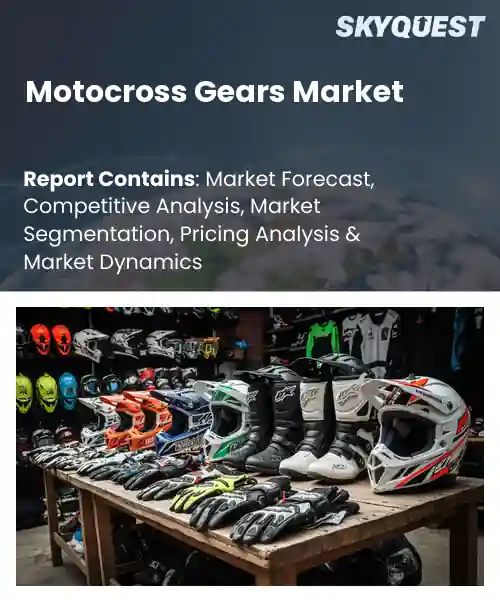
Motocross Gears Market
Report ID: SQMIG25J2236
Report ID: SQMIG25J2236
[email protected]
USA +1 351-333-4748
Report ID:
SQMIG25J2236 |
Region:
Global |
Published Date: July, 2026
Pages:
157
|Tables:
118
|Figures:
77


Global Motocross Gears Market size was valued at USD 1.52 Billion in 2024 and is poised to grow from USD 1.61 Billion in 2025 to USD 2.52 Billion by 2033, growing at a CAGR of 5.81% during the forecast period (2026-2033).
An accelerating primary driver of global motocross gears market is the convergence of growing participation in off-road motorcycle sports and intensified emphasis on rider safety and performance, which together reshape demand patterns. The market comprises protective apparel, helmets, boots, gloves and accessories designed for off-road conditions, and it matters because product improvements reduce injury risk while enabling higher performance for amateurs and professionals alike. Over the past two decades the sector evolved from basic, locally sourced gear to technologically advanced, branded offerings as manufacturers incorporated materials such as carbon fiber and CE-certified impact liners; for example, MXGP popularized premium standards.
A pivotal factor driving market expansion is rapid technological innovation combined with digital distribution, because advanced materials and online channels increase accessibility and perceived value which in turn fuels investment and product differentiation. When manufacturers adopt moisture-wicking fabrics, impact-dissipating foams and 3D-printed components, retailers can justify premium pricing and teams gain measurable safety improvements during racing seasons. Simultaneously, direct-to-consumer e-commerce and social media marketing accelerate adoption among hobbyists and overseas buyers, creating opportunities for subscription rental services at motocross parks and custom-fit offerings for professional riders, resulting in higher average selling prices and broader global penetration, and stronger brand loyalty.
How is AI Improving Safety Testing in the Motocross Gears Market?
The motocross gear market’s safety testing is being revolutionized through improved simulations of real-world experiences using AI. The use of virtual impact simulations and machine learning to improve the performance of sensor arrays, as well as creating digital twin models to provide engineers with the ability to evaluate multiple scenarios in one better allows engineers to get better overall designs compared to just having to constantly build physical prototypes. This combination of traditional drop testing with AI driven projections has helped refine aspects like shell shape, padding, and sensor integration. In addition, with the increased demand for smarter protective systems in this space, manufacturers are increasingly leveraging AI to speed up their overall design and development process and focus the majority of testing resources on the most viable designs.
In December 2025, Alpinestars launched the Tech Air MX airbag system using advanced AI crash detection and data driven testing. This innovation shortens development cycles and improves certification efficiency while boosting consumer confidence and supporting broader market adoption.
Market snapshot - (2026-2033)
Global Market Size
USD 1.52 Billion
Largest Segment
Helmets
Fastest Growth
Body Armor & Chest Protectors
Growth Rate
5.81% CAGR
To get more insights on this market click here to Request a Free Sample Report
Global motocross gears market is segmented by product type, end-user, distribution, certification and region. Based on product type, the market is segmented into helmets, body armor & chest protectors, boots, jerseys & pants and gloves & goggles. Based on end-user, the market is segmented into amateur/recreational riders and professional racers. Based on distribution, the market is segmented into online retail, motosports specialty stores and brand outlets. Based on certification, the market is segmented into DOT certified, ECE certified and FIM/MX certified. Based on region, the market is segmented into North America, Europe, Asia Pacific, Latin America and Middle East & Africa.
Helmets segment dominates because helmets are the primary safety barrier and visual identity for riders, driving purchase priority and manufacturer focus. Continuous material and ventilation innovations raise perceived value and justify premium positioning, prompting heavy R&D and marketing investments that reinforce market leadership. There is high demand for certified, performance-oriented helmet head protection from recreational users and professional users, and how products and channels are put together to maximize revenue through the sale of helmets is a key revenue source and central to the ongoing industry growth.
However, boots are emerging as the most rapidly expanding area due to advances in lightweight protective soles, improved ankle support, and rider demand for mobile safety. Broader adoption from trail and enduro disciplines, plus targeted beginner marketing and aftermarket customization, is spurring investment and unlocking new product tiers and retail opportunities.
ECE certified segment leads because recognition of its international testing protocols drives manufacturer alignment and consumer trust, prompting product redesigns to meet performance and labeling requirements. The certification of materials impacts how and where the source raw materials or products for their sale will also be impacted by testing and research and development partnerships with suppliers. Retailers often choose to sell certified products to limit liability, while also increasing perceived safety/performance of both low-end and high-end products through their use of certification as a marketing tool.
On the other hand, FIM/MX certified is witnessing the strongest growth as professional racing partnerships and event specifications push manufacturers toward race ready products. With increased visibility in competitive competitions, the demand from riders for homologating gear creates an opportunity for new materials and fitting processes leading to higher standards of product and creating new markets for aftermarket upgrades.
To get detailed segments analysis, Request a Free Sample Report
North America commands the global motocross gears market due to a strong combination of consumer enthusiasm, extensive trail and track infrastructure, and a mature retail and distribution network that supports specialist gear. The need for advanced protective equipment and performance apparel is driven by a combination of robust aftermarket support, established safety standards, and broad participation in both amateur and professional customer segments. The collaboration between domestic production, corporate headquarters and financing options helps to provide supply chain stability and encourage new entrants to focus on new materials and designs that are compatible with the range of riding environments they utilize their products. The collaboration between professional riders and gear manufacturers assists in creating new and innovative technologies (textiles) and ergonomic features within the gear.
Motocross gears market benefits from deep consumer engagement, an extensive network of specialty retailers, and a vibrant racing culture that drives demand for performance oriented protective gear. Industry collaboration with professional athletes and designers spurs product differentiation and technical advancement. By utilizing a robust media presence and multiple sponsorship opportunities, brands can create increased visibility. Various retail channels are also utilized to make premium products available to a wide range of riders from both competitive and recreational areas.
Motocross gears market in Canada reflects varied terrain and strong community clubs that prioritize safety and appropriate fit. Developing weather-resistant, strong and durable products for the toughest environments is being achieved by the suppliers through their partnership with local distributors who sell to independent retailers and riding schools to provide product exposure and the ability to select the best products. Expanding cross border rand access and event sponsorships provides additional access for recreational riders which drives the interest of competitive riders in their own region and provides education opportunities for dealers.
Europe is experiencing rapid expansion in the motocross gears market driven by coordinated regulatory frameworks, passionate riding communities, and a network of professional events that boost visibility. Established manufacturers and specialist brands offer localized product development focused on riding conditions for different climate types and terrains. Supporting growth of commercial businesses with a solid dealer network, expanding e-commerce presence, and working with racing schools to develop new riders. Increasingly concerned consumers are opting for safer and more environmentally friendly materials which drives innovation in products used for protection - whether that is in apparel or accessories. International distribution channels, along with the collaboration between brands and events, are facilitating the penetration of the market in these regions. Targeted marketing campaigns are being directed toward younger athletes to help broaden acceptance of motocross gear among the general population and also to establish brand loyalty through the purchase of products at specific retail locations.
Motocross gears market in Germany benefits from strong engineering heritage, rigorous safety testing, and a concentration of specialist manufacturers that supply domestic and export channels. Technical fit and certification are key areas of focus for retailers; while brand and racing team partnerships provide a way to improve products through testing. When consumers are able to trust that a product will perform well and last for a long time, it gives retailers the ability to offer premium priced products.
Motocross gears market in United Kingdom reflects a dynamic rider base and active clubs that promote equipment upgrades. Retailers invest in providing younger riders with a good fit through recommendations and using influencer partnerships to attract new customers through lifestyle marketing. By investing in indoor training facilities and hosting regional events retailers will create opportunities for younger riders to see the gear as well as to see and experience higher level of technical standards.
Motocross gears market in France is emerging through niche brands that combine technical performance with design. Specialty boutiques curate various types of selections with a focus on fit and aesthetics as well as providing protection. Designers collaborate with riders in order to develop specialized gear that is suited for the riding style in that area. As there are more riders involved in off-road events and training, the demand for athletic apparel continues to grow. Because manufacturers are focusing on developing new materials, they will offer unique products to appeal to consumers who want style and need rider education.
Asia Pacific is strengthening its role in the motocross gears market through a combination of manufacturing capacity, growing recreational participation, and focused product adaptation to regional conditions. National producers are working with overseas firms to create product lines that are customised for manufacturing and design for areas with hot and humid weather. The development of manufacturing efficiencies has also reduced the barriers for private label products and smaller brands to enter the marketplace. The establishment of more organised motocross competitions and training facilities is developing local talent and raising expectations of what is required of technical protective equipment. The rapid expansion of the e commerce environment and new distribution partnerships are expanding product access to customers throughout urban and semi urban areas. There is a growing emphasis on using lightweight material and installing cost-effective supply chains.
Motocross gears market in Japan is characterized by a focus on precision engineering, high quality materials, and meticulous attention to fit and finish. These companies also design products for the knowledgeable rider base through collaborative efforts with race teams and technical specialists. Retailers specializing in this type of product will continue to guide the consumer with correct equipment choice, as quality is critical as well as driving consumer requests for advanced protective clothing and accessories.
Motocross gears market in South Korea advances through a technology focused approach emphasizing lightweight construction, innovative fabrics, and modern design. Domestic manufacturers work with partners and riders to improve ergonomics and ventilation for local conditions. Customization and fitting services from retailers help to provide a better experience for the user. Events and training create a nurturing effect for both the competitive and recreational sides of motocross riding and help to develop interest in the sport as a whole.
To know more about the market opportunities by region and country, click here to
Buy The Complete Report
Rising Participation In Motorsports
Technological Advancements In Gear
High Cost Of Premium Gear
Regulatory And Certification Challenges
Request Free Customization of this report to help us to meet your business objectives.
Competition in the global motocross gears market is shaped by race-driven demands and sponsor dynamics that push rapid product cycles. Manufacturers pursue consolidation and portfolio plays such as Vista Outdoor’s acquisition of Fox Racing, team and factory partnerships like Alpinestars supplying Monster Energy Kawasaki, and on-track driven product innovation exemplified by Alpinestars’ Tech-Air MX airbag system.
Top Player’s Company Profile
Recent Developments
SkyQuest’s ABIRAW (Advanced Business Intelligence, Research & Analysis Wing) is our Business Information Services team that Collects, Collates, Correlates, and Analyses the Data collected by means of Primary Exploratory Research backed by robust Secondary Desk research.
As per SkyQuest analysis, the global motocross gears industry is being driven by growing participation in off-road motorcycle sports and heightened emphasis on rider safety, with a second driver being rapid technological innovation combined with digital distribution that raises product value and accessibility. A restraint is the high cost of premium certified gear which limits adoption among price sensitive riders and slows broader penetration. The dominating region is North America thanks to strong participation, infrastructure and mature retail channels, while the dominating segment is helmets because head protection anchors purchase decisions and supports premium pricing. Opportunities center on connected apparel, sustainable materials and AI enabled safety testing.
| Report Metric | Details |
|---|---|
| Market size value in 2024 | USD 1.52 Billion |
| Market size value in 2033 | USD 2.52 Billion |
| Growth Rate | 5.81% |
| Base year | 2024 |
| Forecast period | (2026-2033) |
| Forecast Unit (Value) | USD Billion |
| Segments covered |
|
| Regions covered | North America (US, Canada), Europe (Germany, France, United Kingdom, Italy, Spain, Rest of Europe), Asia Pacific (China, India, Japan, Rest of Asia-Pacific), Latin America (Brazil, Rest of Latin America), Middle East & Africa (South Africa, GCC Countries, Rest of MEA) |
| Companies covered |
|
| Customization scope | Free report customization with purchase. Customization includes:-
|
To get a free trial access to our platform which is a one stop solution for all your data requirements for quicker decision making. This platform allows you to compare markets, competitors who are prominent in the market, and mega trends that are influencing the dynamics in the market. Also, get access to detailed SkyQuest exclusive matrix.
Table Of Content
Executive Summary
Market overview
Parent Market Analysis
Market overview
Market size
KEY MARKET INSIGHTS
COVID IMPACT
MARKET DYNAMICS & OUTLOOK
Market Size by Region
KEY COMPANY PROFILES
Methodology
For the Motocross Gears Market, our research methodology involved a mixture of primary and secondary data sources. Key steps involved in the research process are listed below:
1. Information Procurement: This stage involved the procurement of Market data or related information via primary and secondary sources. The various secondary sources used included various company websites, annual reports, trade databases, and paid databases such as Hoover's, Bloomberg Business, Factiva, and Avention. Our team did 45 primary interactions Globally which included several stakeholders such as manufacturers, customers, key opinion leaders, etc. Overall, information procurement was one of the most extensive stages in our research process.
2. Information Analysis: This step involved triangulation of data through bottom-up and top-down approaches to estimate and validate the total size and future estimate of the Motocross Gears Market.
3. Report Formulation: The final step entailed the placement of data points in appropriate Market spaces in an attempt to deduce viable conclusions.
4. Validation & Publishing: Validation is the most important step in the process. Validation & re-validation via an intricately designed process helped us finalize data points to be used for final calculations. The final Market estimates and forecasts were then aligned and sent to our panel of industry experts for validation of data. Once the validation was done the report was sent to our Quality Assurance team to ensure adherence to style guides, consistency & design.
Analyst Support
Customization Options
With the given market data, our dedicated team of analysts can offer you the following customization options are available for the Motocross Gears Market:
Product Analysis: Product matrix, which offers a detailed comparison of the product portfolio of companies.
Regional Analysis: Further analysis of the Motocross Gears Market for additional countries.
Competitive Analysis: Detailed analysis and profiling of additional Market players & comparative analysis of competitive products.
Go to Market Strategy: Find the high-growth channels to invest your marketing efforts and increase your customer base.
Innovation Mapping: Identify racial solutions and innovation, connected to deep ecosystems of innovators, start-ups, academics, and strategic partners.
Category Intelligence: Customized intelligence that is relevant to their supply Markets will enable them to make smarter sourcing decisions and improve their category management.
Public Company Transcript Analysis: To improve the investment performance by generating new alpha and making better-informed decisions.
Social Media Listening: To analyze the conversations and trends happening not just around your brand, but around your industry as a whole, and use those insights to make better Marketing decisions.
REQUEST FOR SAMPLE
 REQUEST FREE CUSTOMIZATION
Global Motocross Gears Market size was valued at USD 1.52 Billion in 2024 and is poised to grow from USD 1.61 Billion in 2025 to USD 2.52 Billion by 2033, growing at a CAGR of 5.81% during the forecast period (2026-2033).
Competition in the global motocross gears market is shaped by race-driven demands and sponsor dynamics that push rapid product cycles. Manufacturers pursue consolidation and portfolio plays such as Vista Outdoor’s acquisition of Fox Racing, team and factory partnerships like Alpinestars supplying Monster Energy Kawasaki, and on-track driven product innovation exemplified by Alpinestars’ Tech-Air MX airbag system. 'Fox Racing', 'Troy Lee Designs', 'Fly Racing', 'O'Neal MX', 'Leatt Corporation', 'Alpinestars', 'Dainese SpA', 'Bell Helmets', 'Shoei Co. Ltd.', 'AGV (Dainese)', 'THOR MX', 'Klim Powersports', 'EVS Sports', 'Moose Racing', 'Answer Racing (Tucker Powersports)', 'MSR (Tucker Powersports)', '100% (One Industries)', 'Airoh Helmets', 'Scott Sports', 'Forma Boots'
Growing participation in motocross and off-road motorsports has expanded the customer base for specialized gear, driving demand for helmets, protective apparel, and boots. As more riders engage in competitive and recreational events, they seek higher-performance and safer equipment, encouraging manufacturers to broaden product lines and distribution. Retailers respond by stocking diverse SKUs and promoting premium offerings, while brands invest in rider education and community engagement to strengthen loyalty. This dynamic supports steady market expansion through increased replacement cycles and accessory purchases.
Sustainable Materials Adoption: Manufacturers are prioritizing eco-friendly inputs and circular design principles to meet rider expectations for lower environmental impact. Adoption of recycled textiles, plant-based polymers and end-of-life takeback programs is reshaping product development and supplier relationships. This shift enhances brand positioning through sustainability narratives while requiring adjustments in sourcing, testing and manufacturing workflows. Retailers and teams emphasize traceability and transparency to reassure consumers, creating opportunities for premium sustainable lines and long-term loyalty as environmental stewardship becomes a core differentiator in motocross gear.
Why does North America Dominate the Global Motocross Gears Market? |@12


Want to customize this report? This report can be personalized according to your needs. Our analysts and industry experts will work directly with you to understand your requirements and provide you with customized data in a short amount of time. We offer $1000 worth of FREE customization at the time of purchase.
Feedback From Our Clients


 USA (+1) 351-333-4748

