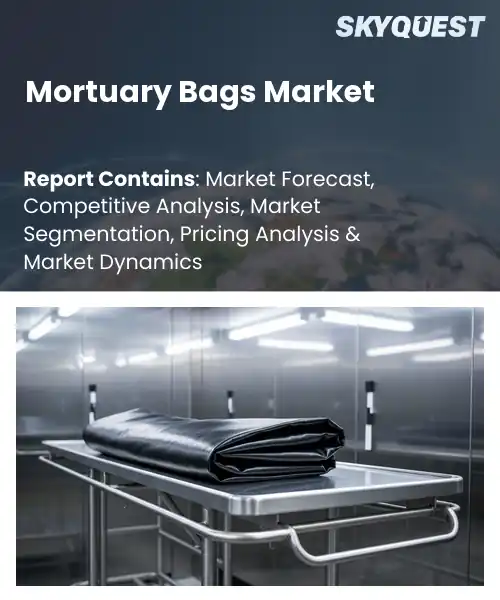
Mortuary Bags Market
Report ID: SQMIG35B2342
Report ID: SQMIG35B2342
[email protected]
USA +1 351-333-4748
Report ID:
SQMIG35B2342 |
Region:
Global |
Published Date: June, 2026
Pages:
157
|Tables:
95
|Figures:
76


Global Mortuary Bags Market size was valued at USD 1.53 Billion in 2024 and is poised to grow from USD 1.63 Billion in 2025 to USD 2.69 Billion by 2033, growing at a CAGR of 6.47% during the forecast period (2026-2033).
What primarily drives the mortuary bags market is the need for effective body management to maintain safety and respect. The demand for mortuary bags is growing due to numerous public health issues, natural catastrophes, and demographic changes. In simple terms, mortuary bags refer to highly durable products used in hospitals, mortuaries, emergencies, and humanitarian relief efforts to transport bodies and keep infections and dignity intact. The evolution of mortuary bags took place from very basic and primitive body sacks to those having anti-leakage features along with identification windows and antimicrobial linings; the recent global pandemic of coronavirus brought a perfect example. regulatory scrutiny worldwide while highlighting supply-chain vulnerabilities too.
One of the major growth factors for the international mortuary bags market would be regulatory compliance and emergency preparedness. The strict regulations regarding infection control measures and disaster response strategies make it compulsory for facilities to purchase validated products. Any amendments in governmental policies and hospital procedures following disasters and pandemics result in larger budgets to invest in procurement and larger scales of production on the part of suppliers, allowing the industry players to utilize eco-friendly materials, tamper-proof seals and traceability mechanisms. In addition, there is an increased demand for reinforced mortuary bags from emergency services in case of floods and earthquakes and body preservation mortuary bags among forensic services.
How is AI Improving Tracking and Management in the Mortuary Bags Market?
AI is improving tracking and management in the market for mortuary bags by integrating intelligent tags with sensor-based telemetry and case management software in order to have a traceable process. Important elements include location tracking while transferring, monitoring temperature when storing the bags, and chain of custody logging, which minimizes the risk of human error. Current state includes increasing use of IoT tagging and AI-powered document automation to automate manual log recording and avoid potential anomalies in the first place. In action, funeral homes and hospitals rely on technology to convert images into documents in order to generate case files and use AI notifications in order to manage transfers and inventory more reliably. Afterword, October 2025, introduced Grace as an AI assistant to be used in funeral homes for automated case file generation through document automation and conversion of handwriting to machine-readable format.
Market snapshot - (2026-2033)
Global Market Size
USD 1.53 Billion
Largest Segment
PVC
Fastest Growth
Polyester
Growth Rate
6.47% CAGR
To get more insights on this market click here to Request a Free Sample Report
Global mortuary bags market is segmented by material type, size, end-user and region. Based on material type, the market is segmented into PVC, Polyethylene, Nylon, Polyester and Others. Based on size, the market is segmented into Adult Bags, Child Bags, Infant Bags and Bariatric Bags. Based on end-user, the market is segmented into Hospitals, Morgues, Forensic Laboratories, Disaster Relief Agencies and Others. Based on region, the market is segmented into North America, Europe, Asia Pacific, Latin America and Middle East & Africa.
The PVC section takes the lead owing to the impermeability and toughness of the material which directly contribute towards reducing the contamination risks associated with the handling and storing of body bags. The ease of using PVC in sealed containers and its ability to withstand chemicals makes it easier to disinfect, hence decreasing liability and operational disruptions. With proven production capacity and widespread acceptance by hospital procurement departments, it ensures steady availability and easy integration with other accessories.
Nevertheless, the fastest growing section is that of polyethylene owing to its lightness and flexible production methods, allowing for reduced logistics costs and scalability in case of emergencies. Increased thickness of polyethylene film as well as production of recycled products widens its application while changes in the procurement process of cost-effective disposable products encourage innovations.
The Bariatric Bags category leads since the unique design of these bags helps handle the specific difficulties faced when dealing with cases involving increased body mass and dignified management thereof. The strong seams, robust zippers, and lift mechanisms help reduce physical strain and time spent on procedures, thus limiting injuries to personnel. For this reason, procurement officers value these products for the long-term use and dependability that they offer, and hence the consistent replacement process and use alongside lifting devices.
Meanwhile, the Infant Bag category is experiencing the greatest momentum due to increased awareness on respectful treatment of infants, development of bereavement procedures, and the needs of pediatric departments and forensic examiners. Innovation in this product line regarding size and transfer mechanisms is driving procurement priorities.
To get detailed segments analysis, Request a Free Sample Report
The dominance of North America in the global mortuary bags market is due to the presence of advanced health care infrastructure, well-developed mortuary and forensic services, standards for body handling, and strong logistical infrastructure. The use of innovative materials and focus on infection control have been the reasons behind the increasing demands for mortuary bags. There is efficient procurement process, effective cooperation between manufacturers and service providers, and favorable regulatory frameworks that encourage product innovation and distribution processes. Demand from hospitals, medical examiner offices, and disaster relief organizations creates a wide variety of products. The investments of both public and private organizations in emergency preparations make the industry resilient and capable of scaling up in case of need. The research into materials and the training of employees facilitate product innovations and adoption processes.
Market for Mortuary Bags in USA is driven by robust institutional demand coming from hospitals, ME offices, and emergency organizations. Concerns about infection control, forensics, and development of materials drive purchasing decisions. Availability of distribution networks and associations with clinicians and disaster management help companies. Product customization and mortuary staff training contribute to steady demand, which helps suppliers meet complex demands.
The Mortuary Bags Market in Canada can be seen as being driven by centralized purchasing within the provincial healthcare systems as well as by the focus on interoperability within hospitals and forensics. The quality of materials and safety considerations lead to a demand for customized containment solutions. The manufacturers partner with local healthcare administrations to overcome logistics issues arising due to differences in geography.
There are growing opportunities in the European mortuary bags market owing to the modernization of health care and forensic services, standardization of infections control protocols, and coordinated purchasing of materials. There is a high level of collaboration in research and strong scientific capabilities in material sciences within the region that can be leveraged for the development of advanced containment products that would meet the needs of varied operating environments. Collaboration between manufacturers and health care regulators helps in adopting best practices in a faster manner. The demand from hospitals, forensic laboratories, and humanitarian organizations, along with standards of quality assurance and staff training, makes suppliers develop differentiated products with customized logistics, ensuring growth in the market. Alignment in regulations and public-private partnerships ensure easy entry into the market for new products and promote quality standards. Focus on disaster response and humanitarian logisticsincreases the need for robust and portable containment products.
Germany’s Mortuary Bags Industry has stringent technical requirements and excellent cooperation between suppliers and forensic organizations with regard to material performance requirements. There is much expectation that any mortuary bag supplied should be durable and approved for use within both clinical and medico-legal settings. The research and industrial capabilities facilitate innovative development as well as customization. Suppliers coordinate their activities with the national health bodies as well as emergency response planners.
UK Mortuary Bags Market is witnessing growth due to the increasing investments in emergency preparedness, attention to standardizing clinical procedures, and collaborative arrangements between suppliers and healthcare trusts. Such market activity is driven by acceptance of new technology in terms of innovative materials and flexible designs that accommodate different operational environments. Training and compatibility with current logistics infrastructure in the field of medicine are key factors that promote adoption.
The Mortuary Bags Market in France is gaining traction as the focus on standardization, quality, and compatibility with hospital logistics increases. Public health organizations and forensic laboratories are working closely with suppliers to determine the performance criteria and procurement process for such bags. The importance of training and cross-industry cooperation will lead to the implementation of dedicated containment bags within the clinical setting.
The Asia Pacific Region is positioning itself well in the mortuary bags industry due to improvements in the country's healthcare infrastructure, increase in local manufacturing capacity, and increasing emphasis on emergency readiness by the countries' authorities. Developments in materials science and adaptation to climatic and logistic challenges ensure that the developments of the solution are done with considerations for their portability and durability. Improvements in the distribution network and collaborations between local and international suppliers ensure better penetration of these solutions within metropolitan and isolated locations. Harmonization of regulations and training of mortuary and forensic experts increase the use of standard products. Collectively, all the efforts ensure that local suppliers are able to cater to the needs of the region by making efficient adaptations while ensuring adequate support systems.
Market for Mortuary Bags in Japan is affected by strict quality requirements, technological progress in materials science, and robust healthcare logistics. Cooperation between producers and research organizations facilitates development of compact and highly effective containment products based on clinical and forensic practices. Concentration on disaster preparedness and effective logistics leads to provision of these goods to cities and rural areas. Producers are concerned with developing durable and ergonomic bags, along with training personnel.
Mortuary Bags Market in South Korea enjoys its success through its capabilities in advanced manufacturing processes, high standards of quality control practices, and partnership with medical facilities and local suppliers. There is an orientation toward materials that strike a balance between strength and convenience of transport, which are required by hospitals and during emergency scenarios. Logistics and integration into emergency response systems contribute toward better delivery channels.
To know more about the market opportunities by region and country, click here to
Buy The Complete Report
Rising Mortality Rates and Incidents
The growing death rates and unforeseen mass casualty events create a need for sturdy and durable mortuary bags, as establishments consider it essential to have safe body containers that ensure safe transportation and reduced risk of contamination. There is therefore an urgent need for mortuary bags that provide safe transportation and prevent any form of leaks. It is this urgency to have a proper process in place for disposal and continuation of operations at mortuaries that has seen the steady adoption of these products.
Stringent Infection Control Protocols
Improved infection control measures in the health care, forensics, and mortuary fields enhance the likelihood that mortuary bags will be selected due to their non-permeability features and ease of use. Institutions prefer products that limit the risks of cross contamination when moving and storing them, meet bio-safety standards, and contribute to efficient hygiene practices. Such preferences encourage suppliers to manufacture bags that are easily disinfectable or disposable, thereby promoting innovations in material and seal designs.
High Procurement and Disposal Costs
The high costs associated with procurement and disposal will hinder market access for smaller facilities and resource-limited service providers because of the increased expenses involved. Service providers that are operating within tight budgets will prefer other options such as reuse, even in the presence of health complications, in order to minimize purchase costs. Moreover, the challenge of managing infectious waste and ensuring that there is disposal will add to the existing difficulties of making purchases often.
Regulatory and Cultural Constraints
Inconsistencies in regulatory policies and mortuary practices embedded in culture could limit market expansion due to fragmented demand as well as the complications that arise from the implementation process. When there are traditions involving the handling of corpses in certain areas which call for a certain method to be used, there may be reluctance on the part of organizations or families to use standardized mortuary bags. Differences in certification processes, restrictions on imports, and other bureaucratic issues increase the time taken for suppliers to adopt them and the difficulty of penetrating the market.
Request Free Customization of this report to help us to meet your business objectives.
Competitive forces within the international mortuary bags industry are based on differentiation in terms of material types and regulatory requirements, with sustainability initiatives and biohazard prevention playing a key role in competitive actions. Firms attempt to innovate their products, with examples including the launch of Mopec’s Safe View bag and the development of environmentally friendly bags as seen in Polcreative’s bio-degradable range. In addition, firms attempt to consolidate through mergers and acquisitions as well as partnerships with suppliers for specialty films and RFID technology. However, two exclusively mortuary bag startups launched since 2019 cannot be identified.
Sustainable Materials Adoption: Both manufacturers and consumers are leaning towards the use of materials that are biodegradable and recyclable, as well as having minimal effects on the environment due to sustainability initiatives. As a result, there is increased innovation regarding the development of polymers and supply chains associated with the materials used. The industry is making provision for materials with proven certification and partnerships with different recycling facilities that provide value-added services to customers, who can then adopt the relevant protocols within their organizations.
Digital Procurement and Traceability: The use of digital procurement systems is being employed by healthcare practitioners and funeral service providers for efficient procurement as well as provenance and resilient inventory management. There is an increasing emphasis on transparency and visibility which will foster better relations with suppliers and allow for prompt responses. Improved digital documentation helps to comply with regulations but provides an avenue for offering bundled services such as inventory management systems from suppliers and automated inventory replenishment.
SkyQuest’s ABIRAW (Advanced Business Intelligence, Research & Analysis Wing) is our Business Information Services team that Collects, Collates, Correlates, and Analyses the Data collected by means ofPrimary Exploratory Research backed by robust Secondary Desk research.
As per SkyQuest analysis, the major factors influencing the global mortuary bags market include the rising requirement for handling human remains in a safe and respectful manner, which leads to increasing demand from hospitals, forensic services, and disaster management teams. The second factor impacting the market is increasing regulatory compliance and emergencies, which results in a requirement to source certified containment bags. Factors such as the higher cost associated with purchasing and disposing of mortuary bags are some of the restraining forces in the market. North America is expected to be a dominant market because of advanced healthcare facilities and procurement process, whereas the PVC material type is likely to dominate in terms of application.
| Report Metric | Details |
|---|---|
| Market size value in 2024 | USD 1.53 Billion |
| Market size value in 2033 | USD 2.69 Billion |
| Growth Rate | 6.47% |
| Base year | 2024 |
| Forecast period | (2026-2033) |
| Forecast Unit (Value) | USD Billion |
| Segments covered |
|
| Regions covered | North America (US, Canada), Europe (Germany, France, United Kingdom, Italy, Spain, Rest of Europe), Asia Pacific (China, India, Japan, Rest of Asia-Pacific), Latin America (Brazil, Rest of Latin America), Middle East & Africa (South Africa, GCC Countries, Rest of MEA) |
| Companies covered |
|
| Customization scope | Free report customization with purchase. Customization includes:-
|
To get a free trial access to our platform which is a one stop solution for all your data requirements for quicker decision making. This platform allows you to compare markets, competitors who are prominent in the market, and mega trends that are influencing the dynamics in the market. Also, get access to detailed SkyQuest exclusive matrix.
Table Of Content
Executive Summary
Market overview
Parent Market Analysis
Market overview
Market size
KEY MARKET INSIGHTS
COVID IMPACT
MARKET DYNAMICS & OUTLOOK
Market Size by Region
KEY COMPANY PROFILES
Methodology
For the Mortuary Bags Market, our research methodology involved a mixture of primary and secondary data sources. Key steps involved in the research process are listed below:
1. Information Procurement: This stage involved the procurement of Market data or related information via primary and secondary sources. The various secondary sources used included various company websites, annual reports, trade databases, and paid databases such as Hoover's, Bloomberg Business, Factiva, and Avention. Our team did 45 primary interactions Globally which included several stakeholders such as manufacturers, customers, key opinion leaders, etc. Overall, information procurement was one of the most extensive stages in our research process.
2. Information Analysis: This step involved triangulation of data through bottom-up and top-down approaches to estimate and validate the total size and future estimate of the Mortuary Bags Market.
3. Report Formulation: The final step entailed the placement of data points in appropriate Market spaces in an attempt to deduce viable conclusions.
4. Validation & Publishing: Validation is the most important step in the process. Validation & re-validation via an intricately designed process helped us finalize data points to be used for final calculations. The final Market estimates and forecasts were then aligned and sent to our panel of industry experts for validation of data. Once the validation was done the report was sent to our Quality Assurance team to ensure adherence to style guides, consistency & design.
Analyst Support
Customization Options
With the given market data, our dedicated team of analysts can offer you the following customization options are available for the Mortuary Bags Market:
Product Analysis: Product matrix, which offers a detailed comparison of the product portfolio of companies.
Regional Analysis: Further analysis of the Mortuary Bags Market for additional countries.
Competitive Analysis: Detailed analysis and profiling of additional Market players & comparative analysis of competitive products.
Go to Market Strategy: Find the high-growth channels to invest your marketing efforts and increase your customer base.
Innovation Mapping: Identify racial solutions and innovation, connected to deep ecosystems of innovators, start-ups, academics, and strategic partners.
Category Intelligence: Customized intelligence that is relevant to their supply Markets will enable them to make smarter sourcing decisions and improve their category management.
Public Company Transcript Analysis: To improve the investment performance by generating new alpha and making better-informed decisions.
Social Media Listening: To analyze the conversations and trends happening not just around your brand, but around your industry as a whole, and use those insights to make better Marketing decisions.
REQUEST FOR SAMPLE
 REQUEST FREE CUSTOMIZATION
Global Mortuary Bags Market size was valued at USD 1.53 Billion in 2024 and is poised to grow from USD 1.63 Billion in 2025 to USD 2.69 Billion by 2033, growing at a CAGR of 6.47% during the forecast period (2026-2033).
Competitive pressure in the global mortuary bags market centers on material differentiation and regulatory compliance, with sustainability mandates and biohazard containment driving competitive moves. Firms pursue product-level innovation such as Mopec’s Safe View transparent bag, eco launches like Polcreative’s bio-compostable line, and consolidation through acquisitions and supplier partnerships to secure specialty film, RFID tracking, and forensic-grade pouches. I could not identify two verified, exclusively mortuary-bag startups founded in 2019 or later; market reporting and supplier activity show most material and product innovation is currently led by established manufacturers and packaging specialists rather than recent standalone mortuary-bag startups. '3M Company', 'Cardinal Health', 'Medline Industries', 'B. Braun SE', 'Baxter International', 'Fresenius SE', 'Terumo Corporation', 'Nipro Corporation', 'Smith & Nephew', 'Stryker Corporation', 'Zimmer Biomet Holdings', 'Henry Schein', 'Owens & Minor', 'DeRoyal Industries', 'Mopec', 'Span-America Medical Systems', 'Romsons Group', 'Poly Medicure', 'GPC Medical', 'Narula Udyog'
Rising mortality and sudden mass casualty incidents increase demand for reliable, durable mortuary bags as facilities and emergency responders prioritize secure body containment and respectful handling. Institutions seek products that facilitate safe transport, prevent leakage and limit exposure to biological hazards, prompting procurement and stockpiling. The heightened emphasis on dignified disposition and continuity of mortuary operations motivates facilities to invest in specialized containment solutions, which supports steady expansion in product adoption across hospitals, forensic centers, disaster response teams and funeral service providers.
Sustainable Materials Adoption: Manufacturers and purchasers are prioritizing biodegradable, recyclable and lower-impact materials for mortuary bags, driven by institutional sustainability commitments and environmental stewardship expectations. This trend is encouraging innovation in polymer formulations and supply chain transparency, reshaping procurement criteria and product design to balance performance with end-of-life considerations. The market is responding with validated material certifications, partnerships across recycling ecosystems and value-added services that communicate environmental credentials, helping buyers align operational protocols with sustainability goals while addressing stakeholder concerns about ecological impact.
Why does North America Dominate the Global Mortuary Bags Market? |@12


Want to customize this report? This report can be personalized according to your needs. Our analysts and industry experts will work directly with you to understand your requirements and provide you with customized data in a short amount of time. We offer $1000 worth of FREE customization at the time of purchase.
Feedback From Our Clients


 USA (+1) 351-333-4748

