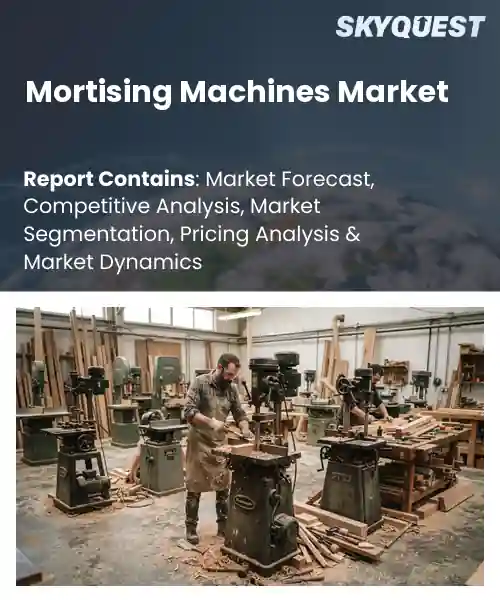
Mortising Machines Market
Report ID: SQMIG20I3735
Report ID: SQMIG20I3735
[email protected]
USA +1 351-333-4748
Report ID:
SQMIG20I3735 |
Region:
Global |
Published Date: August, 2026
Pages:
157
|Tables:
118
|Figures:
77


Global Mortising Machines Market size was valued at USD 752.0 Million in 2024 and is poised to grow from USD 791.86 Million in 2025 to USD 1196.95 Million by 2033, growing at a CAGR of 5.3% during the forecast period (2026-2033).
The global mortising machines market includes manufacturers and suppliers of equipment that cut rectangular holes in wood, a process essential for joinery in furniture, cabinetry and construction. Demand for durable timber products drives adoption of mortising solutions because manual drilling cannot meet the speed or consistency required by producers. During the past decade market has shifted from bulky hydraulic units to CNC models, reflecting advances in control and need for production lines. A cabinet maker replaced a hydraulic press with a mortiser, slashing cycle time by 30 percent and reducing labor costs, showing how efficiency gains have become market’s catalyst. The rising emphasis on sustainable construction acts as the next pivotal driver, because manufacturers increasingly seek equipment that minimizes waste while maintaining precision. Mortising machines equipped with digital sensor feedback can adjust cut depth in time, thereby reducing scrap rates to 20 percent; this efficiency directly translates into lower material costs for producers of eco‑friendly furniture. As green building certifications such as LEED gain market traction, suppliers are launching models powered by inverter drives, which lower electricity consumption and qualify projects for credit points. Consequently, firms that integrate these mortisers gain competitive advantage, attracting architects and developers who prioritize performance.
How is AI-driven automation reshaping the mortising machines market?
AI driven automation is redefining mortising machines by embedding real time sensor feedback, adaptive control algorithms, and predictive maintenance into the core of each unit. These capabilities allow machines to adjust feed rates and cutting depth on the fly, reducing waste and improving repeatability. Manufacturers are integrating vision systems that recognize wood grain and joint geometry, enabling a single setup to handle diverse product lines. The result is faster changeovers, lower operator fatigue, and a tighter link between design intent and final assembly. As the broader woodworking equipment sector expands, AI enhanced mortisers are becoming a preferred choice for high volume timber producers seeking consistent quality.Stiles Machinery announced an AI enabled mortiser line in April 2026, showcasing real time monitoring and self optimizing cutting sequences. The rollout shortens setup time and cuts material loss, illustrating how AI driven automation is accelerating efficiency and supporting growth in the mortising market for manufacturers worldwide today.
Market snapshot - (2026-2033)
Global Market Size
USD 752.0 Million
Largest Segment
Chisel Mortising Machines
Fastest Growth
Chain Mortising Machines
Growth Rate
5.3% CAGR
To get more insights on this market click here to Request a Free Sample Report
Global mortising machines market is segmented by product type, operation mode, application, end user and region. Based on product type, the market is segmented into Chain Mortising Machines, Chisel Mortising Machines and Slot Mortising Machines. Based on operation mode, the market is segmented into Manual, Semi-Automatic and Automatic. Based on application, the market is segmented into Furniture Manufacturing, Door & Window Manufacturing, Cabinet Making and General Woodworking. Based on end user, the market is segmented into Industrial Manufacturers, Small & Medium Workshops and Custom Carpentry Shops. Based on region, the market is segmented into North America, Europe, Asia Pacific, Latin America and Middle East & Africa.
Automatic operation mode segment dominates because it delivers consistent cut depth, reduces operator fatigue, and integrates seamlessly with digital control systems that modern factories demand. Manufacturers favor it for high throughput, reproducible quality, and the ability to link with computer aided manufacturing platforms, which minimizes waste and accelerates production cycles. This alignment with efficiency imperatives drives its leadership within the mortising machines market. Consequently original equipment manufacturers prioritize automatic units in their product roadmaps.
However, semi automatic operation mode segment emerges as the most rapidly expanding because emerging workshops seek a balance between productivity and capital expenditure, finding that semi automatic machines provide sufficient speed while retaining manual flexibility. This cost effective choice spurs adoption across growing enterprises, fueling market expansion and new opportunity creation.
Chisel mortising machines segment dominates because they offer precise, clean cuts in solid wood, meeting the exacting tolerances demanded by high end furniture production. Their robust design tolerates continuous operation, and the straightforward tool change system reduces downtime, enabling manufacturers to sustain high output levels. This reliability reinforces their preferred status among industrial producers seeking consistent quality. Consequently OEMs prioritize chisel technology in new lineups to satisfy demanding production schedules.
Meanwhile, slot mortising machines segment is witnessing the strongest growth momentum because designers are integrating decorative grooves and lightweight joinery that require shallow, elongated slots, which these machines produce efficiently. Their ability to handle multiple material thicknesses without extensive reconfiguration appeals to versatile workshops, accelerating adoption and expanding market opportunity.
To get detailed segments analysis, Request a Free Sample Report
North America maintains its leadership position through a combination of mature manufacturing infrastructure, deep expertise in wood processing, and a highly responsive supply chain that delivers advanced mortising solutions to a broad customer base. The region benefits from a concentration of original equipment manufacturers that prioritize precision engineering and continuous innovation, fostering products that meet stringent performance expectations. Strong after‑sales support and a well‑developed network of service providers enhance equipment uptime, reinforcing buyer confidence. Additionally, the presence of skilled labor and a culture that embraces automation accelerates adoption of sophisticated mortising technologies. Regulatory frameworks that encourage safety and efficiency further bolster market attractiveness, while collaborative partnerships between manufacturers and research institutions drive ongoing product refinement, solidifying North America’s dominant market role.
Mortising Machines Market in the United States is propelled by a robust ecosystem of furniture manufacturers and custom millwork shops that demand high precision and rapid cycle times. The presence of leading equipment builders encourages rapid integration of cutting‑edge features, while an extensive dealer network ensures prompt parts availability and technical assistance. This combination of demand intensity and service excellence sustains a vibrant market environment for producers seeking reliable operation.
Mortising Machines Market in Canada benefits from a strong tradition of residential construction and a growing niche of boutique cabinet makers that value precise joinery. Close proximity to U.S. suppliers facilitates easy access to the latest machine designs, while local distributors provide tailored support and training. The emphasis on sustainable building practices also drives interest in efficient mortising solutions that minimize material waste. Such dynamics reinforce confidence among contractors and design professionals.
Europe’s mortising machines sector is experiencing rapid expansion due to a convergence of high‑value woodworking traditions, strong emphasis on design excellence, and accelerating adoption of automated production lines. The region’s mature furniture and interior fit‑out industries demand equipment that delivers both precision and flexibility, encouraging manufacturers to integrate advanced control systems and modular toolsets. Environmental regulations that promote resource efficiency inspire the development of machines with optimized energy consumption and reduced material loss. Collaborative research initiatives across the continent foster continuous innovation, while a well‑established network of specialized distributors ensures rapid after‑sales service and parts availability. Together, these factors create a fertile environment for sustained market growth across Europe. The growing demand for high‑end residential renovation projects further intensifies the need for versatile mortising solutions that can adapt to diverse material specifications.
Mortising Machines Market in Germany is anchored by a longstanding reputation for engineering excellence and a dense cluster of precision tool manufacturers. German furniture exporters and high‑end cabinet producers rely on machines that combine durability with sophisticated digital interfaces, prompting local OEMs to embed robust automation features. Close collaboration between equipment makers and technical institutes accelerates the introduction of ergonomic designs, ensuring that the market remains responsive to evolving industry standards.
Mortising Machines Market in the United Kingdom is driven by a dynamic custom joinery sector and a resurgence of heritage timber projects that demand meticulous craftsmanship. The market benefits from agile distributors that provide swift training and localized support, enabling small‑to‑medium enterprises to adopt sophisticated equipment without extensive capital outlay. Ongoing collaborations with design schools encourage the integration of innovative mortising techniques that align with contemporary architectural trends.
Mortising Machines Market in France is emerging as boutique interior designers and upscale renovation firms seek machines that deliver high precision while supporting artisanal aesthetics. French manufacturers emphasize compact footprints and modularity, allowing easy integration into limited workshop spaces. Partnerships with European technology hubs facilitate the adoption of smart connectivity features, which enhance workflow efficiency and traceability, appealing to clients focused on both quality and sustainable production practices.
Asia Pacific is steadily strengthening its position by leveraging a combination of rapid industrialization, growing demand for high‑quality timber products, and a strategic focus on automation and precision engineering. Manufacturers in the region are investing heavily in research and development to produce machines that incorporate advanced sensor technology and user‑friendly interfaces, catering to both large‑scale production facilities and emerging small‑shop operators. The rising prominence of export‑oriented furniture hubs encourages the adoption of equipment that can maintain tight tolerances and accelerate cycle times. Government initiatives that support smart manufacturing and sustainable resource utilization further stimulate market momentum, while expanding vocational training programmes ensure a skilled workforce capable of operating sophisticated mortising solutions. These converging forces position Asia Pacific as a burgeoning center of innovation and demand.
Mortising Machines Market in Japan is characterized by a strong emphasis on precision, reliability, and compact design, reflecting the country’s tradition of meticulous engineering. Japanese woodcraft firms prioritize machines that integrate seamless digital controls and low‑vibration operation, supporting intricate joinery work. Local manufacturers collaborate closely with component suppliers to incorporate high‑quality bearings and servo drives, while extensive dealer networks provide rapid technical assistance, fostering confidence among both large manufacturers and specialized artisans.
Mortising Machines Market in South Korea benefits from a rapidly modernizing woodworking sector that emphasizes speed, accuracy, and integration with digital production lines. Korean equipment makers focus on embedding intelligent control algorithms and connectivity features that enable real‑time monitoring and predictive maintenance. Tight collaboration with automotive‑grade component suppliers ensures high durability, while aggressive after‑sales service models guarantee swift parts replacement. This blend of technological sophistication and responsive support drives expanding adoption across midsize factories and custom furniture workshops.
To know more about the market opportunities by region and country, click here to
Buy The Complete Report
Increasing Construction Automation
The rise of automated processes in building projects is encouraging manufacturers to adopt mortising machines that integrate seamlessly with robotic systems, thereby reducing labor intensity and improving precision. Contractors value the ability to synchronize mortising operations with other automated tasks, which shortens cycle times and enhances overall productivity. This alignment with digital construction workflows fosters greater acceptance of advanced mortising equipment, prompting vendors to expand product portfolios and support services, ultimately driving market expansion through heightened demand for efficient, technology‑enabled joinery solutions.
Growing Demand for Custom Furniture
Craftsmen and boutique manufacturers are seeking precise and repeatable mortise joints to meet consumer preferences for high‑quality, bespoke furniture. Mortising machines enable consistent depth and angle control, which is essential for assembling intricate designs without compromising structural integrity. This capability supports rapid prototyping and limited‑run production, aligning with market trends that favor personalization over mass production. As designers prioritize unique aesthetic details, the reliance on specialized mortising equipment intensifies, prompting suppliers to innovate and tailor offerings, thereby reinforcing market growth through expanded application breadth.
High Initial Capital Investment
Purchasing a fully automated mortising system often requires substantial upfront expenditure, which can deter small and medium‑sized enterprises from upgrading their equipment. The financial burden includes not only the machine cost but also installation, training, and maintenance expenses, creating a barrier to entry for firms with limited budgets. Consequently, many operators continue to rely on conventional tools or manual processes, slowing the overall adoption rate of advanced mortising solutions and tempering market expansion until more affordable options become widely available.
Limited Awareness of Advanced Features
Many potential users remain unfamiliar with the latest mortising machine functionalities, such as digital angle settings, integrated sensor feedback, and remote diagnostics. This knowledge gap hampers confidence in transitioning from traditional equipment, as stakeholders may perceive the technology as complex or unnecessary for routine tasks. Without clear understanding of productivity gains and quality improvements, decision‑makers are reluctant to allocate resources toward new acquisitions. Consequently, market penetration is constrained, and growth momentum slows until educational initiatives and demonstrative case studies effectively bridge the awareness divide.
Request Free Customization of this report to help us to meet your business objectives.
The competitive landscape is defined by a concentration of long‑standing manufacturers such as Paolino, Celaschi, Balestrini, Gabbiani, Delta, Masterwood, Omec, Grizzly and Paolino Bacci, each reinforcing market position through product diversification and targeted innovation. A clear driver is the race to embed digital controls and ergonomic designs, exemplified by Powermatic’s launch of the PM701 bench mortiser, which raises performance standards and pressures rivals to accelerate their own technology rollouts.
Top Player’s Company Profile
Recent Developments
SkyQuest’s ABIRAW (Advanced Business Intelligence, Research & Analysis Wing) is our Business Information Services team that Collects, Collates, Correlates, and Analyses the Data collected by means of Primary Exploratory Research backed by robust Secondary Desk research. As per SkyQuest analysis, the mortising machines market is propelled chiefly by increasing construction automation, which pushes manufacturers to adopt equipment that integrates with robotic workflows; a second driver is the rising demand for custom furniture that requires precise, repeatable mortise joints. The primary restraint remains the high initial capital investment, limiting adoption among small and medium workshops. North America emerges as the dominant region thanks to its mature manufacturing base and strong after‑sales support, while the automatic operation mode segment leads the market by delivering consistent cut depth, reduced operator fatigue and seamless digital integration. These dynamics shape growth through 2033.
| Report Metric | Details |
|---|---|
| Market size value in 2024 | USD 752.0 Million |
| Market size value in 2033 | USD 1196.95 Million |
| Growth Rate | 5.3% |
| Base year | 2024 |
| Forecast period | (2026-2033) |
| Forecast Unit (Value) | USD Million |
| Segments covered |
|
| Regions covered | North America (US, Canada), Europe (Germany, France, United Kingdom, Italy, Spain, Rest of Europe), Asia Pacific (China, India, Japan, Rest of Asia-Pacific), Latin America (Brazil, Rest of Latin America), Middle East & Africa (South Africa, GCC Countries, Rest of MEA) |
| Companies covered |
|
| Customization scope | Free report customization with purchase. Customization includes:-
|
To get a free trial access to our platform which is a one stop solution for all your data requirements for quicker decision making. This platform allows you to compare markets, competitors who are prominent in the market, and mega trends that are influencing the dynamics in the market. Also, get access to detailed SkyQuest exclusive matrix.
Table Of Content
Executive Summary
Market overview
Parent Market Analysis
Market overview
Market size
KEY MARKET INSIGHTS
COVID IMPACT
MARKET DYNAMICS & OUTLOOK
Market Size by Region
KEY COMPANY PROFILES
Methodology
For the Mortising Machines Market, our research methodology involved a mixture of primary and secondary data sources. Key steps involved in the research process are listed below:
1. Information Procurement: This stage involved the procurement of Market data or related information via primary and secondary sources. The various secondary sources used included various company websites, annual reports, trade databases, and paid databases such as Hoover's, Bloomberg Business, Factiva, and Avention. Our team did 45 primary interactions Globally which included several stakeholders such as manufacturers, customers, key opinion leaders, etc. Overall, information procurement was one of the most extensive stages in our research process.
2. Information Analysis: This step involved triangulation of data through bottom-up and top-down approaches to estimate and validate the total size and future estimate of the Mortising Machines Market.
3. Report Formulation: The final step entailed the placement of data points in appropriate Market spaces in an attempt to deduce viable conclusions.
4. Validation & Publishing: Validation is the most important step in the process. Validation & re-validation via an intricately designed process helped us finalize data points to be used for final calculations. The final Market estimates and forecasts were then aligned and sent to our panel of industry experts for validation of data. Once the validation was done the report was sent to our Quality Assurance team to ensure adherence to style guides, consistency & design.
Analyst Support
Customization Options
With the given market data, our dedicated team of analysts can offer you the following customization options are available for the Mortising Machines Market:
Product Analysis: Product matrix, which offers a detailed comparison of the product portfolio of companies.
Regional Analysis: Further analysis of the Mortising Machines Market for additional countries.
Competitive Analysis: Detailed analysis and profiling of additional Market players & comparative analysis of competitive products.
Go to Market Strategy: Find the high-growth channels to invest your marketing efforts and increase your customer base.
Innovation Mapping: Identify racial solutions and innovation, connected to deep ecosystems of innovators, start-ups, academics, and strategic partners.
Category Intelligence: Customized intelligence that is relevant to their supply Markets will enable them to make smarter sourcing decisions and improve their category management.
Public Company Transcript Analysis: To improve the investment performance by generating new alpha and making better-informed decisions.
Social Media Listening: To analyze the conversations and trends happening not just around your brand, but around your industry as a whole, and use those insights to make better Marketing decisions.
REQUEST FOR SAMPLE
 REQUEST FREE CUSTOMIZATION


Want to customize this report? This report can be personalized according to your needs. Our analysts and industry experts will work directly with you to understand your requirements and provide you with customized data in a short amount of time. We offer $1000 worth of FREE customization at the time of purchase.
Feedback From Our Clients


 USA (+1) 351-333-4748

