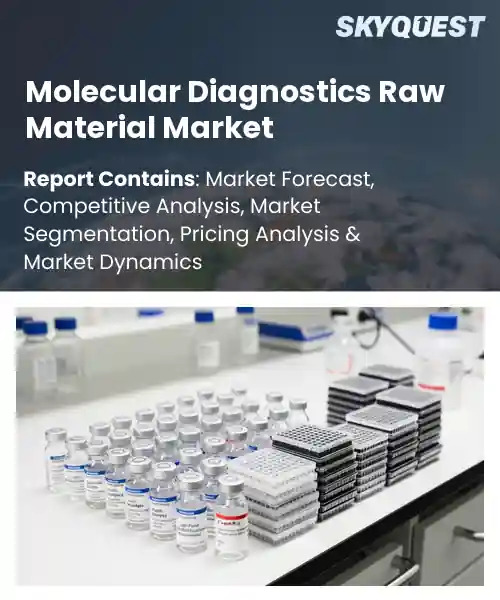
Molecular Diagnostics Raw Material Market
Report ID: SQMIG35B2287
Report ID: SQMIG35B2287
[email protected]
USA +1 351-333-4748
Report ID:
SQMIG35B2287 |
Region:
Global |
Published Date: February, 2026
Pages:
157
|Tables:
131
|Figures:
77


Global Molecular Diagnostics Raw Material Market size was valued at USD 3.5 Billion in 2024 and is poised to grow from USD 3.8 Billion in 2025 to USD 7.29 Billion by 2033, growing at a CAGR of 8.5% during the forecast period (2026-2033).
As molecular diagnostic raw material industry is experiencing significant growth, due to an increase in the use of molecular testing within routine healthcare diagnostics. The use of various types of raw materials, such as enzymes, primers, probes, nucleotides, buffers, and antibodies, is critical to performing various types of molecular diagnostics (e.g. polymerase chain reaction, next generation sequencing and nucleic acid amplification tests).
The demand for accurate and rapid diagnostic tests continues to grow due to the increase in the global burden of infectious disease, cancer, and genetic disease. This is driving the demand for high quality raw materials (i.e. molecular diagnostic raw materials) used in the development of molecular diagnostic assays. In addition, the rapid expansion of personalized medicine and companion diagnostics is encouraging diagnostic manufacturers to develop new and higher-quality molecular assays that require special reagents and unique biological materials.
A second contributing factor to the growth of the molecular diagnostics raw material market is the increased adoption of point-of-care molecular diagnostics and decentralized testing. Healthcare systems around the world are focused on obtaining quicker diagnostic results and improving disease surveillance; therefore, the demand for stable, high-purity reagents and enzymes to be used in point-of-care molecular diagnostics continues to increase. New technologies, such as recombinant proteins, synthetic antibodies, and animal free reagents are also changing the molecular diagnostics raw material market by increasing the sensitivity, reproducibility and consistency of diagnostic assays produced by diagnostic manufacturers.
How is AI Improving Supply Chain Visibility in the Molecular Diagnostics Raw Material Market?
In the molecular diagnostics raw material market, Artificial Intelligence (AI) is used to increase the level of visibility across the procurement, manufacturing, and quality data to provide faster insights. Some of the many benefits of using AI in the molecular diagnostics raw material industry include real-time tracking of inventory levels, demand forecasting, detection of supplier risk and a traceable history of each lot number produced.
In the current supply base, the existence of many suppliers further complicates the supply chain, so friction occurs due to strict regulatory requirements imposed upon both raw materials and finished goods creating risk to the flow of reagents and components across the entire supply chain. The companies can use AI to process procurement records, outputs from instruments and communications with suppliers to identify anomalies, predict potential shortages, and more effectively prioritize sourcing of raw materials.
The use of NLP technologies in providing shipment notifications to customers, the use of image analysis to ensure quality prior to shipping and the use of digital twins to provide visibility into how far in advance you need to order raw materials to ensure supply chains continue operating successfully.
Market snapshot - 2026-2033
Global Market Size
USD 3.5 Billion
Largest Segment
Primers & Probes
Fastest Growth
Primers & Probes
Growth Rate
8.5% CAGR
To get more insights on this market click here to Request a Free Sample Report
The molecular diagnostics raw material market is segmented into product type, technology, application, end user and region. Based on product type, the market is segmented into nucleic acids, primers & probes, enzymes, buffers & reagents, dNTPs (deoxynucleotide triphosphates), proteins & antibodies and others. Based on technology, the market is segmented into PCR (polymerase chain reaction), qPCR/real-time PCR, next-generation sequencing (NGS), microarrays, isothermal amplification, CRISPR-based diagnostics and others.
Based on application, the market is segmented into infectious disease detection, oncology/cancer diagnostics, genetic disorder screening, pharmacogenomics, prenatal & newborn screening, companion diagnostics and others. Based on end user, the market is segmented into hospitals & clinics, diagnostic laboratories, research institutes, biopharmaceutical companies and academic & government laboratories. Based on region, the market is segmented into North America, Europe, Asia Pacific, Latin America and Middle East & Africa.
As per molecular diagnostics raw material market forecast, enzymes segment dominates because high-performance polymerases and reverse transcriptases are foundational to most nucleic acid amplification and sequencing workflows, directly determining assay sensitivity and reliability. Performance of assays will primarily depend upon the type of enzymes used in any given assay. The investment suppliers make into enzyme engineering, formulation stability, and production consistency keeps assay failure rates to a minimum and supports kit developers with consistent quality. The performance-based demand of the enzymes concentrates purchasing suppliers of enzymes while focusing on R&D priorities; as a result, long-lasting supplier relationships and platform-level innovations are developed across the market.
However, Primers & Probes are the fastest-growing area as targeted and multiplex assays increase demand for custom oligonucleotides and fluorescent probes. The improvement in synthesis accuracy and probe chemistries will allow the development of more complex assay designs, which will lead to increased procurement by diagnostic developers and provide specialized manufacturers with opportunities to secure continuous, high-value orders that will contribute to the growth of the marketplace.
As per molecular diagnostics raw material market analysis, qPCR/Real-Time PCR segment dominates because its quantitative capability and rapid turnaround underpin a broad set of clinical and research assays, creating persistent demand for fluorogenic probes, optimized buffers, and instrument-compatible consumables. As more laboratories adopt real-time workflows, there has been an increase in the availability of standardized reagent kits (e.g. fluorogenics) and a trend towards supplier consolidation, which enhances supply reliability and reduces the complexity of development/costs associated with manufacturing and purchasing raw materials; therefore continuing to make qPCR one of the primary drivers of raw material buying and innovation.
As per molecular diagnostics raw material market outlook, next-generation sequencing (NGS) is becoming the fastest growing because of increased demand for cancer (Oncology) profiling, larger gene panels, library preparation kits and high-fidelity reagents. New workflow innovations, greater levels of automation, and bioinformatics integration are creating increased complexity, but also creating more value for materials used in NGS diagnostics. Investment in NGS is also being made to fund new product development, which will provide a greater array of possibilities for diagnostic use and the generation of revenue.
To get detailed segments analysis, Request a Free Sample Report
A combination of deep industrial capacity, a concentration of research excellence, and a well-established commercial ecosystem that supports innovation and scale for molecular diagnostics position in North America as the leader in the market. Within North America, the United States and Canada contain the largest manufacturers of reagents and consumables, as well as some of the most advanced clinical laboratories, and world-renowned academic research institutions that create the highest demands for quality raw materials.
U.S. Molecular Diagnostics Raw Material Market
As per molecular diagnostics raw material industry analysis, United States benefits from a large diverse manufacturing base, its location near many top-tier research hospitals, and an active venture capital environment. Established producers of reagents can be found alongside many innovative start-up companies and contract development/manufacturing operations, which allow for rapid scale-up. Regulatory clarity and a strong laboratory network create a pathway for clinical adoption, while partnerships between academic research and industry are fostering translational innovations.
Canada Molecular Diagnostics Raw Material Market
As per molecular diagnostics raw material market regional forecast, Canada is supported by a strong network of public health laboratories, collaborative research institutes, and targeted industry policies that support the development of biotechnology businesses. As a result of this supportive environment, the manufacturers of these types of products typically have a focus on niche specialties, have established quality standards, and are consistent with international standards for reagents and consumables. Cross-border collaborations with the adjacent markets support supply chain resilience and scalability.
As per molecular diagnostics raw material market regional outlook, the rapid development of Europe is creating opportunities for innovation and commercialization of medical technology due to several factors. There is an established manufacturing tradition within Europe's countries that has contributed greatly to the ability to develop new innovations quickly and efficiently through collaboration between manufacturers and public health systems. Secondly, the existence of many well-established networks of medtech clusters throughout Europe has allowed these clusters to be able to develop and implement new regulations and standards that facilitate the production of raw materials from local sources.
Germany's large-scale manufacturing capabilities and precision engineering have created a strong foundation for the regional supply base; the UK is advancing translational research commercialization; and France is developing its production capabilities through supportive policies. Fourthly, cross-border collaboration, procurement practices that support local resilience, and investments in next-generation sequencing and point-of-care diagnostics have increased demand for specialized reagents and consumables. There is a growing alignment between academic research, clinical laboratories, and manufacturers that has accelerated the use of new material types and standardized supply chain practices.
Germany Molecular Diagnostics Raw Material Market
Germany molecular diagnostics raw material market has the benefit of possessing a highly developed industrial infrastructure with manufacturing capabilities; as well as a high concentration of medtech (medical technology) suppliers. The abundance of engineering talent and commitment to producing goods with high-quality standards enables the market to maintain a dependable supply of highly technical reagents and other material needed for molecular diagnostics. Industrial clusters are present throughout Germany, allowing for improved procurement and logistical processes. Additionally, the close relationship between research organizations and manufacturers supports the rapid improvement of products.
U.K. Molecular Diagnostics Raw Material Market
The UK molecular diagnostics raw material market has a strong and vibrant innovation culture; has many research hospitals and others engaged in translational research; and has several active commercialization pathways (part of the reason for the volume of innovative products entering the UK market). Many of the research hospitals and specialized start-up companies are focusing on developing novel reagents and reagent products (and the demand for those products), while public and venture capital sources of funding are assisting with the scale up of small/early-stage suppliers. Additionally, the UK health system is strongly involved with research organizations and manufacturers through collaboration on projects aimed at rapid clinical assessment and the adoption of new products.
France Molecular Diagnostics Raw Material Market
The French molecular diagnostics raw material market is developing because of increased investment in biotechnology clusters; supportive government-sponsored research institutions; and targeted industrial policies to promote the domestic production of raw materials. The developing clinical validation and manufacturing scale-up capabilities within France will allow local suppliers to compete with larger European suppliers. There is a strong collaborative effort among government, academic, and industry representatives to build reagent development capabilities and develop standardized procedures.
Asia Pacific is taking significant action to increase local production capabilities, improve regulations, and build molecular diagnostics talent. To decrease dependency on international imports of reagents and consumables and restore supply chain safety, governments and businesses are placing an emphasis on domestic production. Investments in the transfer of technology (including the development of quality management systems), and training skilled workers will help to raise product quality and enhance competitiveness globally. As a result, there is an increasing molecular diagnostics raw material market trend for regional firms to collaborate with multi-national corporations to use best practices and accelerate commercialization of products.
Japan Molecular Diagnostics Raw Material Market
Molecular diagnostics raw material market in Japan has a longstanding tradition of precision manufacturing, rigorous quality control and close partnerships between industry and academic research institutes. As a result, there are well-established, high-quality reagent manufacturers and specialty chemical producers who manufacture high-quality input materials for diagnostics applications. Regulatory processes prioritizing safety and reliability will help to build confidence within the market for domestic materials.
South Korea Molecular Diagnostics Raw Material Market
Molecular diagnostics raw material market in South Korea is supported by an active group of innovative biotech companies, strong support from the government and rapid development of manufacturing capabilities. There is also a growing need for specialty reagents and consumables as technology is being adopted more rapidly, particularly with next-generation sequencing and molecular assay components. Strategic alliances with multi-nationals will help to create an effective knowledge transfer and to increase production capabilities.
To know more about the market opportunities by region and country, click here to
Buy The Complete Report
Growing Personalized Medicine Adoption
Growth In Molecular Testing Applications
Complex Supply Chain Challenges
Stringent Regulatory and Quality Requirements
Request Free Customization of this report to help us to meet your business objectives.
Competition in the global molecular diagnostics raw material market is intensifying as consolidation and supply security become primary competitive drivers, pushing firms toward vertical integration, platform locking and strategic partnerships. Two examples of concrete developments in the marketplace are OraSure’s acquisition of Sherlock Biosciences to obtain its molecular testing platforms, and Danaher’s acquisition of Aldevron and Abcam to enhance its enzyme and antibody capabilities; these are indicative of broader trends in M&A and technology acquisition.
Reagent Customization Demand
Adoption of Sustainable Materials
SkyQuest’s ABIRAW (Advanced Business Intelligence, Research & Analysis Wing) is our Business Information Services team that Collects, Collates, Correlates, and Analyses the Data collected by means of Primary Exploratory Research backed by robust Secondary Desk research.
As per SkyQuest analysis, the global molecular diagnostics raw material market is experiencing strong growth due mainly to rising demand for nuclear acid testing that became firmly established and still requires high-quality reagents and consumables. Enzymes have the largest molecular diagnostics raw material market share and are the foundation of most amplification and sequencing processes through their use of engineered polymerases and reverse transcriptase. The North America market leads the world due to concentrated manufacturing, research capability, and secure procurement systems. Additionally, there is another level of growth due to increased use of personalized medicine, which requires specialized reagents for testing purposes. The only hindrance to this expansion is the logistics required to supply the products through complex, global supply chains and their associated vulnerabilities in sourcing and quality.
| Report Metric | Details |
|---|---|
| Market size value in 2024 | USD 3.5 Billion |
| Market size value in 2033 | USD 7.29 Billion |
| Growth Rate | 8.5% |
| Base year | 2024 |
| Forecast period | 2026-2033 |
| Forecast Unit (Value) | USD Billion |
| Segments covered |
|
| Regions covered | North America (US, Canada), Europe (Germany, France, United Kingdom, Italy, Spain, Rest of Europe), Asia Pacific (China, India, Japan, Rest of Asia-Pacific), Latin America (Brazil, Rest of Latin America), Middle East & Africa (South Africa, GCC Countries, Rest of MEA) |
| Companies covered |
|
| Customization scope | Free report customization with purchase. Customization includes:-
|
To get a free trial access to our platform which is a one stop solution for all your data requirements for quicker decision making. This platform allows you to compare markets, competitors who are prominent in the market, and mega trends that are influencing the dynamics in the market. Also, get access to detailed SkyQuest exclusive matrix.
Table Of Content
Executive Summary
Market overview
Parent Market Analysis
Market overview
Market size
KEY MARKET INSIGHTS
COVID IMPACT
MARKET DYNAMICS & OUTLOOK
Market Size by Region
KEY COMPANY PROFILES
Methodology
For the Molecular Diagnostics Raw Material Market, our research methodology involved a mixture of primary and secondary data sources. Key steps involved in the research process are listed below:
1. Information Procurement: This stage involved the procurement of Market data or related information via primary and secondary sources. The various secondary sources used included various company websites, annual reports, trade databases, and paid databases such as Hoover's, Bloomberg Business, Factiva, and Avention. Our team did 45 primary interactions Globally which included several stakeholders such as manufacturers, customers, key opinion leaders, etc. Overall, information procurement was one of the most extensive stages in our research process.
2. Information Analysis: This step involved triangulation of data through bottom-up and top-down approaches to estimate and validate the total size and future estimate of the Molecular Diagnostics Raw Material Market.
3. Report Formulation: The final step entailed the placement of data points in appropriate Market spaces in an attempt to deduce viable conclusions.
4. Validation & Publishing: Validation is the most important step in the process. Validation & re-validation via an intricately designed process helped us finalize data points to be used for final calculations. The final Market estimates and forecasts were then aligned and sent to our panel of industry experts for validation of data. Once the validation was done the report was sent to our Quality Assurance team to ensure adherence to style guides, consistency & design.
Analyst Support
Customization Options
With the given market data, our dedicated team of analysts can offer you the following customization options are available for the Molecular Diagnostics Raw Material Market:
Product Analysis: Product matrix, which offers a detailed comparison of the product portfolio of companies.
Regional Analysis: Further analysis of the Molecular Diagnostics Raw Material Market for additional countries.
Competitive Analysis: Detailed analysis and profiling of additional Market players & comparative analysis of competitive products.
Go to Market Strategy: Find the high-growth channels to invest your marketing efforts and increase your customer base.
Innovation Mapping: Identify racial solutions and innovation, connected to deep ecosystems of innovators, start-ups, academics, and strategic partners.
Category Intelligence: Customized intelligence that is relevant to their supply Markets will enable them to make smarter sourcing decisions and improve their category management.
Public Company Transcript Analysis: To improve the investment performance by generating new alpha and making better-informed decisions.
Social Media Listening: To analyze the conversations and trends happening not just around your brand, but around your industry as a whole, and use those insights to make better Marketing decisions.
REQUEST FOR SAMPLE
 REQUEST FREE CUSTOMIZATION
Global Molecular Diagnostics Raw Material Market size was valued at USD 3.5 Billion in 2024 and is poised to grow from USD 3.8 Billion in 2025 to USD 7.29 Billion by 2033, growing at a CAGR of 8.5% during the forecast period (2026-2033).
Thermo Fisher Scientific, Roche Molecular Diagnostics, Agilent Technologies, Siemens Healthineers, Bio-Rad Laboratories, QIAGEN, PerkinElmer, Illumina, Abbott Molecular, Danaher Corporation, Fujifilm Wako Pure Chemical Corporation, Merck KGaA, Becton, Dickinson and Company, GE Healthcare, Sigma-Aldrich, SeraCare Life Sciences, Pacific Biosciences, Hologic, Genomatix Software GmbH, Spectra Laboratories
The key driver of the Molecular Diagnostics Raw Material Market is the rising demand for advanced molecular testing and diagnostic assays in clinical and research settings. Growth in PCR reagents, nucleic acid extraction kits, and laboratory consumables further fuels market expansion globally.
A key market trend in the Molecular Diagnostics Raw Material Market is the increasing adoption of high-throughput molecular testing technologies and automation in laboratories. Growing focus on personalized medicine, rapid diagnostics, and next-generation sequencing is shaping product innovation and driving market growth.
North America accounted for the largest share in the Molecular Diagnostics Raw Material Market, driven by advanced healthcare infrastructure, early adoption of molecular testing technologies, strong R&D activities, and high demand for PCR reagents and diagnostic assay components in clinical and research labs.


Want to customize this report? This report can be personalized according to your needs. Our analysts and industry experts will work directly with you to understand your requirements and provide you with customized data in a short amount of time. We offer $1000 worth of FREE customization at the time of purchase.
Feedback From Our Clients


 USA (+1) 351-333-4748

