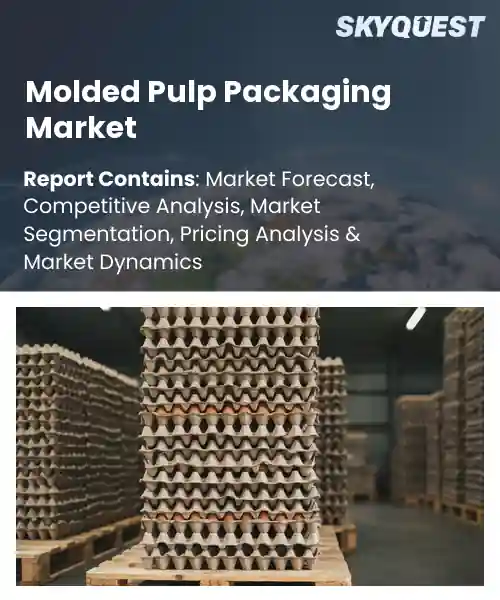
Molded Pulp Packaging Market
Report ID: SQMIG15H2178
Report ID: SQMIG15H2178
[email protected]
USA +1 351-333-4748
Report ID:
SQMIG15H2178 |
Region:
Global |
Published Date: February, 2026
Pages:
157
|Tables:
179
|Figures:
79


Global Molded Pulp Packaging Market size was valued at USD 5.84 Billion in 2024 and is poised to grow from USD 6.21 Billion in 2025 to USD 10.18 Billion by 2033, growing at a CAGR of 6.3% during the forecast period (2026-2033).
The global molded pulp packaging market growth is driven through rising demand for sustainable packaging solutions which create reusable packaging requirements for retail and logistics operations. The industry creates biodegradable protective materials through its production of molded pulp products, which originate from recycled paper and agricultural waste, to protect electronic devices and food service products and consumer goods.
Moreover, the global molded pulp packaging industry progresses toward sustainable plastic-free packaging because of consumer demand for eco-friendly materials combined with regulations that restrict single-use plastic items. Molded pulp products gained popularity because they last long, break down into natural materials, and offer affordable pricing, which increased their use in e-commerce and food delivery and protective packaging for electronics and fast-moving consumer goods (FMCG). The retail sector maintains its strong demand for sustainable packaging solutions, which drives molded pulp packaging volume growth through stores that require both primary and secondary sustainable packaging.
Supermarkets implement molded pulp trays and clamshells in their private-label products and quick-service food offerings, which they use to meet retailer ESG scorecard requirements for reducing plastic use. The resulting tenders lead to high-volume contracts, which support the financial case for automated molding line investments. The business operators experience improved tooling cost distribution and extended contract duration and enhanced minimum order requirements for converters.
How is Automation Improving Production Efficiency in the Molded Pulp Packaging Market?
Digital controls combined with robotics systems drive better production results in molded pulp packaging through their use in all three production stages, which include forming and drying and finishing processes. The system uses automated pulp feeding together with precision molding and inline quality inspection and automated stacking to operate. Producers use automation to increase production capacity because the market currently demands sustainable fiber solutions which require less manual work and decrease material waste. The process produces results that enable faster changes between various designs while maintaining consistent wall thickness and proper fit and finish. The production system uses modular production cells and downstream robotic picks and places to create molded pulp which serves food service and electronics cushioning purposes while maintaining its recycling benefits.
Market snapshot - 2026-2033
Global Market Size
USD 5.2 Billion
Largest Segment
Wood Pulp
Fastest Growth
Non-Wood Pulp
Growth Rate
4.7% CAGR
To get more insights on this market click here to Request a Free Sample Report
The molded pulp packaging market is segmented into source, molded type, product, application, and region. By source, the market is classified into wood pulp and non-wood pulp. By molded type, it includes thick walls, transfer, thermoformed, and processed. By product, it comprises trays, end caps, bowls & cups, clamshells, plates, and others. By application, the market covers food packaging, food service, electronics, healthcare, industrial, and other applications. Based on the region, the market is analyzed across North America, Europe, Asia Pacific, Latin America, and Middle East & Africa.
As per the global molded pulp packaging market analysis, the wood pulp industry produced molded pulp packaging because of its ability to create consistent fiber quality which could be processed through automated systems that handle high production volumes. The material finds common application in drink carriers and fruit trays and egg cartons because it provides essential strength and cushioning properties. The large supermarket egg suppliers depend on wood-fiber cartons because these containers possess the strength needed to survive both cold storage stacking and long-distance transportation. The packaging material offers businesses a cost-effective option which provides them with the best reliability.
However, companies will increase their use of non-wood pulp because agricultural waste materials like bagasse and bamboo and wheat straw enable them to achieve their sustainability goals. Takeaway establishments and food service chains are replacing plastic containers with bagasse containers for their packaging needs. Businesses are adopting alternative fibers for their eco-friendly packaging needs because government institutions are enforcing single-use plastic bans while companies commit to advancing their environmental and social and governance (ESG) goals.
According to the global molded pulp packaging market forecast, as transfer molded pulp strikes a balance between cost and appearance, providing surfaces smoother than thick-wall packaging while being affordable enough for mass production, it had the largest share. The material is commonly used to manufacture drink carriers and egg cartons, and consumer product trays. Quick-service restaurants use transfer molded beverage cup carriers because their strength and stackable design make them suitable for daily operations and transport.
Whereas the thermoformed category is anticipated to have the highest molded pulp packaging market share because of its plastic-like appearance, which resembles superior quality materials. The structure is now used in high-end retail packaging and electronics to replace traditional foam inserts. Cosmetic brands and smartphone accessory manufacturers have adopted thermoformed trays because the trays enable them to protect their product from environmental damage while establishing their brand identity through printing and achieving an exact product match.
To get detailed segments analysis, Request a Free Sample Report
As per the molded pulp packaging market regional forecast, the structural benefits which exist in Asia Pacific combine with market conditions to create an environment which supports the growth of molded pulp packaging. The major economies which have strong manufacturing ecosystems enable the production process of molded pulp solutions to move forward with both efficiency and fast expansion. The supply chain system, which provides producers with necessary raw materials and recycling facilities, enables them to run their operations with minimal hindrances. The electronic manufacturing process, which produces dense items, the extensive logistics system used for e-commerce, and the customers who prefer eco-friendly products create a steady demand for products. The policy framework and business sustainability goals provide companies with extra motivation to replace their use of nonrenewable resources. Continuous investment in product design and automation enhances functionality and cost competitiveness, while regional exporters leverage proximity to global markets. The combination of these factors establishes an ongoing system of supply capability and product innovation and demand which makes Asia Pacific the top region for molded pulp packaging.
Japan Molded Pulp Packaging Market
The molded pulp packaging sector in Japan depends on advanced materials engineering and electronics manufacturing and precision manufacturing and product quality standards which define the country. Producers focus on improving their designs while maintaining hygienic requirements and creating products that work with automated packing systems. Material scientists and brand owners work together to develop specialized applications at a faster rate. The existing recycling infrastructure enables manufacturers to produce molded pulp solutions which match domestic specifications through its closed loop recycling system.
South Korea Molded Pulp Packaging Market
The molded pulp packaging industry in South Korea develops through three main factors which include its access to local supply chains and its position within electronics assembly hubs and its overall acceptance of sustainable packaging alternatives. Local producers create lightweight protective designs which protect high value goods and match requirements for fast logistics operations. Brand leaders and converters partner together to develop customized packaging solutions which enhance operational efficiency and material recovery processes. The company invests in process automation and quality control to develop its domestic operations and export activities.
The European molded pulp packaging market penetration is expanding rapidly because of three main factors which include the introduction of new regulations and the growing consumer demand for sustainable products and the dedicated efforts of brand owners to change their packaging procedures. Procurement requirements for recycled materials and bio-based materials arise from organizations which have established strict waste reduction goals and requirements for circular economy operations. The supply chain for forest products and paper converting capabilities creates advantages for companies which need to adjust their supply chain operations. Retailers and food safety standards both prefer protective packaging, which offers standardized formats that can be recycled. The new material composition and surface treatment innovations enable users to apply the product in both delicate goods and retail presentation areas. The collection and recovery of molded pulp materials from packaging systems will increase through joint efforts between industry, regulators and waste management organizations which will allow the material to transition from niche usage to mainstream applicability across various packaging formats. The continued investment in design options and automation systems by converters leads to better cost competitiveness and aesthetic performance, which enables molded pulp to meet premium presentation standards. The presence of cross border logistics networks and major retail hubs enables businesses to expand their operations beyond their current capacity.
Germany Molded Pulp Packaging Market
The molded pulp packaging market in Germany benefits from an integrated industrial ecosystem, strong engineering capability, and proactive regulatory frameworks that encourage circular materials. The converters use precision molding and surface finishing techniques to achieve industrial standards which require specific operational performance. The waste management network works with partners to secure proper waste collection and production of high-quality feedstock material. The market develops through technical improvements and supply chain reliability which automotive and industrial component and food brand owners have adopted.
United Kingdom Molded Pulp Packaging Market
The molded pulp packaging market in United Kingdom shows strong development through active retail channels and high e-commerce usage and sustainability programs which retailers are implementing. The converters and designers create user-friendly content through their work on visual products and protective materials which weight classifies direct consumer delivery. The policy initiatives and retailer procurement commitments create clear demand signals that attract investment in expansion and product innovation. The combination of design studios and waste recovery schemes offers a market environment which enhances the speed of market adoption.
France Molded Pulp Packaging Market
The molded pulp packaging market in France develops through circular economy priorities and artisanal food and luxury goods and retailers who focus on recyclable product displays. The local converters and creative studios create premium packaging materials through their use of textured finishes and protective inserts which meet their customer base demands. The pilot programs with municipalities and waste operators develop better consistency in feedstock materials. The project between designers, brands, and converters helps companies develop packages which meet both visual and green product requirements.
North America uses its manufacturing upgrades and supply chain systems and brand converter partnerships to protect its current market position through strategic investment in these three areas. Companies now require more recyclable and fiber-based products because their sustainability commitments and procurement policies have increased their need for these materials. Companies that process materials and treat surfaces create new products that enhance their appearance and performance which businesses can use for retail and industrial purposes. Suppliers use regional fiber sources and recycling facilities and distribution networks that connect to major markets to expand their business operations. Waste management partnerships with packaging designers enable better waste collection and circularity development, while value chain partners create specific solutions for various end user needs. The material performance tests done at pilot projects get financial support from investment incentives and cooperation between public and private sectors.
United States Molded Pulp Packaging Market
The molded pulp packaging market in the United States is characterized by adoption among major retailers who need environmentally friendly protective packaging solutions for their products and their store display items. Food service establishments and businesses that produce long-lasting products need their aesthetic and functional goals to be met through converters who spend money on automation and design development. Waste management partnerships with research institutions help verify material performance through better waste collection methods. Companies can design customized solutions for various industrial applications through their use of regional supply networks and their implementation of scale strategies.
Canada Molded Pulp Packaging Market
The Molded Pulp Packaging market in Canada benefits from its location which provides access to fiber resources and its established paper converting industry and its collaborative efforts between converters who develop circular packaging solutions. The packaging industry has advanced its products through safe food packaging solutions and protective packaging systems that safeguard delicate items. The citywide partnership-based recycling programs for collecting recyclable materials provide municipalities with dependable feedstock materials. The research centers cooperate with converters to create specific molded pulp products which will meet both domestic requirements and international market needs.
To know more about the market opportunities by region and country, click here to
Buy The Complete Report
Rising Environmental Sustainability Demand
Expanding Foodservice and Retail Adoption
Higher Production Costs Compared to Alternatives
Performance Limitations for Specific Applications
Request Free Customization of this report to help us to meet your business objectives.
The global molded pulp packaging market has strong competitive pressure which stems from three main factors. The two companies, Pulpex and BASF established their partnership by Pulpex receiving funding through strategic funding which included CMPC investment. The company ALPLA expanded its Paboco operations to produce paper bottles for commercial use while private equity firms bought specialty fiber producers to obtain essential materials and expand their business operations.
Competitive intensity in the global molded pulp packaging market is driven by strategic partnerships, licensing of dry molded fiber technology, and consolidation as brands race to replace plastics. Notable moves include Pulpex partnering with BASF and raising strategic funding including CMPC investment, ALPLA expanding Paboco to industrialize paper bottles, and private equity acquisitions of specialty fiber suppliers to secure feedstock and scale.
Circularity and Brand Sustainability
Ecommerce and Retail Shift
SkyQuest’s ABIRAW (Advanced Business Intelligence, Research & Analysis Wing) is our Business Information Services team that Collects, Collates, Correlates, and Analyses the Data collected by means ofPrimary Exploratory Research backed by robust Secondary Desk research.
As per SkyQuest analysis, the molded pulp packaging market is expanding gradually due to sustainability regulations and initiatives to reduce plastic consumption and the rising demand for environmentally friendly protective packaging. Food delivery and e-commerce shipping and electronics transportation have gained popularity, which leads to wider acceptance across all economic sectors. The development of thermoforming and automation together with alternative fibers enables molded pulp products to achieve enhanced performance while making it possible to compete against foam and plastic substitutes. Although new coatings and fiber blends are increasing performance, there are still two major issues which affect their usability. The market shows signs of sustainable growth because retailers and manufacturers and authorities are showing a growing preference for packaging materials which can be recycled or decomposed or reused.
| Report Metric | Details |
|---|---|
| Market size value in 2024 | USD 5.84 Billion |
| Market size value in 2033 | USD 10.18 Billion |
| Growth Rate | 6.3% |
| Base year | 2024 |
| Forecast period | 2026-2033 |
| Forecast Unit (Value) | USD Billion |
| Segments covered |
|
| Regions covered | North America (US, Canada), Europe (Germany, France, United Kingdom, Italy, Spain, Rest of Europe), Asia Pacific (China, India, Japan, Rest of Asia-Pacific), Latin America (Brazil, Rest of Latin America), Middle East & Africa (South Africa, GCC Countries, Rest of MEA) |
| Companies covered | |
| Customization scope | Free report customization with purchase. Customization includes:-
|
To get a free trial access to our platform which is a one stop solution for all your data requirements for quicker decision making. This platform allows you to compare markets, competitors who are prominent in the market, and mega trends that are influencing the dynamics in the market. Also, get access to detailed SkyQuest exclusive matrix.
Table Of Content
Executive Summary
Market overview
Parent Market Analysis
Market overview
Market size
KEY MARKET INSIGHTS
COVID IMPACT
MARKET DYNAMICS & OUTLOOK
Market Size by Region
KEY COMPANY PROFILES
Methodology
For the Molded Pulp Packaging Market, our research methodology involved a mixture of primary and secondary data sources. Key steps involved in the research process are listed below:
1. Information Procurement: This stage involved the procurement of Market data or related information via primary and secondary sources. The various secondary sources used included various company websites, annual reports, trade databases, and paid databases such as Hoover's, Bloomberg Business, Factiva, and Avention. Our team did 45 primary interactions Globally which included several stakeholders such as manufacturers, customers, key opinion leaders, etc. Overall, information procurement was one of the most extensive stages in our research process.
2. Information Analysis: This step involved triangulation of data through bottom-up and top-down approaches to estimate and validate the total size and future estimate of the Molded Pulp Packaging Market.
3. Report Formulation: The final step entailed the placement of data points in appropriate Market spaces in an attempt to deduce viable conclusions.
4. Validation & Publishing: Validation is the most important step in the process. Validation & re-validation via an intricately designed process helped us finalize data points to be used for final calculations. The final Market estimates and forecasts were then aligned and sent to our panel of industry experts for validation of data. Once the validation was done the report was sent to our Quality Assurance team to ensure adherence to style guides, consistency & design.
Analyst Support
Customization Options
With the given market data, our dedicated team of analysts can offer you the following customization options are available for the Molded Pulp Packaging Market:
Product Analysis: Product matrix, which offers a detailed comparison of the product portfolio of companies.
Regional Analysis: Further analysis of the Molded Pulp Packaging Market for additional countries.
Competitive Analysis: Detailed analysis and profiling of additional Market players & comparative analysis of competitive products.
Go to Market Strategy: Find the high-growth channels to invest your marketing efforts and increase your customer base.
Innovation Mapping: Identify racial solutions and innovation, connected to deep ecosystems of innovators, start-ups, academics, and strategic partners.
Category Intelligence: Customized intelligence that is relevant to their supply Markets will enable them to make smarter sourcing decisions and improve their category management.
Public Company Transcript Analysis: To improve the investment performance by generating new alpha and making better-informed decisions.
Social Media Listening: To analyze the conversations and trends happening not just around your brand, but around your industry as a whole, and use those insights to make better Marketing decisions.
REQUEST FOR SAMPLE
 REQUEST FREE CUSTOMIZATION
Global Molded Pulp Packaging Market size was valued at USD 5.2 Billion in 2024 and is poised to grow from USD 5.44 Billion in 2025 to USD 7.86 Billion by 2033, growing at a CAGR of 4.7% during the forecast period (2026-2033).
Amcor plc, Huhtamaki, Hartmann Packaging A/S, CKF Inc., Stora Enso, PulPac, Genpak, ProAmpac, Pactiv Evergreen Inc., Sabert Corporation, Henry Molded Products Inc., Dart Container Corporation, Jiangyin Pton Molded Fiber Products Co., Ltd, Greif, Inc., Smurfit Kappa Group, WestRock Company, International Paper Company, UFP Technologies Inc., Vegware Ltd., Moulded Fibre Products Ltd.
The key driver of the Molded Pulp Packaging Market is the growing demand for sustainable and biodegradable packaging solutions. Rising environmental concerns, strict regulations on single-use plastics, and increasing consumer preference for eco-friendly materials are encouraging industries to adopt recyclable molded pulp alternatives across various applications.
Key trends in the molded pulp packaging market include the shift toward eco-friendly and recyclable materials, adoption of lightweight and customized packaging, growth in automated pulp molding technologies, expansion of bio-based and compostable products, and rising demand from the food, electronics, and consumer goods sectors.
Asia-Pacific accounted for the largest share in the Molded Pulp Packaging Market, supported by strong manufacturing activity, rapid industrialization, and rising demand for sustainable packaging. Expanding e-commerce, growing food and beverage consumption, and increasing restrictions on plastic packaging further strengthen the region’s market dominance.


Want to customize this report? This report can be personalized according to your needs. Our analysts and industry experts will work directly with you to understand your requirements and provide you with customized data in a short amount of time. We offer $1000 worth of FREE customization at the time of purchase.
Feedback From Our Clients


 USA (+1) 351-333-4748

