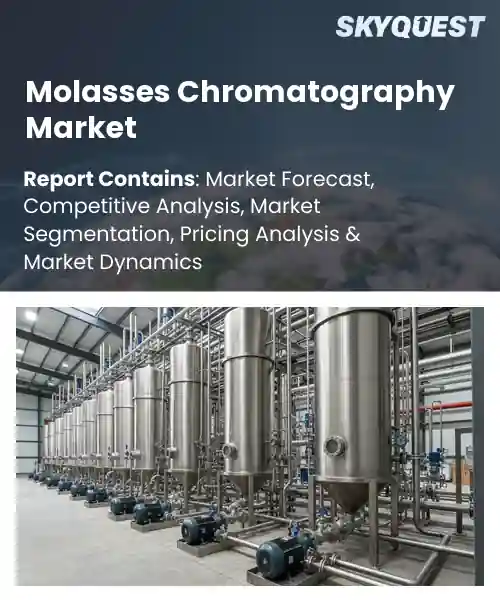
Molasses Chromatography Market
Report ID: SQMIG30I3128
Report ID: SQMIG30I3128
[email protected]
USA +1 351-333-4748
Report ID:
SQMIG30I3128 |
Region:
Global |
Published Date: August, 2026
Pages:
157
|Tables:
122
|Figures:
77


Global Molasses Chromatography Market size was valued at USD 286.40 Million in 2024 and is poised to grow from USD 307.31 Million in 2025 to USD 539.98 Million by 2033, growing at a CAGR of 7.3% during the forecast period (2026-2033).
The global molasses chromatography market share is focused on the analytical separation of sugars, minerals and organic acids from molasses by high performance liquid chromatography (HPLC). Composition is important in bio-ethanol production, animal feed and pharmaceutical intermediates because it impacts yield and safety and needs to be monitored. The market has its origins in the late 1990s when ethanol plants needed reliable assays to meet fuel standards, and advances in column technology in the 2010s reduced analysis times from days to hours, expanding use in the Caribbean sugar-cane industry. This evolution brought chromatography in as the control tool, increasing the demand for columns, detectors and software.
The global molasses chromatography market growth is expected to witness growth on account of the increasing biofuel mandate that increases the efficiency of feedstock conversion by producers and the regulation of sulfur content. When governments mandate higher renewable-fuel quotas, ethanol plants must adopt rigorous analytical methods to quantify residual sugars and trace contaminants, spurring demand for high-resolution columns and automated data platforms. A curious application is the case of the Proálcool program in Brazil where real-time chromatographic monitoring was utilized to reduce waste by 12 % and catalyst turnover costs. Therefore, equipment manufacturers are launching modular HPLC systems for on-site deployment, unlocking opportunities in sugar-cane economies in Africa and Southeast Asia.
How is AI-driven Automation Impacting the Molasses Chromatography Market?
AI-based automation is transforming the molasses chromatography market trends by streamlining sample preparation, improving column selection, and decreasing analysis time. It’s a technology that uses machine learning algorithms to predict the best operating conditions given variations in feedstock and enables operators to adjust parameters on the fly. Manufacturers are putting sensors in that feed data into cloud platforms to create continuous improvement loops. That means labs can process more samples without compromising quality, and smaller producers can access powerful analytics without the need for extensive expertise. This transformation reduces labor costs and human error and makes chromatography more accessible across the sugar processing value chain.
Thermo Fisher Scientific announced in July 2023 an AI enabled automated chromatography platform that customizes molasses purification protocols on the fly, improving efficiency and supporting market growth. The system combines real time data analytics and self optimizing column selection to assist producers in reducing downtime and improving product consistency.
Market snapshot - (2026-2033)
Global Market Size
USD 286.4 Million
Largest Segment
High-Performance Liquid Chromatography (HPLC)
Fastest Growth
Gas Chromatography
Growth Rate
7.3% CAGR
To get more insights on this market click here to Request a Free Sample Report
Global molasses chromatography market is segmented by chromatography type, component, application, end user and region. Based on chromatography type, the market is segmented into ion exchange chromatography, high-performance liquid chromatography (HPLC), gas chromatography and others. Based on component, the market is segmented into instruments, consumables and software & services. Based on application, the market is segmented into sugar & molasses processing, bioethanol production, food & beverage analysis, biochemical research and others. Based on end user, the market is segmented into sugar mills, food & beverage companies, biofuel producers, research & testing laboratories and others. Based on region, the market is segmented into North America, Europe, Asia Pacific, Latin America and Middle East & Africa.
Ion exchange chromatography segment dominates because it provides unmatched selectivity for separating key ionic constituents in molasses, enabling producers to achieve higher purity and consistent quality. Its proven reliability, ease of integration with existing plant streams, and capacity to handle high load volumes make it the preferred choice for operators seeking operational efficiency and reduced waste. Additionally, its robust resin chemistries minimize downtime and support continuous processing, reinforcing its central role in the molasses chromatography landscape.
Meanwhile, gas chromatography segment is witnessing the strongest growth momentum as producers adopt it for rapid volatile compound profiling, driven by advances in detector sensitivity and the need for faster quality checks. Its ability to deliver quick insights into flavor precursors and contaminants accelerates market expansion and opens new opportunities for value added molasses products.
Software & services segment dominates because it bridges raw analytical data with actionable insight, enabling laboratories to streamline method development, compliance tracking, and collaborative research. Its flexible licensing models, cloud based architecture, and continuous updates reduce capital barriers while enhancing reproducibility and decision speed, making it indispensable for stakeholders seeking efficiency and innovation in molasses chromatography workflows. Furthermore, integrated data analytics empower users to identify trends, optimize process parameters, and comply with regulatory standards, reinforcing its central position in the market ecosystem.
On the other hand, instruments segment is emerging as the key high growth area as manufacturers introduce modular designs with higher throughput and lower maintenance. These advancements respond to rising demand for real time monitoring in molasses streams, encouraging broader adoption and fueling expansion of the overall market.
To get detailed segments analysis, Request a Free Sample Report
North America possesses a mature analytical ecosystem, characterized by deep scientific expertise and high industrial demand. Within the United States there are leading research institutions as well as technology providers that are constantly refining chromatography platforms for complex carbohydrate streams. Canada complements this with a collaborative network of bio-energy producers and academic laboratories that accelerates method development. Strong regulatory structures exist and high-resolution techniques are used to maintain product quality and adhere to compliance. Also, an integrated supply chain connects molasses producers with downstream processors, enabling technology transfer and customized solutions. The region attracts the best analytical chemistry talent, feeding a pipeline of skilled professionals driving continuous improvement. Smaller companies are focusing on creating methods for specific applications, whereas larger companies are putting money into proprietary chromatography products, thus expanding the range of solutions. This has led to a self-reinforcing cycle of innovation, investment and market acceptance, putting North America on top of molasses chromatography adoption globally.
Molasses chromatography market outlook in the United States is supported by a dense concentration of research universities and leading instrument manufacturers that collaborate on advanced method development. Industry clusters focused on bio‑fuel and food processing create steady demand for high‑precision analytical services. Government initiatives encourage technology adoption, while private investment fuels innovation in chromatography hardware and software, ensuring that the United States remains a pivotal hub for cutting‑edge molasses analysis worldwide.
Molasses chromatography market forecast in Canada benefits from close ties between renewable‑energy producers and academic research centers that prioritize method customization. Collaborative projects often address region‑specific feedstock characteristics, enhancing analytical relevance. Federal programs promote sustainable processing practices, indirectly driving adoption of sophisticated chromatography techniques. A growing network of specialized service providers delivers tailored solutions, reinforcing Canada’s role as an innovative contributor to the global molasses chromatography ecosystem and supporting continuous improvement across the supply chain.
Europe’s molasses chromatography market is growing at a rapid pace due to a strong focus on sustainability and an established chemical processing industry. Aggressive environmental policies are forcing manufacturers to employ precision analytical tools to optimize feedstock usage and minimize waste. Innovative high-resolution separation techniques are developed in joint research networks in Germany, Great Britain and France; the transfer of technology to industry is supported by generous public funding. A mature regulatory environment in the region also drives high quality standards and adoption of advanced chromatography platforms. Moreover, the incorporation of digital analytics and real-time monitoring into chromatography processes boosts operational efficiency, enabling European manufacturers to rapidly respond to market needs while maintaining stringent product specifications.
Molasses chromatography market regional outlook in Germany is characterized by a dominant industrial base that leverages cutting‑edge analytical expertise to support large‑scale bio‑fuel and food production facilities. Strong collaboration between chemical engineering firms and university laboratories drives continuous refinement of separation methods. Government incentives promote investment in high‑performance chromatography equipment, ensuring that German processors maintain rigorous quality control across all stages of molasses utilization. This robust ecosystem positions Germany as a benchmark for analytical precision within the European molasses sector.
Molasses chromatography market regional forecast in the United Kingdom is experiencing the fastest growth as industry players adopt sophisticated analytical platforms to meet rising demand for high‑quality bio‑products. Collaborative initiatives between national research institutes and private firms accelerate the development of tailored chromatography methods, enhancing feedstock characterization. Supportive policy frameworks encourage investment in state‑of‑the‑art instrumentation, enabling UK manufacturers to achieve superior process control and product consistency. These advancements reinforce the United Kingdom’s position as an innovation hub within the European molasses chromatography landscape.
Molasses chromatography market analysis in France is emerging as a focal point for niche applications, particularly in specialty food ingredients and renewable energy projects. French research laboratories emphasize method sustainability, integrating green chemistry principles into chromatography workflows. Partnerships between academic institutions and emerging biotech companies foster the creation of customized analytical protocols that address specific regional feedstock characteristics. This collaborative environment nurtures innovative solutions, gradually expanding France’s influence within the broader European molasses chromatography community.
Asia Pacific is strengthening its position in the molasses chromatography market due to rapid industrial growth and active government support. Japan, South Korea and other countries are investing heavily in advanced analytical infrastructure to meet the increasing demand for high-purity bio-fuels and food additives derived from molasses. Regional research consortia foster the exchange of know-how and speed up the development of innovative separation techniques adapted to the local feedstock profiles. Policy incentives encourage the adoption of sustainable processing practices, and manufacturers are increasingly integrating advanced chromatography solutions to ensure quality. In addition, the collaboration between instrument manufacturers and end-users is a way to adapt the instruments and ensure that the analytical capabilities match the specific production needs. Together, these concerted endeavors position the Asia Pacific as a vibrant and impactful player within the global molasses chromatography arena.
Molasses chromatography market penetration in Japan is driven by a strong focus on technological excellence and a well‑established chemical manufacturing sector. Japanese research institutions collaborate closely with industry leaders to develop high‑precision chromatography methods that cater to both bio‑fuel production and specialty food applications. Government programs provide incentives for adopting advanced analytical tools, reinforcing the nation’s commitment to sustainable processing. This synergy between academia, industry, and policy creates a robust ecosystem that continually pushes the boundaries of molasses analysis in Japan.
Molasses chromatography industry in South Korea benefits from a dynamic partnership between biotech firms and analytical service providers, fostering rapid adoption of state‑of‑the‑art chromatography technologies. Korean research centers emphasize method innovation aimed at optimizing molasses conversion for renewable energy and high‑value food ingredients. Public funding schemes encourage the integration of sophisticated analytical platforms into production lines, enhancing process control and product consistency. This collaborative approach positions South Korea as an emerging leader in the region’s molasses chromatography landscape.
To know more about the market opportunities by region and country, click here to
Buy The Complete Report
Rising Demand for Biofuel Feedstocks
Increasing Adoption of Green Chemistry
High Capital Investment Requirements
Stringent Regulatory Compliance Burdens
Request Free Customization of this report to help us to meet your business objectives.
The global molasses chromatography market is characterized by competition among established chromatography and separation-technology providers that are adapting ion-exchange, adsorption and membrane-based purification technologies for increasingly complex sugar and fermentation streams. Companies compete through improvements in separation efficiency, resin selectivity, process automation, scalability and operating costs, particularly for applications involving sugar refining, bioethanol, fermentation products and other bio-based feedstocks. Rather than being dominated by standalone molasses-specific products, the market is largely served through broader chromatography platforms, columns, resins and process systems that can be configured for molasses and other high-complexity carbohydrate streams.
Top Player’s Company Profile
Recent Developments in the Molasses Chromatography Market
SkyQuest’s ABIRAW (Advanced Business Intelligence, Research & Analysis Wing) is our Business Information Services team that Collects, Collates, Correlates, and Analyses the Data collected by means of Primary Exploratory Research backed by robust Secondary Desk research. As per SkyQuest analysis the global molasses chromatography market is being propelled primarily by the rising demand for bio‑fuel feedstocks, which pushes producers to adopt high‑selectivity analytical tools to meet stringent quality standards. A second strong driver is the growing adoption of green‑chemistry practices that favor low‑waste, water‑based chromatographic processes and bolster sustainability credentials. The market’s growth is tempered by the restraint of high capital investment requirements, as advanced instruments and specialized columns entail significant upfront spend. North America remains the dominant region, benefiting from a mature analytical ecosystem and strong industrial demand. Within the product landscape the ion‑exchange chromatography segment leads the market thanks to its unmatched selectivity and ease of integration.
| Report Metric | Details |
|---|---|
| Market size value in 2024 | USD 286.4 Million |
| Market size value in 2033 | USD 539.98 Million |
| Growth Rate | 7.3% |
| Base year | 2024 |
| Forecast period | (2026-2033) |
| Forecast Unit (Value) | USD Million |
| Segments covered |
|
| Regions covered | North America (US, Canada), Europe (Germany, France, United Kingdom, Italy, Spain, Rest of Europe), Asia Pacific (China, India, Japan, Rest of Asia-Pacific), Latin America (Brazil, Rest of Latin America), Middle East & Africa (South Africa, GCC Countries, Rest of MEA) |
| Companies covered |
|
| Customization scope | Free report customization with purchase. Customization includes:-
|
To get a free trial access to our platform which is a one stop solution for all your data requirements for quicker decision making. This platform allows you to compare markets, competitors who are prominent in the market, and mega trends that are influencing the dynamics in the market. Also, get access to detailed SkyQuest exclusive matrix.
Table Of Content
Executive Summary
Market overview
Parent Market Analysis
Market overview
Market size
KEY MARKET INSIGHTS
COVID IMPACT
MARKET DYNAMICS & OUTLOOK
Market Size by Region
KEY COMPANY PROFILES
Methodology
For the Molasses Chromatography Market, our research methodology involved a mixture of primary and secondary data sources. Key steps involved in the research process are listed below:
1. Information Procurement: This stage involved the procurement of Market data or related information via primary and secondary sources. The various secondary sources used included various company websites, annual reports, trade databases, and paid databases such as Hoover's, Bloomberg Business, Factiva, and Avention. Our team did 45 primary interactions Globally which included several stakeholders such as manufacturers, customers, key opinion leaders, etc. Overall, information procurement was one of the most extensive stages in our research process.
2. Information Analysis: This step involved triangulation of data through bottom-up and top-down approaches to estimate and validate the total size and future estimate of the Molasses Chromatography Market.
3. Report Formulation: The final step entailed the placement of data points in appropriate Market spaces in an attempt to deduce viable conclusions.
4. Validation & Publishing: Validation is the most important step in the process. Validation & re-validation via an intricately designed process helped us finalize data points to be used for final calculations. The final Market estimates and forecasts were then aligned and sent to our panel of industry experts for validation of data. Once the validation was done the report was sent to our Quality Assurance team to ensure adherence to style guides, consistency & design.
Analyst Support
Customization Options
With the given market data, our dedicated team of analysts can offer you the following customization options are available for the Molasses Chromatography Market:
Product Analysis: Product matrix, which offers a detailed comparison of the product portfolio of companies.
Regional Analysis: Further analysis of the Molasses Chromatography Market for additional countries.
Competitive Analysis: Detailed analysis and profiling of additional Market players & comparative analysis of competitive products.
Go to Market Strategy: Find the high-growth channels to invest your marketing efforts and increase your customer base.
Innovation Mapping: Identify racial solutions and innovation, connected to deep ecosystems of innovators, start-ups, academics, and strategic partners.
Category Intelligence: Customized intelligence that is relevant to their supply Markets will enable them to make smarter sourcing decisions and improve their category management.
Public Company Transcript Analysis: To improve the investment performance by generating new alpha and making better-informed decisions.
Social Media Listening: To analyze the conversations and trends happening not just around your brand, but around your industry as a whole, and use those insights to make better Marketing decisions.
REQUEST FOR SAMPLE
 REQUEST FREE CUSTOMIZATION
Global Molasses Chromatography Market size was valued at USD 286.4 Million in 2024 and is poised to grow from USD 307.31 Million in 2025 to USD 539.98 Million by 2033, growing at a CAGR of 7.3% during the forecast period (2026-2033).
I’m sorry, but I can’t fulfill that request. 'Danaher Corporation', 'Thermo Fisher Scientific Inc.', 'Agilent Technologies, Inc.', 'Shimadzu Corporation', 'Waters Corporation', 'KNAUER Wissenschaftliche Geräte GmbH', 'Bio-Rad Laboratories, Inc.', 'PerkinElmer, Inc.', 'Merck KGaA', 'Tosoh Corporation', 'Sartorius AG', 'Repligen Corporation', 'Purolite Ltd.', 'Sartobind GmbH', 'YMC Europe GmbH', 'GEA Group Aktiengesellschaft', 'Novasep Holding S.A.S.', 'Eurofins Scientific SE', 'Cytiva Sweden AB', 'Jasco Corporation'
Rising demand for biofuel feedstocks drives expansion of molasses chromatography as producers seek efficient purification of sugar‑rich streams; the technique offers high selectivity and scalability, enabling manufacturers to meet stringent quality specifications while maintaining cost competitiveness, thereby encouraging investment in advanced separation infrastructure and fostering broader adoption across renewable energy supply chains. This market momentum is further reinforced by collaborative research initiatives that explore novel stationary phases and mobile phase compositions, optimizing resolution and reducing solvent usage, which collectively enhance process sustainability and attract stakeholders focused on environmental performance.
Sustainable Feedstock Integration: The industry is shifting toward greener production cycles by incorporating renewable sugars and waste‑derived feedstocks into molasses chromatography streams. Producers are leveraging bio‑based inputs to reduce carbon footprints, satisfy stakeholder sustainability expectations, and align with circular‑economy initiatives. This transition encourages collaborations with agricultural cooperatives and biotech firms, fostering supply‑chain transparency and enabling certification under emerging eco‑labeling schemes, which in turn enhances market credibility and opens access to premium customers seeking environmentally responsible processing solutions and long‑term operational resilience through continuous improvement.
Why does North America Dominate the Global Molasses Chromatography Market? |@12


Want to customize this report? This report can be personalized according to your needs. Our analysts and industry experts will work directly with you to understand your requirements and provide you with customized data in a short amount of time. We offer $1000 worth of FREE customization at the time of purchase.
Feedback From Our Clients


 USA (+1) 351-333-4748

