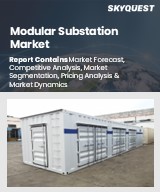
Modular Substation Market
Report ID: SQMIG20E2160
Report ID: SQMIG20E2160
[email protected]
USA +1 351-333-4748
Report ID:
SQMIG20E2160 |
Region:
Global |
Published Date: January, 2026
Pages:
198
|Tables:
123
|Figures:
69


Global Modular Substation Market size was valued at USD 20.89 Billion in 2024 and is poised to grow from USD 22.73 Billion in 2025 to USD 44.63 Billion by 2033, growing at a CAGR of 8.8% during the forecast period (2026–2033).
growing electrification needs, renewable energy integration, and modernization of existing grid infrastructure, are driving incremental use of modular substations globally. Outdoor/container substations dominate in market share because of their mobility, flexibility, and easy installation, best positioned to serve utility growth and industrial use. Gas-insulated substations are expanding most rapidly in the meantime, mainly in highly urbanized segments where high safety and compact structures are priorities. Utility grid deployments account for collective demand, with renewable integration projects witnessing the fastest growth application segment as utilities and governments interconnect solar and wind farms in enormous scale. Asia-Pacific is the world market leader, powered by huge grid investment across China and India. Europe is at the forefront with small, digital substations for city grid, while North America maintains pace with upgrading old infrastructure. Additional growth is visible in Africa and Latin America, where distributed grids are gaining traction. With rising investments in automation, remote monitoring, and digital-ready substations, the market is on course for robust mid-single-digit to high-single-digit growth through 2032.
What is AI Enabling in Modular Substations?
Artificial intelligence is revolutionizing the market for modular substations with the potential for predictive maintenance, remote monitoring, and intelligent fault detection. Global modular substation market strategies in 2024 indicate that global players such as ABB, Siemens, and Schneider are incorporating AI-based analytics in modular substations in order to provide maximum reliability, less downtime, and highest operating efficiency. These are critical for utilities with aged assets and adding renewables dynamically, particularly in Europe and Asia-Pacific. AI-driven monitoring solutions enable real-time information on equipment condition, which facilitates preventive maintenance and reduces outages. They also offer optimal energy flows and safety, which makes modular substations a feasible choice for urban grids as well as renewable schemes. Integration of digital twin and IoT platforms is also pushing grid resilience further through performance simulation and quick decision-making. Convergence of AI and modular substations in 2024 is further advancing deployment speed, reducing lifecycle cost, and converting substations into smart, adaptive infrastructure solutions that meet global sustainability and reliability objectives.
Market snapshot - 2026-2033
Global Market Size
USD 19.2 billion
Largest Segment
Outdoor/Containerized substations
Fastest Growth
Gas-Insulated Modular Substations
Growth Rate
8.8% CAGR
To get more insights on this market click here to Request a Free Sample Report
Global Modular Substation Market is segmented by Type, Voltage, Application, End User and region. Based on Type, the market is segmented into Indoor/Skid-Mounted, Outdoor/Containerized, Mobile/Transportable and Gas-Insulated Modular Substations. Based on Voltage, the market is segmented into Low Voltage (<11kV), Medium Voltage (11–36kV), High Voltage (36–145kV) and Extra-High Voltage (>145kV). Based on Application, the market is segmented into Utility Grid, Renewable Integration, Industrial Plants, Infrastructure & Urban Distribution and Emergency & Temporary Installations. Based on End User, the market is segmented into Power Utilities, Oil & Gas, Mining, Transportation and Data Centers. Based on region, the market is segmented into North America, Europe, Asia Pacific, Latin America and Middle East & Africa.
Containerized/outdoor substations lead the type category in 2024 due to their ease of installation, portability, and lower cost. Utilities and industries employ them for point-of-use deployment in rural and remote locations, as well as grid extension and peak-hour capacity supplementation. Asia-Pacific leads demand, with India and China being major contributors, as metropolitan and rural network extensions demand quick, scalable solutions. Africa and Latin America also are adding containerized substation applications as electrification projects expand.
Gas-insulated modular substations are the most rapidly growing segment, with low footprint driving it, increased safety, and reliability of urbanized areas. They are best applied in high-density cities with limited land available, hence becoming a requirement for Europe and Japan. Low-exposure underground distribution projects with better performance in crowded zones are also facilitated by them. Increased renewable integration and urbanization modernization grid projects are pushing usage, with gas-insulated substations being the most proactive type segment.
Utility grid projects lead in 2024 with power utilities leading the pack of largest modular substation buyers to fuel network expansion and reliability. Ease of installation and standardized design assist utilities in enhancing rural and urban distribution. North America and Asia-Pacific are robust markets in which power demand growth and old grids need to have efficient and reliable solutions. Their prominence gives utility grid applications the dominant share globally.
Renewable integration is the biggest application segment with solar and wind projects witnessing consistent growth around the world. Modular substations are highly flexible pre-fabricated solutions to integrate renewable power plants to national grids, particularly for far-flung or hostile destinations. Europe leads the charge in this development with aggressive net-zero ambitions, followed by Asia-Pacific with China and India making significant investments in solar and wind integration. Renewable integration therefore becomes the fastest-evolving application in the market.
To get detailed segments analysis, Request a Free Sample Report
According to the global modular substation market regional forecast, Asia-Pacific has the largest market share in 2024 with the pace of rapid electrification, industrialization, and growth in renewable energy. Nations in the region are placing orders for containerized and gas-insulated substations to spearhead urban infrastructure and rural integration. China and India are leading the deployment at utility scale, with Japan and South Korea focusing on high-tech, miniaturized substation development to facilitate grid modernization. Government policies, clean energy goals, and urbanization keep Asia-Pacific the most prevalent region globally.
According to the modular substation market regional outlook, adoption demand in Japan is fueled by smart city initiatives, renewable integration, and urban grid resiliency planning. Small gas-insulated substations are increasingly used in cities, with digital monitoring and automation being used by utilities. Investments focus on safety, reliability, and space-saving. Japan's high technological base and the government's support guarantee increasing demand for new innovative modular substations in energy and infrastructure projects.
As per the modular substation market regional analysis in South Korea, modular substations are on the rise in renewable energy, industrial, and urban grid schemes. Security and physical efficiency are prioritized by gas-insulated technology in high-density cities, with containerized technology enabling rural and mobile uses. The government policy decarbonization initiative and smart grid initiatives are driving adoption forward as utilities look to digital-enabled, automated substations as a solution to drive efficiency, resilience, and reliability on the country's power grids across the country.
According to the global modular substation market forecast, North America represented the second-largest market share of 2024 with grid modernization efforts, the integration of renewable energy, and replacing old infrastructure. Industrial customers and utilities are investing in containerised substations for fast deployment and compact gas-insulated types are beginning to surface within the networks of cities. Government incentives, energy security concerns, and private investment are causing gradual growth, and the region is a prime long-term growth driver.
According to the modular substation market outlook, in the United States, the drivers include integration of renewables and upgrading existing grid infrastructure. Utilities prefer containerized substations due to added flexibility and lowered commissioning time, whereas compact substations are also embraced within the urban areas to meet land constraints. State and federal investment in energy infrastructure spur the U.S. position in the modular substation industry.
As per the modular substation market analysis, in Canada, expansion is fuelled by investment in grid resilience, rural power, and renewables projects. Container-based modular substations are employed widely for industrial and far-off locations' supply, and digital control and automation provide peak performance in cities. Government targets for green power and the leadership position of hydroelectric power fuel additional roll-out, led by local development in Canada.
According to the global modular substation market trends, Europe was at number three position in terms of global market share in 2024, driven by city infrastructure growth, integration of renewables, and proactive sustainable plans. Station-class compact gas-insulated substations find acceptance in metros with no land, whereas container units facilitate industrial and transient programs. Regional adoption is spearheaded by Germany, the U.K., and France, which take the lead in spending highly on digitalization, automation, and green infrastructure within EU energy and climate policy.
According to the modular substation industry analysis, modular substations are utilized in Germany to facilitate renewable integration, smart grid development, and industrial electrification. Modular, compact gas-insulated units are prevalent in high-density urban areas, while containerized settings facilitate flexible use. EU energy transition policy and grid modernization investments spearhead demand, and therefore Germany paces the sustainable modular substation adoption.
As per the modular substation industry trends, in the U.K., modular substations are being adopted for urban grid modernization, offshore wind projects, and industrial sites. Utilities use containerized applications for fast deployment and mini substations for localized areas. Clean energy investment in digitally prepared substations and government clean energy commitments fuel growth, and the U.K. a formidable contender in regional development.
According to the modular substation industry, in France, modular substations are more in demand for renewable source integration plans, specifically wind and solar farms. Skid-mounted substations are also in use in cities for minimizing land usage and peak reliability. Government plans for energy transition and smart grids drive adoption, and utilities concentrate on remote connection and automation to provide greater efficiency for the whole power grid.
To know more about the market opportunities by region and country, click here to
Buy The Complete Report
Growing Urgency to Scale Up the Grid Rapidly
Synchronization with Renewable Power Projects
High Initial Capital Costs
Technical Limitations in Harsh Environments
Request Free Customization of this report to help us to meet your business objectives.
The competitive landscape of the global modular substation market statistics in 2024 hinges on increasing need for prefabricated and scalable solutions to meet up with accelerating electrification, renewables integration, and urbanization. Technology leaders such as ABB, Siemens Energy, Schneider Electric, and GE are taking the lead with standardized, digitally enabled substations that reduce the commissioning cycle and improve reliability. They are growing their product offerings with gas-insulated and containerized technologies to industrial and utility clients. The Asia-Pacific is the biggest and fastest-growing regional market, wherein India and China are the largest spenders for renewables and grid modernization, and Europe sees strong adoption of green and compact substations for urban cities. The North American market is stable and mature, wherein most of its attention is on replacement infrastructure. Competition is also influenced by mid-scale regional vendors with made-to-measure cost-efficient solutions for local grids. Foretelling maintenance, and resiliency, whereby local and global industry players are now capable of getting returns on next-generation projects in this new market.
SkyQuest’s ABIRAW (Advanced Business Intelligence, Research & Analysis Wing) is our Business Information Services team that Collects, Collates, Correlates, and Analyses the Data collected by means of Primary Exploratory Research backed by robust Secondary Desk research.
As per SkyQuest analysis, key drivers of market growth include the global modular substation market gaining momentum as utilities and industries seek faster, more reliable, and cost-efficient power distribution solutions. Container substations are currently dominating the installations since they are deployable and mobile within rural and urban settings. Yet, gas-insulated substations are growing exponentially in mature economies where safety, miniaturization, and reliability are critical to grid modernization. The Asia-Pacific region is still driving global demand on the back of electrification plans and renewable energy development, while Europe is witnessing high growth in green and space-saving substations. The North American market is a mature one with replacement of aging infrastructure. Spending on digitization, remote monitoring, and prefabricated renewable integration is dictating the industry trend. Low-cost, sustainable, and innovative businesses will stand the best chance of controlling this new business.
| Report Metric | Details |
|---|---|
| Market size value in 2024 | USD 20.89 Billion |
| Market size value in 2033 | USD 44.63 Billion |
| Growth Rate | 8.8% |
| Base year | 2024 |
| Forecast period | 2026-2033 |
| Forecast Unit (Value) | USD Billion |
| Segments covered |
|
| Regions covered | North America (US, Canada), Europe (Germany, France, United Kingdom, Italy, Spain, Rest of Europe), Asia Pacific (China, India, Japan, Rest of Asia-Pacific), Latin America (Brazil, Rest of Latin America), Middle East & Africa (South Africa, GCC Countries, Rest of MEA) |
| Companies covered |
|
| Customization scope | Free report customization with purchase. Customization includes:-
|
To get a free trial access to our platform which is a one stop solution for all your data requirements for quicker decision making. This platform allows you to compare markets, competitors who are prominent in the market, and mega trends that are influencing the dynamics in the market. Also, get access to detailed SkyQuest exclusive matrix.
Table Of Content
Executive Summary
Market overview
Parent Market Analysis
Market overview
Market size
KEY MARKET INSIGHTS
COVID IMPACT
MARKET DYNAMICS & OUTLOOK
Market Size by Region
KEY COMPANY PROFILES
Methodology
For the Modular Substation Market, our research methodology involved a mixture of primary and secondary data sources. Key steps involved in the research process are listed below:
1. Information Procurement: This stage involved the procurement of Market data or related information via primary and secondary sources. The various secondary sources used included various company websites, annual reports, trade databases, and paid databases such as Hoover's, Bloomberg Business, Factiva, and Avention. Our team did 45 primary interactions Globally which included several stakeholders such as manufacturers, customers, key opinion leaders, etc. Overall, information procurement was one of the most extensive stages in our research process.
2. Information Analysis: This step involved triangulation of data through bottom-up and top-down approaches to estimate and validate the total size and future estimate of the Modular Substation Market.
3. Report Formulation: The final step entailed the placement of data points in appropriate Market spaces in an attempt to deduce viable conclusions.
4. Validation & Publishing: Validation is the most important step in the process. Validation & re-validation via an intricately designed process helped us finalize data points to be used for final calculations. The final Market estimates and forecasts were then aligned and sent to our panel of industry experts for validation of data. Once the validation was done the report was sent to our Quality Assurance team to ensure adherence to style guides, consistency & design.
Analyst Support
Customization Options
With the given market data, our dedicated team of analysts can offer you the following customization options are available for the Modular Substation Market:
Product Analysis: Product matrix, which offers a detailed comparison of the product portfolio of companies.
Regional Analysis: Further analysis of the Modular Substation Market for additional countries.
Competitive Analysis: Detailed analysis and profiling of additional Market players & comparative analysis of competitive products.
Go to Market Strategy: Find the high-growth channels to invest your marketing efforts and increase your customer base.
Innovation Mapping: Identify racial solutions and innovation, connected to deep ecosystems of innovators, start-ups, academics, and strategic partners.
Category Intelligence: Customized intelligence that is relevant to their supply Markets will enable them to make smarter sourcing decisions and improve their category management.
Public Company Transcript Analysis: To improve the investment performance by generating new alpha and making better-informed decisions.
Social Media Listening: To analyze the conversations and trends happening not just around your brand, but around your industry as a whole, and use those insights to make better Marketing decisions.
REQUEST FOR SAMPLE
 REQUEST FREE CUSTOMIZATION


Want to customize this report? This report can be personalized according to your needs. Our analysts and industry experts will work directly with you to understand your requirements and provide you with customized data in a short amount of time. We offer $1000 worth of FREE customization at the time of purchase.
Feedback From Our Clients


 USA (+1) 351-333-4748

