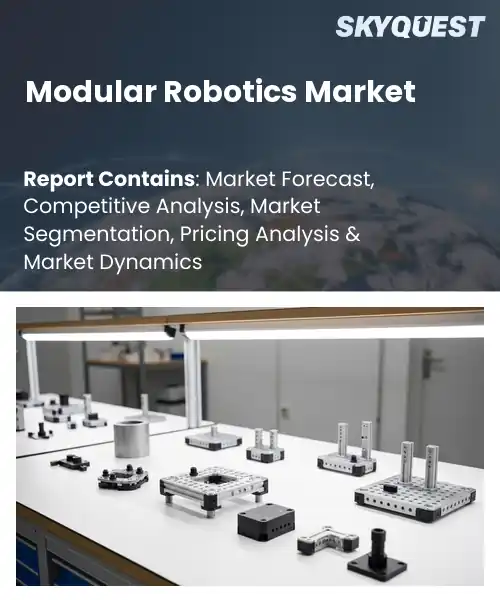
Modular Robotics Market
Report ID: SQMIG20I3164
Report ID: SQMIG20I3164
[email protected]
USA +1 351-333-4748
Report ID:
SQMIG20I3164 |
Region:
Global |
Published Date: June, 2026
Pages:
157
|Tables:
95
|Figures:
76


Global Modular Robotics Market size was valued at USD 11.31 Billion in 2024 and is poised to grow from USD 12.65 Billion in 2025 to USD 30.99 Billion by 2033, growing at a CAGR of 11.85% during the forecast period (2026-2033).
Modular robotics are used throughout the world and are based on interchangeable re-configurable units to perform various tasks. It gives manufacturers a scalable alternative to monolithic machines. The figure also shows the possibility to cut capital expenditures, and to speed up the diversification of the product line, a need that is becoming more and more pressing in the light of the rapid changes in consumers preferences. The field really took off in the early 2010s when research labs developed plug-and-play manipulators for aerospace assembly. By 2020, Boston Dynamics and Yaskawa were among the companies selling commercial kits that could be put together in minutes. The evolution is driven by a need for fast cheap automation able to provide real-time fulfillment of changing production requirements.
Agility: The engine of growth The convergence of sensor networks and edge-computing platforms enables modular robots to sense and react to their environment without central command. Robots will be provided with on-board processors to process sensor data while they are working and to self-diagnose faults, reallocate modules and optimise trajectories. This will reduce downtime and maintenance costs for logistics, agriculture and healthcare users. A warehouse operator has a swarm of modular pickers that reconfigure overnight for 30 percent more throughput to new SKU dimensions. There are opportunities for software vendors and component suppliers as OEMs invest in AI-enabled modules.
How are AI and IoT driving innovation in the modular roboticsmarket?
The hardware becomes a static smart connected platform. AI and IoT are transforming modular robotics. AI algorithms help training robots to learn a task, optimise routes of motion, predict component wear. With IoT each module is connected to a cloud layer that streams the sensor data for remote monitoring and quick reconfiguration. Their production lines are reconfigurable on the fly. Predictive maintenance can minimize downtime, and manufacturers can scale operations without massive retooling. The rise of Industry 4.0 has also increased the demand for modular solutions. The industry responds with a flood of smart robot kits combining plug-and-play mechanics and embedded AI chips with wireless connectivity.
ABB Ltd. has launched modular robot cells with embedded AI and IoT sensors to enable dynamic performance enhancements. Mar 2025 The cells give manufacturers the ability to change the assembly sequence on the fly, reducing set-up time, speeding up the adoption of modular robotics and boosting production efficiency.
Market snapshot - (2026-2033)
Global Market Size
USD 11.31 Billion
Largest Segment
Industrial Modular Robots
Fastest Growth
Educational Modular Robots
Growth Rate
11.85% CAGR
To get more insights on this market click here to Request a Free Sample Report
Global modular robotics market is segmented by product configuration class, functional application layer, target end-use sector and region. Based on product configuration class, the market is segmented into Industrial Modular Robots, Service Modular Robots, Collaborative Modular Robots, Educational Modular Robots and Defense Modular Robots. Based on functional application layer, the market is segmented into Industrial Automation, Healthcare Applications, Logistics & Warehousing and Defense & Security Operations. Based on target end-use sector, the market is segmented into Manufacturing Sector, Healthcare Sector, Logistics Sector, Defense Sector and Others. Based on region, the market is segmented into North America, Europe, Asia Pacific, Latin America and Middle East & Africa.
Industrial Modular Robots segment dominates because manufacturers prioritize flexibility, scalability, and rapid reconfiguration of production lines, which these systems inherently provide. Their ability to integrate plug and play hardware modules reduces downtime and capital expenditure, enabling firms to respond swiftly to shifting demand patterns and product customization trends. Additionally, robust payload capacities and proven reliability make them the preferred choice for high volume, continuous operation environments, supporting long term asset utilization and cost efficiency.
Meanwhile, Collaborative Modular Robots are witnessing the strongest growth momentum as enterprises seek safe human robot interaction for assembly and inspection tasks. Their adaptive software frameworks and sensor rich designs enable quick deployment in mixed skill workcells, unlocking new productivity gains and fostering workforce upskilling. This convergence drives broader acceptance across mid size manufacturers.
The trend is being led by the Industrial Automation segment with plants adopting modular robots to automate repetitive tasks to increase throughput with less retooling. Standard robot modules are modular and allow system upgrades through existing control architectures, allowing producers to remain competitive with reduced engineering overhead. Automation is the driver for the growth of the market. The lean manufacturing paradigm requires flexible and interoperable units that can be easily reprogrammed for different tasks.
A big high growth app – modular robots in healthcare. Hospitals and clinics are deploying modular robots to assist with surgery and to move and sterilize patients. The increasing demand for new revenue streams and the innovation in soft actuation and tactile sensing technologies will assist the market to grow and provide new opportunities for specialized robotic solutions.
To get detailed segments analysis, Request a Free Sample Report
“Engineering has a huge talent pool, many research institutions and a very fast culture to adopt technology. Also very flexible are the robotic modules that draw on decades of precision manufacturing and electronics experience. A good supply chain with easy access to components and support services and Government policies that encourage modular solutions in smart factories. Ecosystems bring together manufacturers, academia and startups to accelerate the innovation cycles. The growing demand for automation in automotive, consumer electronics and logistics underlines the region's leading position in modular robotics.
Japan’s tradition of precision manufacturing and high precision engineering is likely to drive the modular robotics market. The innovation of modular architectures is still in its infancy, driven by the close relationship between large manufacturing companies and academic research institutions. If governments are to compete in the world market they need to be flexible about automation. High-tech integration Expert Technicians Automotive & Electronics Assembly Lines Rapid Prototyping & Installation.
South Korea Modular Robotics Market: Strong Focus on Smart Manufacturing & Adoption of 4th Industrial Revolution to Boost The modular platforms are equipped with the latest sensors and control systems created by the country’s advanced electronics industry. The public policy is aimed to accelerate the digital transformation by incentivizing companies to use re-configurable robotic solutions and not rigid automation. Flex modules for automotive, semiconductor and consumer goods manufacturing are led by conglomerates and technology incubators.
The continent's innovation ecosystem, venture capital and consumer demand are booming, fueling fast growth across the continent. Market demand is for flexible automation and so the company has to be able to respond quickly, he says. Our robots are modular systems that can be reconfigured in a short time frame. Modular solutions will also boost predictive maintenance and process optimization using AI and advanced analytics. The regulatory environment for the use of collaborative robots in logistics and warehousing environments makes them suitable for widespread deployment.
The US Modular Robotics industry has a robust innovation pipeline driven by world class research universities and a vibrant startup ecosystem. Aerospace, automotive and consumer goods manufacturers are adopting automation to boost productivity and adapt to changing design requirements. The provision of highly qualified engineering staff allows for rapid customization of modular components and the development of strategic alliances between technology and industrial companies, accelerating deployment in smart factories.
Advanced research and sustainable manufacturing partnership to speed up Canadian modular robotics market. Federal and provincial programs are developing flexible robotic solutions to help conserve energy and waste. The modular design is setting the pace in academic institutions and research centres and is being increasingly adopted by small and medium sized enterprises in the aerospace, food processing and forestry sectors.
European players with their engineering know-how, aligned standards and policy incentives are shaping the role of the region in modular robotics. One of the broader Industry 4.0 strategies that allow cross-border cooperation and market integration is the development of interoperable solutions. Public-private partnerships are focusing on sustainability and modular designs to extend the life of equipment and reduce the material footprint. Manufacturers can invest in digital infrastructure and upskill their workforce so they can implement modular robotics without losing any quality or efficiency.
Strong automotive supply chain, legacy of precision engineering drives Germany’s Mittelstand ecosystem of the modular robotics market. Modular platform innovation smoothly integrated into production line. Strong research organisations are using digitalisation to create reconfigurable robotic solutions to enable the country to move into flexible high value manufacturing.
The UK Modular Robotics market is witnessing growth due to the presence of leading research universities and a vibrant start-up ecosystem. Venture Capital funds and start-ups in Financial Services developing modular robots. And that’s a good thing because industry associations and government agencies are collaborating to bring flexible automation to pharmaceuticals and aerospace and advanced manufacturing.
However, the France modular robotics market will grow with the growth of modular robotic technologies due to the prevalent research and development activities in the aerospace and defence sector. Government programs are developing automation applicable to a broad spectrum of industrial applications. State-of-the-art engineering and collaborative design to meet stringent safety and quality standards Productivity enhancement modular solutions.
To know more about the market opportunities by region and country, click here to
Buy The Complete Report
Increasing Automation Demand
Advancements In Sensor Technologies
High Initial Capital Expenditure
Complex Integration Challenges
Request Free Customization of this report to help us to meet your business objectives.
The modular robotics sector is intensely competitive as firms race to secure funding, forge strategic alliances and accelerate technology roll‑outs; venture capital inflows such as RobCo’s $100 million round and Bubble Robotics’ multi‑stage raises are reshaping market dynamics, while innovators like Apptronik leverage advanced humanoid platforms to capture niche industrial applications, driving rapid product differentiation and partnership activity.
SkyQuest’s ABIRAW (Advanced Business Intelligence, Research & Analysis Wing) is our Business Information Services team that Collects, Collates, Correlates, and Analyses the Data collected by means of Primary Exploratory Research backed by robust Secondary Desk research. As per SkyQuest analysis, the global modular robotics market is projected to expand at an 11.85 % CAGR, driven primarily by the rising demand for automation that offers flexible, scalable solutions, while advanced sensor technologies serve as a second catalyst enabling real‑time adaptability and safety. High initial capital expenditure remains a key restraint, limiting adoption among cost‑sensitive firms. The industrial modular robot segment leads the market, reflecting manufacturers’ preference for rapid reconfiguration and robust payload capacity. Asia‑Pacific dominates regionally, fueled by strong engineering talent, supportive policies, and a vibrant supply chain that accelerates innovation and deployment across manufacturing, logistics and healthcare.
| Report Metric | Details |
|---|---|
| Market size value in 2024 | USD 11.31 Billion |
| Market size value in 2033 | USD 30.99 Billion |
| Growth Rate | 11.85% |
| Base year | 2024 |
| Forecast period | (2026-2033) |
| Forecast Unit (Value) | USD Billion |
| Segments covered |
|
| Regions covered | North America (US, Canada), Europe (Germany, France, United Kingdom, Italy, Spain, Rest of Europe), Asia Pacific (China, India, Japan, Rest of Asia-Pacific), Latin America (Brazil, Rest of Latin America), Middle East & Africa (South Africa, GCC Countries, Rest of MEA) |
| Companies covered |
|
| Customization scope | Free report customization with purchase. Customization includes:-
|
To get a free trial access to our platform which is a one stop solution for all your data requirements for quicker decision making. This platform allows you to compare markets, competitors who are prominent in the market, and mega trends that are influencing the dynamics in the market. Also, get access to detailed SkyQuest exclusive matrix.
Table Of Content
Executive Summary
Market overview
Parent Market Analysis
Market overview
Market size
KEY MARKET INSIGHTS
COVID IMPACT
MARKET DYNAMICS & OUTLOOK
Market Size by Region
KEY COMPANY PROFILES
Methodology
For the Modular Robotics Market, our research methodology involved a mixture of primary and secondary data sources. Key steps involved in the research process are listed below:
1. Information Procurement: This stage involved the procurement of Market data or related information via primary and secondary sources. The various secondary sources used included various company websites, annual reports, trade databases, and paid databases such as Hoover's, Bloomberg Business, Factiva, and Avention. Our team did 45 primary interactions Globally which included several stakeholders such as manufacturers, customers, key opinion leaders, etc. Overall, information procurement was one of the most extensive stages in our research process.
2. Information Analysis: This step involved triangulation of data through bottom-up and top-down approaches to estimate and validate the total size and future estimate of the Modular Robotics Market.
3. Report Formulation: The final step entailed the placement of data points in appropriate Market spaces in an attempt to deduce viable conclusions.
4. Validation & Publishing: Validation is the most important step in the process. Validation & re-validation via an intricately designed process helped us finalize data points to be used for final calculations. The final Market estimates and forecasts were then aligned and sent to our panel of industry experts for validation of data. Once the validation was done the report was sent to our Quality Assurance team to ensure adherence to style guides, consistency & design.
Analyst Support
Customization Options
With the given market data, our dedicated team of analysts can offer you the following customization options are available for the Modular Robotics Market:
Product Analysis: Product matrix, which offers a detailed comparison of the product portfolio of companies.
Regional Analysis: Further analysis of the Modular Robotics Market for additional countries.
Competitive Analysis: Detailed analysis and profiling of additional Market players & comparative analysis of competitive products.
Go to Market Strategy: Find the high-growth channels to invest your marketing efforts and increase your customer base.
Innovation Mapping: Identify racial solutions and innovation, connected to deep ecosystems of innovators, start-ups, academics, and strategic partners.
Category Intelligence: Customized intelligence that is relevant to their supply Markets will enable them to make smarter sourcing decisions and improve their category management.
Public Company Transcript Analysis: To improve the investment performance by generating new alpha and making better-informed decisions.
Social Media Listening: To analyze the conversations and trends happening not just around your brand, but around your industry as a whole, and use those insights to make better Marketing decisions.
REQUEST FOR SAMPLE
 REQUEST FREE CUSTOMIZATION
Global Modular Robotics Market size was valued at USD 11.31 Billion in 2024 and is poised to grow from USD 12.65 Billion in 2025 to USD 30.99 Billion by 2033, growing at a CAGR of 11.85% during the forecast period (2026-2033).
The modular robotics sector is intensely competitive as firms race to secure funding, forge strategic alliances and accelerate technology roll‑outs; venture capital inflows such as RobCo’s $100 million round and Bubble Robotics’ multi‑stage raises are reshaping market dynamics, while innovators like Apptronik leverage advanced humanoid platforms to capture niche industrial applications, driving rapid product differentiation and partnership activity. 'Fanuc Corporation', 'ABB Ltd', 'Yaskawa Electric Corporation', 'KUKA AG', 'Kawasaki Heavy Industries Ltd', 'Mitsubishi Electric Corporation', 'Denso Wave Incorporated', 'Universal Robots AS', 'Staubli International AG', 'Comau SpA', 'Nachi-Fujikoshi Corp', 'Epson Robots', 'Omron Adept Technologies Inc', 'Rethink Robotics GmbH', 'Kinova Inc', 'HEBI Robotics', 'Modular Robotics LLC', 'Schunk GmbH & Co KG', 'RoboLink', 'Dobot Robotics'
The rising need for automated processes across manufacturing, logistics, and services encourages adoption of modular robotics, as they provide flexible, scalable solutions that can be reconfigured quickly to meet changing production requirements, thereby reducing downtime and facilitating rapid deployment of new capabilities. This adaptability also supports heterogeneous environments where different robot modules cooperate, enabling enterprises to experiment with innovative workflows without extensive capital investment, and fostering a culture of continuous improvement that aligns with strategic goals for efficiency and competitiveness.
Adaptive Manufacturing Flexibility: Customers are increasingly demanding production lines that can be swiftly re‑engineered to accommodate product variations, short runs, and rapid market shifts. Modular robotics offers plug‑and‑play nodes that can be added, removed, or repositioned without extensive downtime, enabling factories to maintain high utilization while embracing customization. This flexibility reduces the need for dedicated equipment, shortens time‑to‑market, and aligns manufacturing with just‑in‑time inventory philosophies, positioning modular solutions as a cornerstone of responsive, resilient supply chains throughout global production ecosystems and service networks.
Why does Asia Pacific Dominate the Global Modular Robotics Market? |@12


Want to customize this report? This report can be personalized according to your needs. Our analysts and industry experts will work directly with you to understand your requirements and provide you with customized data in a short amount of time. We offer $1000 worth of FREE customization at the time of purchase.
Feedback From Our Clients


 USA (+1) 351-333-4748

