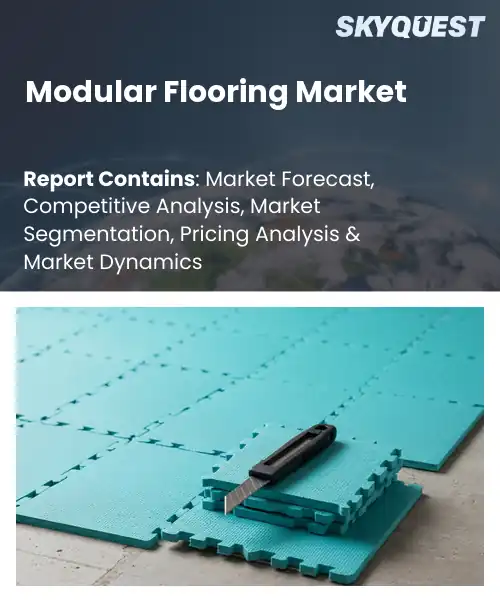
Modular Flooring Market
Report ID: SQMIG20B2156
Report ID: SQMIG20B2156
[email protected]
USA +1 351-333-4748
Report ID:
SQMIG20B2156 |
Region:
Global |
Published Date: June, 2026
Pages:
157
|Tables:
179
|Figures:
79


Global Modular Flooring Market size was valued at USD 64.5 Billion in 2024 and is poised to grow from USD 69.08 Billion in 2025 to USD 119.58 Billion by 2033, growing at a CAGR of 7.1% during the forecast period (2026-2033).
The modular flooring industry includes products consisting of interlocking tiles and planks such as luxury vinyl tile; engineered wood; and raised access panels, which can be quickly installed and replaced without adhesives. This market is particularly relevant because the capability to fit out space quickly will reduce business interruption and will enhance the ability to recycle materials that support circularity and allow for adaptable design for both commercial and institutional applications. The modular flooring industry developed over time from primarily serving industrial flooring to the general market, including office space, hospitals, and retail establishments, because improvements in material science and production capabilities have enabled the incorporation of modular flooring into these markets. Airports installing removable tiles in their terminal buildings for maintenance, and retailers using click-fit planks for temporary retail locations provide evidence of this trend. The underlying driver behind this growth is the need for companies to acquire flexible and low-cost flooring that minimises any business interruption associated with changing from one type of flooring to another.
Another important factor driving the expansion of the global modular flooring market is the advancement of technology in the materials used in manufacturing modular flooring. Developments such as waterproof spc (stone plastic composite) cores; click-lock profiles; and pre-finished surfaces have reduced the time required to install modular flooring; decreased the amount of labour required to install modular flooring and resulted in longer serviceable lives for modular flooring products. As a result, developers and facility managers are choosing to use modular flooring products to reduce their fit-out schedules and the total cost of ownership associated with furnishing their buildings, resulting in a growing demand for modular flooring products in office and retail refurbishment, as well as in healthcare conversion, where time lost is costly.
How is IoT improving installation efficiency in the modular flooring market?
IoT transforms modular flooring installation by making layout measurement inventory and site conditions visible and actionable. Smart sensors and connected markers enable precise pre measurement and digital layout guidance which reduces on site rework. Connected inventory and asset tracking simplify deliveries and staging so installers spend less time locating materials. Remote environmental monitoring and simple device management let teams verify adhesive cure and moisture without repeated site visits. When combined with mobile apps and digital twin workflows the result is smoother coordination between manufacturers distributors and fitters and more predictable project handoffs in a market focused on faster commercial turnarounds and sustainability.
Tarkett in November 2025, launched a Customer Portal app and a Ready to Ship program that improves order and inventory visibility. This suggests that pairing such digital tools with IoT enabled tracking and sensorized site workflows can reduce coordination delays and support faster modular flooring installations.
Market snapshot - (2026-2033)
Global Market Size
USD 64.5 Billion
Largest Segment
Luxury Vinyl Tiles (LVT)
Fastest Growth
Luxury Vinyl Tiles (LVT)
Growth Rate
7.1% CAGR
To get more insights on this market click here to Request a Free Sample Report
Global modular flooring market is segmented by product type, material type, application, installation type, end user, distribution channel and region. Based on product type, the market is segmented into Carpet Tiles, Luxury Vinyl Tiles (LVT), Rubber Flooring Tiles, Raised Access Flooring Panels and Others. Based on material type, the market is segmented into Vinyl, Carpet Fiber, Rubber, Wood and Others. Based on application, the market is segmented into Commercial, Residential, Industrial and Institutional. Based on installation type, the market is segmented into Glue-Down, Loose Lay and Interlocking Systems. Based on end user, the market is segmented into Offices, Retail Spaces, Healthcare Facilities, Educational Institutions, Residential Buildings and Others. Based on distribution channel, the market is segmented into Direct Sales, Distributors & Dealers and Retail Stores. Based on region, the market is segmented into North America, Europe, Asia Pacific, Latin America and Middle East & Africa.
Carpet tiles segment dominates with large modular flooring market share because their modular construction directly addresses acoustic control, maintenance efficiency, and design adaptability sought in modern interiors. The tile format allows targeted replacement and patterning while pile types and backing systems dissipate impact and airborne sound, improving occupant comfort. These performance attributes reduce operational disruptions and maintenance cycles, driving specification by facility managers and designers prioritizing controlled acoustic environments and adaptable aesthetics.
As per modular flooring market outlook, luxury vinyl tiles (LVT) are emerging as the fastest growing product type, driven by realistic visuals, water resistance, and simple upkeep. Improved constructions and click lock backing broaden their use across commercial and residential applications, while expanding design options and faster installation workflows accelerate adoption and open new retrofit and finish-upgrade opportunities.
As per modular flooring market analysis, glue-down format dominates the market segment because of the important benefits of the fixed bond providing consistent load transfer, long-term dimensional stability for high-traffic and large Open plan environments, and minimal movement of the panel once applied, resulting in helping to support the longevity of the panels for continued use. Familiar installation techniques provide broad compatibility of installation materials for the glue-down format as a preferred specification choice for larger scale projects where the goal is permanence; predictability of performance; and minimal adjustments needed after the installation.
As per modular flooring market forecast, the loose lay segment is experiencing the most robust growth momentum due to the ability to install quickly; little preparation to the subfloor is required; and removal requires little disruption to normal operations. Advances in backing materials and dimensional stability qualify the loose lay format to be used in temporary, hybrid, and flexible workplace strategies, therefore creating new opportunities for use in refurbishment projects, short-term leasing, and adaptive reuse applications.
To get detailed segments analysis, Request a Free Sample Report
Asia Pacific dominance in the modular flooring industry is a combination of demand dynamics, manufacturing capability and regional policy orientation that have a bias towards infrastructure and urban growth. Rapid urbanization and high volume building activity drives demand for adaptable, cost effective flooring solutions, supported by a dense network of local manufacturers allowing scalable production and customization. A robust integration of the supply chain with surrounding economies allows for efficient sourcing of raw materials and components to improve competitive pricing and lead times. A preference for design that allows for flexible installation and maintenance and encourages modular alternatives. Investment in advanced production technology and in innovation of materials in the region further increases product quality and performance. Collectively, these structural advantages support the development of a marketplace in which modular flooring is broadly specified in residential, commercial and institutional buildings.
As per modular flooring market regional outlook, Japan is focused on precise manufacturing, high quality finishes, and space efficient design for small urban constructions. Local manufacturers look for robust materials and seamless installation methods that suit rehabilitation and new build segments. Design trends include the use of modular systems with underfloor technologies and aesthetic preferences for delicate textures. Architects, contractors and suppliers collaborate to push forward specification of modular solutions in commercial interiors and high density residential projects.
As per modular flooring market regional forecast, South Korea advantages from technology driven production and design integration in building. Manufacturers are developing designed modules for speedier installation and easier maintenance across commercial and multifamily buildings. Materials innovation focuses on performance and decreased maintenance, while suppliers offer customized finishing options to satisfy architectural needs. Developer, design firm and supplier chain collaboration speeds adoption of modular technologies in urban redevelopment and mixed use developments.
The rapid growth of North America is driven by evolving construction methods, a significant need for effective refurbishment solutions, and a robust distribution network that ensures easy access to products. Speed of install, little interruption and long term maintainability are increasingly valued by design experts and end users all of which dovetail with modular flooring benefits. Its strong aftermarket support and vast contractor knowledge cuts down on adoption friction and its innovation in materials and finishes caters to aesthetic and performance requirements across commercial and residential markets. The emphasis on resource efficiency in policy and the increasing interest for sustainable supply chains favor the choice of modular systems. Manufacturers use regional logistics hubs to reduce lead time and deliver local service; retailers use experiential showrooms to help shoppers compare solutions.
As per modular flooring industry analysis, United States market is anticipated to gain extensive popularity in commercial remodeling projects. The market is driven by the desire for quick installation and easy maintenance. Suppliers offer wide product ranges, custom finishes to match design demands. With strong distribution networks and renovation-focused contractors, it is easy to implement in urban areas and suburban developments. Sustainable materials and supply chain transparency are key drivers for architects and facilities managers specifying dependable, low disruption flooring solutions.
Canada reflects interest in adaptable flooring for renovation projects with emphasis on durability and performance across climates. Regional suppliers tailor product specifications for maintenance efficiency and ease of replacement in high use environments. Distribution channels blend national retailers and dealers to reach contractors and users. Collaboration with design professionals and building owners on lifecycle considerations fosters selection of modular systems that balance aesthetics and long term serviceability.
Europe is gaining ground in the modular flooring sector with a concerted focus on sustainability, technical standards and high end design integration that matches local procurement patterns. In public and private projects, modular solutions are gaining importance, and market players are focusing on recyclable materials, low emission production and product transparency to meet strict construction and environmental standards. Manufacturers are investing in sophisticated production methods and surface technologies to improve durability and aesthetic variation allowing for larger specification. Cross border logistics and established dealer networks facilitate consistent availability and close collaboration between designers, facilities teams and suppliers ensures modular systems are tailored to complex renovation and refurbishment requirements. This convergence of legislation, product innovation and professional practice supports Europe as a leading market for innovative modular flooring.
Germany is driven by precision manufacturing, rigorous building standards, and emphasis on sustainability in material selection. Manufacturers supply engineered systems that meet strict performance and air quality expectations sought by architects and facility managers. Industrial, commercial sectors favor durable, low maintenance options that support operational continuity. Cooperation between suppliers and construction professionals enables tailored solutions for refurbishment and new projects, thereby reinforcing demand for quality modular flooring.
United Kingdom is pushed by design led uptake and retrofit solutions for older building stock. Design experts love modular systems for commercial and hospitality areas because they are quick to install and offer design flexibility. Finishes and alternatives that work for dense metropolitan situations are available from suppliers. Sustainability credentials and product transparency highlighted, driving specification for public procurement and private refurbishing, facilitating penetration of modular flooring across sectors.
France is influenced by attention to aesthetics, material quality and bespoke finishes that appeal to premium residential and hospitality projects. Local manufacturers blend craftsmanship with modern production methods to deliver refined surface textures and tailored installations for renovation and new developments. Sustainability and product provenance guide procurement decisions. Collaboration between design studios, contractors and suppliers supports specification of modular systems that combine decorative appeal with maintenance benefits.
To know more about the market opportunities by region and country, click here to
Buy The Complete Report
Rising Demand For Sustainable Materials
Advances In Installation Technologies
High Initial Material Costs
Limited Awareness Among End Users
Request Free Customization of this report to help us to meet your business objectives.
Competitive landscape in global modular flooring is shaped by consolidation, IP licensing and product differentiation. Large manufacturers secure modular segments through acquisitions and targeted technology deals, for example Gerflor’s purchase of SnapLock and i4F’s patent partnerships that supported Engineered Floors’ digital printing rollouts. Emerging bio based and PVC free suppliers are forcing new partnerships and targeted M&A as incumbents chase sustainable differentiation.
SkyQuest’s ABIRAW (Advanced Business Intelligence, Research & Analysis Wing) is our Business Information Services team that Collects, Collates, Correlates, and Analyses the Data collected by means of Primary Exploratory Research backed by robust Secondary Desk research.
As per SkyQuest analysis, the global modular flooring market growth is being driven by demand for agile, cost-effective installations that reduce downtime and enable rapid reconfiguration, with a key driver being rapid installation and reduced operational disruption. A restraint is the perception of high initial material costs that can deter budget-conscious buyers. The dominating region is Asia Pacific, supported by rapid urbanization and strong manufacturing capability, and the dominating segment is carpet tiles due to acoustic control and maintenance benefits. A second driver is advances in materials and installation technologies such as waterproof cores, click-lock profiles and recyclable formulations that extend service life and simplify fit-outs, unlocking demand across commercial and institutional projects.
| Report Metric | Details |
|---|---|
| Market size value in 2024 | USD 64.5 Billion |
| Market size value in 2033 | USD 119.58 Billion |
| Growth Rate | 7.1% |
| Base year | 2024 |
| Forecast period | (2026-2033) |
| Forecast Unit (Value) | USD Billion |
| Segments covered |
|
| Regions covered | North America (US, Canada), Europe (Germany, France, United Kingdom, Italy, Spain, Rest of Europe), Asia Pacific (China, India, Japan, Rest of Asia-Pacific), Latin America (Brazil, Rest of Latin America), Middle East & Africa (South Africa, GCC Countries, Rest of MEA) |
| Companies covered |
|
| Customization scope | Free report customization with purchase. Customization includes:-
|
To get a free trial access to our platform which is a one stop solution for all your data requirements for quicker decision making. This platform allows you to compare markets, competitors who are prominent in the market, and mega trends that are influencing the dynamics in the market. Also, get access to detailed SkyQuest exclusive matrix.
Table Of Content
Executive Summary
Market overview
Parent Market Analysis
Market overview
Market size
KEY MARKET INSIGHTS
COVID IMPACT
MARKET DYNAMICS & OUTLOOK
Market Size by Region
KEY COMPANY PROFILES
Methodology
For the Modular Flooring Market, our research methodology involved a mixture of primary and secondary data sources. Key steps involved in the research process are listed below:
1. Information Procurement: This stage involved the procurement of Market data or related information via primary and secondary sources. The various secondary sources used included various company websites, annual reports, trade databases, and paid databases such as Hoover's, Bloomberg Business, Factiva, and Avention. Our team did 45 primary interactions Globally which included several stakeholders such as manufacturers, customers, key opinion leaders, etc. Overall, information procurement was one of the most extensive stages in our research process.
2. Information Analysis: This step involved triangulation of data through bottom-up and top-down approaches to estimate and validate the total size and future estimate of the Modular Flooring Market.
3. Report Formulation: The final step entailed the placement of data points in appropriate Market spaces in an attempt to deduce viable conclusions.
4. Validation & Publishing: Validation is the most important step in the process. Validation & re-validation via an intricately designed process helped us finalize data points to be used for final calculations. The final Market estimates and forecasts were then aligned and sent to our panel of industry experts for validation of data. Once the validation was done the report was sent to our Quality Assurance team to ensure adherence to style guides, consistency & design.
Analyst Support
Customization Options
With the given market data, our dedicated team of analysts can offer you the following customization options are available for the Modular Flooring Market:
Product Analysis: Product matrix, which offers a detailed comparison of the product portfolio of companies.
Regional Analysis: Further analysis of the Modular Flooring Market for additional countries.
Competitive Analysis: Detailed analysis and profiling of additional Market players & comparative analysis of competitive products.
Go to Market Strategy: Find the high-growth channels to invest your marketing efforts and increase your customer base.
Innovation Mapping: Identify racial solutions and innovation, connected to deep ecosystems of innovators, start-ups, academics, and strategic partners.
Category Intelligence: Customized intelligence that is relevant to their supply Markets will enable them to make smarter sourcing decisions and improve their category management.
Public Company Transcript Analysis: To improve the investment performance by generating new alpha and making better-informed decisions.
Social Media Listening: To analyze the conversations and trends happening not just around your brand, but around your industry as a whole, and use those insights to make better Marketing decisions.
REQUEST FOR SAMPLE
 REQUEST FREE CUSTOMIZATION
Global Modular Flooring Market size was valued at USD 64.5 Billion in 2024 and is poised to grow from USD 69.08 Billion in 2025 to USD 119.58 Billion by 2033, growing at a CAGR of 7.1% during the forecast period (2026-2033).
Competitive landscape in global modular flooring is shaped by consolidation, IP licensing and product differentiation. Large manufacturers secure modular segments through acquisitions and targeted technology deals, for example Gerflor’s purchase of SnapLock and i4F’s patent partnerships that supported Engineered Floors’ digital printing rollouts. Emerging bio based and PVC free suppliers are forcing new partnerships and targeted M&A as incumbents chase sustainable differentiation. 'Interface', 'Tarkett', 'Mohawk Industries', 'Shaw Industries', 'Milliken & Company', 'Forbo Flooring Systems', 'Mannington Mills', 'Gerflor', 'Beaulieu International Group', 'LX Hausys', 'Polyflor', 'Victoria PLC', 'Engineered Floors', 'Ege Carpets', 'Burmatex', 'Paragon Carpet Tiles', 'Roppe Corporation', 'Armstrong World Industries', 'Florim', 'Milliken Modular'
The increasing preference for environmentally friendly flooring solutions among architects, designers, and end users stimulates demand for modular flooring products made from recycled or low-impact materials. Manufacturers respond by expanding sustainable product lines and investing in certifications and supply chain transparency, which enhances market credibility and broadens adoption across commercial and residential projects. This alignment with sustainability priorities encourages specification by decision makers, creates differentiation for suppliers, and supports premium positioning that collectively drives wider market acceptance and procurement of modular flooring systems.
Sustainable Material Adoption: Market preference is shifting toward modular flooring made from recycled and bio-based inputs, driven by corporate sustainability goals and environmentally conscious consumers. Manufacturers are developing circular production models that facilitate reuse and reclamation at end of life while preserving performance and appearance. This trend encourages collaboration across supply chains, accelerates innovation in material science, enables differentiation through transparent sustainability claims, and supports premium positioning in institutional and commercial segments seeking reduced environmental impact and stronger alignment with green building initiatives.
Why does Asia Pacific Dominate the Global Modular Flooring Market? |@12


Want to customize this report? This report can be personalized according to your needs. Our analysts and industry experts will work directly with you to understand your requirements and provide you with customized data in a short amount of time. We offer $1000 worth of FREE customization at the time of purchase.
Feedback From Our Clients


 USA (+1) 351-333-4748

