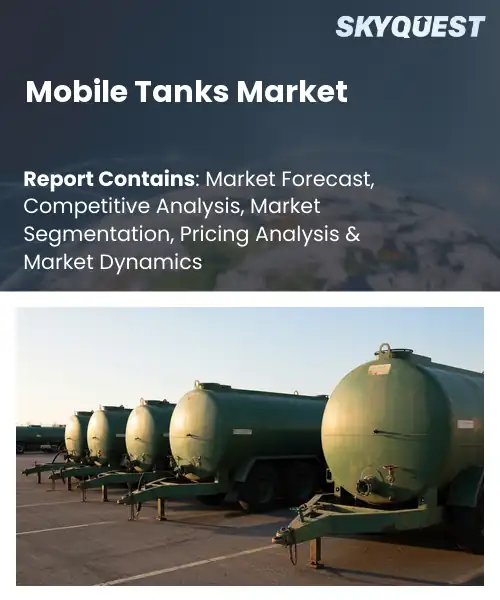
Mobile Tanks Market
Report ID: SQMIG20I3322
Report ID: SQMIG20I3322
[email protected]
USA +1 351-333-4748
Report ID:
SQMIG20I3322 |
Region:
Global |
Published Date: July, 2026
Pages:
157
|Tables:
156
|Figures:
78


Global Mobile Tanks Market size was valued at USD 2.84 Billion in 2024 and is poised to grow from USD 3.0 Billion in 2025 to USD 4.64 Billion by 2033, growing at a CAGR of 5.6% during the forecast period (2026-2033).
The mobile tanks market covers armoured fighting vehicles for use and transport, ranging from lightweight air-transportable models to hybrid electric versions used by armed forces. This is critical because it enables armies to project power across theaters but still be able to withstand threats. The growing demand for expeditionary capability among NATO members and developing powers has driven the procurement of platforms providing a combination of firepower and logistical flexibility.
Another key driver for the global mobile tanks market growth is integration of sensor suites and artificial intelligence algorithms that convert the armor into fighting platforms. These tanks can navigate and fire by integrating battlefield data from drones, satellites and command nets, reducing crew workload, improving survivability and operational tempo. This capability has opened up export potential to warring states as evidenced by India’s acquisition of 100 modified Arjun-Mk II tanks with AI-enabled fire control. This has resulted in major investments in R&D partnerships with digital companies, fast-tracking product cycles and capturing market share in NATO and non-aligned spheres.
Automation powered by artificial intelligence that incorporates intelligent control loops into vehicle platforms is reshaping the mobile tanks market outlook. These machine learning algorithms can help predict the wear of certain machine parts using information received from sensors and enabling repairs made before the breakdown occurs, making sure that the fleets run without interruption. Autonomous piloting systems let tanks carry out specific routes by themselves with minimal human participation and allowing the crew to focus on more important tasks. The targeting systems receive constant battlefield-related information that enhances the ability to react and reduces human mistakes. Each armoured vehicle has a direct link to the command through the means of communication and is aware of its situation and logistics status. All of this combined ensures that missions are successful at various theatres of operation and with the help of more allies.
Market snapshot - (2026-2033)
Global Market Size
USD 2.84 Billion
Largest Segment
Fuel Tanks
Fastest Growth
Waste Collection Tanks
Growth Rate
5.6% CAGR
To get more insights on this market click here to Request a Free Sample Report
The global mobile tanks market is segmented by product type, material, capacity, end user, distribution channel and region. Based on product type, the market is segmented into Fuel Tanks, Water Tanks, Chemical Tanks, Waste Collection Tanks and Others. Based on material, the market is segmented into Steel, Stainless Steel, Polyethylene, FRP and Others. Based on capacity, the market is segmented into Up to 500 Liters, 501-2,000 Liters, 2,001-5,000 Liters and Above 5,000 Liters. Based on end user, the market is segmented into Construction, Agriculture, Oil & Gas, Municipal and Others. Based on distribution channel, the market is segmented into OEM, Distributors, Rental Providers and Others. Based on region, the market is segmented into North America, Europe, Asia Pacific, Latin America and Middle East & Africa.
As per the mobile tanks market analysis, Fuel tanks are the market leader, as their intrinsic energy density fits perfectly with the mobile industry’s requirement for small, high-capacity storage solutions. Operators want dependable fuel, and these tanks offer high standards of safety, corrosion resistance and ease of integration into vehicle chassis. Hence, R&D efforts by manufacturers are aimed at improving performance, which helps to strengthen the segment’s primary function of powering mobile equipment in the oil-field, construction and agricultural applications along the supply chain and servicing.
However, the water tanks segment is expected to witness the fastest growth due to the growing demand for mobile water storage with on-site hygiene and fire-suppression capabilities. The progress in lightweight design and fast-install fittings allows more applications in remote construction and disaster assistance, thereby accelerating market penetration and opening up new prospects.
According to the mobile tanks market forecast, the stainless steel sector leads the way with increased mechanical strength and corrosion resistance to meet the arduous demands of mobile tank applications in demanding environments. Its endurance reduces maintenance cycles, which in turn assures OEMs and end users. Recyclability complies with the sustainability requirements. It is the material of choice for high performance fuel and chemical storage. It also offers greater design freedom for customized mobile systems due to compatibility with complex welding procedures that permit complex geometries.
At the same time, the polyethylene market is witnessing the fastest growth momentum as producers are seeking for cheaper and lighter solutions for transportation of low risk liquids. Better polymer engineering means improved impact resistance and UV stability. Therefore these tanks are attractive for temporary construction sites and agricultural irrigation thus increasing market penetration and new container ideas.
To get detailed segments analysis, Request a Free Sample Report
As per the mobile tanks market regional forecast, Asia Pacific is the largest market propelled by robust manufacturing capabilities, large investments in logistics infrastructure and a rapidly growing industrial base in key markets. Intense collaborations between equipment suppliers and major energy companies speed product development, and the local focus on high-efficiency designs is well aligned with rigorous safety and environmental standards. South Korea and Japan have robust research ecosystems that facilitate the adoption of intelligent monitoring technology and lightweight composites to enhance operational reliability. Furthermore, supportive government policies facilitate export-oriented growth and modernize transport fleets, reinforcing the region’s leadership and sustaining momentum in the global mobile tank market. The Asia Pacific manufacturers have a competitive edge in that they can quickly adapt to the evolving customer needs and establish the global industry standards. The reason is the culture of continuous development and the availability of highly skilled engineering talent.
Mobile Tanks Market in Japan
The Mobile Tanks industry in Japan has a strong local production base focusing on high reliability and precision engineering. To address the sophisticated requirements of the supply chain, equipment makers collaborate with logistics companies to develop innovative solutions. Government programs that promote the upgrade of transportation infrastructure support the deployment of state-of-the-art mobile tank systems. All these factors underpin Japan’s position as a leader in the wider Asia Pacific region, creating a strong demand environment.
Mobile Tanks Market in South Korea
The South Korea’s mobile tanks sector is fueled by a changing industry that is centered around efficiency and automation. And the heavy equipment manufacturers are tied into the big names in the automotive industry, and this translates into the latest technology being built into mobile tank designs. Strong government incentives for upgrading logistics infrastructure will facilitate wider application in the petrochemical and energy sectors. This environment is conducive to strong demand, putting South Korea in a prominent position in the regional market dynamics.
The European mobile tanks market penetration is driven by strict environmental laws, a strong engineering heritage and a shared commitment to environmentally friendly transportation options. Top manufacturers are bringing together their broad experience with precision fabrication and modular design to meet the exacting performance requirements of a variety of industrial sectors. The transition to more efficient and low-leakage mobile tank systems is supported by policy frameworks for emission reduction and the promotion of a circular economy. International collaboration in research projects accelerates the use of new materials and digital monitoring, resulting in more operational visibility and safety. Together they create an environment that encourages further growth and makes Europe a hub of innovation and a powerful engine for the world market. It is also supported by industry clusters in Germany, the UK and France that match supply chain skills to new legislative requirements, creating a competitive advantage that ripples across the continent.
Mobile Tanks Market in Germany
The German mobile tank market is driven by its leading engineering companies and an established industrial base. High performance propulsion technology and advanced safety procedures are combined to meet the stringent requirements imposed by national and international regulators. Logistics companies and carmakers are joining forces to build better modular tank solutions. This ecosystem supports strong demand in the chemical processing, energy distribution and defense sectors, reaffirming Germany’s leadership position in the European market.
Mobile Tanks Market in the UK
The UK mobile tanks market share is witnessing healthy growth due to supportive legislative frameworks and aggressive use of pioneering logistical solutions. Many industries are investing in digital twin technology and real-time monitoring to improve operational safety and efficiency. The collaboration between equipment makers and research institutions is speeding up the development of lightweight, low-emission tank designs. This volatile climate means that the UK is currently Europe’s fastest growing market for mobile tanks.
Mobile Tanks Market in France
Integration of renewable energy logistics and sustainability is driving the growth of the French mobile tank market. Government incentives are helping manufacturers develop low-emission tank options for the booming chemical and agricultural markets. Modular designs can be tailored to different distribution networks by partnering with inland and maritime transport providers. These cumulative developments, in support of a growing demand base, put France in a position to be a contributor to the growth of the European mobile tank market.
A combination of government backing, strategic alliances and technological innovations are helping North America to secure its position in the mobile tank market. The region is home to a bunch of top tech firms and defense contractors, who are pouring in tons of R&D just to get next generation mobile tanks in motion with extraordinary capabilities. They’re working on artificial intelligence, better surveillance systems,and more solid armor technology, so these vehicles can stay more effective and longer-lasting out in modern warfare. Also, strategic alliances between North American companies and foreign defense organizations matter a lot. These partnerships keep North American companies at the forefront of mobile tank development, by trading information, resources, and know-how. On top of that, defense contracts and government support for defense research projects are essential too. For example, the U.S. The Department of Defense often awards contracts to firms, both domestic and foreign, for the development and purchase of advanced military equipment, including mobile tanks. Moreover, increasing focus on the modernization and upgradation of the existing military fleet across North America is also anticipated to enhance the demand for advanced mobile tanks. The armed forces of the area are trying to replace the outdated models with more modern, capable equipment that can handle the demands of the current and next wars. The trend is also supported by the growing emphasis on joint and coalition operations, which require highly capable and interoperable military equipment.
Mobile tanks in the United States
The US mobile tanks market is characterized by robust technological capabilities and a wide base of suppliers serving multiple sectors. Manufacturers use high-tech composite materials and automated monitoring to meet strict safety and efficiency standards. Major energy and chemical companies are converging, accelerating the deployment of next-generation tank platforms. This climate results in a strong demand pipeline, which keeps the United States as a hotspot in the North American mobile tank market.
Mobile Tanks Market in Canada
The Canadian mobile tank industry has high environmental compliance and a cooperative industry structure, combining national safety standards with local laws. Rolling out state-of-the-art low-emission technologies and modular designs, companies are aiming to serve the country’s vast natural resources and far-flung distribution networks. It partners with research universities to develop innovative telemetry and leak prevention systems. These factors enhance Canada’s market position and make it a significant player in the overall North America mobile tank market.
To know more about the market opportunities by region and country, click here to
Buy The Complete Report
Rising Demand for Remote Surveillance
Operators want to be able to deploy rapidly and continuously monitor hazardous environments without putting human lives at risk and are turning to mobile tanks with sophisticated sensor suites. The market for defense, mining and emergency response is growing as the need for real-time situational awareness in hazardous areas increases. Their modular payload capacity offers greater appeal to a wide range of customers seeking flexible and scalable solutions, allowing for tailoring to specific mission requirements. End-users are demanding operational efficiency and flexibility, which is leading to faster procurement cycles.
Advancements In Autonomous Navigation
With strong communication networks and AI based decision making algorithms, mobile tanks can operate independently with low human operators and latency in critical missions. This technical advancement boosts consumer confidence with autonomy capabilities seen as a means to enhance safety, reduce operational costs and extend mission endurance. Hence, the market is growing in every industry due to the fact that companies are investing heavily in next-generation platforms that allow easy data exchange and flexible behavior in the search for innovative mobility solutions. The adoption is also driven by the drive for complete autonomy in keeping with strategic sustainability targets.
Stringent Regulatory Compliance Requirements
Stringent regulatory regimes for the use of armed autonomous platforms have resulted in inflexible testing, certification and compliance processes that delay development timelines and add to the administrative burden for producers. Such duties often involve complex paperwork and compliance with national and international safety regulations, which hinder market access and discourage smaller firms without the capacity to manage demanding approval processes. This could mean businesses spending more time on legal requirements than on product development, which would mean a loss of innovation in the sector.
High Production and Maintenance Costs
It is costly to build out a full range of sensors, tough armor, and reliable power sources. As a result, transportable tanks are more expensive in total, making them less affordable for budget-conscious consumers. The purchases of advanced components are costly and buyers are exposed to higher financial risks due to longer amortization periods and lack of economies of scale. Organizations may defer a procurement decision or resort to other, less effective remedies. Therefore, there is less market momentum and broad adoption in those emerging economies with constrained budgets.
Request Free Customization of this report to help us to meet your business objectives.
The global mobile tank market is highly competitive with advanced autonomous navigation, modular armor combinations and quick deployment of AI-enabled target systems. Recent M&A activity, such as a major defense contractor acquiring a leading sensor-fusion start-up and strategic partnerships between armored vehicle manufacturers and battery tech innovators, shows how companies are expanding operational capabilities and accelerating product differentiation.
Top Player’s Company Profile
Recent Developments in the Mobile Tanks Market
Western Global’s new product line features double-wall mobile gasoline tanks with advanced spill-containment technologies and integrated telematics. They are designed for applications that require safer on-site storage and monitoring of fuels, such as mining, construction and emergency response.
Kingspan enhanced its mobile fuel storage systems with state-of-the-art monitoring technologies, including remote fuel-level monitoring and leak detection, to help fleet operators optimize fuel management and compliance.
Mauser Packaging Solutions, a global leader in sustainable flexible and rigid packaging, announced the expansion of its portfolio of UN-certified Intermediate Bulk Containers (IBCs) and reusable mobile tank solutions as part of its continued commitment to supporting the sustainability efforts of the chemical and industrial markets.
SkyQuest’s ABIRAW (Advanced Business Intelligence, Research & Analysis Wing) is our Business Information Services team that Collects, Collates, Correlates, and Analyses the Data collected by means of Primary Exploratory Research backed by robust Secondary Desk research.
As per SkyQuest analysis, the market will grow rapidly during the forecast period, driven by the demand for remote surveillance, which encourages operators to use sensor-rich tanks for efficiency and safety, and the development of autonomous navigation, which drives the adoption of such tanks by reducing crew workload and operational costs. But stringent regulatory compliance requirements that increase development times and make certification more difficult are a huge barrier to the market. Asia Pacific leads the market with robust manufacturing infrastructure and favourable policies. Fuel-tank sector is a key segment with high energy density and a critical role in powering construction, agriculture and oil-field equipment.
| Report Metric | Details |
|---|---|
| Market size value in 2024 | USD 2.84 Billion |
| Market size value in 2033 | USD 4.64 Billion |
| Growth Rate | 5.6% |
| Base year | 2024 |
| Forecast period | (2026-2033) |
| Forecast Unit (Value) | USD Billion |
| Segments covered |
|
| Regions covered | North America (US, Canada), Europe (Germany, France, United Kingdom, Italy, Spain, Rest of Europe), Asia Pacific (China, India, Japan, Rest of Asia-Pacific), Latin America (Brazil, Rest of Latin America), Middle East & Africa (South Africa, GCC Countries, Rest of MEA) |
| Companies covered |
|
| Customization scope | Free report customization with purchase. Customization includes:-
|
To get a free trial access to our platform which is a one stop solution for all your data requirements for quicker decision making. This platform allows you to compare markets, competitors who are prominent in the market, and mega trends that are influencing the dynamics in the market. Also, get access to detailed SkyQuest exclusive matrix.
Table Of Content
Executive Summary
Market overview
Parent Market Analysis
Market overview
Market size
KEY MARKET INSIGHTS
COVID IMPACT
MARKET DYNAMICS & OUTLOOK
Market Size by Region
KEY COMPANY PROFILES
Methodology
For the Mobile Tanks Market, our research methodology involved a mixture of primary and secondary data sources. Key steps involved in the research process are listed below:
1. Information Procurement: This stage involved the procurement of Market data or related information via primary and secondary sources. The various secondary sources used included various company websites, annual reports, trade databases, and paid databases such as Hoover's, Bloomberg Business, Factiva, and Avention. Our team did 45 primary interactions Globally which included several stakeholders such as manufacturers, customers, key opinion leaders, etc. Overall, information procurement was one of the most extensive stages in our research process.
2. Information Analysis: This step involved triangulation of data through bottom-up and top-down approaches to estimate and validate the total size and future estimate of the Mobile Tanks Market.
3. Report Formulation: The final step entailed the placement of data points in appropriate Market spaces in an attempt to deduce viable conclusions.
4. Validation & Publishing: Validation is the most important step in the process. Validation & re-validation via an intricately designed process helped us finalize data points to be used for final calculations. The final Market estimates and forecasts were then aligned and sent to our panel of industry experts for validation of data. Once the validation was done the report was sent to our Quality Assurance team to ensure adherence to style guides, consistency & design.
Analyst Support
Customization Options
With the given market data, our dedicated team of analysts can offer you the following customization options are available for the Mobile Tanks Market:
Product Analysis: Product matrix, which offers a detailed comparison of the product portfolio of companies.
Regional Analysis: Further analysis of the Mobile Tanks Market for additional countries.
Competitive Analysis: Detailed analysis and profiling of additional Market players & comparative analysis of competitive products.
Go to Market Strategy: Find the high-growth channels to invest your marketing efforts and increase your customer base.
Innovation Mapping: Identify racial solutions and innovation, connected to deep ecosystems of innovators, start-ups, academics, and strategic partners.
Category Intelligence: Customized intelligence that is relevant to their supply Markets will enable them to make smarter sourcing decisions and improve their category management.
Public Company Transcript Analysis: To improve the investment performance by generating new alpha and making better-informed decisions.
Social Media Listening: To analyze the conversations and trends happening not just around your brand, but around your industry as a whole, and use those insights to make better Marketing decisions.
REQUEST FOR SAMPLE
 REQUEST FREE CUSTOMIZATION
Global Mobile Tanks Market size was valued at USD 2.84 Billion in 2024 and is poised to grow from USD 3.0 Billion in 2025 to USD 4.64 Billion by 2033, growing at a CAGR of 5.6% during the forecast period (2026-2033).
The competitive landscape of the global mobile tanks market is shaped by intense rivalry among firms leveraging advanced autonomous navigation, modular armor designs, and rapid integration of AI-driven targeting systems. Recent M&A activity, such as the acquisition of a leading sensor‑fusion startup by a major defense contractor, and strategic partnerships linking battery‑tech innovators with armored vehicle manufacturers, illustrate how companies are accelerating product differentiation and expanding operational capabilities. 'Chart Industries, Inc.', 'Cryolor SAS', 'Linde plc', 'Air Liquide S.A.', 'Cryofab, Inc.', 'Wessington Cryogenics Ltd.', 'Taylor-Wharton International LLC', 'INOXCVA', 'FIBA Technologies, Inc.', 'Cryogas Equipment Pvt. Ltd.', 'Cryoquip LLC', 'Worthington Enterprises, Inc.', 'Auguste Cryogenics NV', 'VRV S.p.A.', 'Suretank Group Ltd.', 'Hexagon Purus ASA', 'CIMC Enric Holdings Limited', 'Chart Ferox, a.s.', 'Rootselaar Group', 'Cryonorm Systems B.V.'
The growing need for real‑time situational awareness in hazardous environments drives operators to adopt mobile tanks equipped with advanced sensor suites, enabling rapid deployment and continuous monitoring without exposing personnel to danger, thereby expanding market demand across defense, mining, and emergency response sectors. These platforms also provide modular payload capacity, allowing customization for specific mission requirements, which further enhances their appeal to a broad customer base seeking flexible and scalable solutions. Consequently, procurement cycles shorten as end‑users prioritize adaptability and operational efficiency.
Electrification Drive Expands Mobile Tanks: The global shift toward low‑carbon logistics is prompting defense and civilian operators to adopt electric‑propulsion mobile tanks. Manufacturers are integrating high‑capacity battery packs and regenerative braking systems, reducing fuel dependency and acoustic signatures. This transition aligns with broader sustainability targets, enabling quieter deployment in urban and semi‑urban theatres while extending mission endurance through modular energy modules. As infrastructure for rapid charging expands, stakeholders anticipate a smoother adoption curve and new service‑oriented business models centered on energy management through innovative partnerships.
Why does Asia Pacific Dominate the Global Mobile Tanks Market? |@12


Want to customize this report? This report can be personalized according to your needs. Our analysts and industry experts will work directly with you to understand your requirements and provide you with customized data in a short amount of time. We offer $1000 worth of FREE customization at the time of purchase.
Feedback From Our Clients


 USA (+1) 351-333-4748

