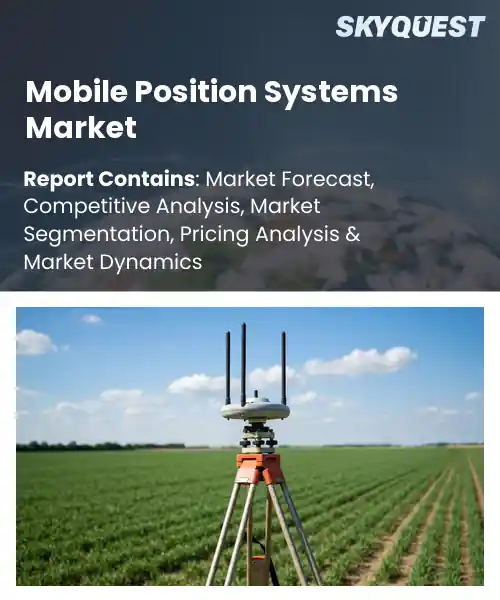
Mobile Position Systems Market
Report ID: SQMIG45H2258
Report ID: SQMIG45H2258
[email protected]
USA +1 351-333-4748
Report ID:
SQMIG45H2258 |
Region:
Global |
Published Date: July, 2026
Pages:
157
|Tables:
120
|Figures:
77


Global Mobile Position Systems Market size was valued at USD 4.28 Billion in 2024 and is poised to grow from USD 4.69 Billion in 2025 to USD 9.77 Billion by 2033, growing at a CAGR of 9.6% during the forecast period (2026-2033).
The global mobile position systems market includes technologies that locate smartphones, tablets, and wearables using satellite constellations, cellular towers, Wi‑Fi networks, and sensor fusion. Its importance lies in enabling location‑based services that improve navigation, asset tracking, and advertising. Early adoption began in the late 1990s as GPS chips entered handsets, yet broad uptake accelerated with 4G LTE deployment and the explosion of mobile apps in the 2010s. The primary driver now is the rise of logistics, where firms depend on tracking to optimise routes, cut fuel use, and enhance transparency, as demonstrated by courier companies integrating positioning platforms into fleets. The convergence of 5G connectivity with edge computing emerges as a decisive factor for the global mobile position systems market because it supplies high‑precision, low‑latency location data that fuels use cases. Faster bandwidth and signal delay enable devices to compute satellite corrections and network triangulation onboard, delivering centimeter‑level accuracy demanded by autonomous vehicles, drone deliveries, and smart‑city sensors. Automotive firms illustrate the impact by fitting electric fleets with 5G‑enabled positioning units that lower collision risk and raise utilization rates. This capability spurs R&D investments among telecom operators, chipset suppliers, and map providers, expanding the addressable market and inviting fresh entrants.
How are AI and IoT enhancing accuracy in the mobile positioning systems market?
AI and IoT are reshaping mobile positioning by merging vast sensor data with intelligent algorithms. AI models analyze signals from GPS, Wi‑Fi, Bluetooth and cellular towers, filtering noise and predicting movement patterns, while IoT devices continuously stream location‑rich information from wearables, vehicles and smart infrastructure. This synergy creates a feedback loop where real‑time updates refine positioning maps, leading to tighter accuracy in dense urban environments and indoor spaces. The market now sees vendors bundling AI‑enhanced analytics with IoT connectivity, offering solutions that adapt to dynamic conditions and reduce reliance on a single satellite source. As a result, service providers can deliver more reliable navigation, asset tracking and location‑based services, driving broader adoption across logistics, retail and public safety.A recent rollout integrated AI‑driven sensor fusion into a mobile positioning platform, sharpening location precision and boosting operational efficiency, thereby reinforcing market momentum. The enhancement leverages edge computing to process data locally, cutting latency and supporting seamless user experiences across multiple verticals.
Market snapshot - (2026-2033)
Global Market Size
USD 4.28 Billion
Largest Segment
GNSS
Fastest Growth
Wi-Fi Positioning
Growth Rate
9.6% CAGR
To get more insights on this market click here to Request a Free Sample Report
Global mobile position systems market is segmented by technology, component, application, end user and region. Based on technology, the market is segmented into GPS, GNSS, Cellular Positioning and Wi-Fi Positioning. Based on component, the market is segmented into Hardware, Software and Services. Based on application, the market is segmented into Navigation, Fleet Management, Asset Tracking and Emergency Response. Based on end user, the market is segmented into Transportation, Defense, Logistics and Consumer Electronics. Based on region, the market is segmented into North America, Europe, Asia Pacific, Latin America and Middle East & Africa.
GNSS segment dominates because it provides the most precise and reliable location data across diverse environments, enabling core functionalities such as turn by turn guidance and high accuracy tracking. Its global coverage, mature constellation architecture, and continuous signal improvements give it a strategic advantage over alternative methods. Consequently, device manufacturers and service providers prioritize GNSS integration, reinforcing its central role in shaping market standards and investment decisions.
However, Cellular positioning segment is witnessing the strongest growth momentum as mobile operators roll out dense 5G networks and advanced network based location APIs. This infrastructure enables precise positioning without satellite reliance, opening opportunities for indoor navigation, low power IoT devices, and emerging smart city services. Its rapid adoption is expanding the market reach.
Asset Tracking application stands out because it demands continuous, real time visibility of high value items across supply chains, prompting investment in robust positioning solutions. The critical need for loss prevention, regulatory compliance, and operational efficiency compels enterprises to embed sophisticated hardware and software, making asset tracking the primary revenue generator and technology driver. These requirements also stimulate service ecosystems offering analytics, predictive maintenance, and integration with enterprise planning, deepening market penetration and fostering innovation.
On the other hand, Navigation application is emerging as a high growth area as consumer devices and automotive platforms embed advanced positioning for enhanced experiences. The rise of augmented reality, location based services, and autonomous driving fuels demand for seamless navigation, prompting investment in maps and contextual intelligence. This momentum expands market horizons and opens fresh revenue streams.
To get detailed segments analysis, Request a Free Sample Report
North America leverages a mature technology ecosystem, robust investment in research and development, and widespread adoption of advanced telecommunications infrastructure. The region benefits from a high concentration of industry leaders and a collaborative environment between academia, government, and private enterprises that accelerates innovation. Consumer demand for seamless connectivity and enterprise reliance on location‑aware services further reinforce market depth. Regulatory frameworks support rapid deployment of emerging standards, ensuring that North America remains at the forefront of product refinement and service diversification across the mobile positioning landscape.
United States Mobile Position Systems Market
Mobile Position Systems Market thrives on strong venture capital presence, extensive carrier networks, and a culture of early adoption that drives continuous enhancements in accuracy and functionality. Partnerships between technology firms and automotive manufacturers create integrated solutions that expand use cases beyond navigation to include logistics, health monitoring, and smart city initiatives. The ecosystem’s emphasis on data security and privacy fosters confidence among enterprise clients, reinforcing the United States as a hub for cutting‑edge positioning services and platform development.
Canada Mobile Position Systems Market
Mobile Position Systems Market in Canada is shaped by a proactive policy environment that encourages public‑private collaboration and the deployment of next‑generation network assets. Emphasis on sustainability and remote‑area connectivity fuels innovative applications in resource management and indigenous community services. Robust research institutions contribute specialized expertise, while a supportive regulatory climate promotes the integration of positioning technologies into transportation, agriculture, and emergency response sectors, solidifying Canada’s role in advancing the broader market.
Europe’s expansion is propelled by a cohesive regulatory landscape that prioritizes interoperability and data protection, creating a trustworthy environment for both consumers and enterprises. Strong emphasis on digital sovereignty encourages investment in indigenous technologies and cross‑border collaborations among leading research hubs. The region’s advanced automotive sector and dense urban environments demand high‑precision positioning, catalyzing development of sophisticated services for mobility, logistics, and smart infrastructure. Combined with a growing focus on sustainability, Europe positions itself as a fertile ground for innovative location‑based solutions that address societal and industrial challenges.
Germany Mobile Position Systems Market
Mobile Position Systems Market in Germany benefits from a well‑established engineering tradition and a vibrant automotive ecosystem that integrates positioning capabilities into next‑generation vehicles and freight solutions. Collaborative initiatives between research institutes and industry accelerate the commercialization of high‑accuracy mapping and sensor fusion technologies. Government incentives promote the rollout of robust network coverage, while a strong emphasis on data privacy ensures user confidence, reinforcing Germany’s leadership in delivering reliable and secure positioning services across multiple sectors.
United Kingdom Mobile Position Systems Market
Mobile Position Systems Market in the United Kingdom experiences rapid growth driven by a dynamic fintech and e‑commerce landscape that exploits precise location data for personalized services and logistics optimization. The nation’s commitment to 5G deployment and open‑source innovation fosters a fertile environment for startups and established firms to co‑create advanced positioning platforms. Strong academic partnerships and a regulatory focus on consumer protection further stimulate adoption across retail, tourism, and public‑transport domains, positioning the United Kingdom as a catalyst for market acceleration.
France Mobile Position Systems Market
Mobile Position Systems Market in France is emerging through strategic investments in smart city initiatives and a vibrant tourism sector that leverages location intelligence to enhance visitor experiences. Collaborative frameworks between governmental agencies and technology firms promote the integration of positioning data into public transport, cultural heritage mapping, and sustainable mobility projects. A growing startup ecosystem, supported by favorable innovation policies, drives the development of niche applications that expand the market’s reach across diverse French industries.
Asia Pacific fortifies its position by capitalizing on the region’s high adoption rates of mobile devices and a growing appetite for location‑centric applications. Nations within the region prioritize the rollout of high‑capacity network infrastructure, enabling more precise and reliable positioning services. Strong manufacturing capabilities, coupled with a vibrant consumer market, spur innovation in wearable technology, autonomous navigation, and logistics solutions. Collaborative government policies encourage cross‑border standardization and investment in research, positioning Asia Pacific as an influential player shaping the future of mobile positioning ecosystems.
Japan Mobile Position Systems Market
Mobile Position Systems Market in Japan benefits from a long‑standing focus on robotics and advanced consumer electronics, fostering seamless integration of positioning technologies into everyday devices. Government initiatives promote the development of ultra‑precise location services for disaster management and urban mobility, while strong corporate R&D drives innovations in sensor accuracy and low‑power consumption. Collaborative ecosystems between manufacturers, telecom operators, and academia ensure continuous refinement of solutions that meet both domestic and global demand.
South Korea Mobile Position Systems Market
Mobile Position Systems Market in South Korea thrives on an aggressive rollout of next‑generation connectivity and a culture of rapid technology diffusion. The nation’s emphasis on smart manufacturing and autonomous vehicle testing creates a demand for high‑resolution positioning data. Synergies between leading semiconductor firms and telecom providers accelerate the development of integrated chips and network features that enhance accuracy and reliability. Supportive regulatory measures and a vibrant startup scene further propel the adoption of advanced location‑based services across multiple sectors.
To know more about the market opportunities by region and country, click here to
Buy The Complete Report
Increasing Demand for Real-Time Tracking
Adoption Of Integrated Navigation Solutions
High Cost Of Advanced Sensors
Security Concerns Over Data Privacy
Request Free Customization of this report to help us to meet your business objectives.
The competitive landscape of the Global Mobile Position Systems market is shaped by intense rivalry among technology leaders pursuing strategic M&A, joint ventures with telecom operators, and rapid rollout of next‑generation positioning chips. Recent consolidation moves, such as carrier‑backed acquisitions of niche location‑analytics firms, illustrate how players are expanding service portfolios, while partnerships with cloud providers accelerate the integration of AI‑enhanced geofencing capabilities. Continuous innovation in multi‑constellation GNSS modules and edge‑computing solutions further intensifies competition, driving differentiation through accuracy, power efficiency, and real‑time data processing.
Top Player’s Company Profile
Recent Developments
SkyQuest’s ABIRAW (Advanced Business Intelligence, Research & Analysis Wing) is our Business Information Services team that Collects, Collates, Correlates, and Analyses the Data collected by means of Primary Exploratory Research backed by robust Secondary Desk research. As per SkyQuest analysis, the global mobile position systems market is propelled primarily by the growing need for real‑time tracking that enhances logistics efficiency and emergency response, while a second catalyst is the widespread adoption of integrated navigation solutions that fuse GNSS, Wi‑Fi and cellular signals for seamless coverage. The GNSS technology segment continues to dominate because of its superior accuracy, and North America leads the market thanks to its mature tech ecosystem and strong investment in R&D. However, the high cost of advanced sensors restrains broader adoption, especially among smaller firms, tempering the otherwise rapid expansion. This dynamic is expected to drive continued investment in AI‑enhanced analytics and 5G‑enabled edge solutions.
| Report Metric | Details |
|---|---|
| Market size value in 2024 | USD 4.28 Billion |
| Market size value in 2033 | USD 9.77 Billion |
| Growth Rate | 9.6% |
| Base year | 2024 |
| Forecast period | (2026-2033) |
| Forecast Unit (Value) | USD Billion |
| Segments covered |
|
| Regions covered | North America (US, Canada), Europe (Germany, France, United Kingdom, Italy, Spain, Rest of Europe), Asia Pacific (China, India, Japan, Rest of Asia-Pacific), Latin America (Brazil, Rest of Latin America), Middle East & Africa (South Africa, GCC Countries, Rest of MEA) |
| Companies covered |
|
| Customization scope | Free report customization with purchase. Customization includes:-
|
To get a free trial access to our platform which is a one stop solution for all your data requirements for quicker decision making. This platform allows you to compare markets, competitors who are prominent in the market, and mega trends that are influencing the dynamics in the market. Also, get access to detailed SkyQuest exclusive matrix.
Table Of Content
Executive Summary
Market overview
Parent Market Analysis
Market overview
Market size
KEY MARKET INSIGHTS
COVID IMPACT
MARKET DYNAMICS & OUTLOOK
Market Size by Region
KEY COMPANY PROFILES
Methodology
For the Mobile Position Systems Market, our research methodology involved a mixture of primary and secondary data sources. Key steps involved in the research process are listed below:
1. Information Procurement: This stage involved the procurement of Market data or related information via primary and secondary sources. The various secondary sources used included various company websites, annual reports, trade databases, and paid databases such as Hoover's, Bloomberg Business, Factiva, and Avention. Our team did 45 primary interactions Globally which included several stakeholders such as manufacturers, customers, key opinion leaders, etc. Overall, information procurement was one of the most extensive stages in our research process.
2. Information Analysis: This step involved triangulation of data through bottom-up and top-down approaches to estimate and validate the total size and future estimate of the Mobile Position Systems Market.
3. Report Formulation: The final step entailed the placement of data points in appropriate Market spaces in an attempt to deduce viable conclusions.
4. Validation & Publishing: Validation is the most important step in the process. Validation & re-validation via an intricately designed process helped us finalize data points to be used for final calculations. The final Market estimates and forecasts were then aligned and sent to our panel of industry experts for validation of data. Once the validation was done the report was sent to our Quality Assurance team to ensure adherence to style guides, consistency & design.
Analyst Support
Customization Options
With the given market data, our dedicated team of analysts can offer you the following customization options are available for the Mobile Position Systems Market:
Product Analysis: Product matrix, which offers a detailed comparison of the product portfolio of companies.
Regional Analysis: Further analysis of the Mobile Position Systems Market for additional countries.
Competitive Analysis: Detailed analysis and profiling of additional Market players & comparative analysis of competitive products.
Go to Market Strategy: Find the high-growth channels to invest your marketing efforts and increase your customer base.
Innovation Mapping: Identify racial solutions and innovation, connected to deep ecosystems of innovators, start-ups, academics, and strategic partners.
Category Intelligence: Customized intelligence that is relevant to their supply Markets will enable them to make smarter sourcing decisions and improve their category management.
Public Company Transcript Analysis: To improve the investment performance by generating new alpha and making better-informed decisions.
Social Media Listening: To analyze the conversations and trends happening not just around your brand, but around your industry as a whole, and use those insights to make better Marketing decisions.
REQUEST FOR SAMPLE
 REQUEST FREE CUSTOMIZATION


Want to customize this report? This report can be personalized according to your needs. Our analysts and industry experts will work directly with you to understand your requirements and provide you with customized data in a short amount of time. We offer $1000 worth of FREE customization at the time of purchase.
Feedback From Our Clients


 USA (+1) 351-333-4748

