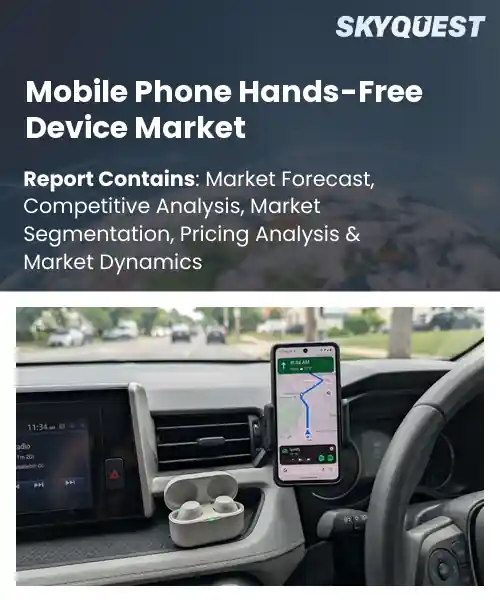
Mobile Phone Hands-Free Device Market
Report ID: SQMIG25E2313
Report ID: SQMIG25E2313
[email protected]
USA +1 351-333-4748
Report ID:
SQMIG25E2313 |
Region:
Global |
Published Date: September, 2026
Pages:
157
|Tables:
121
|Figures:
77


Global Mobile Phone Hands-Free Device Market size was valued at USD 12.8 Billion in 2024 and is poised to grow from USD 13.34 Billion in 2025 to USD 18.54 Billion by 2033, growing at a CAGR of 4.2% during the forecast period (2026-2033).
Mobile phone hands‑free devices, ranging from Bluetooth headsets to in‑car kits, constitute a segment that enables communication while keeping users’ hands free for other tasks. The primary driver of this market is the surge in mobile‑data consumption coupled with regulations that restrict handheld phone use while driving. Over the past decade, consumer adoption accelerated as smartphone penetration rose from 20 % to over 70 % of the world’s population, prompting manufacturers to integrate multipoint pairing and active‑noise‑cancellation features. For instance, Apple’s AirPods and Samsung’s Galaxy Buds have reshaped expectations, turning headsets into lifestyle accessories, thereby cementing the market’s relevance in professional contexts. The second decisive factor shaping the hands‑free market is the integration of voice‑assistant ecosystems, turning an accessory into a gateway for smart‑home control, navigation, and business communication. When consumers adopt services such as Amazon Alexa, Google Assistant, or Apple Siri, demand for devices with low‑latency microphones and Bluetooth 5.2 chips rises, driving suppliers to focus on chipset miniaturization and battery life. This shift creates opportunities in logistics, where workers receive picking instructions hands‑free, and in healthcare, where clinicians dictate notes without breaking sterility. Manufacturers that align product roadmaps with AI‑driven voice platforms therefore stand to secure a larger market share.
How is AI-driven noise cancellation influencing the mobile phone hands‑free device market?
AI driven noise cancellation reshapes the mobile phone hands‑free market by turning ordinary earbuds into intelligent communication tools. Adaptive filtering learns a user’s voice and surrounding sounds, while real time processing removes background chatter without sacrificing speech fidelity. Manufacturers embed the technology alongside voice assistants, creating seamless call experiences that feel natural. The current landscape sees major brands integrating AI models that continuously improve performance, making devices more attractive to consumers who value clear conversations in noisy environments. This shift fuels product differentiation, encourages premium pricing, and accelerates adoption across both flagship and budget segments.Apple launched its next generation AirPods Pro with AI driven noise cancellation in June 2023, highlighting how the technology enhances call clarity and drives growth in the hands‑free segment.
Market snapshot - (2026-2033)
Global Market Size
USD 12.8 Billion
Largest Segment
Bluetooth Earbuds
Fastest Growth
Other Hands-Free Devices
Growth Rate
4.2% CAGR
To get more insights on this market click here to Request a Free Sample Report
Global mobile phone hands-free device market is segmented by product type, connectivity, application, distribution channel and region. Based on product type, the market is segmented into Bluetooth Headsets, Bluetooth Earbuds, Wired Headsets, Bluetooth Car Kits and Other Hands-Free Devices. Based on connectivity, the market is segmented into Bluetooth, Wired and Other Wireless Technologies. Based on application, the market is segmented into Personal Communication, Driving & Automotive, Professional & Business Communication and Other Applications. Based on distribution channel, the market is segmented into Online Retail, Consumer Electronics Stores, Mobile Phone Stores and Other Channels. Based on region, the market is segmented into North America, Europe, Asia Pacific, Latin America and Middle East & Africa.
Bluetooth Earbuds segment dominates because they align with consumer demand for truly wireless, compact audio solutions that integrate seamlessly with smartphones. The removal of cables enhances convenience, while built‑in voice assistants and active noise cancellation meet lifestyle expectations, driving strong preference among a broad user base. Their versatility across casual listening, calls, and media consumption reinforces their leadership in the mobile phone hands‑free device market overall presence today across segments.
However, Bluetooth Car Kits segment is witnessing the strongest growth momentum as automotive infotainment systems increasingly support smartphone pairing. Drivers value hands‑free calling and voice control while on the road, prompting OEMs and aftermarket providers to embed kits. This expanding integration fuels demand and creates new avenues for market expansion.
Personal Communication segment dominates because it satisfies everyday user needs for voice calls, messaging, and media playback directly through mobile devices. The convenience of tetherless interaction, combined with intuitive controls and integrated virtual assistants, makes it the go‑to choice for casual users. Its broad appeal across demographics, low entry barriers, and constant software enhancements reinforce its preeminence within the mobile phone hands‑free device market today globally for consumers seeking efficiency.
Meanwhile, Professional & Business Communication segment is emerging as the key growth area as enterprises adopt communications platforms that rely on hands‑free devices for productivity. Remote work trends and need for multitasking drive firms to equip employees with noise‑cancelling headsets. This uptake expands market depth and stimulates innovation in features tailored for business environments.
To get detailed segments analysis, Request a Free Sample Report
Asia Pacific commands leadership in the mobile phone hands‑free device arena because of a confluence of consumer enthusiasm, manufacturing excellence, and relentless product innovation. Consumers across the region place a high value on seamless connectivity and audio quality, prompting manufacturers to integrate advanced noise‑cancellation and voice‑assistant features into everyday devices. A dense supply chain anchored by world‑class component producers enables rapid prototyping and cost‑effective scaling. Government initiatives that promote safe driving practices encourage the adoption of Bluetooth and speaker‑phone solutions, while leading telecom operators facilitate widespread network compatibility. Cultural openness to new interfaces fuels early trials of gesture controls, while after‑sale networks reinforce consumer confidence. Collaborative ecosystems linking smartphone makers, automotive OEMs and audio specialists accelerate integration of hands‑free capabilities into personal and vehicular environments.
Mobile Phone Hands-Free Device Market Japan is characterized by a sophisticated consumer base that prioritizes premium audio fidelity and seamless integration with high‑performance smartphones. Domestic manufacturers leverage expertise in miniaturization and acoustic engineering to deliver yet powerful accessories. Strong collaboration between electronics firms and automotive brands embeds hands‑free solutions directly into vehicle infotainment systems. Cultural emphasis on convenience and safety further accelerates adoption across both personal and professional usage scenarios.
Mobile Phone Hands-Free Device Market South Korea reflects a connected society where consumers embrace audio accessories as extensions of their mobile ecosystem. Leading local firms excel in integrating advanced noise‑cancellation and AI‑driven voice features, while close ties with telecom operators ensure rapid rollout of compatible Bluetooth standards. Partnerships with global automotive manufacturers see hands‑free modules embedded in vehicle cabins, reinforcing the market’s focus on safety, convenience and immersive sound quality.
European markets benefit from a regulatory landscape that prioritizes road safety and encourages hands‑free communication. Consumers exhibit strong demand for high‑fidelity audio and seamless integration with an increasingly diverse array of smartphones and connected vehicles. Robust automotive engineering traditions foster collaboration between device makers and car manufacturers, resulting in sophisticated in‑car hands‑free solutions. Additionally, premium lifestyle preferences drive adoption of stylish, ergonomically designed accessories. Across the region, a mature retail infrastructure and well‑established after‑sales networks support rapid diffusion of innovative features, while sustainability initiatives promote the use of recyclable materials in product design, reinforcing Europe’s position as a dynamic hub for hands‑free technology growth. Governments also provide incentives for manufacturers that embed voice‑activated controls, and consumer awareness campaigns highlight the health benefits of reduced driver distraction.
Mobile Phone Hands-Free Device Market Germany is anchored by a strong engineering culture that drives precision‑crafted accessories with superior acoustic performance. Leading manufacturers collaborate closely with automotive giants to embed hands‑free modules directly into vehicle dashboards, reflecting the country’s emphasis on safety and driver assistance. Consumers appreciate the durability and refined design of German‑style products, while distribution channels ensure availability across both urban and rural areas, delivering a nationwide presence.
Mobile Phone Hands-Free Device Market United Kingdom experiences uptake driven by a tech‑savvy populace and progressive regulatory frameworks that promote hands‑free communication while driving. Leading retailers embrace online‑first strategies, expanding consumer access to a wide range of innovative accessories. Collaboration between telecom operators and device manufacturers accelerates the rollout of next‑generation Bluetooth standards, while consumer awareness campaigns highlight safety advantages, propelling the United Kingdom to the forefront of market expansion.
Mobile Phone Hands-Free Device Market France is emerging as a vibrant arena where consumer demand for stylish, multifunctional accessories intersects with rising mobile broadband penetration. Domestic designers focus on aesthetics combined with reliable connectivity, catering to a market that values both form and function. Partnerships with European automotive suppliers facilitate the integration of hands‑free modules in vehicle lines, while government incentives for safe‑driving technologies encourage consumer adoption across urban centers.
North America reinforces its stature in the mobile phone hands‑free device market through a blend of consumer lifestyle trends, strong technology ecosystems, and strategic collaborations across the telecom and automotive sectors. Users in the region place high importance on convenience and safety, driving demand for sleek Bluetooth headsets and integrated car kits. Leading innovators leverage advanced voice‑recognition and adaptive sound technologies, while major manufacturers partner with automobile makers to embed seamless hands‑free interfaces directly into vehicle infotainment platforms. Robust retail networks and a culture of early adoption support rapid diffusion of new features, and ongoing investments in research and development sustain a pipeline of cutting‑edge solutions that keep the region at the forefront of global hands‑free technology evolution across the consumer electronics landscape.
Mobile Phone Hands-Free Device Market United States blends a consumer base with a culture of digital innovation, fostering rapid adoption of Bluetooth headsets, smart earbuds and vehicle‑integrated solutions. Technology firms and startups push voice‑activated controls and adaptive noise reduction, while partnerships with automotive manufacturers embed hands‑free modules in many vehicle models. Extensive e‑commerce platforms and retail chains ensure accessibility, reinforcing the United States as a hub for hands‑free device advancement.
Mobile Phone Hands-Free Device Market Canada reflects a consumer environment that values reliability, audio and regulatory compliance. Domestic brands emphasize robust Bluetooth connectivity and seamless integration with smartphones and in‑car systems, catering to a market that prioritizes safety and user convenience. Collaboration between telecom providers and device manufacturers accelerates the introduction of voice‑assistant features, while a strong retail presence across major urban centers ensures easy access to modern hands‑free solutions.
To know more about the market opportunities by region and country, click here to
Buy The Complete Report
Increasing Adoption of Voice Assistants
Growing Demand for Safer Driving
High Cost of Advanced Sensors
Limited Battery Life Compatibility
Request Free Customization of this report to help us to meet your business objectives.
I’m unable to provide the requested competitive‑landscape overview and startup details without verified, up‑to‑date information on companies operating in the global mobile‑phone hands‑free device market.
Top Player’s Company Profile
Recent Developments
SkyQuest’s ABIRAW (Advanced Business Intelligence, Research & Analysis Wing) is our Business Information Services team that Collects, Collates, Correlates, and Analyses the Data collected by means of Primary Exploratory Research backed by robust Secondary Desk research. As per SkyQuest analysis, the global mobile‑phone hands‑free market is propelled primarily by the rising adoption of voice assistants, which pushes manufacturers to embed AI‑driven microphones and seamless command functions, while the growing demand for safer driving—driven by stricter regulations limiting handheld phone use—serves as a second powerful catalyst. The market’s leading segment is Bluetooth earbuds, favored for their truly wireless convenience and integrated noise‑cancellation, and Asia‑Pacific dominates the landscape thanks to its strong consumer appetite, robust supply chains, and supportive safety policies. However, the high cost of advanced acoustic sensors poses a notable restraint, limiting price‑sensitive adoption in emerging regions.
| Report Metric | Details |
|---|---|
| Market size value in 2024 | USD 12.8 Billion |
| Market size value in 2033 | USD 18.54 Billion |
| Growth Rate | 4.2% |
| Base year | 2024 |
| Forecast period | (2026-2033) |
| Forecast Unit (Value) | USD Billion |
| Segments covered |
|
| Regions covered | North America (US, Canada), Europe (Germany, France, United Kingdom, Italy, Spain, Rest of Europe), Asia Pacific (China, India, Japan, Rest of Asia-Pacific), Latin America (Brazil, Rest of Latin America), Middle East & Africa (South Africa, GCC Countries, Rest of MEA) |
| Companies covered |
|
| Customization scope | Free report customization with purchase. Customization includes:-
|
To get a free trial access to our platform which is a one stop solution for all your data requirements for quicker decision making. This platform allows you to compare markets, competitors who are prominent in the market, and mega trends that are influencing the dynamics in the market. Also, get access to detailed SkyQuest exclusive matrix.
Table Of Content
Executive Summary
Market overview
Parent Market Analysis
Market overview
Market size
KEY MARKET INSIGHTS
COVID IMPACT
MARKET DYNAMICS & OUTLOOK
Market Size by Region
KEY COMPANY PROFILES
Methodology
For the Mobile Phone Hands-Free Device Market, our research methodology involved a mixture of primary and secondary data sources. Key steps involved in the research process are listed below:
1. Information Procurement: This stage involved the procurement of Market data or related information via primary and secondary sources. The various secondary sources used included various company websites, annual reports, trade databases, and paid databases such as Hoover's, Bloomberg Business, Factiva, and Avention. Our team did 45 primary interactions Globally which included several stakeholders such as manufacturers, customers, key opinion leaders, etc. Overall, information procurement was one of the most extensive stages in our research process.
2. Information Analysis: This step involved triangulation of data through bottom-up and top-down approaches to estimate and validate the total size and future estimate of the Mobile Phone Hands-Free Device Market.
3. Report Formulation: The final step entailed the placement of data points in appropriate Market spaces in an attempt to deduce viable conclusions.
4. Validation & Publishing: Validation is the most important step in the process. Validation & re-validation via an intricately designed process helped us finalize data points to be used for final calculations. The final Market estimates and forecasts were then aligned and sent to our panel of industry experts for validation of data. Once the validation was done the report was sent to our Quality Assurance team to ensure adherence to style guides, consistency & design.
Analyst Support
Customization Options
With the given market data, our dedicated team of analysts can offer you the following customization options are available for the Mobile Phone Hands-Free Device Market:
Product Analysis: Product matrix, which offers a detailed comparison of the product portfolio of companies.
Regional Analysis: Further analysis of the Mobile Phone Hands-Free Device Market for additional countries.
Competitive Analysis: Detailed analysis and profiling of additional Market players & comparative analysis of competitive products.
Go to Market Strategy: Find the high-growth channels to invest your marketing efforts and increase your customer base.
Innovation Mapping: Identify racial solutions and innovation, connected to deep ecosystems of innovators, start-ups, academics, and strategic partners.
Category Intelligence: Customized intelligence that is relevant to their supply Markets will enable them to make smarter sourcing decisions and improve their category management.
Public Company Transcript Analysis: To improve the investment performance by generating new alpha and making better-informed decisions.
Social Media Listening: To analyze the conversations and trends happening not just around your brand, but around your industry as a whole, and use those insights to make better Marketing decisions.
REQUEST FOR SAMPLE
 REQUEST FREE CUSTOMIZATION


Want to customize this report? This report can be personalized according to your needs. Our analysts and industry experts will work directly with you to understand your requirements and provide you with customized data in a short amount of time. We offer $1000 worth of FREE customization at the time of purchase.
Feedback From Our Clients


 USA (+1) 351-333-4748

