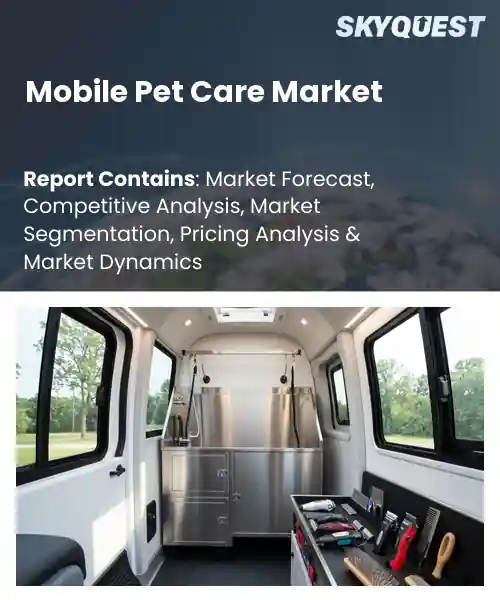
Mobile Pet Care Market
Report ID: SQMIG25S2097
Report ID: SQMIG25S2097
[email protected]
USA +1 351-333-4748
Report ID:
SQMIG25S2097 |
Region:
Global |
Published Date: May, 2026
Pages:
157
|Tables:
122
|Figures:
77


Global Mobile Pet Care Market size was valued at USD 789.5 Million in 2024 and is poised to grow from USD 846.34 Million in 2025 to USD 1476.06 Million by 2033, growing at a CAGR of 7.2% during the forecast period (2026-2033).
The main reason the mobile pet care market has grown is because people now prefer convenient, personalized services. This shift means vet and grooming services can be booked on demand and often come right to your door. Mobile pet care includes house calls, grooming vans, and easy online booking for things like vaccines or checkups. It benefits both pets—reducing their stress—and busy owners who need more scheduling flexibility. Originally just random house calls, it’s now organized with franchises and tech platforms that manage routes and keep electronic records, even doing telemedicine. Startups like Wag and VetPronto made scheduling simpler through apps, and now big clinics use mobile units too.
This evolution is driven by the integration of platforms that optimize logistics and help with making money, thus lowering costs and boosting customer loyalty. When GPS routing and electronic health records work together, providers can serve more households on each route, cutting down travel time and passing those savings to customers through lower prices. In turn, this makes services more attractive in both urban and suburban areas. Plus, as telemedicine handles simple issues, vets have more time for complicated cases in person, improving care and their profit margins. Examples include monthly wellness plans from franchise networks and contracts with employer-sponsored pet clinics, which create reliable revenue sources and draw in investors.
How is AI Enhancing Service Delivery in the Mobile Pet Care Market?
AI's changing mobile pet care is pretty cool. It's helping out with scheduling, triage, remote monitoring, and on-site choices. For one, booking gets automated along with routing – this cut down travel time and no-shows. Then there's AI triage that sorts urgent cases and guides online chats too. Plus, gadgets like collars and image tech spot early health or behavior issues. The pet care world loves easy, personal service. That means many care teams add AI to their apps and even the van, keeping real vet eyes involved always. There are chatbots to check-in clients, virtual triage helpers, and predictive alarms from collar sensors to warn mobile groomers and vets to act sooner for good results.
Market snapshot - (2026-2033)
Global Market Size
USD 789.5 Million
Largest Segment
Mobile Grooming Services
Fastest Growth
Mobile Veterinary Services
Growth Rate
7.2% CAGR
To get more insights on this market click here to Request a Free Sample Report
Global mobile pet care market is segmented by service type, pet type, business model, end user and region. Based on service type, the market is segmented into Mobile Grooming Services, Mobile Veterinary Services, Mobile Pet Training Services, Mobile Pet Boarding & Daycare and Mobile Pet Wellness Services. Based on pet type, the market is segmented into Dogs, Cats, Birds, Small Mammals, Reptiles & Exotic Petsand Others. Based on business model, the market is segmented into Independent Mobile Service Providers, Franchise-Based Operators, Subscription-Based Services and On-Demand/App-Based Services. Based on end user, the market is segmented into Residential Pet Owners and Commercial & Institutional Clients. Based on region, the market is segmented into North America, Europe, Asia Pacific, Latin America and Middle East & Africa.
The Mobile Grooming Services segment is leading the way since it focuses on convenience and stress relief for both pets and their owners. This approach allows providers to lock in frequent repeat business via convenient doorstep appointments. Operating in purpose-built vans, they offer all necessary services, boosting their perceived value and allowing them to charge more. The mobile model cuts down on logistical hassles, builds trust within the community, and lets providers manage their time better with route optimization. As a result, customers clearly prefer grooming right at home.
On the other side, Mobile Pet Wellness Services is experiencing the fastest growth. People now recognize the importance of preventive care, and advances in technology make portable diagnostic tools more widely available. New services such as vaccination clinics and health screenings are expanding the market. These initiatives combined with easy online booking and remote monitoring create steady revenue streams and fuel further expansion and diversification of services.
The Franchise-Based Operators segment dominate because of their standardization and brand strength. Standardized operating procedures, brand recognition, and centralized training mean they can quickly expand, keeping service quality consistent across different areas. This system also cuts risks for individual operators and makes making investments easier, boosting both consumer trust and business stability. It creates a cycle where franchises grow faster, forge strong supplier ties, and get bigger shares of the market.
On the other hand, Subscription-Based Services are driving the quickest growth right now. By turning random requests into regular commitments through convenient bundles, these services secure steady incomes. This predictability lets them put more into tech and fleet expansion, as well as into client retention and offering personalized options. So, they grab new followers and keep the revenue flowing.
To get detailed segments analysis, Request a Free Sample Report
Why does North America Dominate the Global Mobile Pet Care Market?
North America leads in mobile pet services because of its strong ecosystem. Consumers are willing to pay for the convenience, plus there are mature veterinary networks and advanced logistics to support mobile deliveries. In cities and suburbs, there’s a steady need for home pet care services. The high professional standards and industry groups keep the quality up and earn trust. This region attracts investment and has supply chains that allow for specialized vehicle modification and gear access. They use tech platforms for booking and virtual health checks to run things smoothly. Both big providers and small-time operators work together with pet product shops to come up with new service ideas. With the rise of insurance and wellness care trends, preventive measures become more common, spreading best practices across the board.
The Mobile Pet Care Market uses convenient at-home services and expert knowledge from mobile clinics. Convenience drives a variety of pet care options, and working with vet groups ensures high standards. Technology for booking and online assessments makes things run smoother. Companies stand out with packages focused on owner ease and pet comfort, all while making smart business moves.
The Mobile Pet Care Market in Canada includes both rural and urban needs for vet and grooming services at home. Providers work on overcoming access issues and dealing with long distances too. By focusing on preventive care and educating pet owners, they boost mobile service usage. They partner up with local clinics and suppliers which helps create a network of referrers. Using their mobile units lets them maintainhigh standards while reaching more places. Marketing their services also helps build trust with people looking for easy, home-based care for their pets.
Europe's fast-growing market is pushed by folks favoring quick options, growing cities, and pros in mobile vet and grooming. Regulations and funding help in some areas, lowering service start-up costs. Franchise and tech platform deals speed up business launch and growth. Prevention care focus means constant need for home services. Quality's improved thanks to staff training and mobile rules, paired with retailer ties and easy online bookings. Plus, strong hygiene and green practices in setup raise trust in providers. Niche services from nimble new companies fit what owners want now, powering growth in varied spots.
The Mobile Pet Care Market in Germany follows strict clinical standards and places a strong focus on animal welfare, so there's high acceptance of preventive at-home services. To meet practice norms, operators include biosecurity and specific equipment in their mobile units. Clinics work with mobile specialists to ensure continuous care and support for referrals. Plus, tech use for booking and customer communication, along with regional training networks, keeps quality high and builds consumer trust in mobile services.
The Mobile Pet Care Market in the UK is fueled by urban areas and a culture that loves convenient at-home services. Digital booking, subscription wellness plans, and telemedicine make it easy for fast growth. Service providers focus on personal experiences and fancy mobile options. They also form ties with pet shops and local clinics for more referral links. Investments in staff training and car setups keep up quality as businesses spread out from cities to suburbs.
The Mobile Pet Care Market in France is booming through pilot programs that highlight convenience and preventive care. These programs draw in urban pet owners looking for flexible options. Local operators boost their credibility by combining clinic services with mobile outreach. They focus on quality assurance, client education, and personalized service plans to lower hesitancy. Investments in slick, equipped mobile units and digital booking systems aid in expansion. As awareness and trust grow, so do at-home vet services.
Asia Pacific is getting a stronger grip by seeing more pet owners, fast-growing cities, and folks warming up to fresh ways of pet care. Companies there use digital tools for finding services, booking appointments, and video chats, which helps bridge gaps between vets and pet owners. Businesses tweak their vehicles to fit busy city streets and send staff to clinics for training. Retailers, tech firms, and vet clinics form partnerships to provide more services. As pets become more like humans in people's minds, there's a bigger call for convenient health services. Startups and local businesses pour money into gear that works well in different areas, matching what locals like. Everyone from government bodies to trade groups is talking about setting guidelines to smooth operations. Newcomers start home-based care options like testing and check-ups, making mobile health care more appealing.
The Mobile Pet Care Market in Japan is growing thanks to small mobile units made for crowded cities. These operators focus on super clean procedures and top-notch service to please owners. They use digital platforms for bookings and virtual consults, making it easier to get help. These mobile services work with pet stores and local clinics too, building a strong support network. Since Japanese culture values detailed pet care, there's a real liking for fancy mobile services and special wellness programs for pets.
South Korea's Mobile Pet Care Market thrives because of tech-savvy services and urban living. Providers use apps, integrated payments, and telehealth for easy delivery and client interaction. They partner with pet shops and groomers to offer full at-home packages. By focusing on branding, quality, and personal wellness programs, they win over owners who want convenience without sacrificing professionalism. This is why mobile services are growing in cities.
To know more about the market opportunities by region and country, click here to
Buy The Complete Report
Rising Pet Ownership Rates
With the rise in number of pet adoption,, there's a bigger need for handy vet and grooming services at home or in mobile clinics. With pet owners wanting convenient, time-saving solutions, mobile options become super appealing. In response, service providers are broadening their reach and customizing offerings to better fit what neighborhoods need. All this boosts competition, pushing providers to offer flexible appointments and more personalized care. This just makes customers happier and helps grow the market even more.
Growing Preference for in Home Care
There is a higher preference for in-home pet care, thereby driving the market. This shift reduces stress on pets and owners while making life easier. As a result, services like mobile grooming become more popular than fixed clinics. To keep up with this trend, providers are offering more services and longer hours. Happy customers then return and recommend the service to others. This positive cycle spurs even more investments in vehicles, training, and hiring better-staffed to meet what clients now expect.
Regulatory Compliance Challenges
Mobile pet care faces big challenges from complex rules. Regulatory requirements change a lot between different places, making it hard for providers to follow all the animal health and waste disposal rules. These varying obligations make it tougher to offer many services on the go and mean there's more paperwork to deal with. The result? New entrants get scared off, expansions take longer, and existing operators might have to spend extra cash on specialized gear and training. All of this hinders quick market growth and stops services from easily adapting to what locals want.
Limited Reimbursement and Coverage
Limited reimbursement and inconsistent insurance coverage restrict the growth of the market for mobile veterinary and specialized services. When coverage is limited or excludes mobile procedures, pet owners might choose cheaper clinic visits or skip care altogether. This not only reduces service use but also adds to owners' uncertainty and financial stress. For providers, dealing with various payers and the lack of set reimbursement rules make expansion tricky. It’s hard to get stable revenue, so they’re less likely to invest in mobile services. This all slows down the spread of these more convenient care models.
Request Free Customization of this report to help us to meet your business objectives.
Consolidation and platform integration are changing how things work in retail and telehealth. Chains now aim for vertical growth too. They do this through M&A, tying up commerce with clinical care, partnering with employers for pet benefits, and launching telemedicine with integrated pharmacies to keep customers loyal. To prove it, look at Chewy buying Modern Animal, Airvet’s push into more employer collaborations, and Vetster’s rise in telehealth and pharmacy services.
Home Based Preventive Care Uptake: More pet owners now favor at-home preventive services, pushing providers to offer more home-based options like vaccinations and parasite treatment. This trend stresses ease for customers; fosters trust and creates steady income through regular services. To meet these demands, firms invest in training, proper mobile protocols, and collaborations with nearby vets. Their main goals? Make routes efficient, manage inventory better, and stand out with great service experiences.
Technology Enabled Service Personalization: Digital tools let providers create custom care for pets and owners, making plans feel more personal and useful. This boosts engagement through teletriage, electronic health records, and wearables for remote monitoring. Client portals help too, by offering easy follow-ups and preventive care tips. These technologies not only make operations smoother but allow for different service levels, including pricier options. To keep clients loyal and paying for top-tier, ongoing care, businesses focus on data privacy and clear communication across platforms.
SkyQuest’s ABIRAW (Advanced Business Intelligence, Research & Analysis Wing) is our Business Information Services team that Collects, Collates, Correlates, and Analyses the Data collected by means ofPrimary Exploratory Research backed by robust Secondary Desk research.
As per SkyQuest analysis, the global mobile pet care market is booming because more folks want convenient, personalized services right at home. Leading the charge is North America, with Mobile Grooming Services leading the pack. These services make money through regular repeat visits. Tech also boosts the field with AI routing, telehealth for animals, and wearable tech that makes operations smoother and boosts care follow-through. These benefits fuel both franchises and subscription-based services, drawing in investors. Yet, quirky reimbursement setups and varied local laws will impact how fast and where these services expand.
| Report Metric | Details |
|---|---|
| Market size value in 2024 | USD 789.5 Million |
| Market size value in 2033 | USD 1476.06 Million |
| Growth Rate | 7.2% |
| Base year | 2024 |
| Forecast period | (2026-2033) |
| Forecast Unit (Value) | USD Million |
| Segments covered |
|
| Regions covered | North America (US, Canada), Europe (Germany, France, United Kingdom, Italy, Spain, Rest of Europe), Asia Pacific (China, India, Japan, Rest of Asia-Pacific), Latin America (Brazil, Rest of Latin America), Middle East & Africa (South Africa, GCC Countries, Rest of MEA) |
| Companies covered |
|
| Customization scope | Free report customization with purchase. Customization includes:-
|
To get a free trial access to our platform which is a one stop solution for all your data requirements for quicker decision making. This platform allows you to compare markets, competitors who are prominent in the market, and mega trends that are influencing the dynamics in the market. Also, get access to detailed SkyQuest exclusive matrix.
Table Of Content
Executive Summary
Market overview
Parent Market Analysis
Market overview
Market size
KEY MARKET INSIGHTS
COVID IMPACT
MARKET DYNAMICS & OUTLOOK
Market Size by Region
KEY COMPANY PROFILES
Methodology
For the Mobile Pet Care Market, our research methodology involved a mixture of primary and secondary data sources. Key steps involved in the research process are listed below:
1. Information Procurement: This stage involved the procurement of Market data or related information via primary and secondary sources. The various secondary sources used included various company websites, annual reports, trade databases, and paid databases such as Hoover's, Bloomberg Business, Factiva, and Avention. Our team did 45 primary interactions Globally which included several stakeholders such as manufacturers, customers, key opinion leaders, etc. Overall, information procurement was one of the most extensive stages in our research process.
2. Information Analysis: This step involved triangulation of data through bottom-up and top-down approaches to estimate and validate the total size and future estimate of the Mobile Pet Care Market.
3. Report Formulation: The final step entailed the placement of data points in appropriate Market spaces in an attempt to deduce viable conclusions.
4. Validation & Publishing: Validation is the most important step in the process. Validation & re-validation via an intricately designed process helped us finalize data points to be used for final calculations. The final Market estimates and forecasts were then aligned and sent to our panel of industry experts for validation of data. Once the validation was done the report was sent to our Quality Assurance team to ensure adherence to style guides, consistency & design.
Analyst Support
Customization Options
With the given market data, our dedicated team of analysts can offer you the following customization options are available for the Mobile Pet Care Market:
Product Analysis: Product matrix, which offers a detailed comparison of the product portfolio of companies.
Regional Analysis: Further analysis of the Mobile Pet Care Market for additional countries.
Competitive Analysis: Detailed analysis and profiling of additional Market players & comparative analysis of competitive products.
Go to Market Strategy: Find the high-growth channels to invest your marketing efforts and increase your customer base.
Innovation Mapping: Identify racial solutions and innovation, connected to deep ecosystems of innovators, start-ups, academics, and strategic partners.
Category Intelligence: Customized intelligence that is relevant to their supply Markets will enable them to make smarter sourcing decisions and improve their category management.
Public Company Transcript Analysis: To improve the investment performance by generating new alpha and making better-informed decisions.
Social Media Listening: To analyze the conversations and trends happening not just around your brand, but around your industry as a whole, and use those insights to make better Marketing decisions.
REQUEST FOR SAMPLE
 REQUEST FREE CUSTOMIZATION
Global Mobile Pet Care Market size was valued at USD 789.5 Million in 2024 and is poised to grow from USD 846.34 Million in 2025 to USD 1476.06 Million by 2033, growing at a CAGR of 7.2% during the forecast period (2026-2033).
Consolidation and platform integration are reshaping the competitive landscape as retail and telehealth chains pursue vertical scale. Major strategic moves include M&A to combine commerce with clinical assets, employer partnerships to embed pet benefits, and telemedicine plus integrated pharmacy rollouts to lock in customers. Recent examples include Chewy’s acquisition of Modern Animal, expanded employer partnerships by Airvet, and telehealth and pharmacy growth at Vetster. 'Rover Group, Inc.', 'Wag! Group Co.', 'PetBacker', 'Swifto Inc.', 'Fetch! Pet Care', 'Camp Bow Wow', 'The Dog Stop', 'Dogtopia Enterprises', 'Pet Palace Resorts', 'A Place for Rover, Inc.', 'PetSmart Inc.', 'Petco Health and Wellness Company, Inc.', 'Barkbus', 'Fuzzy Pet Health', 'Airvet, Inc.', 'WhiskerDocs', 'Pawshake', 'Pet Paradise Resort', 'Holidog', 'Gudog'
The sustained increase in pet ownership expands the addressable customer base and creates greater demand for accessible veterinary and grooming services delivered at home or via mobile clinics. As more households acquire companion animals, owners prioritize convenience and time-saving solutions, making mobile offerings more attractive. This preference encourages service providers to expand routes and tailor packages, enhancing availability across neighborhoods. The resulting competitive environment stimulates innovation in appointment flexibility and service personalization, further reinforcing market expansion through improved consumer satisfaction.
Home Based Preventive Care Uptake: Pet owners increasingly prefer routine preventive and wellness services delivered at home, driving providers to expand mobile offerings focused on vaccinations, parasite prevention, grooming, and chronic condition monitoring. This shift emphasizes convenience, trust building, and recurring service models that deepen customer relationships and revenue predictability. Firms are investing in staff training, mobile clinical protocols, and partnerships with local practices to maintain quality and continuity of care. Operational focus moves toward efficient routing, inventory control, and brand differentiation through service experience.
Why does North America Dominate the Global Mobile Pet Care Market? |@12


Want to customize this report? This report can be personalized according to your needs. Our analysts and industry experts will work directly with you to understand your requirements and provide you with customized data in a short amount of time. We offer $1000 worth of FREE customization at the time of purchase.
Feedback From Our Clients


 USA (+1) 351-333-4748

