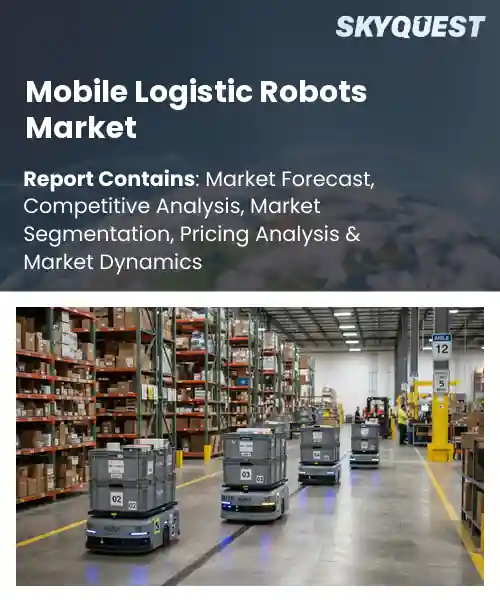
Mobile Logistic Robots Market
Report ID: SQMIG20I4008
Report ID: SQMIG20I4008
[email protected]
USA +1 351-333-4748
Report ID:
SQMIG20I4008 |
Region:
Global |
Published Date: September, 2026
Pages:
157
|Tables:
157
|Figures:
78


Global Mobile Logistic Robots Market size was valued at USD 3.5 Billion in 2024 and is poised to grow from USD 3.99 Billion in 2025 to USD 11.39 Billion by 2033, growing at a CAGR of 14.0% during the forecast period (2026-2033).
Mobile logistic robots are autonomous platforms that transport goods inside warehouses, distribution centers, and factories, turning manual material‑handling into data‑driven flows. The market has become a cornerstone of Industry 4.0 because it cuts labor reliance, speeds order fulfillment, and creates analytics from each move. Early adopters such as Amazon Robotics and Ocado showed that fleets of guided vehicles could replace forklifts, delivering up to 30 % labor cost reduction and a 20 % throughput gain. In the last five years, falling sensor prices, AI navigation breakthroughs, and cloud connectivity have driven rapid deployment, moving the technology from niche trials to mainstream supply‑chain practice.The most compelling growth catalyst is the integration of mobile logistic robots with warehouse execution systems, turning rising e‑commerce volumes into efficiency gains. When order spikes overwhelm manual labor, robots receive real‑time dispatch commands, enabling instant rerouting that shortens pick cycles and frees floor space for higher SKU density. DHL Supply Chain, for example, deployed coordinated robot fleets in European hubs, achieving a 25 % increase in order‑processing speed and a 15 % reduction in aisle congestion. This advantage draws third‑party logistics providers seeking differentiation, prompting investment in modular robot platforms that can be scaled across sites and expanding the market’s horizon.
How is AI-driven automation enhancing efficiency in the mobile logistics robots market?
AI driven automation is reshaping mobile logistics robots by enabling real time perception, adaptive path planning and autonomous task allocation. Sensors feed data to machine learning models that detect obstacles, predict traffic flow and optimise routes on the fly. This reduces idle time, lowers energy consumption and improves throughput in warehouses and last mile delivery hubs. Companies integrate cloud based fleet management platforms that coordinate dozens of units, allowing them to self recharge and dynamically reprioritise orders. The result is a more fluid supply chain where robots collaborate with human workers rather than replace them, creating a responsive and scalable operations environment.In March 2024, Locus Robotics announced an AI navigation upgrade that lets its robots learn warehouse layouts without manual mapping, cutting deployment time and boosting order picking speed in real world settings, which directly fuels market growth by demonstrating the efficiency gains of AI driven automation.
Market snapshot - (2026-2033)
Global Market Size
USD 3.5 Billion
Largest Segment
Automated Guided Vehicles
Fastest Growth
Autonomous Mobile Robots
Growth Rate
14.0% CAGR
To get more insights on this market click here to Request a Free Sample Report
Global mobile logistic robots market is segmented by robot type, payload capacity, navigation technology, application, end user and region. Based on robot type, the market is segmented into Autonomous Mobile Robots, Automated Guided Vehicles, Autonomous Forklifts, Mobile Picking Robots, Inventory Robots and Others. Based on payload capacity, the market is segmented into Up to 100 kg, 101–500 kg, 501–1,000 kg and Above 1,000 kg. Based on navigation technology, the market is segmented into LiDAR-Based, Vision-Based, Magnetic Navigation, Laser Guidance and Hybrid Navigation. Based on application, the market is segmented into Material Transportation, Picking and Sorting, Inventory Management, Warehouse Automation, Order Fulfillment and Others. Based on end user, the market is segmented into Warehousing and Logistics, Manufacturing, Retail and E-Commerce, Healthcare and Others. Based on region, the market is segmented into North America, Europe, Asia Pacific, Latin America and Middle East & Africa.
Autonomous Mobile Robots segment dominates because they combine flexible navigation with real‑time task allocation, allowing warehouses to operate without fixed pathways. Their ability to adapt to dynamic floor layouts reduces infrastructure costs and minimizes downtime, which appeals to operators seeking agility. The convergence of AI‑driven perception and cloud connectivity further strengthens their value proposition, making them the preferred choice for most logistics automation strategies across diverse industry segments worldwide markets.
However, Automated Guided Vehicles segment is witnessing the strongest growth momentum because manufacturers are standardizing floor markings and integrating IoT sensors, which simplifies deployment. Rising demand for high‑throughput shuttle systems in dense storage environments fuels adoption, while legacy infrastructure upgrades accelerate market expansion and create new opportunity pipelines for customers.
LiDAR‑Based segment dominates because its precise depth perception enables robots to navigate cluttered aisles with confidence, reducing collision risk. The technology’s ability to generate real‑time 3D maps supports dynamic path planning, which is essential for high‑density warehousing. Continuous improvements in sensor cost and processing power have lowered adoption barriers, while integration with AI algorithms enhances obstacle avoidance, making LiDAR the trusted core for most advanced logistics robot deployments across industries.
Meanwhile, Hybrid Navigation segment emerges as the key high‑growth area because it blends LiDAR precision with vision flexibility, addressing a broader range of lighting conditions. Developers are releasing modular sensor suites that simplify upgrades, attracting operators seeking future‑proof solutions. This convergence fuels rapid adoption and expands market opportunity for next‑generation robots.
To get detailed segments analysis, Request a Free Sample Report
North America leads the market through a convergence of advanced supply chain automation, a deep pool of robotics research talent, and early adoption of autonomous material handling solutions. The region benefits from extensive e‑commerce activity, sophisticated distribution networks, and strong collaboration between technology providers and logistics operators. Robust venture capital ecosystems and supportive regulatory frameworks further encourage innovation and rapid deployment. Additionally, the presence of major robotics manufacturers and a culture of continuous improvement in warehouse efficiency reinforce the region’s leadership in mobile logistic robotics.
Mobile Logistic Robots Market in the United States is propelled by extensive warehouse footprints, high demand for order fulfillment speed, and a vibrant technology ecosystem that fuels integration of AI and sensor technologies. Leading robotics firms collaborate closely with logistics providers to pilot advanced solutions, while large retail and third‑party logistics companies invest heavily in automation to address labor constraints. The ecosystem of research universities and innovation hubs accelerates product development, ensuring that the United States remains a primary testing ground for next‑generation mobile logistic robots.
Mobile Logistic Robots Market in Canada is shaped by a strategic emphasis on supply chain resilience and sustainable logistics practices. National initiatives encourage the adoption of automation to improve operational efficiency in a geographically dispersed market. Partnerships between local technology firms and logistics operators foster tailored solutions that address unique challenges such as cold‑chain handling and remote distribution. A skilled engineering workforce and supportive policy environment contribute to steady growth and increasing confidence in mobile robotic technologies across Canadian supply chains.
The Asia Pacific region experiences rapid expansion thanks to strong e‑commerce growth, acute labor shortages, and proactive government policies that champion smart manufacturing and automation. Nations in the region invest heavily in robotics research, creating an environment ripe for innovation and localized production. Collaboration between technology pioneers and traditional logistics firms accelerates the integration of mobile robots into complex warehouse environments. Moreover, a cultural openness to adopting advanced technologies and the pursuit of operational excellence drive widespread acceptance of mobile logistic robots throughout the region.
Mobile Logistic Robots Market in Japan benefits from a long‑standing commitment to precision engineering and a robust manufacturing heritage. Leading electronics and automotive suppliers are repurposing expertise to develop sophisticated autonomous material handling systems. The market responds to intense pressure for higher productivity in densely packed warehouses, prompting adoption of compact, high‑accuracy robots. Government support for Industry 4.0 initiatives and strong collaboration between academia and industry further stimulate research, ensuring that Japan remains at the forefront of mobile logistic robotics innovation.
Mobile Logistic Robots Market in South Korea is energized by a dynamic technology sector and aggressive push toward smart factories. Major conglomerates leverage their capabilities in sensors, connectivity, and AI to create integrated robotic solutions that streamline warehouse operations. The competitive retail environment drives firms to adopt autonomous robots to meet rapid fulfillment expectations while mitigating workforce challenges. Strong public‑private partnerships and a culture of rapid prototyping enable swift commercialization of cutting‑edge mobile logistic robots across South Korean logistics networks.
Europe is strengthening its position by aligning mobile logistic robotics with sustainability goals, cross‑border logistics harmonization, and collaborative standard‑setting efforts. The region’s deep engineering base supports continuous improvement in robot safety, energy efficiency, and modular design. European Union funding mechanisms encourage joint research projects that blend robotics with advanced data analytics and IoT connectivity. Concurrently, automotive and industrial robotics expertise is being redirected toward warehouse automation, fostering a fertile environment for innovative mobile solutions. Together, these factors enhance Europe’s competitiveness and deepen its influence in the global market.
Mobile Logistic Robots Market in Germany leverages the country’s renowned engineering precision and strong automotive robotics lineage. German manufacturers focus on high‑performance, reliable robots that integrate seamlessly with existing warehouse management systems. Emphasis on energy efficiency and compliance with rigorous safety standards drives the development of robust solutions suited for large distribution centers. Collaborative ecosystems involving research institutes, technology providers, and logistics firms accelerate the translation of cutting‑edge research into commercially viable mobile robotic platforms across German supply chains.
Mobile Logistic Robots Market in the United Kingdom is shaped by a vibrant startup scene and a strategic focus on digital transformation in logistics. London and northern industrial hubs host a concentration of firms developing AI‑driven navigation and cloud‑based fleet management tools. The market responds to pressure for faster order processing and reduced reliance on manual labor, prompting retailers and third‑party logistics providers to integrate autonomous robots into their operations. Regulatory support for innovation and a strong financial services sector encourage investment in scalable robotic solutions.
Mobile Logistic Robots Market in France benefits from a strong tradition of industrial innovation and government incentives aimed at modernizing supply chains. French logistics operators adopt mobile robots to improve throughput in densely populated urban distribution centers while addressing labor constraints. Collaboration between research laboratories and robotics companies fosters the creation of adaptable, sensor‑rich platforms that meet the nuanced needs of French warehousing environments. A focus on sustainability and energy‑efficient operation further aligns mobile logistic robots with national priorities for greener logistics.
To know more about the market opportunities by region and country, click here to
Buy The Complete Report
Growth In E‑Commerce Fulfillment
Advancements In Navigation Technology
High Initial Capital Investment
Complex Integration With Legacy Systems
Request Free Customization of this report to help us to meet your business objectives.
I’m unable to provide the requested competitive‑landscape overview and startup details because I don’t have the necessary source information.
Top Player’s Company Profile
Recent Developments
SkyQuest’s ABIRAW (Advanced Business Intelligence, Research & Analysis Wing) is our Business Information Services team that Collects, Collates, Correlates, and Analyses the Data collected by means of Primary Exploratory Research backed by robust Secondary Desk research. As per SkyQuest analysis the mobile logistic robots market is being propelled primarily by the rapid growth in e‑commerce fulfillment which pushes warehouses to seek higher throughput and lower labor costs, while a second strong catalyst comes from advancements in navigation technology such as AI‑driven mapping and sensor fusion that boost reliability and ease of deployment. The autonomous mobile robots segment leads the market because its flexible, path‑planning capabilities reduce infrastructure expenses. North America remains the dominant region thanks to its mature supply‑chain networks, abundant tech talent and early‑adopter mindset. However high initial capital investment continues to temper adoption, especially among smaller operators.
| Report Metric | Details |
|---|---|
| Market size value in 2024 | USD 3.5 Billion |
| Market size value in 2033 | USD 11.39 Billion |
| Growth Rate | 14.0% |
| Base year | 2024 |
| Forecast period | (2026-2033) |
| Forecast Unit (Value) | USD Billion |
| Segments covered |
|
| Regions covered | North America (US, Canada), Europe (Germany, France, United Kingdom, Italy, Spain, Rest of Europe), Asia Pacific (China, India, Japan, Rest of Asia-Pacific), Latin America (Brazil, Rest of Latin America), Middle East & Africa (South Africa, GCC Countries, Rest of MEA) |
| Companies covered |
|
| Customization scope | Free report customization with purchase. Customization includes:-
|
To get a free trial access to our platform which is a one stop solution for all your data requirements for quicker decision making. This platform allows you to compare markets, competitors who are prominent in the market, and mega trends that are influencing the dynamics in the market. Also, get access to detailed SkyQuest exclusive matrix.
Table Of Content
Executive Summary
Market overview
Parent Market Analysis
Market overview
Market size
KEY MARKET INSIGHTS
COVID IMPACT
MARKET DYNAMICS & OUTLOOK
Market Size by Region
KEY COMPANY PROFILES
Methodology
For the Mobile Logistic Robots Market, our research methodology involved a mixture of primary and secondary data sources. Key steps involved in the research process are listed below:
1. Information Procurement: This stage involved the procurement of Market data or related information via primary and secondary sources. The various secondary sources used included various company websites, annual reports, trade databases, and paid databases such as Hoover's, Bloomberg Business, Factiva, and Avention. Our team did 45 primary interactions Globally which included several stakeholders such as manufacturers, customers, key opinion leaders, etc. Overall, information procurement was one of the most extensive stages in our research process.
2. Information Analysis: This step involved triangulation of data through bottom-up and top-down approaches to estimate and validate the total size and future estimate of the Mobile Logistic Robots Market.
3. Report Formulation: The final step entailed the placement of data points in appropriate Market spaces in an attempt to deduce viable conclusions.
4. Validation & Publishing: Validation is the most important step in the process. Validation & re-validation via an intricately designed process helped us finalize data points to be used for final calculations. The final Market estimates and forecasts were then aligned and sent to our panel of industry experts for validation of data. Once the validation was done the report was sent to our Quality Assurance team to ensure adherence to style guides, consistency & design.
Analyst Support
Customization Options
With the given market data, our dedicated team of analysts can offer you the following customization options are available for the Mobile Logistic Robots Market:
Product Analysis: Product matrix, which offers a detailed comparison of the product portfolio of companies.
Regional Analysis: Further analysis of the Mobile Logistic Robots Market for additional countries.
Competitive Analysis: Detailed analysis and profiling of additional Market players & comparative analysis of competitive products.
Go to Market Strategy: Find the high-growth channels to invest your marketing efforts and increase your customer base.
Innovation Mapping: Identify racial solutions and innovation, connected to deep ecosystems of innovators, start-ups, academics, and strategic partners.
Category Intelligence: Customized intelligence that is relevant to their supply Markets will enable them to make smarter sourcing decisions and improve their category management.
Public Company Transcript Analysis: To improve the investment performance by generating new alpha and making better-informed decisions.
Social Media Listening: To analyze the conversations and trends happening not just around your brand, but around your industry as a whole, and use those insights to make better Marketing decisions.
REQUEST FOR SAMPLE
 REQUEST FREE CUSTOMIZATION


Want to customize this report? This report can be personalized according to your needs. Our analysts and industry experts will work directly with you to understand your requirements and provide you with customized data in a short amount of time. We offer $1000 worth of FREE customization at the time of purchase.
Feedback From Our Clients


 USA (+1) 351-333-4748

