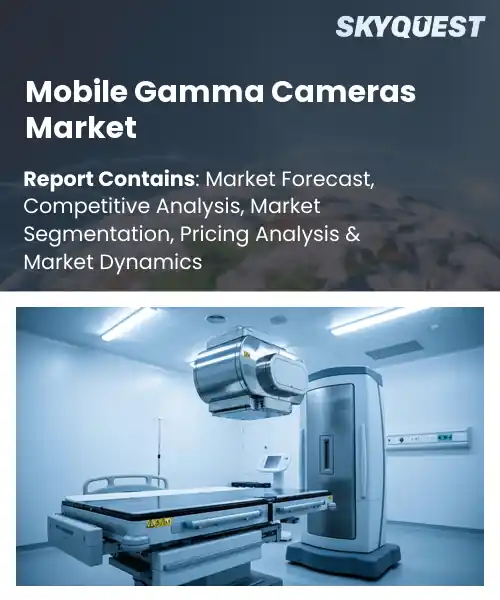
Mobile Gamma Cameras Market
Report ID: SQMIG35A3401
Report ID: SQMIG35A3401
[email protected]
USA +1 351-333-4748
Report ID:
SQMIG35A3401 |
Region:
Global |
Published Date: May, 2026
Pages:
157
|Tables:
180
|Figures:
79


Global Mobile Gamma Cameras Market size was valued at USD 60.1 Million in 2024 and is poised to grow from USD 62.56 Million in 2025 to USD 86.28 Million by 2033, growing at a CAGR of 4.1% during the forecast period (2026-2033).
As more and more clinicians ask for point of care nuclear imaging to be performed in the operating room and bedside settings, mobile gamma cameras are becoming an integral part of surgical workflows by providing clinicians with tools to improve their outcomes as well as their ability to manage patients’ needs during surgery. They are compact scintillation or semiconductor devices that allow physicians to map sentinel lymph nodes (the first lymph nodes to receive drainage from a tumor), localize parathyroid glands, and define the margins of tumors while they are operating. They also provide clinicians the means to make immediate clinical decisions, thereby reducing patient transfers between departments.
Historically, mobile gamma cameras have evolved from the use of large, fixed gamma cameras to the use of portable mobile gamma cameras in the 1990s to the development of digital CZT and hybrid mobile gamma camera systems in the 2010s. As hospitals and oncology clinics have incorporated these mobile gamma camera systems into their surgical approaches, there is evidence to suggest that they are significantly shortening procedure times.
Beyond clinical utilization, rapid advancements in technology are the primary force driving the mobile gamma camera market’s growth. Technological advancements have helped to reduce barriers for entry and have provided scalable commercial models for mobile gamma camera manufacturers. In fact, with the improvements in spatial resolution and sensitivity for semiconductor CZT detectors, scan durations have been shortened and the intraoperative feedback received by surgeons has improved significantly, allowing hospitals to justify capital investments in mobile gamma cameras.
As a result, mobile gamma camera manufacturers are signing contracts with new ambulatory surgery centers and expanding leasing programs to facilitate the rural health care providers’ ability to perform sentinel lymph node biopsies in patients with breast cancer and melanoma - procedures that have historically required the use of tertiary care centers. Additionally, integrating software with navigation and artificial intelligence analytics has increased diagnostic confidence in mobile gamma camera systems, leading to a growing number of procurement cycles based on demonstrable clinical outcomes and reimbursement alignment.
How is AI Improving Diagnostic Accuracy in the Mobile Gamma Cameras Market?
Mobile gamma cameras enable nuclear imaging at the bedside, while artificial intelligence (AI) has enabled a higher degree of accuracy for diagnosis through enhancing the formation of and interpretation of images. AI enhances reconstructed SPECT images by reducing noise and providing sharper detail. Machine learning aids in the detection of lesions and standardization of uptake values, which makes the clinician's ability to make affirmative decisions from the scan easier. AI also streamlines the workflow through automated quality-control checks and triage of examinations so that the specialist's limited time is focused on cases with the highest utilization. The current market demand is for compact systems that provide clinical value at the point of care, making AI a key differentiation factor for both vendors and early adopters.
In April 2026, Catalyst MedTech announced it had acquired X3D, a manufacturer of gamma cameras, to expand its gamma camera manufacturing function as well as to support the integration of advanced image-processing functions and AI-driven reconstructions to produce clarity and speed in mobile installations.
Market snapshot - (2026-2033)
Global Market Size
USD 60.1 Million
Largest Segment
Single-head Mobile Gamma Cameras
Fastest Growth
Handheld Gamma Cameras
Growth Rate
4.1% CAGR
To get more insights on this market click here to Request a Free Sample Report
Global mobile gamma cameras market is segmented into by product type, application, technology, end user, mobility type, detector type and region. Based on by product type, the market is segmented into single-head mobile gamma cameras, dual-head mobile gamma cameras, handheld gamma cameras, compact mobile gamma cameras and hybrid mobile gamma cameras. Based on by application, the market is segmented into cardiology imaging, oncology imaging, thyroid imaging, bone scintigraphy, sentinel lymph node mapping, intraoperative imaging and others. Based on by technology, the market is segmented into SPECT mobile gamma cameras, solid-state detector gamma cameras, CZT-based gamma cameras and digital gamma cameras. Based on by end user, the market is segmented into hospitals, diagnostic imaging centers, ambulatory surgical centers, research institutes and others. Based on by mobility type, the market is segmented into cart-based systems, handheld systems and portable wearable systems. Based on by detector type, the market is segmented into sodium iodide detectors, cadmium zinc telluride detectors and others. Based on region, the market is segmented into North America, Europe, Asia Pacific, Latin America and Middle East & Africa.
The dual-head mobile gamma camera segment is strong due to their paired detector configuration offering better sensitivity and improved imaging microscopy for each plane tomographic views, which directly advance diagnostic confidence across cardiology and oncology workflows And it will streamline hospital diagnostic centers application in and encouraging vendor investment and integration with established SPECT protocols.
Handheld gamma cameras are the fastest-growing product category due to advances in miniaturization and development of improved detectors, allowing point-of-care and intraoperative applications. They are easy to move and use in surgical procedure rooms, enabling surgical teams and ambulatory providers to create new workflows using compact imaging devices that expand possible uses in a clinical setting.
The segment of gamma cameras based on CZT will be differentiated from their competition through their direct conversion of cadmium zinc telluride detector design that provides greater energy resolution and spatial resolution, thus enhancing the visual representation of lesions and providing a way to perform low dose imaging for mobile settings. Additionally, these performance features provide more clinical confidence in the imaging capabilities of cardiac and oncology and allow for the design of smaller systems which will generate additional provider interest as well as create greater focus from vendors developing products for CZT platforms; thus establishing CZT platforms as a leader in strategic technology.
In the meantime, digital gamma cameras are now becoming a major growth segment due to improvements made with detector electronics, software image enhancement capabilities, as well as more simplistically connected devices to enhance workflow speed and allow for remote diagnostics. These devices’ compatibility with both AI and cloud-based solutions is advancing the speed at which they are being implemented into both outpatient and surgery-type environments and creating a need for next-generation mobile imaging devices.
To get detailed segments analysis, Request a Free Sample Report
The global mobile gamma cameras market growth for portable nuclear imaging systems is being driven by North America since it has favorable conditions for the use of market. There is a high concentration of advanced hospital and specialty imaging centers, which supports early adoption of portable nuclear imaging solutions. In addition, the region has well-established reimbursement procedures and procurement channels that allow for widespread adoption of these systems in different care settings. The leading manufacturers in the mobile gamma camera industry have established regional headquarters and service networks, which provide manufacturers with a streamlined method to develop new products, navigate the regulatory process and provide post-sale support. Numerous research studies and collaborations between industry and academic institutions are accelerating the validation of new applications and creating a strong foundation of private and public investment to support innovation in the areas of detector sensitivity, portability and system integration. All of these factors combined create a platform for North America to remain the leading market for the portable nuclear imaging industry, while maintaining a highly competitive environment that is focused on clinical flexibility and operational efficiency.
Mobile mobile gamma cameras market share in United States has been greatly attributable to the fast-paced adoption of the technology in acute and outpatient environments, supported by the large number of specialty care facilities and existing service networks. Manufacturers (OEMs) offer mobile gamma cameras in a broad geography and have local support available, so that there are fewer barriers to deploying the devices. Collaborative clinical studies and partner/vendor relationships have also contributed to the diversity of applications for mobile gamma cameras. Operating room and outpatient surgery procurement practices favour mobile systems that contribute to increased flexibility and throughput for staff and patients; such requirements further support the preference for advanced and serviceable imaging devices.
Mobile mobile gamma cameras market trends in Canada is aided by comprehensive provincial healthcare infrastructures and joint purchasing techniques that support serviceable and scalable imaging systems. Adoption of clinically used mobile gamma cameras is aided by regional excellence centers, which provide coordinated training for their use in distributed care settings. The focus on low-cost imaging and long-term service agreements supports procurement of mobile imaging units that can be utilized in many locations. Manufacturers have partnered with providers to develop a customized solution to each provider's particular clinical workflow.
Europe is seeing a rapid rise in mobile gamma cameras as a result of a mix of clinical need, industry capability and new care delivery models. Strong local manufacturers and specialist distributors provide rapid market access, while international clinical partnerships and multi-centre validation trials create clinical confidence in mobile nuclear imaging for multiple specialties. The shift toward decentralised diagnostics and outpatient care is creating increasing demand for smaller, mobile systems that can be shared across multiple locations. Reimbursement reforms and health system strategies focused on improving efficiency lead to purchasing arrangements that favour mobility and serviceability. Regulatory harmonisation across Europe and dedicated investments in imaging infrastructure reduce barriers to adoption, allowing for quick diffusion of new device capabilities and greater clinical integration. Additionally, service models that include flexible financing and integrated maintenance support greatly increase the attractiveness of mobile systems to hospitals and diagnostic chains.
Mobile gamma cameras market outlook in Germany benefits from a strong domestic manufacturing capability and established clinical networks that help facilitate early clinical assessment and integration. The hospitals and regional imaging centres are particularly focused on obtaining systems with proven detector performance and robust service arrangements because of their need for technical precision and reliability. The collaboration between academic institutions and device manufacturers allows for the refinement of the application, while the establishment of a centralised tendering system and large hospital groups allows for an effective and coordinated deployment throughout care pathways has further established Germany as one of the leading markets in the region.
Mobile gamma cameras market regional outlook in United Kingdom is a rapidly growing sector with numerous applications utilized by physicians and mobile medical equipment companies for a variety of acute and community care sites. The focus on reducing hospital stays and increasing outpatient diagnostics supports mobile nuclear imaging trials in a variety of clinical environments. The use of strong distributor networks and an increasing number of new models of care (e.g., rental programs and managed service agreements) have made it easier for physicians to acquire mobile gamma cameras. Additionally, the collaboration between clinical leaders and manufacturers will continue to promote innovative configurations and improved operational workflows for mobile gamma cameras.
Mobile Gamma Cameras Market in France is emerging as the use of portable nuclear imaging in support of oncology and cardiology pathways at or near point of care continues to be explored by both regional clinics and hospitals within the country. Purchasing decisions are often made based on the balance of technical capability, lifecycle service agreements and preliminary pilot projects demonstrating operational benefits in decentralized environments. Increased interest from private diagnostic groups and collaborative trials with academic hospitals are currently expanding clinical applications of mobile systems. As confidence in the use of mobile imaging continues to grow, so will the amount of mobile gamma cameras procured.
Due to targeted investment on advanced/novel imaging capabilities, an increase in clinical validation and an increase in the footprint of both manufacturing & services, the Asia Pacific is gaining stronger foothold within mobile gamma camera industry. The leading markets have both high-capital hospitals as well as active research communities, which allow for the evaluation of new design concepts (i.e., detector technology and portability). By working collaboratively with local manufacturing and global vendors, the development of products meets regional workflow and procurement requirements. Various financial options will assist with the varied budget constraints between public and private facilities, while at the same time, the increasing level of clinical awareness of point of care nuclear medicine applications and the effort to incorporate Mobile Systems into existing diagnostic and tele-health pathways, are helping create relevance and accelerate the use of mobile systems in many different Heathcare settings. Finally, the various supportive policies and public procurement programs that exist in many key markets are helping create the baseline infrastructure, which will support pilot projects that will demonstrate actual operational value.
Mobile gamma cameras market forecast in Japan is driven by an advanced hospital system and strong focus on imaging. In this market, there is to be an increased engagement between clinical centers and manufacturers to optimize the performance and ergonomics of gamma camera detectors. The need for high-precision and integrated diagnostic workflows has caused an increase in demand for portable units that support established fixed imaging suites. Local manufacturer experience and established service networks help provide a reliable way to deploy and maintain mobile gamma cameras, and pilot programs demonstrate how they can be useful in specialized clinical pathways.
Mobile gamma cameras market penetration in South Korea benefit from strong electronic devices and engineering capabilities to provide innovative portable imaging solutions for compact clinical environments. There is rapid vendor response and a high degree of clinical trial-related focus in major hospital systems to confirm new configurations; acquisition models are flexible and support both private & public providers by allowing for easier adoption. Collaboration between manufacturers, distributors & clinical stakeholders allows for streamlined deployment, service & training with minimal integration issues into the diagnostic workflow system.
To know more about the market opportunities by region and country, click here to
Buy The Complete Report
Expansion Of Portable Imaging Solutions
Integration With Advanced Detection Software
High Cost Of Imaging Equipment
Regulatory Complexity and Approval Delays
Request Free Customization of this report to help us to meet your business objectives.
Competitive landscape in global mobile gamma cameras is shaped by established imaging manufacturers and agile startups, with competition driven by sensor innovation and strategic alliances. Established firms pursue acquisitions and integrations for detector technologies while startups form partnerships with robotics and energy operators to commercialize real time mapping, exemplified by Digirad’s solid state gamma evolution and Gamma Reality’s robotics collaborations.
SkyQuest’s ABIRAW (Advanced Business Intelligence, Research & Analysis Wing) is our Business Information Services team that Collects, Collates, Correlates, and Analyses the Data collected by means of Primary Exploratory Research backed by robust Secondary Desk research.
As per SkyQuest analysis, trends indicate that the global mobile gamma cameras market is developing continuously and being positively affected by new technologies that result in improved detector performance (such as increased sensitivity and quality), improved intraoperative efficiency, and new AI-based imaging devices, as well as software that will help to streamline workflow and improve confidence in diagnoses. However, a challenge to continued growth in this sector is the high cost of acquiring and maintaining mobile gamma cameras, which impedes their adoption by smaller providers. The North American region leads in the mobile gamma camera marketplace, primarily due to strong clinical demands for the products, reimbursement and the number of manufacturers provided to hospitals and diagnostic centres. Dual-head mobile gamma cameras account for the largest market share due to the increased sensitivity, shorter time required to perform a scan, and increased number of hospitals/diagnostic centres using dual-head technology.
| Report Metric | Details |
|---|---|
| Market size value in 2024 | USD 60.1 Million |
| Market size value in 2033 | USD 86.28 Million |
| Growth Rate | 4.1% |
| Base year | 2024 |
| Forecast period | (2026-2033) |
| Forecast Unit (Value) | USD Million |
| Segments covered |
|
| Regions covered | North America (US, Canada), Europe (Germany, France, United Kingdom, Italy, Spain, Rest of Europe), Asia Pacific (China, India, Japan, Rest of Asia-Pacific), Latin America (Brazil, Rest of Latin America), Middle East & Africa (South Africa, GCC Countries, Rest of MEA) |
| Companies covered |
|
| Customization scope | Free report customization with purchase. Customization includes:-
|
To get a free trial access to our platform which is a one stop solution for all your data requirements for quicker decision making. This platform allows you to compare markets, competitors who are prominent in the market, and mega trends that are influencing the dynamics in the market. Also, get access to detailed SkyQuest exclusive matrix.
Table Of Content
Executive Summary
Market overview
Parent Market Analysis
Market overview
Market size
KEY MARKET INSIGHTS
COVID IMPACT
MARKET DYNAMICS & OUTLOOK
Market Size by Region
KEY COMPANY PROFILES
Methodology
For the Mobile Gamma Cameras Market, our research methodology involved a mixture of primary and secondary data sources. Key steps involved in the research process are listed below:
1. Information Procurement: This stage involved the procurement of Market data or related information via primary and secondary sources. The various secondary sources used included various company websites, annual reports, trade databases, and paid databases such as Hoover's, Bloomberg Business, Factiva, and Avention. Our team did 45 primary interactions Globally which included several stakeholders such as manufacturers, customers, key opinion leaders, etc. Overall, information procurement was one of the most extensive stages in our research process.
2. Information Analysis: This step involved triangulation of data through bottom-up and top-down approaches to estimate and validate the total size and future estimate of the Mobile Gamma Cameras Market.
3. Report Formulation: The final step entailed the placement of data points in appropriate Market spaces in an attempt to deduce viable conclusions.
4. Validation & Publishing: Validation is the most important step in the process. Validation & re-validation via an intricately designed process helped us finalize data points to be used for final calculations. The final Market estimates and forecasts were then aligned and sent to our panel of industry experts for validation of data. Once the validation was done the report was sent to our Quality Assurance team to ensure adherence to style guides, consistency & design.
Analyst Support
Customization Options
With the given market data, our dedicated team of analysts can offer you the following customization options are available for the Mobile Gamma Cameras Market:
Product Analysis: Product matrix, which offers a detailed comparison of the product portfolio of companies.
Regional Analysis: Further analysis of the Mobile Gamma Cameras Market for additional countries.
Competitive Analysis: Detailed analysis and profiling of additional Market players & comparative analysis of competitive products.
Go to Market Strategy: Find the high-growth channels to invest your marketing efforts and increase your customer base.
Innovation Mapping: Identify racial solutions and innovation, connected to deep ecosystems of innovators, start-ups, academics, and strategic partners.
Category Intelligence: Customized intelligence that is relevant to their supply Markets will enable them to make smarter sourcing decisions and improve their category management.
Public Company Transcript Analysis: To improve the investment performance by generating new alpha and making better-informed decisions.
Social Media Listening: To analyze the conversations and trends happening not just around your brand, but around your industry as a whole, and use those insights to make better Marketing decisions.
REQUEST FOR SAMPLE
 REQUEST FREE CUSTOMIZATION
Global Mobile Gamma Cameras Market size was valued at USD 60.1 Million in 2024 and is poised to grow from USD 62.56 Million in 2025 to USD 86.28 Million by 2033, growing at a CAGR of 4.1% during the forecast period (2026-2033).
Competitive landscape in global mobile gamma cameras is shaped by established imaging manufacturers and agile startups, with competition driven by sensor innovation and strategic alliances. Established firms pursue acquisitions and integrations for detector technologies while startups form partnerships with robotics and energy operators to commercialize real time mapping, exemplified by Digirad’s solid state gamma evolution and Gamma Reality’s robotics collaborations. 'GE HealthCare', 'Siemens Healthineers', 'Philips Healthcare', 'Digirad Corporation', 'DDD-Diagnostic', 'Mediso', 'Spectrum Dynamics Medical', 'Oncovision', 'Crystal Photonics', 'Gamma Medica', 'MiE America', 'SurgicEye', 'Adolesco Healthcare', 'Crystal Clear Imaging', 'BrightView Technologies', 'Neurologica', 'Dilon Technologies', 'Esaote', 'Canon Medical Systems', 'Shimadzu Corporation'
Mobile gamma cameras have become more compact and user friendly, enabling providers to offer imaging at the bedside and in remote settings, which increases access to services and shortens diagnostic pathways. This portability supports decentralized care models by removing constraints tied to fixed imaging suites and allows faster decision making in clinical workflows. The flexibility to perform procedures outside traditional environments encourages broader clinical adoption and integration into various specialties, thereby expanding demand among hospitals, outpatient centers, and clinics seeking efficient, patient centered imaging capabilities.
Ai Enhanced Imaging Integration: Adoption of advanced software for automated image processing and decision support is reshaping the utility of mobile gamma cameras. Vendors are integrating machine learning to streamline image acquisition, enhance lesion visibility, and assist prioritization of studies, enabling richer clinical insights at the point of care. Collaborations between device manufacturers and analytics firms accelerate software-driven updates and service models, improving workflow efficiency and confidence. This trend underscores interoperability, neutral architectures and investment in clinical validation and user training to support uptake.
Why does North America Dominate the Global Mobile Gamma Cameras Market? |@12


Want to customize this report? This report can be personalized according to your needs. Our analysts and industry experts will work directly with you to understand your requirements and provide you with customized data in a short amount of time. We offer $1000 worth of FREE customization at the time of purchase.
Feedback From Our Clients


 USA (+1) 351-333-4748

