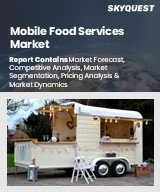
Mobile Food Services Market
Report ID: SQMIG25Q2010
Report ID: SQMIG25Q2010
[email protected]
USA +1 351-333-4748
Report ID:
SQMIG25Q2010 |
Region:
Global |
Published Date: January, 2026
Pages:
176
|Tables:
94
|Figures:
69


Global Mobile Food Services Market size was valued at USD 23.64 Billion in 2024 and is poised to grow from USD 25.18 Billion in 2025 to USD 41.67 Billion by 2033, growing at a CAGR of 6.5% during the forecast period (2026–2033).
The global mobile food services market growth is driven rapidly due to multiple drivers; the first is urbanization and the fast-paced way many consumers live today. This rapid urbanization means more people demand ease of access to food/meal solutions that they can have quickly, which makes mobile food services a viable option for consumers looking for on-the-go meals. The increase in disposable income and changing consumer preferences for diverse, authentic, and gourmet meals. Advancements in technology play a role because mobile apps and solutions that allow consumers to place orders and pay with cashless payment methods, as well as technology to allow consumers to see where the various food trucks and services are and the estimated time for food delivery will improve the convenience for customers and the operational efficiency of the mobile food service provider. Also, social media is a significant factor driving the popularity of mobile food services because social media gives food trucks and vendors the ability to communicate with audiences and create food experiences that are shareable, which enhances brand awareness and loyalty. Another driver of amusement park food service is globalization and the opportunities for brand expansion through international investment and expansion of the service model itself. Globalization enables innovations in food and services that may not be available or downloaded previously. The trends in social responsibility and environmental sustainability (ex. eco-friendly packaging, local sourcing, etc.) and the opportunity for a consumer to have a connection to a local farmer or regional food enterprise is attractive to many increasingly conscious consumers. These drivers contribute to an opportunity-rich landscape for growth in the mobile food services market.
How are Digital Technologies Helping Efficient Business Operations?
Digital technology within the global mobile food services market share has prompted a turnaround for how operators carry out business operations. Mobile ordering and delivery technology has redefined the traditional food truck model. No longer does growing your customer reach, convenience, and options mean growing in terms of physical proximity. For instance, "Roaming Hunger", a food truck booking platform that connects consumers, event organizers, and food vendors by using advanced technology in the mobile space. They utilize multiple digital platforms to build a customer-centric system that culls the need for food services to create a booking system on their own. Roaming Hunger technology not only simplifies ordering and booking, but it also lets organizers start thinking bigger in terms of event planning. This means additional revenues, operational scalability, and customer experience improvement for food operators and a better experience for consumers. Roaming Hunger is also providing data analytical services that allow vendors to better streamline menu items, prices, and marketing strategies as well as being a food services event planner.
Market snapshot - 2026-2033
Global Market Size
USD 21.37 Billion
Largest Segment
Urban Commuters
Fastest Growth
Event Attendees
Growth Rate
5.8% CAGR
To get more insights on this market click here to Request a Free Sample Report
Global Mobile Food Services Market is segmented by Service Type, Product Category, Business Model, Location Type and region. Based on Service Type, the market is segmented into Food Trucks, Food Trailers, Food Carts, Mobile Catering and Pop-Up Kitchens. Based on Product Category, the market is segmented into Food, Beverages and Desserts & Snacks. Based on Business Model, the market is segmented into Independent Vendors, Franchises and Restaurant Chains with Mobile Units. Based on Location Type, the market is segmented into Urban Professionals, Events & Festivals, Travelers / Leisure Pursuers, Residential Areas and Corporate Campuses / Industrial Zones. Based on region, the market is segmented into North America, Europe, Asia Pacific, Latin America and Middle East & Africa.
As per the 2024 global mobile food services market analysis, fast food is the largest share of mobile food services market by food category. Fast food has pride in place overall, as it is naturally most akin to all the conveniences, speed, and affordability, all of which are why any of us use mobile food services when we are busy and on the go. From urban commuters to those attending events and functions, fast food caters to every demographic because of the short time it takes to be created and the large range of generally similar menu items it offers. The fast-food segment is likely to be the largest simply because of the demand for easily accessible, time-saving meals to fit busy lifestyles, and we compile traditionally based mobile food that would include the fast-food segment.
The fastest growing food category segment is gourmet and ethnic, as consumers evolve their preferences for authenticity, quality, and unique experiences in even mobile settings. Consumers are looking increasingly for different and specialty dishes that reflect the food culture trends of being adventurous and exploring new flavors combined with a premium market for food products. While mobile food has traditionally been considered street food based primarily on convenience, the rise of gourmet and ethnic food categories is bringing a newer edge of recognition towards the experience based and unique aspects of these food categories through innovative delivery and customer service.
Based on the 2024 global mobile food services market forecast, the largest segment of end consumers is urban commuters. Urban commuters make up the most significant client's share because they are continuously demanding meals catered to frequent and convenient meal solutions that are tightly wrapped into their day-to-day process of busy schedules. Urban routes, including office workers and commuters, are well suited for mobile food services when urban commuters are looking for quick, accessible, and affordable food options. Urban or metropolitan areas have substantial employment levels which contribute to high volumes of demand and frequency. The demand for urban commuting consumers is a basis of customer segments in these types of mobile food offerings to fill the void in semi-casual meals as they have a demand for meals throughout a busy day alongside work.
The fastest growing segment of end consumers is event attendees. This group has the highest growth in mobile food services as mobile food services are more often found at festivals, concerts, sports events, and other large gatherings. Event attendees embody a growing trend in which on-site dining options are provided by mobile food vendors. Moreover, event attendees are likely to have varied on-site specialty type meals that contribute to the social and entertainment experience. The current rise in event-based consumption accelerates market dynamics by providing higher strong sales volume during concentrated periods of time while also allowing mobile food services operators to profit from these events.
To get detailed segments analysis, Request a Free Sample Report
As per the mobile food services market regional analysis, the most prevalent region in the mobile food services market is North America. The leading reason this region is the market leader is because of the well-established food truck culture, high consumer spending power, and extensive food landscape in North America. Strong demand for diverse dining experiences and the growing number of food truck festivals and events in North America are the main drivers of this domination. North America has supportive regulations, as well as a strong entrepreneurial mindset and technology innovation such as mobile ordering and cashless payments that help operational efficiency and customer convenience in the mobile food services market.
The United States holds the most considerable dominance in North America, as it holds the largest concentration of mobile food services market in the world. The U.S. has the most considerable market concentration due to the large population, established culture and infrastructure, and street food culture. Cities such as Austin, New York, and Los Angeles are locations for food trucks and mobile vendors offering cuisines such as tacos, pad thai, curry, have a dessert cart, or offer a gourmet lunch. The U.S. remains at the forefront of innovating mobile food service and digital ordering platforms that hold the attention and complete spending from the consumer sector of the market.
Canada's market is growing well, factors pushing these numbers include increased consumer expenditures on convenience foods, demand for access to food trucks that offer different international cuisines, and increasing reliance on technology like online ordering, AI driven consumer recommendations, and cloud kitchens. Major metropolitan areas like Toronto exemplify the trend with a plethora of QSR and creative foodservice concepts. Additionally, the multicultural population adds to the demand for food truck food's diverse and gourmet mobile dining options.
Asia Pacific is the fastest growing section of the mobile food services industry. The region is rapidly growing due to accelerating urbanization, an emerging new middle class, and rising disposable incomes in China, India and Southeast Asia. The segment is supported by the demand for convenient, accessible, affordable and straightforward dining options, from stressed, busy consumers that spend increasingly more time dealing with technology-driven and mobile food ordering and food delivery platforms. Also, with the rich street food culture across the Asia region and the ongoing appetite for food trends, constant innovation is pushed upon the market.
China is currently the most predominant market for mobile food services. China has an ever-increasing population, a very stable growing economy, a middle class that continues to expand, and a robust embrace of digital goods, processes and experiences. China also has a rich street food community that has seen expansion through urbanization and evolving consumer trends and demands. Food ordering and delivery services based on digital platforms are commonplace in China compared to the rest of the world, which has elevated convenience that can be maintained and provides an overall market presence. China contains the largest and growing component of the region's market and will continue to experience growth.
India is the fastest growing country in the region. Urbanization, investments in infrastructure, and a very young, digitally friendly population willing to engage in food ordering and delivery to their homes, businesses and more is why change in India is so rapid compared to the rest of the region. Major markets including metro and non-metro cities, and smaller towns, are seeing growth in the quick-service restaurant (QSR) and casual dining sectors. As disposable income continues to increase and newer products are offered to consumers and grow, there are more attractive, engaging products on the market, leading to increased demand. India is an opportunity for mobile food services to be positioned for the growth of distracted consumers with nearly no limits.
Europe has a powerful presence with a strong street food culture and increasingly popular mobile dining options. The main driving factors of this growth include urbanization and food tourism, as well as people's habit of seeking quick, convenient meals. The countries in Europe that have gravitated toward food trucks, pop-up kitchens, and event-driven catering include the UK, Germany, France, and Italy. Sustainability trends provide a backdrop for local sourcing and environmentally friendly packaging, which shines through European consumers.
The UK market, despite the demand for mobile food services, has begun to settle after COVID-19 and, in large cities like London, Manchester, and Birmingham, the demand for food trucks and pop-ups providing quick, affordable meals is high. Recent growth in street food markets and food festivals rounded off by many local councils opening street food options, has also activated this area as a cannon fodder territory with room to grow for mobile food festivals. Health-conscious and sustainable food trends, vegan, gluten-free, etc., as well as an increase in digital ordering and payment technologies have helped position the UK as a market leader.
The market is experiencing rapid growth, largely thanks to changing consumer preferences towards sustainable, locally sourced ingredients, coupled with fun and innovative business models. Cloud kitchens and delivery targeting concepts are rapidly developing, as well. There is a great deal of energy in the urban food scene in the Netherlands, more importantly in Amsterdam and Rotterdam, and strong demand for casual, contemporary dining concepts. The pace of innovation is significant and is driven by the growing use of mobile ordering apps and the expansion of cashless point of sale systems.
Germany has a healthy, and persistently growing market, owing to many people living in urban areas, good economic strength, and a burgeoning street food culture. The food truck scenes in cities such as Berlin, Hamburg, and Munich include a variety of food styles, with examples of both traditional German and international cuisines. Consumer demand for high-quality mobile dining options, coupled with convenience and ease of digital ordering (and cashless payment systems) is working in Germany's favour. Moreover, sustainability and local sourcing trends, are appealing to German consumers, so the market remains open to continued growth.
To know more about the market opportunities by region and country, click here to
Buy The Complete Report
Urbanization and Busy Lifestyles
Technological Advancements
Regulatory and Compliance Challenges
Operational and Maintenance Costs
Request Free Customization of this report to help us to meet your business objectives.
The mobile food services market outlook is a combination of international quick-service restaurant chains, established regional players, niche brands, and a vast array of independent operators. The large multi-national companies have the scale, volume, loyalty programs, aggressive expansion and speed and scale of novel digital solutions such as artificial intelligence for ordering and payments. Regional companies will compete in their market area with local menus and forms of franchise models. Emerging companies and start-ups will focus on innovative and technology driven solutions such as plant-based menus, gourmet fast casual ideas and sustainable practices. Independent operators will offer a variety of options through specialty cuisines and locally sourced foods. While the market will grow because of technological advancement, sustainability, and flexibility in consumer demand, it will additionally grow because of continued innovation and competition.
SkyQuest’s ABIRAW (Advanced Business Intelligence, Research & Analysis Wing) is our Business Information Services team that Collects, Collates, Correlates, and Analyses the Data collected by means of Primary Exploratory Research backed by robust Secondary Desk research.
As per SkyQuest analysis, the mobile food services market statistics is a vibrant, active segment of the larger foodservice industry, undertaking changes that reflect urbanization, new consumer trends, convenience, and speed. The original mobile food service model has evolved significantly via technological innovation through digital ordering and AI based platforms. This has allowed mobile food services potential to elevate from backspace operations to global operations, allowing consumers easier access to mobile food services. The diversity of this mobile food marketplace is extensive and corresponds to global fast-food franchises, regional mid-sized companies, new start-ups in the gourmet, ethnic and sustainable food areas. North America is the largest market, while Asia Pacific has the highest growth, adding emerging middle classes and digital accelerants into the marketplace. There are vast regulatory and operational hurdles in hospitality, however with the support from governments to create viable operator opportunities in the mobile food sector and increasing demand for food experiences, technology evolution, as well as sustainability, the mobile food services segment is enjoying a viability that is not present in other segments like hospitality.
| Report Metric | Details |
|---|---|
| Market size value in 2024 | USD 23.64 Billion |
| Market size value in 2033 | USD 41.67 Billion |
| Growth Rate | 6.5% |
| Base year | 2024 |
| Forecast period | 2026-2033 |
| Forecast Unit (Value) | USD Billion |
| Segments covered |
|
| Regions covered | North America (US, Canada), Europe (Germany, France, United Kingdom, Italy, Spain, Rest of Europe), Asia Pacific (China, India, Japan, Rest of Asia-Pacific), Latin America (Brazil, Rest of Latin America), Middle East & Africa (South Africa, GCC Countries, Rest of MEA) |
| Companies covered |
|
| Customization scope | Free report customization with purchase. Customization includes:-
|
To get a free trial access to our platform which is a one stop solution for all your data requirements for quicker decision making. This platform allows you to compare markets, competitors who are prominent in the market, and mega trends that are influencing the dynamics in the market. Also, get access to detailed SkyQuest exclusive matrix.
Table Of Content
Executive Summary
Market overview
Parent Market Analysis
Market overview
Market size
KEY MARKET INSIGHTS
COVID IMPACT
MARKET DYNAMICS & OUTLOOK
Market Size by Region
KEY COMPANY PROFILES
Methodology
For the Mobile Food Services Market, our research methodology involved a mixture of primary and secondary data sources. Key steps involved in the research process are listed below:
1. Information Procurement: This stage involved the procurement of Market data or related information via primary and secondary sources. The various secondary sources used included various company websites, annual reports, trade databases, and paid databases such as Hoover's, Bloomberg Business, Factiva, and Avention. Our team did 45 primary interactions Globally which included several stakeholders such as manufacturers, customers, key opinion leaders, etc. Overall, information procurement was one of the most extensive stages in our research process.
2. Information Analysis: This step involved triangulation of data through bottom-up and top-down approaches to estimate and validate the total size and future estimate of the Mobile Food Services Market.
3. Report Formulation: The final step entailed the placement of data points in appropriate Market spaces in an attempt to deduce viable conclusions.
4. Validation & Publishing: Validation is the most important step in the process. Validation & re-validation via an intricately designed process helped us finalize data points to be used for final calculations. The final Market estimates and forecasts were then aligned and sent to our panel of industry experts for validation of data. Once the validation was done the report was sent to our Quality Assurance team to ensure adherence to style guides, consistency & design.
Analyst Support
Customization Options
With the given market data, our dedicated team of analysts can offer you the following customization options are available for the Mobile Food Services Market:
Product Analysis: Product matrix, which offers a detailed comparison of the product portfolio of companies.
Regional Analysis: Further analysis of the Mobile Food Services Market for additional countries.
Competitive Analysis: Detailed analysis and profiling of additional Market players & comparative analysis of competitive products.
Go to Market Strategy: Find the high-growth channels to invest your marketing efforts and increase your customer base.
Innovation Mapping: Identify racial solutions and innovation, connected to deep ecosystems of innovators, start-ups, academics, and strategic partners.
Category Intelligence: Customized intelligence that is relevant to their supply Markets will enable them to make smarter sourcing decisions and improve their category management.
Public Company Transcript Analysis: To improve the investment performance by generating new alpha and making better-informed decisions.
Social Media Listening: To analyze the conversations and trends happening not just around your brand, but around your industry as a whole, and use those insights to make better Marketing decisions.
REQUEST FOR SAMPLE
 REQUEST FREE CUSTOMIZATION


Want to customize this report? This report can be personalized according to your needs. Our analysts and industry experts will work directly with you to understand your requirements and provide you with customized data in a short amount of time. We offer $1000 worth of FREE customization at the time of purchase.
Feedback From Our Clients


 USA (+1) 351-333-4748

