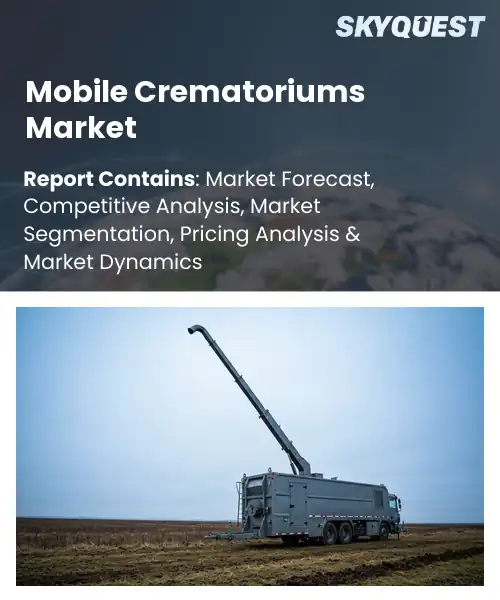
Mobile Crematoriums Market
Report ID: SQMIG25S2089
Report ID: SQMIG25S2089
[email protected]
USA +1 351-333-4748
Report ID:
SQMIG25S2089 |
Region:
Global |
Published Date: March, 2026
Pages:
157
|Tables:
118
|Figures:
77


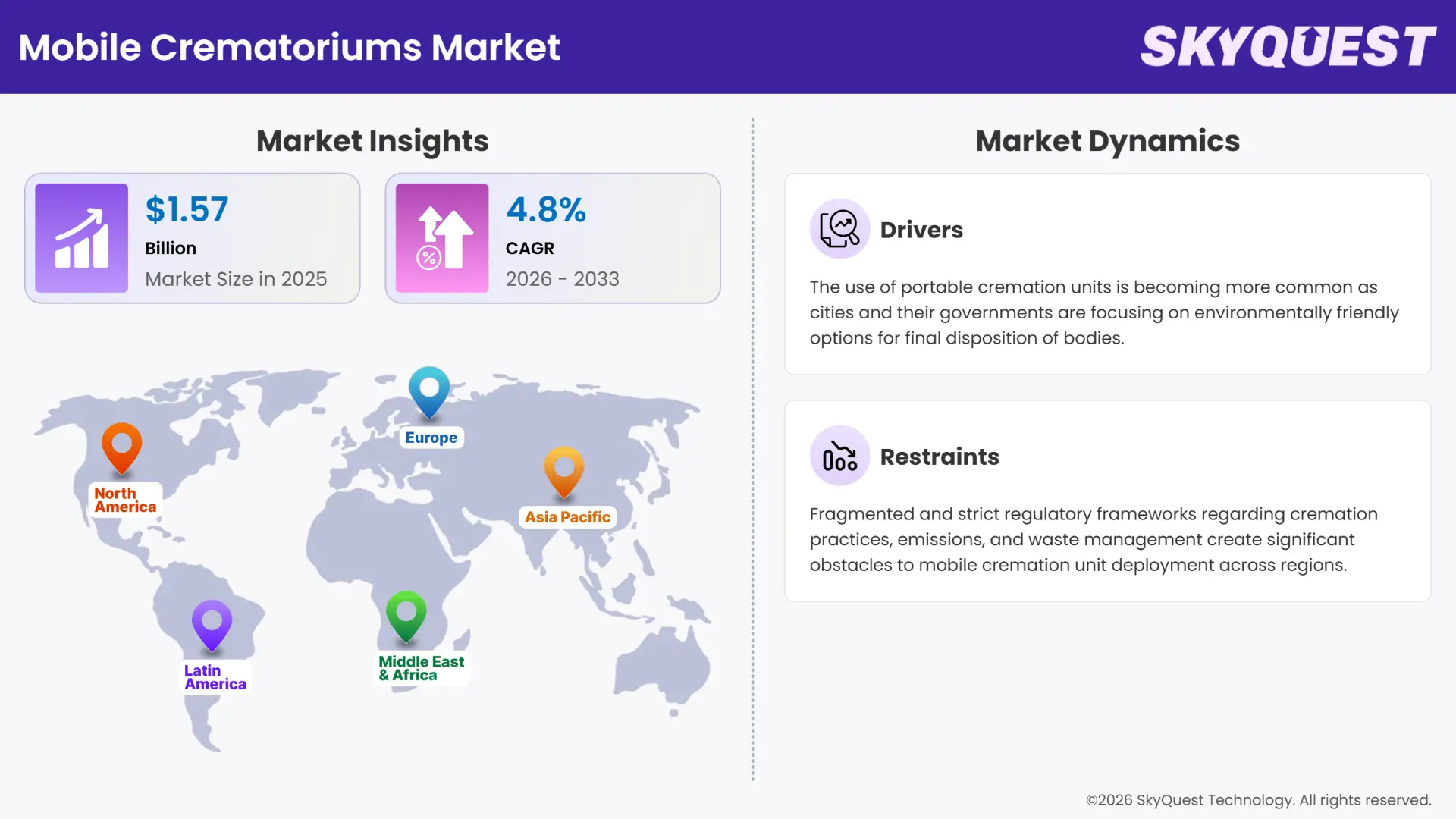
Global Mobile Crematoriums Market size was valued at USD 1.50 Billion in 2024 and is poised to grow from USD 1.57 Billion in 2025 to USD 2.29 Billion by 2033, growing at a CAGR of 4.8% during the forecast period (2026-2033).
Key Takeaways: Market Trends & Insights
The mobile crematoriums market share provides on-site combustion services, emergency disposal and temporary mortuary support. Its primary driver is the convergence of rapid urbanization; pandemic pressures and disaster response needs that strain fixed cremation facilities. Over the decade globally manufacturers refined mobile retorts, improved emissions control through advanced filtration and created modular units deployed during mass casualty events, rural outreach programs and environmental crises such as wildfire seasons and pandemic surges.
Building on those developments, a key factor shaping the global mobile crematoriums market is regulatory pressure to reduce emissions and meet environmental standards, which drives investment in cleaner combustion technology and filtration. The tightening of emissions restrictions has driven manufacturers to innovate with catalytic converters and particle scrubbers, leading to increased unit operating costs while also opening up opportunities to qualify for municipal contracts that provide value for compliance and health protection. In practice, cities that are dealing with mass fatality events or remote areas without adequate infrastructure have purchased certified mobile units to provide service continuity; in addition, NGOs have deployed certified mobile units in their humanitarian responses.
How is IoT Improving Operational Efficiency in the Mobile Crematoriums Market?
IoT is improving operational efficiency in the mobile crematoriums market by connecting sensors cameras and telemetry to core equipment and fleet systems. Key aspects include remote temperature and emissions monitoring predictive maintenance alerts and real time route and fuel tracking. The current state shows operators using these capabilities to reduce unplanned downtime improve safety and ensure regulatory compliance. In many markets mobile units serve remote communities and disaster response where quick reliable service matters. Practical examples include remote diagnostics that allow technicians to resolve issues off site and fleet coordination that shortens response times while improving service quality.
To get more insights on this market click here to Request a Free Sample Report
The mobile crematoriums market is segmented by fuel/power source, mobility platform, system technology, application domain and region. Based on fuel/power source, the market is segmented into LPG/propane fired, diesel fired and electric/hybrid systems. Based on mobility platform, the market is segmented into trailer-mounted units, integrated truck/van mounted and containerized portable units. Based on system technology, the market is segmented into single-chamber burners, dual-chamber and automated PLC controlled systems. Based on application domain, the market is segmented into disaster & emergency management, veterinary & pet cremation services, military & remote field use and municipal/government mobile services. Based on region, the market is segmented into North America, Europe, Asia Pacific, Latin America and Middle East & Africa.
Integrated truck/van mounted segment dominates because these self-contained platforms incorporate cremation equipment, fuel reserves, and controls within a single vehicle, enabling immediate deployment and streamlined operations. The designs they have created use a single system to reduce complexity of setting up, logistical support, and staff and site preparation. Using designs that provide consistent performance regardless of field condition.
However, containerized portable units are emerging as the fastest growing option due to modular design that enables rapid transport, standardized retrofitting, and scalable deployment. By providing a sustainable option to manufacture efficiently, convert quickly by utilizing leasing and reuse models to reduced up front capital investment as an operator.
Diesel fired segment dominates because diesel fuel delivers high thermal output, consistent combustion, and accessible refueling options suited to prolonged field operations. Reliably predictable heat generation supports complete cycles of cremation at differing rates of cremation and under a variety of circumstances, allowing fewer interruptions in processing as a result of simplified burner regulation. Existing familiarity with the overall maintenance of the cremation process and the number of serviceable technicians available to complete this work encourage potential purchasers to obtain machines designed for long-term use with low reliance on infrastructure.
However, electric/hybrid systems are the fastest growing power choice as operators prioritize lower emissions, quieter operation, and simplified fuel logistics for sensitive deployments. An increase in electrical storage options and smaller, more efficient engines for hybrid systems will enable the implementation of longer-working hours between recharges and will meet increasing environmental demands.
To get detailed segments analysis, Request a Free Sample Report
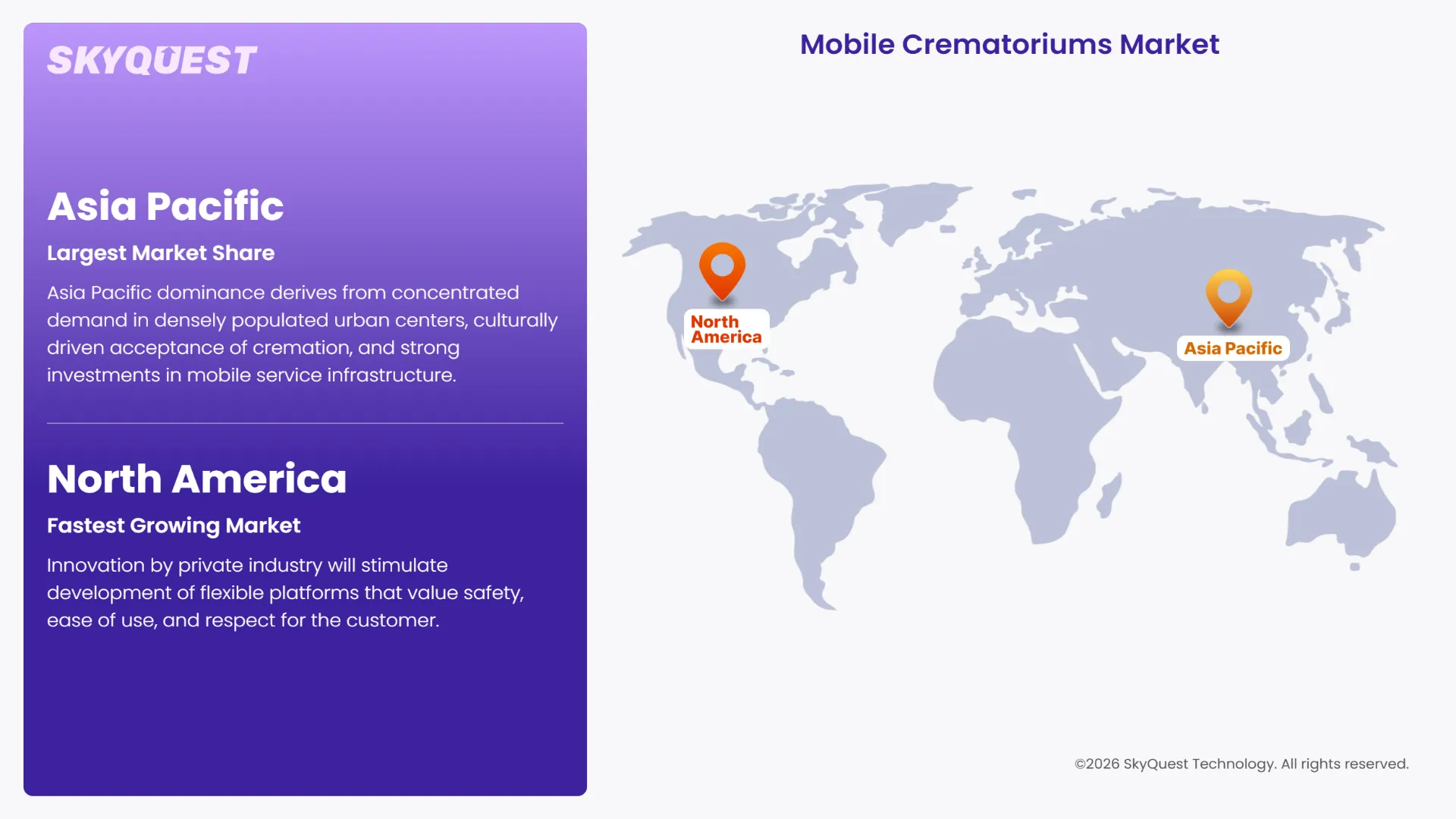
Asia Pacific dominance derives from concentrated demand in densely populated urban centers, culturally driven acceptance of cremation, and strong investments in mobile service infrastructure. The technology in Japan and Korea is advanced & helps create innovate compact & efficient equipment and connects with remote monitoring device to track environmental conditions. Supply chains are already in place to manufacture or have access to high quality product components and engineers who are skilled at developing equipment that meets customer needs. The partnerships between private operators and municipalities increase the use of mobile units in both emergency response and routine cremation services. This is to strengthen their leadership position in the industry through product development and expanding the market for their product.
Mobile crematoriums market in Japan reflects advanced engineering and a cultural propensity for cremation, encouraging compact, high efficiency units that integrate privacy features and stringent emissions controls. Efficiency, sound suppression, and discreet portability are high priorities for operators in both metropolitan areas as well as rural locations. In addition, operators collaborate with local governments and the funeral association in a way that establishes an easily understood protocol of service, technical certification pathways, and acceptance by the communities.
Mobile crematoriums market in South Korea is characterized by adoption of technologically advanced units designed for compact urban deployment and strict environmental compliance. Close partnerships between manufacturing companies and research facilities allow manufacturers to develop new heat management technologies by collaborating with research institutions. In addition to service network providers, providing repairs, training for operators, and adapting locally to meet the needs of various communities.
Expansion in North America is driven by evolving end user preferences for flexible funeral services, increasing municipal interest in contingency planning, and the ability of mobile solutions to bridge service gaps in rural and underserved urban locales. Regulatory frameworks that allow for innovative product/service designs will allow for more creative types of product development and service delivery to customers, while also ensuring compliance with environmental and health regulations.
Innovation by private industry will stimulate development of flexible platforms that value safety, ease of use, and respect for the customer. Collaboration between the manufacturers, funeral home, and emergency management organizations will enhance the adoption of best practice protocols, training for operators, and integrated logistics. Additionally, with increased understanding of total lifecycle costs, and streamlined service delivery, operators will be motivated to provide operational efficiencies and much larger geographical regions of service.
Mobile crematoriums market in the United States reflects diverse operational needs across large geographic areas, prompting providers to offer scalable mobile platforms and comprehensive service packages. Compliance with environmental and public health regulations affect design decisions and deployment practices. Funeral service providers and emergency planners work together to select units that provide reliable performance, are capable of operator training, and address logistics. Private sector innovation promotes modularity and digital monitoring capabilities as solutions for improving service quality.
Mobile crematoriums market in Canada combines emphasis on environmental stewardship with the need to serve remote and dispersed communities, leading providers to develop low emission, transportable units with robust maintenance support. The collaborative efforts of the provincial government, the funeral industry, and equipment producers will help establish standard operational guidelines and training frameworks. Service models typically focus on efficient deployment of resources, modular service delivery, and community involvement to ensure respectful and reliable care in a variety of geographic and climatic settings.
Europe is enhancing its role through a combination of stringent environmental regulation, investments in low emission technologies, and cross border collaboration to harmonize operational standards. Manufacturers are prioritising sustainability and developing units that will meet stringent emissions regulations but also creating designs that allow for maximum operation flexibility. Public procurement and partnerships with local authorities can speed up pilot installations in both urban and rural areas of the country.
Through the development of training for operators, establishment of safety protocols and provision of clear certification to operators, funeral service providers and their communities have confidence in one another. Collaborative research and exchange of information between manufacturers of equipment, regulators and service providers work toward continual improvement in thermal efficiency and emissions management and will position the region as the leader in responsible, technologically advanced mobile cremation systems.
Mobile crematoriums market in Germany is centered on rigorous environmental compliance and engineering excellence, leading suppliers to prioritize low emission combustion systems. Funeral service providers and city officials value safety, training for workers, and transparent maintenance schedules in their approach to resolving issues; they believe the emphasis on standardizing certificates and working together with environmental agencies will help generate public confidence. Typically, modularity, energy efficiency, and noise control are emphasized by many service providers when it comes to operating in densely populated cities; these providers also align with goals of sustainability as well.
Mobile crematoriums market in the United Kingdom emphasizes service flexibility and community engagement, with operators deploying units for both planned services and contingency response. Public expectation, especially in built-up areas, requires noise reduction by the designer, as well as dust management (through elimination) and a need for silent operation. Close relationships between local government, funeral operators and technical service providers lead to standardised processes, operator certification and maintenance programs resulting in the reliability of mobile cremation services and public confidence in them.
Mobile crematoriums market trends in France aligns innovation with cultural sensitivity, as providers adapt unit design to respect ritual requirements while meeting environmental standards. Municipal authorities work with manufacturers and funeral operators to define operational protocols and safety measures. Focus on emission controls, operator training and clear communication supports community acceptance. Treating people respectfully, providing discreet logistics, and delivering dependable maintenance support for the burial infrastructure that is already established within the various local cultures.
To know more about the market opportunities by region and country, click here to
Buy The Complete Report
Rising Environmental Awareness
Increased Demand For Emergency Response
Regulatory And Permitting Challenges
Cultural And Religious Considerations
Request Free Customization of this report to help us to meet your business objectives.
The competitive landscape for global mobile crematoriums market outlook is driven by demand for flexible local capacity, prompting concrete consolidation, strategic investments, and product innovation. In order to secure cremation capacity, large acquisition companies wish to acquire businesses. In order to secure cremation capacity, large acquisition companies wish to acquire businesses. Vendors are also differentiating themselves through the use of portable modular units and additional services. There are several examples of this activity occurring including mergers and acquisitions by larger funeral homes and operators, the establishment of strategic investment partnerships with new start-up companies that provide deathcare services, and the launch of portable modular cremation products.
Mobile Service Model Innovation
Technology Integration with Ecosystem
SkyQuest’s ABIRAW (Advanced Business Intelligence, Research & Analysis Wing) is our Business Information Services team that Collects, Collates, Correlates, and Analyses the Data collected by means of Primary Exploratory Research backed by robust Secondary Desk research.
As per SkyQuest analysis, the global mobile crematoriums industry is propelled by growing demand for emergency response capacity as a key driver and IoT-enabled operational efficiency as a second driver. Challenges with regulations and permitting are affecting the rollout of deployment and slowing adoption and have created fragmented obstacles. Asia Pacific is still the largest market, thanks to urban density and cultural acceptance of the product as well as a strong manufacturing base in the region. The integrated truck/van mounted systems will continue to lead the market as they are easily deployed and provide a complete state-of-the-art system. Manufacturers and service providers who provide solutions for compliance with emissions regulations and community engagement will have the greatest opportunity for growth.
| Report Metric | Details |
|---|---|
| Market size value in 2024 | USD 1.50 Billion |
| Market size value in 2033 | USD 2.29 Billion |
| Growth Rate | 4.8% |
| Base year | 2024 |
| Forecast period | 2026-2033 |
| Forecast Unit (Value) | USD Billion |
| Segments covered |
|
| Regions covered | North America (US, Canada), Europe (Germany, France, United Kingdom, Italy, Spain, Rest of Europe), Asia Pacific (China, India, Japan, Rest of Asia-Pacific), Latin America (Brazil, Rest of Latin America), Middle East & Africa (South Africa, GCC Countries, Rest of MEA) |
| Companies covered |
|
| Customization scope | Free report customization with purchase. Customization includes:-
|
To get a free trial access to our platform which is a one stop solution for all your data requirements for quicker decision making. This platform allows you to compare markets, competitors who are prominent in the market, and mega trends that are influencing the dynamics in the market. Also, get access to detailed SkyQuest exclusive matrix.
Table Of Content
Executive Summary
Market overview
Parent Market Analysis
Market overview
Market size
KEY MARKET INSIGHTS
COVID IMPACT
MARKET DYNAMICS & OUTLOOK
Market Size by Region
KEY COMPANY PROFILES
Methodology
For the Mobile Crematoriums Market, our research methodology involved a mixture of primary and secondary data sources. Key steps involved in the research process are listed below:
1. Information Procurement: This stage involved the procurement of Market data or related information via primary and secondary sources. The various secondary sources used included various company websites, annual reports, trade databases, and paid databases such as Hoover's, Bloomberg Business, Factiva, and Avention. Our team did 45 primary interactions Globally which included several stakeholders such as manufacturers, customers, key opinion leaders, etc. Overall, information procurement was one of the most extensive stages in our research process.
2. Information Analysis: This step involved triangulation of data through bottom-up and top-down approaches to estimate and validate the total size and future estimate of the Mobile Crematoriums Market.
3. Report Formulation: The final step entailed the placement of data points in appropriate Market spaces in an attempt to deduce viable conclusions.
4. Validation & Publishing: Validation is the most important step in the process. Validation & re-validation via an intricately designed process helped us finalize data points to be used for final calculations. The final Market estimates and forecasts were then aligned and sent to our panel of industry experts for validation of data. Once the validation was done the report was sent to our Quality Assurance team to ensure adherence to style guides, consistency & design.
Analyst Support
Customization Options
With the given market data, our dedicated team of analysts can offer you the following customization options are available for the Mobile Crematoriums Market:
Product Analysis: Product matrix, which offers a detailed comparison of the product portfolio of companies.
Regional Analysis: Further analysis of the Mobile Crematoriums Market for additional countries.
Competitive Analysis: Detailed analysis and profiling of additional Market players & comparative analysis of competitive products.
Go to Market Strategy: Find the high-growth channels to invest your marketing efforts and increase your customer base.
Innovation Mapping: Identify racial solutions and innovation, connected to deep ecosystems of innovators, start-ups, academics, and strategic partners.
Category Intelligence: Customized intelligence that is relevant to their supply Markets will enable them to make smarter sourcing decisions and improve their category management.
Public Company Transcript Analysis: To improve the investment performance by generating new alpha and making better-informed decisions.
Social Media Listening: To analyze the conversations and trends happening not just around your brand, but around your industry as a whole, and use those insights to make better Marketing decisions.
REQUEST FOR SAMPLE
 REQUEST FREE CUSTOMIZATION
Global Mobile Crematoriums Market size was valued at USD 1.5 Billion in 2024 and is poised to grow from USD 1.57 Billion in 2025 to USD 2.29 Billion by 2033, growing at a CAGR of 4.8% during the forecast period (2026-2033).
Key vendors in the Mobile Crematoriums Market include leading manufacturers and service providers such as INCINER8, Matthews Environmental Solutions, Addfield Environmental Systems, Dutch Furnace Works Europe, B&L Cremation Systems, Enviro Care Engineers, LEEC, InvoCare, Batesville, and Victoriaville & Co..
The key driver of the Mobile Crematoriums Market is the increasing demand for flexible and rapid cremation solutions, particularly during emergencies and in remote areas. Rising urbanization, growing preference for cremation, and limited availability of traditional facilities are further supporting adoption of mobile cremation units.
A key market trend in the Mobile Crematoriums Market is the increasing shift toward eco-friendly and low-emission technologies, including cleaner fuels and advanced filtration systems. Additionally, there is growing adoption of digital monitoring, automation, and compact mobile designs to improve efficiency and rapid deployment.
Asia-Pacific accounted for the largest share in the Mobile Crematoriums Market, driven by high population density, increasing preference for cremation, and rising demand for efficient and flexible cremation solutions in countries such as India and China.


Want to customize this report? This report can be personalized according to your needs. Our analysts and industry experts will work directly with you to understand your requirements and provide you with customized data in a short amount of time. We offer $1000 worth of FREE customization at the time of purchase.
Feedback From Our Clients


 USA (+1) 351-333-4748

