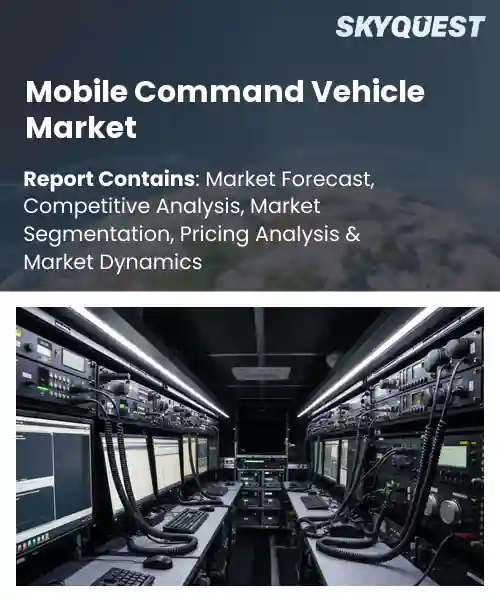
Mobile Command Vehicle Market
Report ID: SQMIG25C2276
Report ID: SQMIG25C2276
[email protected]
USA +1 351-333-4748
Report ID:
SQMIG25C2276 |
Region:
Global |
Published Date: July, 2026
Pages:
157
|Tables:
146
|Figures:
78


Global Mobile Command Vehicle Market size was valued at USD 612.4 Million in 2024 and is poised to grow from USD 650.37 Million in 2025 to USD 1052.34 Million by 2033, growing at a CAGR of 6.2% during the forecast period (2026-2033).
Among the forces shaping the global MCV market, integration of advanced telematics and autonomous navigation is the principal growth catalyst because it turns command units into hubs. When vehicles embed 5G routers, AI‑driven situational platforms and driver‑assist sensors, response teams receive video, hazard analytics and route optimisation without manual input, shortening decision cycles and expanding operational reach. The U.S. Army’s Joint Light Tactical Vehicle program now equips MCVs with autonomous convoy capability, reducing personnel exposure during logistics missions. This shift creates opportunities for software firms, satellite providers and defence contractors, and prompts municipalities to upgrade fleets to meet resilience standards.
How is AI and IoT integration enhancing operational efficiency in the mobile command vehicle market?
AI and IoT are turning mobile command vehicles into real‑time data hubs. Sensors collect video, environmental and biometric feeds while edge AI filters and prioritises information, reducing the bandwidth needed for central analysis. Integrated IoT platforms enable predictive maintenance by alerting crews to component wear before failures occur, keeping vehicles mission‑ready. Fleet managers can now coordinate multiple units through a shared digital twin, allowing rapid re‑routing and resource allocation during emergencies. The convergence of these technologies creates a seamless command loop where situational awareness, decision support and vehicle health are continuously optimised, driving higher operational efficiency across the sector.In March 2026 a leading defense contractor unveiled an AI‑enabled command vehicle that fused IoT sensor data with autonomous navigation, cutting response setup time and improving coordination for field operations.
Market snapshot - (2026-2033)
Global Market Size
USD 612.4 Million
Largest Segment
Vans
Fastest Growth
Trailers
Growth Rate
6.2% CAGR
To get more insights on this market click here to Request a Free Sample Report
Global mobile command vehicle market is segmented by vehicle type, application, communication system, end user, mobility and region. Based on vehicle type, the market is segmented into Vans, Trucks and Trailers. Based on application, the market is segmented into Emergency Response, Military & Defense, Law Enforcement, Disaster Management and Public Events. Based on communication system, the market is segmented into Satellite Communication, Radio Communication and Cellular Communication. Based on end user, the market is segmented into Government Agencies, Defense Organizations, Fire & Rescue Services and Police Departments. Based on mobility, the market is segmented into Off-Road and On-Road. Based on region, the market is segmented into North America, Europe, Asia Pacific, Latin America and Middle East & Africa.
Vans segment dominates because their compact footprint and modular interior allow rapid reconfiguration for diverse mission profiles, enabling quick deployment in congested urban environments while still accommodating essential command and control equipment. The ease of loading, lower vehicle weight, and existing fleet familiarity further reinforce their preferred status among agencies seeking cost effective, versatile platforms and support long term sustainability in fleet management, making them the backbone of command mobility solutions worldwide.
However, trucks segment is witnessing the strongest growth momentum as agencies prioritize higher payload capacity and rugged durability for extended field operations, prompting manufacturers to integrate advanced power systems and mission specific modules. This surge expands market opportunities by attracting users who require robust platforms capable of transporting extensive equipment and personnel across varied terrains.
Radio Communication segment leads because its proven reliability, low latency, and extensive legacy infrastructure enable instant voice and data exchange across dispersed units, essential for coordinated tactical operations. Agencies value the simplicity of deployment, interoperability with existing equipment, and resilience to network disruptions, making radio the cornerstone of command networks in both urban and field environments, providing a cost effective solution that supports continuous mission readiness and rapid scalability across multiple response tiers.
Meanwhile, satellite communication segment is emerging as the key high growth area as demand for beyond line of sight connectivity expands across remote and maritime operations, prompting integration of compact terminals and resilient broadband links. This innovation drives market expansion by enabling real time situational awareness, video streaming, and secure data transfer where terrestrial networks are unavailable.
To get detailed segments analysis, Request a Free Sample Report
North America retains dominance because it combines mature public‑safety infrastructure with extensive investment in emergency‑response technology. Government agencies and private contractors benefit from a strong ecosystem of vehicle manufacturers, communications firms, and defense partners that accelerate development of fully integrated command platforms. The region’s regulatory environment encourages rapid certification and deployment of advanced mobile units, while the presence of large training academies ensures skilled operators are readily available. Furthermore, a culture of inter‑agency collaboration and frequent large‑scale drills creates continual demand for versatile, resilient vehicles capable of supporting disaster relief, homeland security, and critical incident management. These factors collectively reinforce North America’s leading position in the global market.
Mobile Command Vehicle Market in United States is propelled by close ties between federal emergency agencies and leading automotive OEMs that tailor chassis for modular command suites. Robust research collaborations enable integration of real‑time data analytics, satellite communications, and autonomous navigation capabilities. Procurement processes emphasize interoperability across fire, law‑enforcement, and medical response units, fostering a versatile fleet that can be rapidly reconfigured for natural disasters, public events, and security incidents.
Mobile Command Vehicle Market in Canada leverages tradition of federal‑provincial emergency planning combined with innovative vehicle engineering. Partnerships with northern‑focused chassis producers allow adaptation to extreme climates and remote terrain, while integrated communication suites ensure seamless connectivity across vast jurisdictions. Emphasis on sustainable power solutions and modular interiors supports multi‑agency deployments ranging from wildfire suppression to Arctic search and rescue, reinforcing Canada capability to respond swiftly to diverse critical crises.
Europe’s rapid expansion is fueled by stringent public‑safety regulations, strong governmental investment in cross‑border emergency frameworks, and a mature automotive engineering base that excels in modular vehicle design. Collaborative programs among EU member states promote standardization of communication protocols, enabling seamless deployment of mobile command platforms across diverse jurisdictions. The region’s focus on environmental sustainability encourages incorporation of low‑emission powertrains and renewable energy sources within command units. Additionally, rising demand for coordinated response to large‑scale public events, climate‑induced incidents, and urban security challenges spurs continuous innovation. Together, these dynamics position Europe as a hotbed for advanced, interoperable mobile command solutions that can be rapidly scaled to meet complex operational requirements.
Mobile Command Vehicle Market in Germany benefits from the nation’s automotive sector and rigorous safety standards that drive precision engineering of command platforms. Cooperation between federal emergency services and chassis manufacturers yields customizable vehicles equipped with communication and sensor arrays. Emphasis on interoperability ensures compatibility with European response networks, while sustainability goals promote hybrid and electric power options. This ecosystem sustains Germany’s leadership in delivering reliable effective mobile command solutions.
Mobile Command Vehicle Market in United Kingdom accelerates through partnerships that fund prototyping of command suites. Emphasis on digital twins and AI situational awareness equips vehicles with predictive analytics for disaster mitigation. Harmonization of national and regional emergency protocols enables cross‑border deployment during events. Investment in propulsion aligns with the green agenda, while modular interiors allow reconfiguration for incidents, positioning United Kingdom as a fast‑growing hub for mobile command solutions.
Mobile Command Vehicle Market in France evolves through focus on design and energy integration within command platforms. Collaboration between civil protection agencies and automotive innovators drives deployable vehicles equipped with communications. Emphasis on compliance with EU safety directives ensures compatibility, while investment in electric powertrains supports climate objectives. This capability strengthens France ability to respond to emergencies and positions it as a growing contributor to the European mobile command ecosystem.
Asia Pacific is strengthening its position by leveraging rapid urbanization, heightened natural‑disaster exposure, and a burgeoning defense manufacturing sector. Nations invest heavily in versatile command platforms that combine advanced telematics, resilient power solutions, and terrain‑adaptive mobility to meet the demands of densely populated megacities and remote islands alike. Integration of cutting‑edge robotics and AI facilitates real‑time decision‑making during floods, earthquakes, and large‑scale public events. Collaborative research programs between governments and leading vehicle producers accelerate technology transfer and standardization across the region. A cultural emphasis on rapid response and self‑reliance further drives adoption of mobile command assets, positioning Asia Pacific as a dynamic hub for next‑generation emergency command capabilities.
Mobile Command Vehicle Market in Japan thrives on precision engineering and proactive disaster management policies. Cooperation between Self‑Defense Forces, municipal authorities, and automotive innovators yields compact high‑capacity command units optimized for earthquake and tsunami response. Emphasis on hybrid powertrains and fuel‑cell technology aligns with sustainability goals while ensuring uninterrupted operation. Integrated sensor fusion and satellite connectivity provide rapid situational awareness, reinforcing Japan’s reputation for resilient, technologically advanced mobile command solutions.
Mobile Command Vehicle Market in South Korea benefits from an electronics sector and emphasis on infrastructure. Partnerships between defense firms and agencies produce command vehicles with communication arrays and AI analytics for decision support. Focus on electric and hydrogen propulsion aligns with goals and ensures operation across terrain. Mapping and navigation improve response during floods, industrial accidents, and mass gatherings, positioning South Korea as an innovative regional mobile command player.
To know more about the market opportunities by region and country, click here to
Buy The Complete Report
Growing Demand For Mobile Command
Enhanced Interoperability With Public Networks
High Acquisition Cost And Maintenance
Regulatory Constraints On Frequency Use
Request Free Customization of this report to help us to meet your business objectives.
The market is shaped by a handful of OEMs and defense contractors racing to integrate autonomous navigation, 5G connectivity and modular power systems into mobile command platforms, with recent M&A activity such as a major defense firm acquiring a specialist autonomous‑vehicle supplier and partnerships linking vehicle manufacturers to satellite‑communication providers to accelerate field‑ready deployments.
Top Player’s Company Profile
Recent Developments
SkyQuest’s ABIRAW (Advanced Business Intelligence, Research & Analysis Wing) is our Business Information Services team that Collects, Collates, Correlates, and Analyses the Data collected by means of Primary Exploratory Research backed by robust Secondary Desk research. As per SkyQuest analysis the mobile command vehicle market is being propelled primarily by a growing demand for integrated, rapid‑deployment command units that improve emergency response and disaster management, while enhanced interoperability with civilian cellular and satellite networks serves as a second strong driver by lowering setup time and costs. High acquisition and ongoing maintenance expenses act as a major restraint, especially for smaller agencies. North America remains the dominating region thanks to its mature public‑safety infrastructure and strong OEM ecosystem. Within the market the van configuration dominates, offering compact footprint and modular interiors that deliver operational flexibility across urban and rural missions.
| Report Metric | Details |
|---|---|
| Market size value in 2024 | USD 612.4 Million |
| Market size value in 2033 | USD 1052.34 Million |
| Growth Rate | 6.2% |
| Base year | 2024 |
| Forecast period | (2026-2033) |
| Forecast Unit (Value) | USD Million |
| Segments covered |
|
| Regions covered | North America (US, Canada), Europe (Germany, France, United Kingdom, Italy, Spain, Rest of Europe), Asia Pacific (China, India, Japan, Rest of Asia-Pacific), Latin America (Brazil, Rest of Latin America), Middle East & Africa (South Africa, GCC Countries, Rest of MEA) |
| Companies covered |
|
| Customization scope | Free report customization with purchase. Customization includes:-
|
To get a free trial access to our platform which is a one stop solution for all your data requirements for quicker decision making. This platform allows you to compare markets, competitors who are prominent in the market, and mega trends that are influencing the dynamics in the market. Also, get access to detailed SkyQuest exclusive matrix.
Table Of Content
Executive Summary
Market overview
Parent Market Analysis
Market overview
Market size
KEY MARKET INSIGHTS
COVID IMPACT
MARKET DYNAMICS & OUTLOOK
Market Size by Region
KEY COMPANY PROFILES
Methodology
For the Mobile Command Vehicle Market, our research methodology involved a mixture of primary and secondary data sources. Key steps involved in the research process are listed below:
1. Information Procurement: This stage involved the procurement of Market data or related information via primary and secondary sources. The various secondary sources used included various company websites, annual reports, trade databases, and paid databases such as Hoover's, Bloomberg Business, Factiva, and Avention. Our team did 45 primary interactions Globally which included several stakeholders such as manufacturers, customers, key opinion leaders, etc. Overall, information procurement was one of the most extensive stages in our research process.
2. Information Analysis: This step involved triangulation of data through bottom-up and top-down approaches to estimate and validate the total size and future estimate of the Mobile Command Vehicle Market.
3. Report Formulation: The final step entailed the placement of data points in appropriate Market spaces in an attempt to deduce viable conclusions.
4. Validation & Publishing: Validation is the most important step in the process. Validation & re-validation via an intricately designed process helped us finalize data points to be used for final calculations. The final Market estimates and forecasts were then aligned and sent to our panel of industry experts for validation of data. Once the validation was done the report was sent to our Quality Assurance team to ensure adherence to style guides, consistency & design.
Analyst Support
Customization Options
With the given market data, our dedicated team of analysts can offer you the following customization options are available for the Mobile Command Vehicle Market:
Product Analysis: Product matrix, which offers a detailed comparison of the product portfolio of companies.
Regional Analysis: Further analysis of the Mobile Command Vehicle Market for additional countries.
Competitive Analysis: Detailed analysis and profiling of additional Market players & comparative analysis of competitive products.
Go to Market Strategy: Find the high-growth channels to invest your marketing efforts and increase your customer base.
Innovation Mapping: Identify racial solutions and innovation, connected to deep ecosystems of innovators, start-ups, academics, and strategic partners.
Category Intelligence: Customized intelligence that is relevant to their supply Markets will enable them to make smarter sourcing decisions and improve their category management.
Public Company Transcript Analysis: To improve the investment performance by generating new alpha and making better-informed decisions.
Social Media Listening: To analyze the conversations and trends happening not just around your brand, but around your industry as a whole, and use those insights to make better Marketing decisions.
REQUEST FOR SAMPLE
 REQUEST FREE CUSTOMIZATION


Want to customize this report? This report can be personalized according to your needs. Our analysts and industry experts will work directly with you to understand your requirements and provide you with customized data in a short amount of time. We offer $1000 worth of FREE customization at the time of purchase.
Feedback From Our Clients


 USA (+1) 351-333-4748

