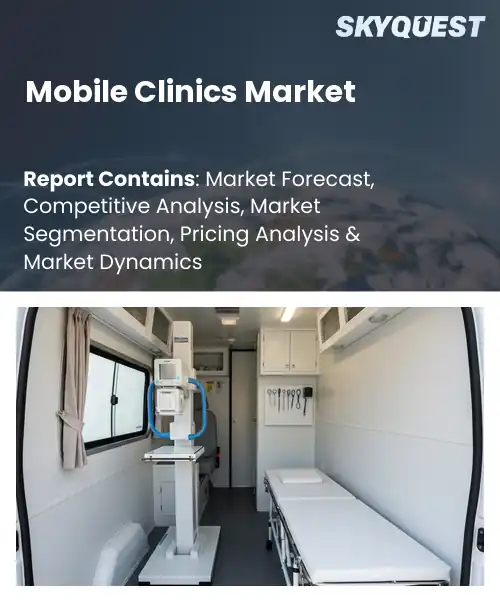
Mobile Clinics Market
Report ID: SQMIG35D2581
Report ID: SQMIG35D2581
[email protected]
USA +1 351-333-4748
Report ID:
SQMIG35D2581 |
Region:
Global |
Published Date: July, 2026
Pages:
157
|Tables:
179
|Figures:
79


Global Mobile Clinics Market size was valued at USD 4.8 Billion in 2024 and is poised to grow from USD 5.21 Billion in 2025 to USD 10.0 Billion by 2033, growing at a CAGR of 8.5% during the forecast period (2026-2033).
The mobile clinics market consists of vendors providing health services from vehicles to the underserved or remote populations. Its value is in being able to fill access gaps, cut travel costs, and deliver preventive care right into the communities where there are no permanent facilities. The sector started in the early 2000s with organisations in sub-Saharan Africa using vans for vaccination drives and scaled up in 2015 by government health departments in India and Brazil to support chronic disease management. The use of mobile units has accelerated over the past decade, driven by urban congestion, integration of telemedicine and demand from the pandemic, and today they represent a resilient and critical component of global health systems.
One of the key drivers for the global mobile clinics market is the convergence of health platforms with on-site diagnostics, which is helping to convert episodic visits into care ecosystems. Moving unit embedding testing and data transmission allows providers to triage patients, prescribe treatment and update records without referral delays, improving patient outcomes and reducing hospital readmissions. This has led to partnerships between telecom companies and health NGOs in Kenya to deliver HIV monitoring using solar vans as part of vaccination campaigns, generating income for operators. Insurers are seeing huge cost benefits, reimbursement models are expanding, creating opportunities for investments in both developed markets.
How is AI Improving Service Delivery Efficiency In The Mobile Clinics Market?
AI is transforming mobile clinics with automated patient intake, optimized route planning and real-time clinical decision support. Smart chatbots collect symptoms and medical history before the vehicle arrives, cutting down on paperwork and letting clinicians focus on care. Using demographic and health data to schedule visits when demand is highest reduces travel time and fuel use. Onboard diagnostic tools with machine learning analyze lab results in real time, allowing providers to prescribe treatment immediately.
These capabilities deliver a seamless workflow that reduces appointment cycles, increases penetration into underserved neighborhoods, and enhances overall utilization of resources. Mobile Health Map in March 2026, created an AI-driven dispatch platform that connects patients with the closest clinic within minutes, enabling appointments and increasing clinic efficiency while promoting market growth.
Market snapshot - (2026-2033)
Global Market Size
USD 4.8 Billion
Largest Segment
Medical Mobile Clinics
Fastest Growth
Specialty Care Mobile Clinics
Growth Rate
8.5% CAGR
To get more insights on this market click here to Request a Free Sample Report
Global mobile clinics market is segmented by clinic type, vehicle type, application, end user, service model, deployment area and region. Based on clinic type, the market is segmented into Medical Mobile Clinics, Dental Mobile Clinics, Diagnostic & Screening Mobile Clinics, Specialty Care Mobile Clinics and Others. Based on vehicle type, the market is segmented into Vans, Buses, Trucks & Trailers and Others. Based on application, the market is segmented into Primary Healthcare Services, Preventive Care & Screening, Dental Care, Maternal & Child Health Services, Chronic Disease Management and Others. Based on end user, the market is segmented into Hospitals & Healthcare Systems, Government & Public Health Agencies, Non-Governmental Organizations (NGOs), Military & Defense Organizations and Others. Based on service model, the market is segmented into Public Mobile Clinics, Private Mobile Clinics and Nonprofit Mobile Clinics. Based on deployment area, the market is segmented into Urban Areas, Rural Areas and Remote & Underserved Areas. Based on region, the market is segmented into North America, Europe, Asia Pacific, Latin America and Middle East & Africa.
Medical Mobile Clinics is the largest segment as they deliver full primary and acute care at the point of need, replicating the capabilities of fixed‑site facilities. The facilities’ flexibility allows the addition of examination rooms, pharmacy counters and some basic laboratory functions to meet broad patient expectations. Health systems want to help reduce the burden on emergency departments and insurance reimbursement models favor services that can be provided in a single, mobile setting, which makes them the market leader.
However, the Diagnostic & Screening Mobile Clinics are witnessing the best growth momentum as rapid developments in point-of-care testing are enabling high-volume health assessments on the go. The demand for early disease detection and population health initiatives is shaping adoption, driving manufacturers to incorporate sophisticated imaging and lab modules, in turn broadening the market reach of scalable screening solutions.
Vans segment holds a dominant share owing to their small footprint and maneuverability that helps providers to reach densely populated neighborhoods and narrow streets where larger units cannot operate. The built-in space provides efficient space for exam rooms, refrigeration and power systems with cost-effective acquisition and maintenance. Vans are preferred by health operators because they are quickly deployed, less expensive to operate, and easier to park than bulkier options and in other climates.
By contrast, buses are the key high-growth area, with their larger interior capacity enabling multi-disciplinary teams to provide comprehensive services in one visit. Their modular interior designs and advanced suspension systems are making them suitable for community health fairs, creating renewed interest and further market opportunity.
To get detailed segments analysis, Request a Free Sample Report
North America leads the global mobile clinics market owing to a combination of advanced healthcare infrastructure, robust public‑private partnerships, and a mature regulatory environment that fosters innovative delivery models. US and Canada health systems have adopted mobile units as a strategy to expand access to underserved urban and rural communities through the use of sophisticated telemedicine platforms and data analysis to improve patient outcomes. Solid funding mechanisms, such as government reimbursement and private insurance coverage, help to remove financial barriers for providers. Additionally, the acceptance of technology helps to incorporate electronic health records and remote monitoring, thus increasing the value proposition of mobile clinics. Together, these strengths make North America the gold standard for scalable, high-quality mobile healthcare solutions around the world. Such collective actions also contribute to scaling up mobile services across different health systems while ensuring consistent quality of care.
The United States Mobile Clinics Market is sustained by a complex network of federal grants, insurance reimbursement pathways, and a vibrant web of non-profit and for-profit operators. Integration with advanced telehealth platforms allows patient monitoring and data sharing across health systems. Collaboration with academic medical centers fuels research on service effectiveness, outreach programs customize services to demographic needs, and the United States is a leader in mobile health innovation.
Support from strong province health authorities, universal coverage models, and collaboration models combining mobile units with primary care networks are supporting the Canada Mobile Clinics Market. Local health programs in Indigenous and remote northern communities guide customized service delivery . Federal funding encourages the use of technology , including portable diagnostic equipment . Canada is a leader in mobile health solutions and, because of its focus on equitable access and cost-effectiveness, has the potential to scale across the country.
Europe’s mobile clinics market is expanding rapidly due to coordinated health policies, strong emphasis on preventive care, and collaborative cross‑border initiatives that prioritize universal access. Government incentives and EU‑funded programs encourage the deployment of mobile units in underserved rural areas and densely populated urban districts. Integration with digital health ecosystems, including interoperable electronic records and teleconsultation services, enhances diagnostic accuracy and patient continuity. Growing awareness of health disparities, particularly among aging populations and migrant communities, drives demand for flexible service models. Partnerships between public health agencies, academic institutions, and private technology firms foster innovation in portable diagnostic tools and sustainable vehicle designs, reinforcing Europe’s reputation for high‑quality, patient‑centred mobile healthcare solutions. These collective efforts also support the scaling of mobile services across diverse health systems, ensuring consistent quality of care.
Mobile Clinics Market in Germany is propelled by strong federal health initiatives that integrate mobile units into the national preventive care strategy. Collaboration with medical universities drives research on outcome effectiveness, while public‑private partnerships fund vehicle designs equipped with sources. Emphasis on data privacy ensures patient information exchange, and regional health authorities tailor services to urban hotspots and remote villages, reinforcing Germany’s position as a benchmark for mobile health delivery.
Mobile Clinics Market in the United Kingdom is as health authorities prioritize outreach to underserved populations and integrate mobile solutions within the national public health agenda. Pilots between regional hospitals and start‑ups test portable point‑of‑care devices and teleconsultation platforms. Funding from European health funds and French agencies encourages adoption of vehicle fleets. Emphasis on competence ensures services are tailored to community needs, strengthening France’s role in the evolving European mobile health landscape.
Mobile Clinics Market in France is as health authorities prioritize outreach to underserved populations and integrate mobile solutions within the national public health agenda. Pilots between regional hospitals and start‑ups test portable point‑of‑care devices and teleconsultation platforms. Funding from European health funds and French agencies encourages adoption of vehicle fleets. Emphasis on competence ensures services are tailored to community needs, strengthening France’s role in the evolving European mobile health landscape.
Asia Pacific is strengthening its position in the mobile clinics market by leveraging rapid urbanization, expansive public health initiatives, and a growing appetite for technology‑enabled care delivery. Governments across the region are allocating resources to deploy mobile units that address gaps in primary care, maternal health, and infectious disease surveillance, particularly in remote islands and densely populated megacities. Integration with mobile broadband and AI‑driven diagnostic tools enhances service efficiency and patient engagement. The region’s dynamic start‑up ecosystem fuels innovation in portable medical equipment and sustainable vehicle platforms, while cross‑border collaborations facilitate knowledge sharing and regulatory harmonization. These combined efforts elevate Asia Pacific as a critical driver of next‑generation mobile health solutions on the global stage. Increasing public awareness of mobile health benefits further encourages community participation and acceptance of these services.
Mobile Clinics Market in Japan is shaped by an emphasis on preventive health and an aging demographic that demands accessible care. Government health programs fund mobile units equipped with diagnostics and telemedicine links to hospital networks. Partnerships with robotics and sensor technology firms yield devices, while a focus on disaster resilience ensures rapid deployment after natural events. These initiatives position Japan as a leading model for high‑technology mobile health services.
Mobile Clinics Market in South Korea benefits from government support for transformation and a culture that embraces technology adoption. Insurance schemes provide reimbursement pathways for mobile services, encouraging providers to extend care to mountain regions and urban districts. Partnerships with leading electronics manufacturers deliver telehealth consoles and imaging devices. The focus on efficiency and patient convenience drives widespread acceptance, establishing South Korea as a significant hub for mobile health innovation.
To know more about the market opportunities by region and country, click here to
Buy The Complete Report
Increasing Access To Remote Care
Advancements In Telehealth Integration
High Initial Capital Investment
Regulatory Compliance Challenges
Request Free Customization of this report to help us to meet your business objectives.
The mobile clinics market is shaped by intense competition as providers race to secure funding, forge strategic partnerships, and integrate advanced telehealth platforms. Recent M&A activity includes larger health systems acquiring niche mobile‑clinic operators to broaden geographic reach, while collaborations with technology firms accelerate the deployment of AI‑driven diagnostics on the road. Companies such as Enzo Health and Trase have leveraged sizable capital raises to expand service fleets and introduce real‑time patient data integration, intensifying pressure on incumbents to innovate and scale quickly.
Top Player’s Company Profile
SkyQuest’s ABIRAW (Advanced Business Intelligence, Research & Analysis Wing) is our Business Information Services team that Collects, Collates, Correlates, and Analyses the Data collected by means of Primary Exploratory Research backed by robust Secondary Desk research.
As per SkyQuest analysis the global mobile clinics market is propelled primarily by the drive to increase access to remote care which encourages governments and NGOs to fund vehicle‑based health services while the rapid integration of telehealth stands as a second catalyst that expands diagnostic and specialist reach on the road. High initial capital investment emerges as the main restraint limiting entry for smaller operators. North America leads the market benefiting from advanced infrastructure, reimbursement pathways and strong public‑private partnerships. Within the segment mix, medical mobile clinics dominate because they deliver comprehensive primary and acute care comparable to fixed facilities, reinforcing the region’s growth trajectory.
| Report Metric | Details |
|---|---|
| Market size value in 2024 | USD 4.8 Billion |
| Market size value in 2033 | USD 10.0 Billion |
| Growth Rate | 8.5% |
| Base year | 2024 |
| Forecast period | (2026-2033) |
| Forecast Unit (Value) | USD Billion |
| Segments covered |
|
| Regions covered | North America (US, Canada), Europe (Germany, France, United Kingdom, Italy, Spain, Rest of Europe), Asia Pacific (China, India, Japan, Rest of Asia-Pacific), Latin America (Brazil, Rest of Latin America), Middle East & Africa (South Africa, GCC Countries, Rest of MEA) |
| Companies covered |
|
| Customization scope | Free report customization with purchase. Customization includes:-
|
To get a free trial access to our platform which is a one stop solution for all your data requirements for quicker decision making. This platform allows you to compare markets, competitors who are prominent in the market, and mega trends that are influencing the dynamics in the market. Also, get access to detailed SkyQuest exclusive matrix.
Table Of Content
Executive Summary
Market overview
Parent Market Analysis
Market overview
Market size
KEY MARKET INSIGHTS
COVID IMPACT
MARKET DYNAMICS & OUTLOOK
Market Size by Region
KEY COMPANY PROFILES
Methodology
For the Mobile Clinics Market, our research methodology involved a mixture of primary and secondary data sources. Key steps involved in the research process are listed below:
1. Information Procurement: This stage involved the procurement of Market data or related information via primary and secondary sources. The various secondary sources used included various company websites, annual reports, trade databases, and paid databases such as Hoover's, Bloomberg Business, Factiva, and Avention. Our team did 45 primary interactions Globally which included several stakeholders such as manufacturers, customers, key opinion leaders, etc. Overall, information procurement was one of the most extensive stages in our research process.
2. Information Analysis: This step involved triangulation of data through bottom-up and top-down approaches to estimate and validate the total size and future estimate of the Mobile Clinics Market.
3. Report Formulation: The final step entailed the placement of data points in appropriate Market spaces in an attempt to deduce viable conclusions.
4. Validation & Publishing: Validation is the most important step in the process. Validation & re-validation via an intricately designed process helped us finalize data points to be used for final calculations. The final Market estimates and forecasts were then aligned and sent to our panel of industry experts for validation of data. Once the validation was done the report was sent to our Quality Assurance team to ensure adherence to style guides, consistency & design.
Analyst Support
Customization Options
With the given market data, our dedicated team of analysts can offer you the following customization options are available for the Mobile Clinics Market:
Product Analysis: Product matrix, which offers a detailed comparison of the product portfolio of companies.
Regional Analysis: Further analysis of the Mobile Clinics Market for additional countries.
Competitive Analysis: Detailed analysis and profiling of additional Market players & comparative analysis of competitive products.
Go to Market Strategy: Find the high-growth channels to invest your marketing efforts and increase your customer base.
Innovation Mapping: Identify racial solutions and innovation, connected to deep ecosystems of innovators, start-ups, academics, and strategic partners.
Category Intelligence: Customized intelligence that is relevant to their supply Markets will enable them to make smarter sourcing decisions and improve their category management.
Public Company Transcript Analysis: To improve the investment performance by generating new alpha and making better-informed decisions.
Social Media Listening: To analyze the conversations and trends happening not just around your brand, but around your industry as a whole, and use those insights to make better Marketing decisions.
REQUEST FOR SAMPLE
 REQUEST FREE CUSTOMIZATION
Global Mobile Clinics Market size was valued at USD 4.8 Billion in 2024 and is poised to grow from USD 5.21 Billion in 2025 to USD 10.0 Billion by 2033, growing at a CAGR of 8.5% during the forecast period (2026-2033).
The mobile clinics market is shaped by intense competition as providers race to secure funding, forge strategic partnerships, and integrate advanced telehealth platforms. Recent M&A activity includes larger health systems acquiring niche mobile‑clinic operators to broaden geographic reach, while collaborations with technology firms accelerate the deployment of AI‑driven diagnostics on the road. Companies such as Enzo Health and Trase have leveraged sizable capital raises to expand service fleets and introduce real‑time patient data integration, intensifying pressure on incumbents to innovate and scale quickly. 'Winnebago Specialty Vehicles', 'Rosenbauer America LLC', 'Odulair LLC', 'LifeLine Mobile, Inc.', 'Mobile Healthcare Facilities LLC', 'Matthews Specialty Vehicles, Inc.', 'Farber Specialty Vehicles', 'AVAN Mobility Group Inc.', 'EMS Mobil Sistemler A.Ş.', 'LDV Specialty Vehicles, Inc.', 'La Boit Specialty Vehicles, Inc.', 'CGS Premier, Inc.', 'Medical Coaches, Inc.', 'MOHC Mobile Outreach Health Clinics', 'A&M Cold Storage Trailers Ltd.', 'Hiji Mobile Medical', 'OMC Mobile Medical Vehicles', 'Vehicle Technology Ltd.', 'SVI Trucks', 'WE Care Mobile Clinics'
The growing demand for healthcare services in underserved regions drives the adoption of mobile clinics, as they can swiftly reach populations lacking permanent facilities. By delivering preventive, diagnostic, and treatment services directly to communities, mobile units reduce travel barriers and improve health outcomes. This capability encourages governments and NGOs to prioritize mobile clinic deployments, reinforcing investment in vehicle customization, telemedicine integration, and staff training, thereby expanding market demand and fostering sustained growth across diverse geographies through collaborative partnerships and policy support.
Telehealth Integration Expansion: The convergence of mobile clinics with telehealth platforms is accelerating, enabling real‑time remote consultations, diagnostics, and patient monitoring. Providers leverage high‑speed connectivity to extend specialist reach into underserved regions, reducing referral delays and improving continuity of care. This synergy also supports data sharing across electronic health records, fostering coordinated treatment plans. As health systems prioritize digital health solutions, mobile clinics become pivotal nodes, delivering hybrid services that blend in‑person care with virtual expertise, enhancing overall health system resilience for patients.
Why does North America Dominate the Global Mobile Clinics Market? |@12


Want to customize this report? This report can be personalized according to your needs. Our analysts and industry experts will work directly with you to understand your requirements and provide you with customized data in a short amount of time. We offer $1000 worth of FREE customization at the time of purchase.
Feedback From Our Clients


 USA (+1) 351-333-4748

