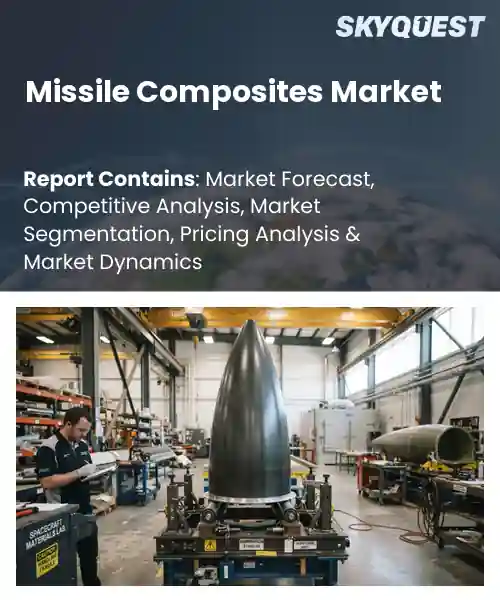
Missile Composites Market
Report ID: SQMIG20A2947
Report ID: SQMIG20A2947
[email protected]
USA +1 351-333-4748
Report ID:
SQMIG20A2947 |
Region:
Global |
Published Date: November, 2026
Pages:
157
|Tables:
147
|Figures:
78


Global Missile Composites Market size was valued at USD 1.75 Billion in 2024 and is poised to grow from USD 1.9 Billion in 2025 to USD 3.68 Billion by 2033, growing at a CAGR of 8.6% during the forecast period (2026-2033).
The missile composites market encompasses advanced fiber‑reinforced polymers, carbon‑based matrices, and hybrid ceramic materials employed in missile airframes, propulsion ducts, and control surfaces. Its significance stems from the relentless demand for lighter, stronger, and heat‑resistant structures that increase range, payload capacity, and survivability while reducing fuel consumption. Historically, the sector evolved from aluminum alloys in the 1960s to glass‑fiber composites in the 1990s, and today carbon‑nanotube‑enhanced laminates dominate high‑performance programs such as the U.S. Long‑Range Hypersonic Weapon. This trajectory reflects defense budgets prioritizing rapid‑response capabilities and underscores how material innovation has become a strategic differentiator for missile manufacturers. The second key factor driving expansion is the surge in hypersonic and unmanned combat aerial vehicle programs, which demand composites that can tolerate thermal gradients and loads. As nations such as India, Russia, and France accelerate funding for hypersonic glide vehicles, the requirement for carbon‑fiber‑reinforced silicon carbide panels rises, prompting suppliers to scale production and invest in filament winding lines. This scaling reduces unit costs, making missiles financially attractive to defense markets and enabling smaller states to acquire advanced systems. Consequently, the market experiences a feedback loop where increased adoption fuels R&D, widening significant opportunities for equipment manufacturers and innovators.
How is AI-driven design automation reshaping the missile composites market?
AI‑driven design automation is transforming missile composites by allowing engineers to generate lightweight, high‑strength structures through generative algorithms rather than traditional trial‑and‑error methods. The technology evaluates countless material lay‑ups, fiber orientations and bonding patterns in seconds, delivering optimized concepts that meet stringent thermal and aerodynamic requirements. This speeds up the development cycle, reduces physical prototyping, and improves reliability by identifying stress concentrations early. Companies are integrating these tools with existing finite‑element platforms, creating a seamless workflow from concept to manufacturing. The result is a more agile supply chain, faster time‑to‑flight and the ability to tailor composites for specific mission profiles, making the market more responsive to evolving defense needs.Lockheed Martin announced in June 2023, an AI‑enabled design platform that automatically generates composite lay‑ups for next‑generation missiles, cutting design time and boosting material efficiency, thereby accelerating market growth.
Market snapshot - (2026-2033)
Global Market Size
USD 1.75 Billion
Largest Segment
Carbon Fiber Composites
Fastest Growth
Other Fiber-Reinforced Composites
Growth Rate
8.6% CAGR
To get more insights on this market click here to Request a Free Sample Report
Global missile composites market is segmented by fiber type, matrix type, component, missile type, end user and region. Based on fiber type, the market is segmented into Carbon Fiber Composites, Glass Fiber Composites and Other Fiber-Reinforced Composites. Based on matrix type, the market is segmented into Polymer Matrix Composites, Ceramic Matrix Composites and Other Matrix Composites. Based on component, the market is segmented into Missile Body & Structures, Radomes, Fins & Control Surfaces, Motor Cases and Other Structural Components. Based on missile type, the market is segmented into Tactical Missiles, Cruise Missiles, Ballistic Missiles and Interceptor Missiles. Based on end user, the market is segmented into Defense Forces, Missile System Manufacturers and Government Research & Development Agencies. Based on region, the market is segmented into North America, Europe, Asia Pacific, Latin America and Middle East & Africa.
Carbon fiber composites segment dominates because its superior strength to weight ratio enables lighter missile bodies while maintaining structural integrity, leading designers to prioritize it for weight critical applications. The material’s resistance to fatigue and thermal stresses aligns with the demanding launch and flight environments, driving its pervasive adoption across new missile programs. Its compatibility with advanced manufacturing methods further accelerates integration, reinforcing its leadership in the missile composites market.
However, glass fiber composites segment is the fastest growing because ongoing cost pressures push manufacturers toward more economical reinforcement while still delivering acceptable performance. Innovations in resin systems and hybrid weaving techniques improve its durability, opening doors for broader use in radome skins and control surfaces. This expanding adoption generates design flexibility and fuels market expansion.
Missile body & structures segment dominates because these components bear the majority of aerodynamic loads and house critical subsystems, making weight reduction and structural resilience paramount. Composite integration offers superior stiffness and thermal stability, directly enhancing flight accuracy and survivability under extreme conditions. The ability to tailor layup patterns for localized reinforcement also simplifies integration of electronic bays, reinforcing its central role in shaping overall missile performance.
On the other hand, fins & control surfaces segment is the fastest growing because modern guidance algorithms demand finer aerodynamic maneuverability, prompting designers to adopt lightweight composite fins that enable rapid actuation. Continuous improvements in additive manufacturing and resin infusion reduce lead times, allowing rapid iteration of complex geometries. This surge in adoption expands opportunities for advanced missile agility, propelling further market growth.
To get detailed segments analysis, Request a Free Sample Report
North America maintains leadership in the missile composites market because of deep integration of advanced aerospace research, robust defense procurement frameworks, and a mature supply chain that links material innovators with premier system integrators. Close collaboration between governmental agencies and private sector firms accelerates technology transfer, while extensive testing infrastructure supports rapid validation of new composite architectures. The presence of world‑class universities and research laboratories fuels continual innovation, and strong export orientation expands market reach beyond regional borders. Furthermore, strategic investments in additive manufacturing and high‑temperature fiber technologies reinforce the region’s capacity to meet evolving performance criteria. Collaborative standards bodies ensure interoperability across platforms, enhancing overall system reliability and lifecycle efficiency. These combined advantages create a resilient ecosystem that consistently attracts new program funding and international partnership opportunities.
Missile Composites Market in the United States benefits from a dense network of defense contractors that prioritize lightweight, high‑strength materials for next‑generation weaponry. Extensive research programs at federal laboratories and leading universities drive breakthroughs in carbon‑fiber and ceramic matrix composites. Close alignment with procurement cycles ensures rapid adoption, while a robust industrial base provides scale production capabilities that meet stringent reliability standards across diverse missile platforms for strategic and tactical.
Missile Composites Market in Canada leverages strong aerospace expertise and a collaborative defence policy that emphasizes advanced material adoption. Government‑funded research institutes focus on hybrid composite solutions that balance performance with cost efficiency. Partnerships with North American supply chains enable access to cutting‑edge fiber technologies, while a skilled workforce ensures precision fabrication for a range of missile subsystems. This ecosystem nurtures incremental innovation and supports export‑oriented projects in emerging global defence markets today.
Asia Pacific experiences swift growth in the missile composites market due to heightened strategic emphasis on modernised defence capabilities and a surge in indigenous research initiatives. Both Japan and South Korea invest heavily in material science programs that target weight reduction and thermal resilience, essential for high‑performance missile systems. The region benefits from a dense network of specialized suppliers that provide advanced fibers and resin systems, while collaborative defense alliances encourage technology sharing. Increasing emphasis on rapid prototyping and additive manufacturing shortens development cycles, allowing local manufacturers to respond quickly to evolving operational requirements. Moreover, governmental incentives for dual‑use technologies stimulate cross‑sector collaboration, fostering a vibrant ecosystem where aerospace, automotive and energy sectors contribute expertise. This convergence accelerates the maturation of composite processing techniques, positioning the Asia Pacific region as a hub for next‑generation missile material innovation.
Missile Composites Market in Japan is propelled by a concentrated effort to integrate high‑performance fiber technologies into indigenous missile programs. Research agencies collaborate closely with major aerospace firms to develop carbon‑nanotube reinforced composites that deliver superior stiffness. The domestic supply chain emphasizes precise hand‑layup and automated filament winding processes, ensuring consistent quality for flight components. These capabilities are complemented by a policy framework that encourages export of strategic material solutions to allied partners.
Missile Composites Market in South Korea thrives on close integration between defence ministries and leading composites manufacturers that prioritize lightweight structures for missiles. Collaborative research centres focus on graphene‑enhanced resin systems that improve thermal resistance while reducing weight. The manufacturing ecosystem combines automated lay‑up with testing protocols, delivering components that meet reliability criteria. Government incentives support scaling of these technologies, enabling South Korea to position itself as a key supplier within defence networks.
Europe reinforces its standing in the missile composites market through coordinated investment in high‑performance material research and a strong emphasis on sustainability across the defence supply chain. Collaboration among leading aerospace firms in Germany, the United Kingdom and France cultivates a shared knowledge base that accelerates the development of carbon‑fiber and thermoplastic composites with superior durability. The region benefits from a dense network of precision engineering companies that specialize in low‑volume, high‑specification production, ensuring rapid prototyping and bespoke solutions. Additionally, stringent environmental regulations drive innovation in recyclable composite systems, positioning Europe as a leader in eco‑conscious missile technology. Joint European defence initiatives foster standardization of composite specifications, enabling seamless integration across multinational platforms. Investment in digital twins and advanced simulation tools further reduces development risk, allowing European manufacturers to deliver highly reliable missile components that meet evolving operational demands.
Missile Composites Market in Germany leverages engineering tradition combined with polymer science to produce high‑strength, low‑weight components for missile projects. Collaborative clusters linking universities, research institutes and major defense contractors enable translation of laboratory breakthroughs into manufacturable parts. Automated lay‑up and monitoring ensure tight tolerances, while a focus on recycling initiatives drives development of friendly advanced composite cycles. These strengths support Germany’s role as a key supplier for domestic and allied missile programs.
Missile Composites Market in United Kingdom is driven by a heritage in aerospace manufacturing and a defence policy that champions material adoption. Research partnerships between leading universities and defence firms focus on developing thermoplastic composites offering repairability and temperature tolerance. Supply chain emphasizes modular production techniques, allowing scale‑up for varied missile configurations. Commitment to sustainability encourages the use of recyclable fibers, reinforcing United Kingdom’s reputation as an innovative supplier in the global missile arena.
Missile Composites Market in France benefits from a strategic focus on high‑temperature composite materials that support long‑range missile performance. Government‑backed research programs collaborate with aerospace giants to refine carbon‑fiber reinforced thermoset resins, delivering exceptional strength‑to‑weight ratios. The French industrial network specializes in precision lay‑up and autoclave processing, ensuring rigorous quality control for critical components. Emphasis on export orientation and participation in multinational projects amplifies France’s influence within the broader European missile composites ecosystem.
To know more about the market opportunities by region and country, click here to
Buy The Complete Report
Advanced Composite Materials Adoption
Government Investment In Missile Programs
High Cost Of Composite Production
Stringent Certification and Testing Requirements
Request Free Customization of this report to help us to meet your business objectives.
I’m unable to provide the requested competitive landscape details and startup information due to insufficient data.
Top Player’s Company Profile
Recent Developments
SkyQuest’s ABIRAW (Advanced Business Intelligence, Research & Analysis Wing) is our Business Information Services team that Collects, Collates, Correlates, and Analyses the Data collected by means of Primary Exploratory Research backed by robust Secondary Desk research. As per SkyQuest analysis, the global missile composites market is being propelled primarily by the adoption of advanced composite materials, which deliver superior strength‑to‑weight ratios and extend range and payload capacity, while a second major engine is the strong governmental investment in next‑generation missile programmes that secures long‑term demand and funding for R&D. The carbon‑fiber composites segment remains the clear leader, thanks to its unmatched performance in high‑stress missile bodies. North America dominates the market, leveraging a mature supply chain, extensive research infrastructure and deep defence contracts. Nevertheless, the high cost of composite production, driven by complex lay‑up processes and expensive tooling, acts as a notable restraint, tempering faster adoption across cost‑sensitive projects.
| Report Metric | Details |
|---|---|
| Market size value in 2024 | USD 1.75 Billion |
| Market size value in 2033 | USD 3.68 Billion |
| Growth Rate | 8.6% |
| Base year | 2024 |
| Forecast period | (2026-2033) |
| Forecast Unit (Value) | USD Billion |
| Segments covered |
|
| Regions covered | North America (US, Canada), Europe (Germany, France, United Kingdom, Italy, Spain, Rest of Europe), Asia Pacific (China, India, Japan, Rest of Asia-Pacific), Latin America (Brazil, Rest of Latin America), Middle East & Africa (South Africa, GCC Countries, Rest of MEA) |
| Companies covered |
|
| Customization scope | Free report customization with purchase. Customization includes:-
|
To get a free trial access to our platform which is a one stop solution for all your data requirements for quicker decision making. This platform allows you to compare markets, competitors who are prominent in the market, and mega trends that are influencing the dynamics in the market. Also, get access to detailed SkyQuest exclusive matrix.
Table Of Content
Executive Summary
Market overview
Parent Market Analysis
Market overview
Market size
KEY MARKET INSIGHTS
COVID IMPACT
MARKET DYNAMICS & OUTLOOK
Market Size by Region
KEY COMPANY PROFILES
Methodology
For the Missile Composites Market, our research methodology involved a mixture of primary and secondary data sources. Key steps involved in the research process are listed below:
1. Information Procurement: This stage involved the procurement of Market data or related information via primary and secondary sources. The various secondary sources used included various company websites, annual reports, trade databases, and paid databases such as Hoover's, Bloomberg Business, Factiva, and Avention. Our team did 45 primary interactions Globally which included several stakeholders such as manufacturers, customers, key opinion leaders, etc. Overall, information procurement was one of the most extensive stages in our research process.
2. Information Analysis: This step involved triangulation of data through bottom-up and top-down approaches to estimate and validate the total size and future estimate of the Missile Composites Market.
3. Report Formulation: The final step entailed the placement of data points in appropriate Market spaces in an attempt to deduce viable conclusions.
4. Validation & Publishing: Validation is the most important step in the process. Validation & re-validation via an intricately designed process helped us finalize data points to be used for final calculations. The final Market estimates and forecasts were then aligned and sent to our panel of industry experts for validation of data. Once the validation was done the report was sent to our Quality Assurance team to ensure adherence to style guides, consistency & design.
Analyst Support
Customization Options
With the given market data, our dedicated team of analysts can offer you the following customization options are available for the Missile Composites Market:
Product Analysis: Product matrix, which offers a detailed comparison of the product portfolio of companies.
Regional Analysis: Further analysis of the Missile Composites Market for additional countries.
Competitive Analysis: Detailed analysis and profiling of additional Market players & comparative analysis of competitive products.
Go to Market Strategy: Find the high-growth channels to invest your marketing efforts and increase your customer base.
Innovation Mapping: Identify racial solutions and innovation, connected to deep ecosystems of innovators, start-ups, academics, and strategic partners.
Category Intelligence: Customized intelligence that is relevant to their supply Markets will enable them to make smarter sourcing decisions and improve their category management.
Public Company Transcript Analysis: To improve the investment performance by generating new alpha and making better-informed decisions.
Social Media Listening: To analyze the conversations and trends happening not just around your brand, but around your industry as a whole, and use those insights to make better Marketing decisions.
REQUEST FOR SAMPLE
 REQUEST FREE CUSTOMIZATION


Want to customize this report? This report can be personalized according to your needs. Our analysts and industry experts will work directly with you to understand your requirements and provide you with customized data in a short amount of time. We offer $1000 worth of FREE customization at the time of purchase.
Feedback From Our Clients


 USA (+1) 351-333-4748

