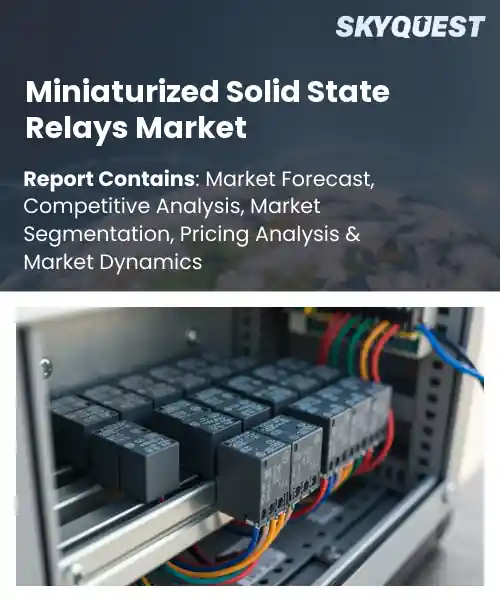
Miniaturized Solid State Relays Market
Report ID: SQMIG45J2412
Report ID: SQMIG45J2412
[email protected]
USA +1 351-333-4748
Report ID:
SQMIG45J2412 |
Region:
Global |
Published Date: February, 2026
Pages:
157
|Tables:
148
|Figures:
78


Global Miniaturized Solid State Relays Market size was valued at USD 6.5 Billion in 2024 and is poised to grow from USD 7.55 Billion in 2025 to USD 24.91 Billion by 2033, growing at a CAGR of 16.1% during the forecast period (2026-2033).
As a result of growing consumer and industrial demand for smaller size and energy efficient electronic devices, a new segment within the supply chain has opened up for miniaturised solid-state relays using semiconductor technology as a replacement for large bulky mechanical relays in both consumer and industrial applications. With advances in miniaturising solid-state relays, they are able to be used in a much wider range of applications due to their improved performance characteristics including longer life, faster and quieter switching times, and reduced electromagnetic interference (EMI). Historically, the integration of solid-state relays into the marketplace has followed the trends of Moore's Law in terms of component miniaturisation.
Building on the push for miniaturization described above, thermal management and power density are the principal constraints driving innovation and market growth. As devices shrink, heat concentration increases, which forces manufacturers to invest in advanced substrates, heat-sinking techniques and SiC components; these investments reduce failure rates and enable deployment in compact inverters for electric vehicles and densely packed server racks. Consequently, OEMs prioritize relays with lower on-resistance and improved thermal cycling, creating opportunities for suppliers to offer integrated modules and design services. Real-world use in EV battery management and 5G remote radio units shows how thermal solutions convert into revenue.
IoT is increasing demand for miniaturized solid state relays because more intelligence is moving to edge nodes and compact controllers. Key aspects are small footprint, silent wear free switching, low leakage and solid isolation for crowded PCBs in industrial settings. The current state shows designers replacing bulky electromechanical relays with compact SSRs to improve reliability and enable remote control. Market context favors space saving parts in motor controllers, battery management systems and smart factory IOT gateways. Practical instances include embedded relay modules in PLCs and modular motor drives where miniaturized SSRs simplify wiring and support predictive maintenance.
Vishay Intertechnology in October 2024 introduced a space saving SOP4 solid state relay with automotive grade qualification. That compact fast switching device enables isolated switching on smaller control boards and supports IoT enabled motor controls and battery systems, improving reliability and board level efficiency in industrial automation.
Market snapshot - 2026-2033
Global Market Size
USD 6.5 Billion
Largest Segment
AC Output SSR
Fastest Growth
DC Output SSR
Growth Rate
16.1% CAGR
To get more insights on this market click here to Request a Free Sample Report
Global miniaturized solid state relays market is segmented by type, voltage range, mounting type, application area, end user sector and region. Based on type, the market is segmented into AC Output SSR and DC Output SSR. Based on voltage range, the market is segmented into low voltage and high voltage. Based on mounting type, the market is segmented into PCB mounted, surface mounted and others. Based on application area, the market is segmented into motor control, switching power supplies, temperature control systems, lighting control and others. Based on end user sector, the market is segmented into industrial automation, automotive, consumer electronics, telecommunications, energy & power, medical & healthcare and others. Based on region, the market is segmented into North America, Europe, Asia Pacific, Latin America and Middle East & Africa.
Based on the global miniaturized solid state relays market forecast, AC output SSR segment dominates because its inherent compatibility with alternating current infrastructure and ability to handle mains switching make it foundational for miniaturized relay applications. The main reasons why designers prefer using AC output devices are because they provide reliable zero-cross switching, produce less EMI (Electromagnetic Interference), and are easier to interface with typical loads (such as motors or lighting). By taking advantage of these features, designers can reduce the amount of circuitry required for their product designs, thereby allowing for faster integration of these devices into small, highly reliable systems.
However, DC Output SSR is emerging as the most rapidly expanding area due to rising adoption of DC power architectures and battery systems. Advances in low-on-resistance switching and thermal handling plus demand from compact power conversion and electric vehicle subsystems are driving integration and creating new miniaturized relay opportunities.
Surface Mounted segment dominates because its compatibility with high-density printed circuit boards and automated assembly processes enables ultra-compact relay implementations for space-constrained electronics. Because of the reduction of lead inductance (which enhances signal integrity), the increased signal integrity, as well as the more direct thermal paths for surface mounted packaged devices, manufacturers are emphasizing their use. All three of these factors also assist with easier integration of surface-mounted packaged devices into modular products. Therefore, surface-mount devices have become the most efficient choice for implementing miniaturized solid-state relays in compact consumer and industrial products.
Meanwhile, PCB Mounted is witnessing the strongest growth momentum as demand rises for board-level robustness and serviceability in modular systems. PCB mounted formats are selected by designers to ensure reliable current pathways & make it easier to replace parts, allowing for discrete power modules and custom connectors. This trend is causing an increase in usage of these formats within both industrial and custom electronic products, while also creating design possibilities for new products.
To get detailed segments analysis, Request a Free Sample Report
As per the global miniaturized solid state relays market analysis, Asia Pacific leads the industry due to a combination of concentrated electronics manufacturing, strong component supply chains, and deep integration with downstream industries. By working closely with suppliers and original equipment manufacturers on product refinement and customization for their local needs, the regional OEMs can bring their shares of the market through miniaturized modules to fruition more quickly than ever before. Access to a high-density of advanced semiconductor fabrication and a large number of contract manufacturers enables the regions' OEMs to get their products to market more quickly. Furthermore, the region's testing and certification support infrastructure and its competitive supplier base support iterative innovation and cost reduction opportunities for compact solid-state switching devices, making the region a major center of both volume production and advanced application development.
Miniaturized Solid State Relays Market in Japan benefits from a reputation for precision engineering and rigorous quality standards, with manufacturers emphasizing miniaturization for automotive electronics and industrial control modules. Furthermore, close working relationships developed between component manufacturers and integrators enables them to develop customized design solutions and enables to utilize stringent certifications, contributing to Japan's ability to provide high reliability relay solutions to many of its customers requiring demanding applications.
Miniaturized Solid State Relays Market in South Korea draws strength from advanced electronics manufacturing and a focus on high performance, energy efficient modules for telecommunications and industrial automation. The relationships among component suppliers and consumer electronics brands allow Component suppliers and brands to rapidly iterate designs and increase production quantities together. Much of the current government and private technology research encourages the integration of semiconductors, compact power switches, and locally optimized products designed to meet strict guidelines for heat dissipation and reliability within small form factors.
North America is experiencing rapid expansion in the miniaturized solid state relays market driven by a strong emphasis on system level integration, demand for reliable low profile components in industrial automation, and ongoing modernization across power distribution and control systems. A fast-moving ecosystem of OEM's, engineering services and specialized component suppliers develops custom products and conducts approved qualification cycles. With a pull from telecommunications, medical device manufacturing and advanced manufacturing, custom relay designs are becoming increasingly compact with lower thermal profiles. Collaboration on R&D and modular architectures allow for the rapid integration of multiple systems and designs into one complete solution. Market-driven compliance and safety requirements direct investment towards solidly built miniaturized solutions that work in challenging environments. Proximity to semiconductor design and advanced packaging centers allows for prototyping and scaling. The customer lifecycle for support and reliability drives product roadmaps and suppliers provide variant portfolios that qualify for fast-tracking across a variety of end users.
Miniaturized Solid State Relays Market in United States benefits from a broad base of system integrators and design houses that demand compact, high reliability switching solutions for sectors such as industrial automation, medical equipment, and aerospace. A strong emphasis on testing, certification and lifecycle support leads suppliers to create customized modules. Good engineering services along with access to advanced packaging capabilities also help expedite the process of prototyping and adapting for specific applications, which can continue to improve on the product's maturity and reliability.
Miniaturized Solid State Relays Market in Canada is influenced by a focus on reliable power management and adaptation to harsh operating conditions across energy and industrial sectors. The promotion of certification procedures and after sales support have prompted many suppliers to concentrate on producing durable products. These new, small and durable relay modules will facilitate the use of reliable and compact switches in critical infrastructure and specialty industrial applications where compact and reliable switching is essential.
Europe is strengthening its position in the miniaturized solid state relays market through concentrated efforts on technical standardization, high quality manufacturing, and application driven customization. Automotive electronics, industrial control systems, and renewable energy integration in the region provide stable demand for compact and rugged switches. Product reliability and market acceptability are enhanced by research consortia along with strong test and certification infrastructure across country boundaries. Modular design and thermal management are important priorities for suppliers to meet various regulatory and environmental constraints, whereas, through close working relationships with system integrators or other specialist manufacturers, they are able to deliver custom solutions to complex European end-use markets. Development of advanced packaging and precision assembly skills in regional industrial clusters improves manufacturability for small form factor relays. These developments will increase product acceptability within conservative procurement processes throughout industrial and automotive supply chains.
Miniaturized Solid State Relays Market in Germany is shaped by a strong industrial engineering tradition and close integration with automotive automation supply chains. The collaborative efforts of universities, research institutes, and manufacturers of components are supporting improvements of advanced thermal management and reliability. German- based feature requirements driving purchase of its preferred suppliers' performance are motivating suppliers to furnish validated modules designed specifically for each application used within critical businesses.
Miniaturized Solid State Relays Market in United Kingdom benefits from strong electronics design capabilities and a services oriented supply chain that aids system integration for telecommunication and medical device sectors. Focus on flexible prototyping and certification pathways enables tailored miniaturized relay offerings. Collaboration between design houses and small scale manufacturers encourages niche innovation, while procurement emphasis on performance and supportability steers suppliers to provide documented, application tuned compact switching solutions.
Miniaturized Solid State Relays Market in France leverages strong research institutions and specialized manufacturing centers to advance compact power switching for industrial and energy applications. The development of high reliability miniaturized systems is encouraged through the emphasis placed on their thermal efficiency and design for thermal reliability. Customised solutions can be developed by integrators and their component providers through working together to produce innovative, high performance components, which will be designed for thermal efficiency and long-term reliability.
To know more about the market opportunities by region and country, click here to
Buy The Complete Report
Demand For Compact Switching Solutions
Demand for compact, reliable switching devices in automated manufacturing and process control has led engineers to prefer miniaturized solid state relays because they offer improved durability, lower maintenance and easier integration into dense control cabinets. With a small footprint size, higher density channels can be achieved on control boards and in modular systems, making it easier to design systems while reducing physical restrictions. Increased reliability when loads are applied at various levels will decrease the likelihood of unscheduled downtime for both end-users and manufacturers, resulting in greater acceptance within multiple sectors trying to develop long lasting operational stability and simplify the process of preventing maintenance.
Adoption In Renewable Energy Systems
Growing deployment of renewable energy installations calls for compact, efficient and reliable power switching components that can endure variable operating conditions, making miniaturized solid state relays attractive for control and protection functions. The long-term system durability of solid state relays is enhanced because they have no mechanical wear, a very fast switching time (on the order of 10 microseconds), and work well with semiconductor based inverters to reduce replacement cycles. The ability to integrate these devices into distributed generation and smart grid systems is particularly advantageous because their smaller size can lead to less electromagnetic interference, making them attractive for developers to use in both the design of new renewable energy installations and the retrofitting of existing projects.
High Thermal Management Requirements
Miniaturized solid state relays generate heat during operation and require effective thermal management to maintain reliability, which complicates implementation in space constrained designs and raises design complexity for product developers. Thermal challenges can lead to a reluctance to use electrical switching applications, with the designer taking into account alternative methods of switching with easier cooling / certification options due to the extreme compactness of the application or that the designer places a greater emphasis on the use of passive cooling techniques.
High Initial Component Costs
Higher upfront cost of miniaturized solid state relays compared to some legacy electromechanical alternatives can slow procurement decisions for price sensitive customers, especially in applications where immediate capital expenditure constraints dominate. Cost premiums stem from specialized semiconductor components, rigorous testing and the requirement for careful thermal solutions, which raise manufacturing and qualification expenses. Buyers may choose to adopt existing low-cost alternatives due to perceived economic uncertainty around future savings. This makes it less likely that they will pursue a larger share of the global miniaturized solid state relays market growth until there is more clarity on benefits related to total cost of ownership.
Request Free Customization of this report to help us to meet your business objectives.
Competitive intensity in the global miniaturized solid state relays market outlook is rising as demand for compact, high reliability switching in EV battery management, industrial automation and instrumentation forces firms to secure wide bandgap semiconductor and packaging expertise. Incumbents pursue targeted M&A to add semiconductor capability, launch compact SSR product families, and form partnerships to accelerate GaN driven miniaturization.
AGNIT Semiconductors: Established in 2019, their main objective is to produce application specific GaN wafers and devices for RF and power electronics to enable compact, high efficiency switching building blocks for miniaturized SSR designs. The IISc spinout has advanced device work toward pilot production and secured early venture financing and industry interest to scale GaN wafer and device output for compact power modules.
QPT: Established in 2019, their main objective is to commercialize ultra high frequency GaN based power modules and motor drives that enable much higher switching speeds and dramatically reduced system size, making them applicable to next generation miniaturized solid state relay platforms. The company won ABB’s Power Density challenge, received a UK Advanced Propulsion Centre grant to develop a 400V 60 kW high frequency GaN inverter demonstrator, and ran a Crowdcube funding round that surpassed one million pounds.
SkyQuest’s ABIRAW (Advanced Business Intelligence, Research & Analysis Wing) is our Business Information Services team that Collects, Collates, Correlates, and Analyses the Data collected by means of Primary Exploratory Research backed by robust Secondary Desk research.
As per SkyQuest analysis, the global miniaturized solid state relays industry is propelled by growing demand for compact switching solutions that enable higher channel density and reliability, while a key restraint remains high thermal management requirements that complicate space constrained designs. The dominating region is Asia Pacific, supported by dense electronics manufacturing and tight supplier–OEM integration. The dominating segment is AC Output SSR due to compatibility with mains switching and zero-cross advantages. A second driver accelerating adoption is IoT and edge integration, which pushes intelligence toward compact controllers and increases demand for small, silent, low-leakage relays in industrial and consumer applications.
| Report Metric | Details |
|---|---|
| Market size value in 2024 | USD 6.5 Billion |
| Market size value in 2033 | USD 24.91 Billion |
| Growth Rate | 16.1% |
| Base year | 2024 |
| Forecast period | 2026-2033 |
| Forecast Unit (Value) | USD Billion |
| Segments covered |
|
| Regions covered | North America (US, Canada), Europe (Germany, France, United Kingdom, Italy, Spain, Rest of Europe), Asia Pacific (China, India, Japan, Rest of Asia-Pacific), Latin America (Brazil, Rest of Latin America), Middle East & Africa (South Africa, GCC Countries, Rest of MEA) |
| Companies covered |
|
| Customization scope | Free report customization with purchase. Customization includes:-
|
To get a free trial access to our platform which is a one stop solution for all your data requirements for quicker decision making. This platform allows you to compare markets, competitors who are prominent in the market, and mega trends that are influencing the dynamics in the market. Also, get access to detailed SkyQuest exclusive matrix.
Table Of Content
Executive Summary
Market overview
Parent Market Analysis
Market overview
Market size
KEY MARKET INSIGHTS
COVID IMPACT
MARKET DYNAMICS & OUTLOOK
Market Size by Region
KEY COMPANY PROFILES
Methodology
For the Miniaturized Solid State Relays Market, our research methodology involved a mixture of primary and secondary data sources. Key steps involved in the research process are listed below:
1. Information Procurement: This stage involved the procurement of Market data or related information via primary and secondary sources. The various secondary sources used included various company websites, annual reports, trade databases, and paid databases such as Hoover's, Bloomberg Business, Factiva, and Avention. Our team did 45 primary interactions Globally which included several stakeholders such as manufacturers, customers, key opinion leaders, etc. Overall, information procurement was one of the most extensive stages in our research process.
2. Information Analysis: This step involved triangulation of data through bottom-up and top-down approaches to estimate and validate the total size and future estimate of the Miniaturized Solid State Relays Market.
3. Report Formulation: The final step entailed the placement of data points in appropriate Market spaces in an attempt to deduce viable conclusions.
4. Validation & Publishing: Validation is the most important step in the process. Validation & re-validation via an intricately designed process helped us finalize data points to be used for final calculations. The final Market estimates and forecasts were then aligned and sent to our panel of industry experts for validation of data. Once the validation was done the report was sent to our Quality Assurance team to ensure adherence to style guides, consistency & design.
Analyst Support
Customization Options
With the given market data, our dedicated team of analysts can offer you the following customization options are available for the Miniaturized Solid State Relays Market:
Product Analysis: Product matrix, which offers a detailed comparison of the product portfolio of companies.
Regional Analysis: Further analysis of the Miniaturized Solid State Relays Market for additional countries.
Competitive Analysis: Detailed analysis and profiling of additional Market players & comparative analysis of competitive products.
Go to Market Strategy: Find the high-growth channels to invest your marketing efforts and increase your customer base.
Innovation Mapping: Identify racial solutions and innovation, connected to deep ecosystems of innovators, start-ups, academics, and strategic partners.
Category Intelligence: Customized intelligence that is relevant to their supply Markets will enable them to make smarter sourcing decisions and improve their category management.
Public Company Transcript Analysis: To improve the investment performance by generating new alpha and making better-informed decisions.
Social Media Listening: To analyze the conversations and trends happening not just around your brand, but around your industry as a whole, and use those insights to make better Marketing decisions.
REQUEST FOR SAMPLE
 REQUEST FREE CUSTOMIZATION
Global Miniaturized Solid State Relays Market size was valued at USD 6.5 Billion in 2024 and is poised to grow from USD 7.55 Billion in 2025 to USD 24.91 Billion by 2033, growing at a CAGR of 16.1% during the forecast period (2026-2033).
Competitive intensity in the global miniaturized solid state relays market is rising as demand for compact, high reliability switching in EV battery management, industrial automation and instrumentation forces firms to secure wide bandgap semiconductor and packaging expertise. Incumbents pursue targeted M&A to add semiconductor capability, launch compact SSR product families, and form partnerships to accelerate GaN driven miniaturization. 'Crydom', 'Omron', 'Panasonic', 'Solid State Devices', 'Vishay Intertechnology', 'IXYS Corporation', 'Broadcom', 'TE Connectivity', 'NTE Electronics', 'Carlo Gavazzi', 'Schneider Electric', 'Fujitsu', 'Microsemi', 'STMicroelectronics', 'Coto Technology', 'Mitsubishi Electric', 'Bivar', 'AutomationDirect', 'Phoenix Contact', 'Siemens'
Demand for compact, reliable switching devices in automated manufacturing and process control has led engineers to prefer miniaturized solid state relays because they offer improved durability, lower maintenance and easier integration into dense control cabinets. The compact footprint enables higher channel density on control boards and in modular systems, simplifying system design and reducing space constraints. Enhanced reliability under varying load conditions reduces the risk of unplanned outages and supports adoption across many industrial segments seeking long term operational stability and simpler preventative maintenance.
Iot And Edge Integration: Miniaturized solid state relays are increasingly designed to integrate seamlessly with IoT and edge computing architectures, enabling compact, reliable switching close to sensors and actuators. Their small footprint supports distributed control topologies and simplifies system packaging for smart devices. Enhanced compatibility with digital control interfaces facilitates remote monitoring, predictive maintenance, and faster field upgrades. This trend expands application opportunities across industrial automation, building management, and medical equipment, where space constraints and connectivity requirements prioritize compact, easily maintainable power switching components.
As per the global miniaturized solid state relays market analysis, Asia Pacific leads the industry due to a combination of concentrated electronics manufacturing, strong component supply chains, and deep integration with downstream industries.


Want to customize this report? This report can be personalized according to your needs. Our analysts and industry experts will work directly with you to understand your requirements and provide you with customized data in a short amount of time. We offer $1000 worth of FREE customization at the time of purchase.
Feedback From Our Clients


 USA (+1) 351-333-4748

