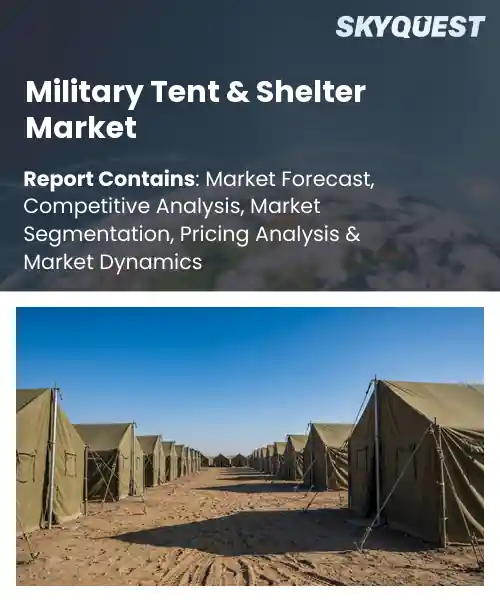
Military Tent & Shelter Market
Report ID: SQMIG20A2583
Report ID: SQMIG20A2583
[email protected]
USA +1 351-333-4748
Report ID:
SQMIG20A2583 |
Region:
Global |
Published Date: May, 2026
Pages:
157
|Tables:
146
|Figures:
73


Global Military Tent & Shelter Market size was valued at USD 2.52 Billion in 2024 and is poised to grow from USD 2.69 Billion in 2025 to USD 4.52 Billion by 2033, growing at a CAGR of 6.72% during the forecast period (2026-2033).
The military tent and shelter market is one that encompasses deployable fabric-based shelters and modular shelters that are used by military forces and other entities such as relief agencies, and it is important due to the role that shelters play in enabling force projection, force sustenance, and humanitarian efforts during times of instability. The key motivator has been instability in the international environment coupled with expeditionary doctrine changes that required mobility and resilience, resulting in the need for lightweight, environmentally controllable, and blast proof shelters since the 1990s following peacekeeping and counterinsurgency missions. An example is the NATO field hospital in Afghanistan.
The operational developments mentioned above make technological advances the main drivers of global market growth since new materials, architectural designs, and technologies contribute to increasing shelter capabilities and reducing costs. For example, when forces use lightweight materials and fast assemble shelters, they can set up temperature-controlled medical stations and secure command centers easily and fast; hence, casualties will be evacuated faster and logistics will not be strained. The procurement process favors turnkey operations and services, hence, making room for commercial operations. Some of the practical applications of this approach include medical facilities used during pandemics and expeditionary sites created by NATO forces.
How is IoT-enabled Sensor Integration Enhancing Operational Effectiveness in the Military Tent and Shelter Market?
Incorporation of IoT-powered sensors into military tents and shelters has transformed static structures into dynamic assets for their missions. Some of the important factors are the monitoring of the environment, tracking of assets, predictive maintenance, and energy management. In current technologies, data from environmental and equipment conditions are streamed into edge devices so that the leaders may take care of resupply and safety of people. There is a trend towards intelligent shelter suites for addressing issues related to fast deployment and austere footprints. Some real-world examples of such technologies are sensors used for monitoring the HVAC units and locating generators and medical equipment. W5 Solutions secured an order from Kongsberg in March 2026 for integrating advanced shelter solutions that leverage on the benefits of IoT-based solutions.
Market snapshot - (2026-2033)
Global Market Size
USD 2.52 Billion
Largest Segment
General Purpose Tents
Fastest Growth
Inflatable Shelters
Growth Rate
6.72% CAGR
To get more insights on this market click here to Request a Free Sample Report
Global military tent & shelter market is segmented by type, material, end-user, distribution and region. Based on type, the market is segmented into General Purpose Tents, Medical Tents, Command & Control Shelters, Containerized Shelters and Inflatable Shelters. Based on material, the market is segmented into Nylon, Polyester and Canvas. Based on end-user, the market is segmented into Army, Navy, Air Force and Paramilitary. Based on distribution, the market is segmented into Direct Government Contracts and Distributors. Based on region, the market is segmented into North America, Europe, Asia Pacific, Latin America and Middle East & Africa.
The Command & Control Shelters segment leads due to military need for secure, integrated shelters designed for leadership, communication, and intelligence operations, resulting in procurement of customized shelters that incorporate features such as survival and interactivity. The function of this category as an integral platform for these operations leads to a need for interface standardization, which encourages manufacturers to improve durability, electromagnetic interference protection, and ease of deployment of these shelters.
In contrast, Inflatable Shelters is emerging as the fastest growing market segment owing to its high speed of deployment, reduced logistics requirement, and ease of setup. In addition to being used for temporary accommodation purposes, recent improvements in inflatable materials have led to increased usage of these shelters as emergency facilities for medical and repair operations.
Canvas fabric segment dominates the market because military organizations appreciate the fabric's durable characteristics, such as its ability to withstand tears and repair, making it a popular choice for durable and lasting shelter construction. Being breathable and suitable for conventional treatments means that occupants experience comfortable living and aging in predictable ways, thereby increasing certainty in terms of lifecycle and maintenance requirements. Procurement practices favor tested fabrics for reliable shelter construction.
On the other hand, nylon fabric is gaining popularity at the fastest rate because of lightweight characteristics and ability to be coated with protective solutions such as those that prevent water and fire damage.
To get detailed segments analysis, Request a Free Sample Report
Dominance in North America is attributable to the advanced technological proficiency, highly developed defense procurement networks, and synchronization of the needs of the government with capabilities within the industries. This advantage lies in the abundance of manufacturers who have knowledge of materials science, modular manufacturing, and electronics and provide advanced shelter solutions to a wide variety of users. Excellent logistics and support networks allow for efficient delivery of equipment into the field and continued operations. Experience of the equipment in many different theaters leads to stringent testing standards, and the collaboration of the military branches, research facilities, and companies fosters innovation.
US Military Tent and Shelter Market features a requirement for high-performing and flexible equipment which will aid both expeditionary and fixed base operations. There is an emphasis placed on survivability, interoperability, and integration with communication and environmental control systems. Close partnerships between prime contractors and suppliers ensure the development of innovative fabrics and deployment methods. Lifecyle sustainment is critical for maintenance and spare parts management and in-field upgrade capabilities. Testing facilities are employed to ensure proper performance of products.
Canadian Military Tent & Shelter Market prioritizes flexibility and adaptability to meet demands under all weather conditions. Purchasing considerations focus on transportability, insulation, and ease of assembly. Working with local manufacturers, along with adopting global concepts, aids in meeting sovereignty goals and building local capacity. The importance of interoperability with allies, and sustainability,means that tents must be able to be used for multiple purposes and civil operations.
The development in the Asia Pacific region is fueled by changing regional security environment, the modernization process, and a growing need for speed and flexibility during disaster or mission deployments. The rising need for modular, mobile, and climate resistant shelters fits into the general trend towards investment in expeditionary capabilities and base camps infrastructure. Regional policies aimed at local production and technology transfer induce international companies to build their manufacturing bases and partnerships within the region. The joint military training and operations lead to new needs for common shelters systems that include command centers, medical facilities, and sustainment elements.
Japan Military Tent and Shelters Market is governed by the need for rapid deployment, provision for coast and island defense operations, and preparedness for disaster relief missions. Quality, ease of transportation due to compact design, and quick and safe setup are among the key considerations. Cooperation with domestic producers will concentrate on adapting technologies to work with communication and environment control systems. The procurement will focus on dual-use capabilities, which can fulfill both defense and civilian missions, and be aligned with ally forces’ concepts.
Korean Military Tent & Shelter Market emphasizes mobility, toughness, and flexibility in order to meet the demands of forward deployed troops and border operations. Military shelters can be erected quickly, withstand all sorts of weather conditions, and integrate well with military command & control and medical equipment. There is heavy involvement from the Korean defense industry in conjunction with foreign companies, leading to the transfer of technology and localization of parts.
Through modernization activities, harmonized procurements, and investment in sustainable, modular shelters, Europe is consolidating its position in the global market. Stressing the importance of standards and interoperability helps multinational deployments and joint procurements. Utilizing innovative materials, environmental controls, and modular designs, the European producers address all types of mission scenarios, from expeditionary missions to homeland security and disaster relief missions. Partnerships between public entities and corporations and consortium-based programs facilitate collaboration by enabling expertise, testing facilities, and manufacturing capabilities. Lifecycle management and sustainability are some additional strengths of these products that enhance their attractiveness for defense organizations searching for durable and cost-effective shelters.
Military Tent & Shelter Market in Germany places particular focus on engineering accuracy and sustainability. The suppliers strive to ensure that the products meet all requirements in terms of materials quality and environmental sustainability as well as integrate easily with command modules and medical shelters. The collaboration between the defense industry and research organizations is used to develop new materials and test them. Procurement may combine flexibility of operation and sustained use, making it possible for the shelters to be used for national, NATO, or civil purposes.
UK Military Tent and Shelters Market emphasizes expeditionary capabilities, rapid deployment, and integration with technologies used in command and medical activities. Efforts are directed toward developing systems that are light in weight and can be erected fast while offering communication and life support capabilities. The interaction between end-users and suppliers results in continuous innovation in design and testing. Emphasis is placed on efficient logistics and compatibility with allied forces equipment for varied deployments.
The Military Tent & Shelter Market in France revolves around flexible shelters that serve overseas deployments, quick reaction forces, and civil emergency response situations. The companies operating in the country offer products that are strong, modularly designed, and able to integrate with field medical and command systems. Sourcing is inclined towards the adoption of capabilities that ensure effectiveness and sustainment efficiency.
To know more about the market opportunities by region and country, click here to
Buy The Complete Report
Rising Need for Rapid Deployments
Military forces worldwide are prioritizing modernization of expeditionary capabilities and rapid deployment infrastructure, which directs procurement toward advanced tents and shelters that support mobility, protection, and fast assembly. Requirement for modular, transportable shelter systems encourages manufacturers to develop lighter materials, standardized components, and integrated support features, making these products central to mission planning. Procurement emphasis on operational readiness and reduced logistical burden drives sustained demand as armed services seek durable, adaptable shelter solutions that facilitate diverse missions and enhance force projection.
Technological Advancements in Materials
Advances in fabrics, coating technologies, and structural systems have enabled military shelters to offer greater durability, thermal performance, and reduced weight, which appeals to procurement officials focused on lifecycle value and operational efficiency. Integration of modular frames, rapid erection mechanisms, and compatibility with power and communications systems enhances functional utility and mission adaptability. As manufacturers leverage new materials and design approaches, end users benefit from shelters that require less maintenance and provide improved environmental control, thereby stimulating demand for next-generation tent and shelter solutions in defense applications.
High Procurement and Lifecycle Costs
The total cost associated with acquisition, customization, and long-term maintenance of specialized military tents and shelters can limit large-scale procurement, as defense budgets must balance multiple competing priorities. High upfront expenditure for ruggedized designs, integration of climate control or power modules, and specialized training for assembly and upkeep reduces procurement agility and lengthens adoption cycles. Budgetary caution and preference for multifunctional investments encourage decision makers to prioritize alternatives, which constrains rapid market expansion despite operational advantages offered by advanced shelter systems.
Logistical and Maintenance Complexity
Complex logistics for deployment, repair, and sustainment of specialized shelter systems can impede widespread adoption, as supply chains for spare parts, skilled maintenance personnel, and refurbishment facilities are often fragmented. Diverse operational environments demand varied configurations and continual upkeep, increasing reliance on vendor support and complicating in-field repairs. These practical sustainment challenges elevate operational risk and decision making complexity, prompting procurement authorities to favor simpler, lower-support solutions, which in turn restrains market growth for more sophisticated tent and shelter offerings.
Request Free Customization of this report to help us to meet your business objectives.
Competitive strategies revolve around consolidation, intersector collaboration, and fast-paced product innovation. This includes deals such as the acquisition of HDT Global by Nexus Capital and alliances, like that between Weatherhaven and Compotech, which demonstrate consolidation and bundling capabilities. Armed forces and OEMs are demanding modules that incorporate energy management and CBRN compatibility to ensure long-term procurement contracts.
Rapid Modularization of Shelters: The current need for defense organizations is toward shelters that are modular and fast to deploy with the ability to adapt to diverse conditions depending upon their mission profiles. Supplier organizations are concentrating on offering products that consist of easily interchangeable parts as well as interfaces in order to allow faster assembly and ease of maintenance, along with flexibility in in integrating payloads. Such a trend helps military organizations collaborate with system integrators to offer scalable platforms. Attention to modularity also provides scope for post-market product modifications, logistics reduction, and dual usage. This gives militaries the opportunity to customize shelters without going for a tailor-made investment.
Converging Smart Shelter Technologies: Demand from the military sector is making suppliers incorporate smart technologies in shelters that include sensors and climate control mechanisms as well as power and communication capabilities. Collaboration between suppliers and electronics as well as software solution providers help in offering enhanced situational awareness and endurance capabilities with the use of remote monitoring and predictive maintenance technologies. The focus on interoperability and cybersecurity makes sure that there is secure data exchange in military networks.
SkyQuest’s ABIRAW (Advanced Business Intelligence, Research & Analysis Wing) is our Business Information Services team that Collects, Collates, Correlates, and Analyses the Data collected by means ofPrimary Exploratory Research backed by robust Secondary Desk research.
As per SkyQuest analysis, the drivers of the worldwide military tent and shelter market include one significant factor, namely, technology advancements in materials and systems aimed at increasing deployability and reducing lifetime cost implications, whereas one significant barrier in the form of high procurement and lifetime cost issues persists. The leading regions include North America, whereasCommand & Control Shelters represent the dominant segments due to the requirements for hardened nodes in conducting leadership, communications and intelligence operations. Another important factorinfluencing the industry includes the increased requirement for expeditionary logistics and rapid deployments, thus contributing to the development of modular, sensor-based and serviceable shelter systems.
| Report Metric | Details |
|---|---|
| Market size value in 2024 | USD 2.52 Billion |
| Market size value in 2033 | USD 4.52 Billion |
| Growth Rate | 6.72% |
| Base year | 2024 |
| Forecast period | (2026-2033) |
| Forecast Unit (Value) | USD Billion |
| Segments covered |
|
| Regions covered | North America (US, Canada), Europe (Germany, France, United Kingdom, Italy, Spain, Rest of Europe), Asia Pacific (China, India, Japan, Rest of Asia-Pacific), Latin America (Brazil, Rest of Latin America), Middle East & Africa (South Africa, GCC Countries, Rest of MEA) |
| Companies covered |
|
| Customization scope | Free report customization with purchase. Customization includes:-
|
To get a free trial access to our platform which is a one stop solution for all your data requirements for quicker decision making. This platform allows you to compare markets, competitors who are prominent in the market, and mega trends that are influencing the dynamics in the market. Also, get access to detailed SkyQuest exclusive matrix.
Table Of Content
Executive Summary
Market overview
Parent Market Analysis
Market overview
Market size
KEY MARKET INSIGHTS
COVID IMPACT
MARKET DYNAMICS & OUTLOOK
Market Size by Region
KEY COMPANY PROFILES
Methodology
For the Military Tent & Shelter Market, our research methodology involved a mixture of primary and secondary data sources. Key steps involved in the research process are listed below:
1. Information Procurement: This stage involved the procurement of Market data or related information via primary and secondary sources. The various secondary sources used included various company websites, annual reports, trade databases, and paid databases such as Hoover's, Bloomberg Business, Factiva, and Avention. Our team did 45 primary interactions Globally which included several stakeholders such as manufacturers, customers, key opinion leaders, etc. Overall, information procurement was one of the most extensive stages in our research process.
2. Information Analysis: This step involved triangulation of data through bottom-up and top-down approaches to estimate and validate the total size and future estimate of the Military Tent & Shelter Market.
3. Report Formulation: The final step entailed the placement of data points in appropriate Market spaces in an attempt to deduce viable conclusions.
4. Validation & Publishing: Validation is the most important step in the process. Validation & re-validation via an intricately designed process helped us finalize data points to be used for final calculations. The final Market estimates and forecasts were then aligned and sent to our panel of industry experts for validation of data. Once the validation was done the report was sent to our Quality Assurance team to ensure adherence to style guides, consistency & design.
Analyst Support
Customization Options
With the given market data, our dedicated team of analysts can offer you the following customization options are available for the Military Tent & Shelter Market:
Product Analysis: Product matrix, which offers a detailed comparison of the product portfolio of companies.
Regional Analysis: Further analysis of the Military Tent & Shelter Market for additional countries.
Competitive Analysis: Detailed analysis and profiling of additional Market players & comparative analysis of competitive products.
Go to Market Strategy: Find the high-growth channels to invest your marketing efforts and increase your customer base.
Innovation Mapping: Identify racial solutions and innovation, connected to deep ecosystems of innovators, start-ups, academics, and strategic partners.
Category Intelligence: Customized intelligence that is relevant to their supply Markets will enable them to make smarter sourcing decisions and improve their category management.
Public Company Transcript Analysis: To improve the investment performance by generating new alpha and making better-informed decisions.
Social Media Listening: To analyze the conversations and trends happening not just around your brand, but around your industry as a whole, and use those insights to make better Marketing decisions.
REQUEST FOR SAMPLE
 REQUEST FREE CUSTOMIZATION
Global Military Tent & Shelter Market size was valued at USD 2.52 Billion in 2024 and is poised to grow from USD 2.69 Billion in 2025 to USD 4.52 Billion by 2033, growing at a CAGR of 6.72% during the forecast period (2026-2033).
Competitive dynamics center on consolidation, cross sector partnerships, and rapid product innovation, driving differentiation in mobility, protection, and after market services. Recent M&A such as Nexus Capital’s acquisition of HDT Global and manufacturer alliances like Weatherhaven’s Compotech deal show consolidation and capability bundling, while armed forces and OEMs push modular, CBRN capable and energy integrated shelter standards to win long term defense and humanitarian contracts. 'HDT Global', 'Alaska Structures', 'AAR Corp.', 'Weatherhaven Global Resources', 'Roder HTS Hocker', 'General Dynamics Ordnance & Tactical', 'DHS Systems', 'Zeppelin Mobile Systeme', 'Losberger De Boer', 'Weatherhaven (Weatherhaven Resources)', 'Eastern Tent & Canvas', 'AME International', 'Pacific Coast Tents', 'CAMSS Shelters', 'Ultimate Survival Technologies'
Military forces worldwide are prioritizing modernization of expeditionary capabilities and rapid deployment infrastructure, which directs procurement toward advanced tents and shelters that support mobility, protection, and fast assembly. Requirement for modular, transportable shelter systems encourages manufacturers to develop lighter materials, standardized components, and integrated support features, making these products central to mission planning. Procurement emphasis on operational readiness and reduced logistical burden drives sustained demand as armed services seek durable, adaptable shelter solutions that facilitate diverse missions and enhance force projection.
Rapid Modularization Of Shelters: Defense customers are prioritizing modular, rapidly deployable shelters that can be reconfigured for varied missions and environments. Suppliers emphasize interchangeable components and standardized interfaces to enable faster assembly, easier maintenance, and flexible payload integration. This trend encourages partnerships between system integrators and defense agencies to deliver scalable platforms that adapt across operational tempos. Focus on modularity also supports aftermarket upgrades, logistics simplification, and dual use applications, allowing militaries to tailor shelter footprints without committing to bespoke, single purpose sustainable investments.
Why does North America Dominate the Global Military Tent & Shelter Market? |@12


Want to customize this report? This report can be personalized according to your needs. Our analysts and industry experts will work directly with you to understand your requirements and provide you with customized data in a short amount of time. We offer $1000 worth of FREE customization at the time of purchase.
Feedback From Our Clients


 USA (+1) 351-333-4748

