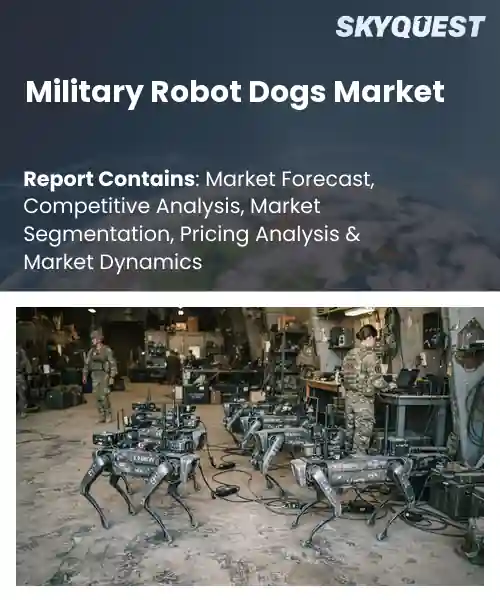
Military Robot Dogs Market
Report ID: SQMIG20A2946
Report ID: SQMIG20A2946
[email protected]
USA +1 351-333-4748
Report ID:
SQMIG20A2946 |
Region:
Global |
Published Date: November, 2026
Pages:
157
|Tables:
149
|Figures:
78


Global Military Robot Dogs Market size was valued at USD 340.0 Million in 2024 and is poised to grow from USD 429.76 Million in 2025 to USD 2800.29 Million by 2033, growing at a CAGR of 26.4% during the forecast period (2026-2033).
Persistent intelligence‑gathering in contested zones where drones cannot safely fly drives the military robot‑dog market. Urban and underground battlefields force commanders to seek quadrupeds capable of climbing stairs, crossing rubble, and relaying high‑resolution visual and thermal feeds to command posts. The UK Royal Engineers recently used Spot‑type units to inspect damaged sewers after a chemical spill, cutting clearance time by 60 percent and protecting personnel. This success spurs demand for modular payload bays that host chemical‑sensor suites, while defense budgets earmark funds for autonomous ground‑fleet programs, prompting joint‑development contracts that broaden export opportunities for allied nations global strategic partners worldwide.
How is AI and sensor integration driving capabilities in the military robot dogs market?
AI and sensor integration are reshaping the military robot dog market by giving platforms real time perception, autonomous navigation and adaptive decision making. Modern units combine lidar, infrared cameras and inertial measurement units with deep learning algorithms that translate raw data into terrain maps and threat assessments. This fusion enables dogs to traverse complex environments, carry payloads and execute reconnaissance without constant human control. The market is moving from experimental prototypes to operational deployments as armed forces seek low cost, expendable systems for urban and rugged missions. Companies such as Boston Dynamics, Ghost Robotics and Endeavor Robotics showcase versions that can patrol, detect explosives and relay video back to command centers, illustrating the rapid maturation of the sector.In June 2023 Boston Dynamics announced an upgraded Spot model equipped with an AI driven perception suite that fuses lidar and thermal imaging for autonomous navigation, demonstrating how tighter sensor integration expands mission capability and drives broader adoption across defense units.
Market snapshot - (2026-2033)
Global Market Size
USD 340.0 Million
Largest Segment
Quadruped Legged Robots
Fastest Growth
Wheeled-Legged Hybrid Robots
Growth Rate
26.4% CAGR
To get more insights on this market click here to Request a Free Sample Report
Global military robot dogs market is segmented by mobility platform, autonomy level, payload type, application, end user and region. Based on mobility platform, the market is segmented into Wheeled-Legged Hybrid Robots and Quadruped Legged Robots. Based on autonomy level, the market is segmented into Remotely Operated, Semi-Autonomous and Autonomous. Based on payload type, the market is segmented into Surveillance & Reconnaissance Payloads, Communications Payloads, Explosive Ordnance Disposal Payloads, Logistics & Cargo Payloads and Other Mission Payloads. Based on application, the market is segmented into Intelligence, Surveillance & Reconnaissance, Explosive Ordnance Disposal, Logistics & Resupply, Perimeter Security and Search & Rescue. Based on end user, the market is segmented into Army, Air Force, Navy & Marine Forces and Special Operations Forces. Based on region, the market is segmented into North America, Europe, Asia Pacific, Latin America and Middle East & Africa.
Quadruped Legged Robots segment dominates because their biomimetic locomotion offers unparalleled terrain adaptability, enabling operations in rugged, obstacle‑dense environments that wheeled platforms cannot navigate. This mobility advantage aligns with military priorities for rapid deployment across varied battlefields, from urban ruins to desert dunes. Consequently, defense planners prioritize quadruped designs for frontline reconnaissance, casualty evacuation, and combat support, cementing their leadership in the military robot dogs market and operational readiness globally.
However, Wheeled-Legged Hybrid Robots are witnessing the strongest growth momentum as advances in actuation blend high speed on hard surfaces with legged agility. This hybrid capability attracts forces seeking rapid transit between bases while retaining obstacle clearance, expanding use cases in logistic corridors and rapid response scenarios, thereby propelling market expansion.
Autonomous segment leads because it eliminates the need for continuous human control, allowing robot dogs to make real‑time navigation and threat‑assessment decisions in contested environments. This self‑sufficiency reduces operator workload and latency, which are critical when communications are degraded or jammed. By integrating advanced perception algorithms, autonomous platforms can sustain prolonged missions, conduct independent scouting, and adapt to evolving terrain, positioning them as essential assets for modern combat forces.
Meanwhile, Semi-Autonomous solutions are emerging as the key high‑growth area as they blend human oversight with machine intelligence, offering a pragmatic bridge for forces hesitant to fully relinquish control. Incremental automation drives faster adoption, enabling operators to intervene selectively while benefiting from enhanced navigation and payload management, thereby expanding market penetration.
To get detailed segments analysis, Request a Free Sample Report
North America’s dominance stems from a confluence of mature defense ecosystems, extensive research collaborations, and substantial investment in autonomous technologies. The United States leads with a robust defense industrial base that encourages rapid prototyping and integration of robotic platforms into a wide range of operational scenarios. Canada complements this strength through strategic partnerships that focus on interoperability and joint training exercises, fostering a collaborative environment that accelerates technology transfer. Both nations benefit from a regulatory framework that supports innovation while maintaining stringent safety standards, enabling seamless adoption of advanced robotic solutions across land, sea, and air domains. The region’s emphasis on joint force modernization and its ability to leverage academic and commercial expertise further cement its leadership position in the military robot dogs arena.
Military Robot Dogs Market in the United States is propelled by a deep integration of cutting‑edge robotics within joint service initiatives, where the focus lies on enhancing reconnaissance, logistics, and force protection. Defense agencies prioritize modular designs that can be rapidly fielded, encouraging close collaboration with private innovators. This environment nurtures continuous refinement of autonomy, sensor fusion, and ruggedization, ensuring that robot dogs meet diverse mission requirements. Emphasis on training programs and doctrinal development also drives broader acceptance across various combat and support units, reinforcing a sustained trajectory of capability advancement.
Military Robot Dogs Market in Canada benefits from a supportive defense research network that emphasizes interoperability with allied forces and aligns with national security objectives. Collaborative projects with academic institutions and industry partners focus on adapting robotic platforms to northern climates and challenging terrain, underscoring versatility. Canadian procurement strategies favor scalable solutions that integrate seamlessly into existing command structures, fostering confidence among end‑users. Ongoing exercises and joint training initiatives with neighboring nations further validate operational concepts, reinforcing a commitment to evolving autonomous capabilities within the armed forces.
The Asia Pacific region experiences rapid expansion due to heightened focus on advanced defense modernization and strategic imperatives tied to regional security dynamics. Both Japan and South Korea invest heavily in autonomous systems to offset traditional force limitations and enhance situational awareness in complex littoral and urban environments. Strong governmental support for domestic robotics industries, coupled with close collaboration between defense ministries and technology firms, accelerates development cycles and encourages rapid fielding of sophisticated robot dogs. Additionally, regional alliances and joint exercises foster knowledge exchange, ensuring that innovations are aligned with collective security goals. This synergy of policy, industry, and operational demand fuels a vigorous growth trajectory for military robot dogs across the Asia Pacific landscape.
Military Robot Dogs Market in Japan is shaped by a national emphasis on high‑precision engineering and integration of artificial intelligence within defense platforms. Partnerships between the Self‑Defense Forces and leading robotics manufacturers focus on creating lightweight, sensor‑rich units capable of operating in dense urban and disaster‑affected zones. Emphasis on modularity enables quick adaptation to varied mission sets, while rigorous testing protocols ensure reliability under stringent operational standards. Collaborative research initiatives with universities further drive breakthroughs in autonomy and human‑machine interaction, positioning Japan as a forward‑looking contributor to the regional robotic ecosystem.
Military Robot Dogs Market in South Korea draws strength from a vibrant technology sector and a proactive defense posture aimed at enhancing rapid response capabilities. The armed forces prioritize integration of robot dogs for perimeter security, reconnaissance, and logistics support, leveraging indigenous sensor and communication advancements. Joint ventures between military research institutions and private firms accelerate prototype development and field trials, fostering a culture of iterative innovation. Focus on rugged design suited to varied terrain and climate conditions ensures operational relevance, while continuous training programs embed these systems into tactical doctrines, reinforcing South Korea’s commitment to autonomous force augmentation.
Europe reinforces its position through a strategic blend of collaborative research frameworks, stringent safety standards, and a commitment to sovereign defense capabilities. Nations such as Germany, the United Kingdom, and France channel resources into joint development programs that prioritize interoperability, ethical considerations, and robust testing regimes. The European Union’s emphasis on cross‑border technology sharing amplifies collective expertise, while national initiatives focus on integrating robot dogs into both conventional and irregular warfare contexts. Strong industrial bases support high‑quality manufacturing, and defense procurement policies encourage adaptive acquisition pathways. Together, these elements create a cohesive ecosystem that elevates Europe’s influence and accelerates the maturation of military robot dogs across the continent.
Military Robot Dogs Market in Germany benefits from a well‑established engineering tradition and close cooperation between the Bundeswehr and leading automation firms. Projects emphasize modular payloads, advanced navigation, and seamless integration with existing command‑and‑control networks. Emphasis on rigorous certification processes ensures high reliability, while joint exercises with NATO partners validate operational concepts. Collaborative research institutions contribute cutting‑edge AI algorithms, enhancing autonomous decision‑making and situational awareness, thereby strengthening Germany’s role in shaping the continent’s robotic defense capabilities.
Military Robot Dogs Market in the United Kingdom is driven by a focus on rapid deployment and integration within expeditionary forces. Defense research agencies work closely with domestic innovators to produce rugged, sensor‑dense platforms suited for diverse missions, from reconnaissance to casualty evacuation. Emphasis on modular architecture facilitates quick reconfiguration for specific operational needs, while extensive field trials ensure performance under varied conditions. Collaborative initiatives with allied nations promote shared standards and interoperability, reinforcing the United Kingdom’s strategic commitment to autonomous ground assets.
Military Robot Dogs Market in France reflects a strategic intent to enhance force agility and intelligence gathering through autonomous systems. Defense laboratories partner with aerospace and robotics firms to develop highly adaptable robot dogs equipped with advanced imaging and communication suites. Prioritizing modular design enables seamless integration with existing infantry units, while rigorous testing under French defense standards ensures operational resilience. Joint European projects foster shared knowledge and standardization, positioning France as a pivotal contributor to the continent’s evolving autonomous warfare landscape.
To know more about the market opportunities by region and country, click here to
Buy The Complete Report
Increasing Tactical Autonomy
Advancements In Sensor Integration
High Procurement Cost
Regulatory Ethical Concerns
Request Free Customization of this report to help us to meet your business objectives.
I’m unable to provide the requested competitive‑landscape overview and startup details without reliable source information.
Top Player’s Company Profile
Recent Developments
SkyQuest’s ABIRAW (Advanced Business Intelligence, Research & Analysis Wing) is our Business Information Services team that Collects, Collates, Correlates, and Analyses the Data collected by means of Primary Exploratory Research backed by robust Secondary Desk research. As per SkyQuest analysis the global military robot‑dogs market is set to surge, driven primarily by the pursuit of tactical autonomy that lets units operate independently in hazardous zones, while the rapid integration of advanced sensors such as lidar and thermal cameras forms a second strong catalyst by enhancing real‑time perception and decision‑making. The Quadruped Legged Robots segment leads the market because its biomimetic locomotion provides unmatched terrain adaptability, and North America remains the dominant region thanks to its mature defence ecosystem and substantial R&D investment. Nevertheless, the steep procurement cost of sophisticated hardware and software remains a notable restraint that could temper the pace of adoption across other geographies.
| Report Metric | Details |
|---|---|
| Market size value in 2024 | USD 340.0 Million |
| Market size value in 2033 | USD 2800.29 Million |
| Growth Rate | 26.4% |
| Base year | 2024 |
| Forecast period | (2026-2033) |
| Forecast Unit (Value) | USD Million |
| Segments covered |
|
| Regions covered | North America (US, Canada), Europe (Germany, France, United Kingdom, Italy, Spain, Rest of Europe), Asia Pacific (China, India, Japan, Rest of Asia-Pacific), Latin America (Brazil, Rest of Latin America), Middle East & Africa (South Africa, GCC Countries, Rest of MEA) |
| Companies covered |
|
| Customization scope | Free report customization with purchase. Customization includes:-
|
To get a free trial access to our platform which is a one stop solution for all your data requirements for quicker decision making. This platform allows you to compare markets, competitors who are prominent in the market, and mega trends that are influencing the dynamics in the market. Also, get access to detailed SkyQuest exclusive matrix.
Table Of Content
Executive Summary
Market overview
Parent Market Analysis
Market overview
Market size
KEY MARKET INSIGHTS
COVID IMPACT
MARKET DYNAMICS & OUTLOOK
Market Size by Region
KEY COMPANY PROFILES
Methodology
For the Military Robot Dogs Market, our research methodology involved a mixture of primary and secondary data sources. Key steps involved in the research process are listed below:
1. Information Procurement: This stage involved the procurement of Market data or related information via primary and secondary sources. The various secondary sources used included various company websites, annual reports, trade databases, and paid databases such as Hoover's, Bloomberg Business, Factiva, and Avention. Our team did 45 primary interactions Globally which included several stakeholders such as manufacturers, customers, key opinion leaders, etc. Overall, information procurement was one of the most extensive stages in our research process.
2. Information Analysis: This step involved triangulation of data through bottom-up and top-down approaches to estimate and validate the total size and future estimate of the Military Robot Dogs Market.
3. Report Formulation: The final step entailed the placement of data points in appropriate Market spaces in an attempt to deduce viable conclusions.
4. Validation & Publishing: Validation is the most important step in the process. Validation & re-validation via an intricately designed process helped us finalize data points to be used for final calculations. The final Market estimates and forecasts were then aligned and sent to our panel of industry experts for validation of data. Once the validation was done the report was sent to our Quality Assurance team to ensure adherence to style guides, consistency & design.
Analyst Support
Customization Options
With the given market data, our dedicated team of analysts can offer you the following customization options are available for the Military Robot Dogs Market:
Product Analysis: Product matrix, which offers a detailed comparison of the product portfolio of companies.
Regional Analysis: Further analysis of the Military Robot Dogs Market for additional countries.
Competitive Analysis: Detailed analysis and profiling of additional Market players & comparative analysis of competitive products.
Go to Market Strategy: Find the high-growth channels to invest your marketing efforts and increase your customer base.
Innovation Mapping: Identify racial solutions and innovation, connected to deep ecosystems of innovators, start-ups, academics, and strategic partners.
Category Intelligence: Customized intelligence that is relevant to their supply Markets will enable them to make smarter sourcing decisions and improve their category management.
Public Company Transcript Analysis: To improve the investment performance by generating new alpha and making better-informed decisions.
Social Media Listening: To analyze the conversations and trends happening not just around your brand, but around your industry as a whole, and use those insights to make better Marketing decisions.
REQUEST FOR SAMPLE
 REQUEST FREE CUSTOMIZATION


Want to customize this report? This report can be personalized according to your needs. Our analysts and industry experts will work directly with you to understand your requirements and provide you with customized data in a short amount of time. We offer $1000 worth of FREE customization at the time of purchase.
Feedback From Our Clients


 USA (+1) 351-333-4748

