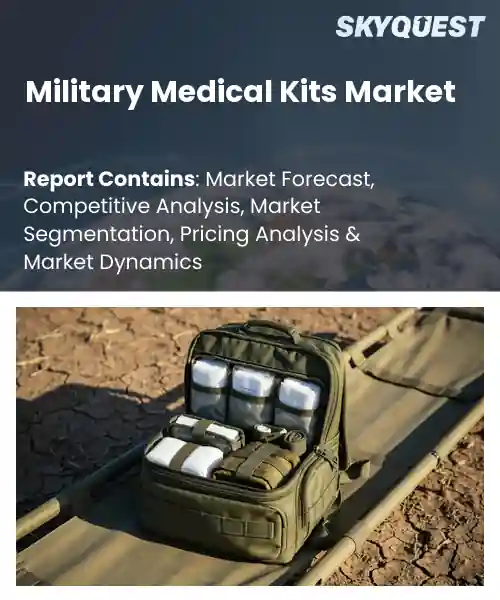
Military Medical Kits Market
Report ID: SQMIG20A2576
Report ID: SQMIG20A2576
[email protected]
USA +1 351-333-4748
Report ID:
SQMIG20A2576 |
Region:
Global |
Published Date: March, 2026
Pages:
157
|Tables:
119
|Figures:
77


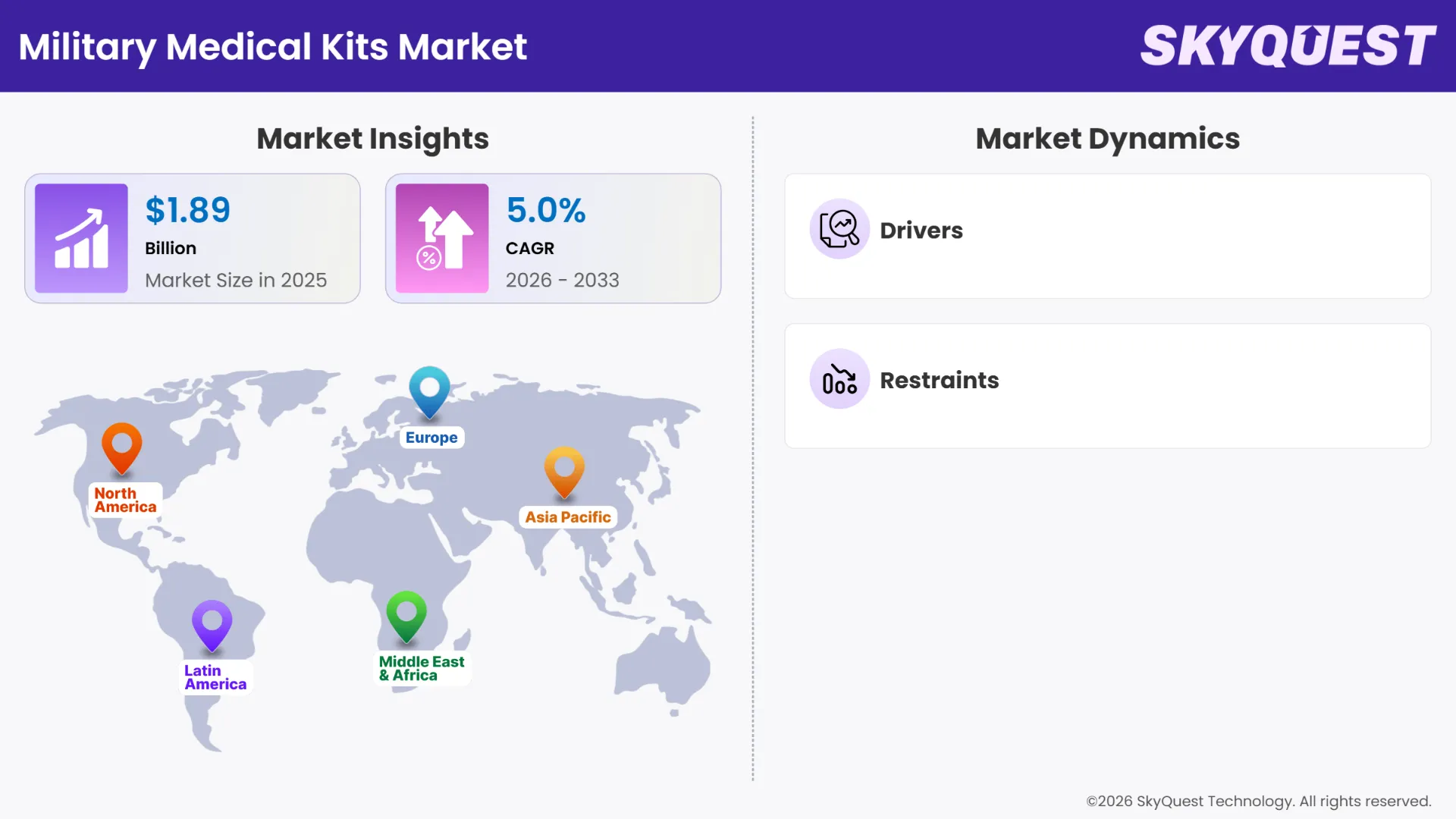
Global Military Medical Kits Market size was valued at USD 1.8 Billion in 2024 and is poised to grow from USD 1.89 Billion in 2025 to USD 2.79 Billion by 2033, growing at a CAGR of 5.0% during the forecast period (2026-2033).
The global military medical kits market growth is driven because armed forces need immediate medical treatment to stop preventable deaths from combat injuries. The kits provide essential equipment for border medicine practice through their collection of triage tools and haemorrhage control devices and airway equipment and compact diagnostic systems. The military standardized Tactical Combat Casualty Care based on data from Iraq and Afghanistan which demonstrated that using tourniquets and conducting quick haemorrhage control procedures helped people survive better.
Moreover, the global military medical kits market outlook has progressed from its initial stage of providing basic bandage packs to its current state of offering lightweight modular systems that can be customized for operations and uses sensor technology to match modern military and humanitarian requirements. The market grows because technological innovation enables services to operate more effectively through investments in miniaturized diagnostic tools and telemedicine systems and advanced haemostatic agents. Military organizations can conduct more efficient casualty evaluations through lightweight point of care analysers which leads to shorter evacuation processes that benefit NATO operations and UN peacekeeping missions. Lifecycle support procurement reforms drive manufacturers to provide training and upgrades and maintenance services which create consistent income streams while developing stronger customer relationships.
How is AI Enhancing Supply Chain Efficiency for Military Medical Kits?
AI technology helps military medical kits operations by using predictive forecasting and inventory optimization combined with real time tracking to ensure proper supply distribution. The system enables mission needs prediction through machine learning and operational status reporting through sensor equipped kits and supply deliveries through automated drone and vehicle routing. The current situation shows that defense logistic organizations and suppliers use these tools to minimize stockout events and surplus inventory while adapting kit contents to specific mission requirements. The market demands fast and reliable field care which leads to practical pilot programs that build trust among frontline medics, while supply chain networks become more efficient.
To get more insights on this market click here to Request a Free Sample Report
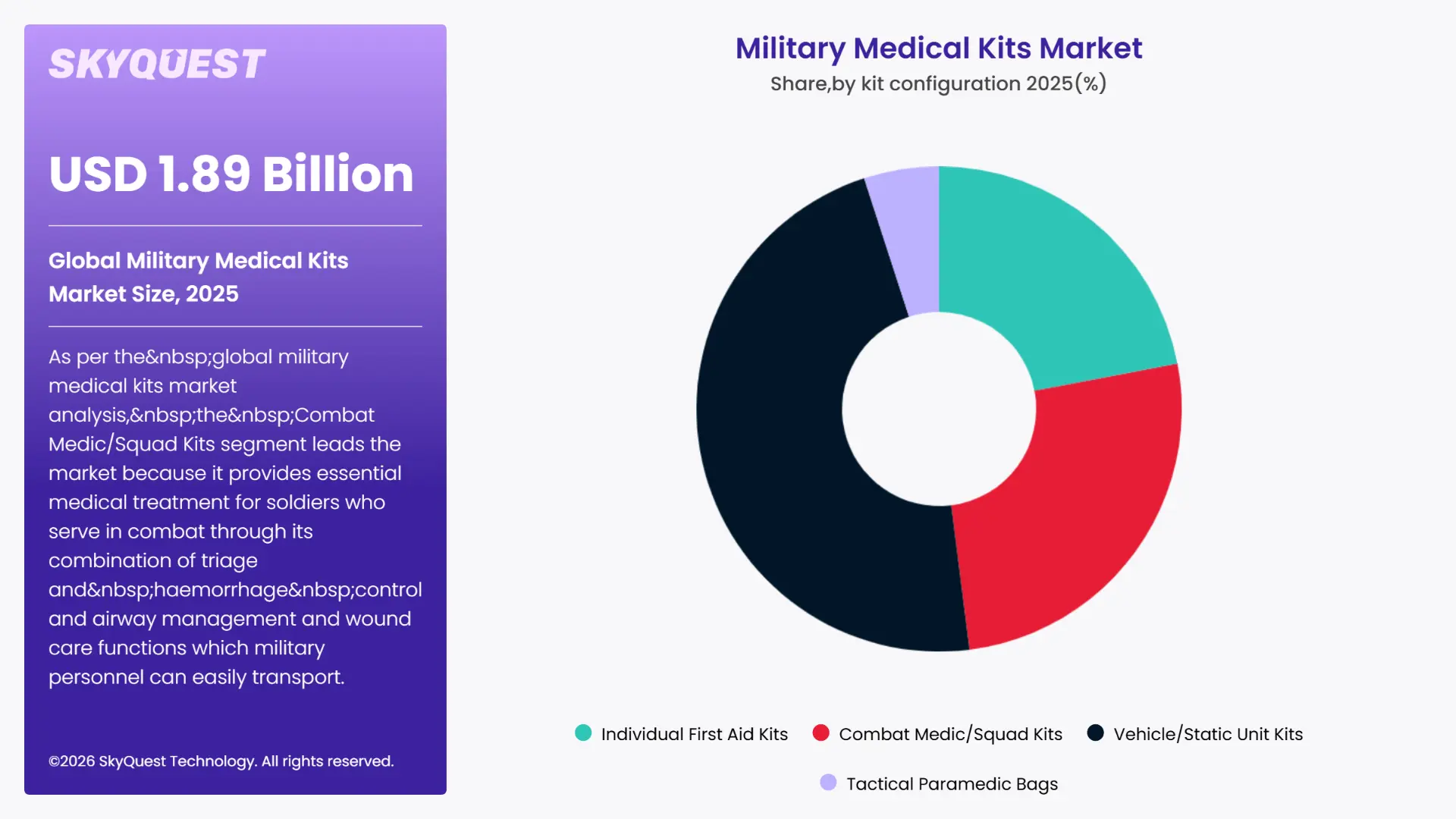
The global military medical kits market is segmented based on kit configuration, component focus, tactical environment, end user, and region. In terms of kit configuration, the market includes individual first aid kits, combat medic or squad kits, vehicle or static unit kits, and tactical paramedic bags. Based on component focus, the market is categorized into hemostatic agents and tourniquets, airway and chest management, burn and wound dressings, and hypothermia prevention gear. By tactical environment, it is segmented into standard combat operations, special forces, and humanitarian and disaster relief scenarios. Depending on end users, the market is divided into army and ground forces, navy and marines, and air force and specialized airborne units. Regionally, the market is analyzed across North America, Europe, Asia Pacific, Latin America, and the Middle East & Africa.
As per the global military medical kits market analysis, the Combat Medic/Squad Kits segment leads the market because it provides essential medical treatment for soldiers who serve in combat through its combination of triage and haemorrhage control and airway management and wound care functions which military personnel can easily transport. The military prioritizes contracts that provide operational support through equipment which works with their mission requirements and their training procedures, so manufacturers create standardized designs which offer robust and multifunctional capabilities. The business maintains its market dominance through the combination of tactical needs and existing user knowledge and active supply chain operations.
However, the deployment of advanced prehospital practitioners drives demand for Tactical Paramedic Bags who need modular capacity packs to conduct advanced life support operations. The new lightweight materials with their custom interior designs and integrated monitoring capabilities become popular among organizations which need extended point of injury care services.
According to the global military medical kits market forecast, the segment which contains Hemostatic Agents and Tourniquets has become the leading segment in the market because these two products provide immediate battlefield identification solution for controlling severe blood loss. The products demonstrate their life saving power in tactical scenarios, which makes them easy to train while military organizations use them in their standard casualty care packages. Manufacturers work to create products which are simple to use and have long shelf life and complete compatibility with different dressing materials, which establishes these components as vital parts of military medical supply networks.
Whereas the Airway & Chest Management segment is predicted to achieve the largest military medical kits market share because military forces now focus on prehospital treatment for both penetrating and blast injuries. The market for compact ventilation devices and sealed chest drains and rapid airway adjuncts and advanced life support training currently experiences growth because these products serve various needs while suppliers develop modular solutions for respiratory and thoracic care which can be used in the field.
To get detailed segments analysis, Request a Free Sample Report
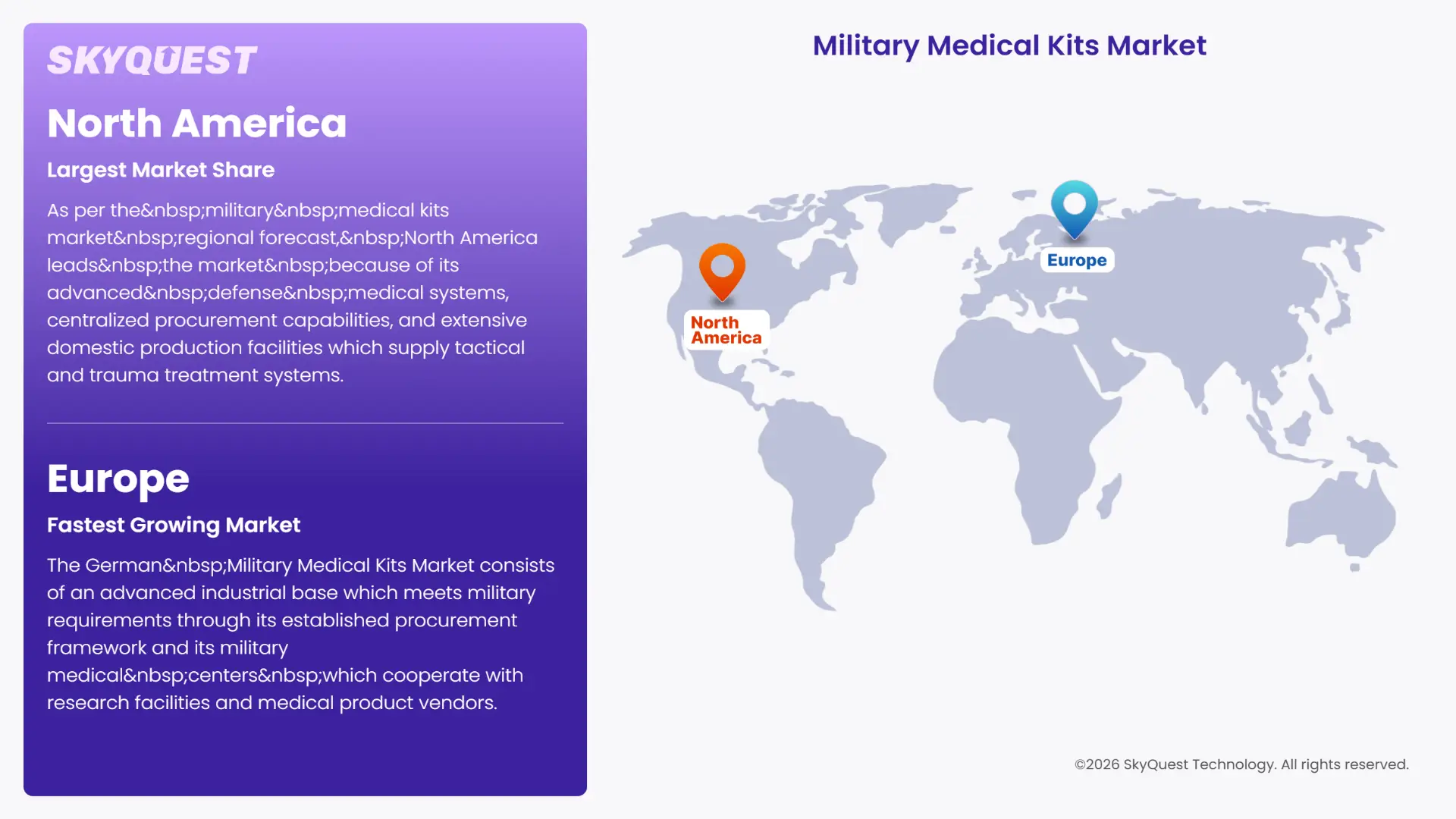
As per the military medical kits market regional forecast, North America leads the market because of its advanced defense medical systems, centralized procurement capabilities, and extensive domestic production facilities which supply tactical and trauma treatment systems. Established manufacturers, integrated supply chains, and close collaboration between military medical corps and private industry accelerate product development and field adoption. The military requires advanced kit designs and flexible parts systems because they need equipment which detects and treats injuries from combat situations. Organizations depend on actual testing operations and combined training programs and feedback systems from operational units to create ongoing improvements. The combination of regulatory frameworks and logistics networks enables swift delivery of supplies during military operations and emergency response situations, which strengthens the region's capabilities and innovative capabilities. Government funding in medical research together with partnerships between academic institutions and industry groups plus a focus on system support during their operational life enables constant development of both small and major system upgrades which fulfill military requirements.
The United States Military Medical Kits industry develops through American manufacturers who produce advanced military equipment while military medical corps work with these manufacturers for developing trauma and expeditionary medical solutions. The operational units provide ongoing user feedback which drives the design process and development of rugged products. The kit design depends on the integration of telemedicine and diagnostic equipment and the procedures for moving injured soldiers from combat areas. The established testing ranges and logistics infrastructure enable fielding and sustainment, while industrial partnerships and training institutions support capability maturation.
The military medical kits sector in the country emphasizes the need for equipment which functions in cold-weather conditions and remote locations and works with partner forces while providing specialized kits for operations in distant areas. The procurement process uses international cooperation to obtain specific solutions from domestic suppliers. Research collaborations between academic institutions and military defense institutions create user-friendly field designs. The procurement process focuses on medevac compatibility and reserve training and logistics resilience, while small and medium enterprises deliver niche materials and ergonomic product developments.
European countries expand their military medical kits market because defense forces modernize through different programs while countries create systems which allow military personnel to work together with their partners. National procurement programs promote standardization through modular kit designs which operate in various operational settings within alliance frameworks. The specialized manufacturers market, advanced medical suppliers' market, and defense-focused research institutes market create an ecosystem which drives innovation for trauma care and contamination mitigation and durable packaging development. The combination of advanced civil-military emergency response and simulation training and regulatory streamlining activities helps to accelerate technology implementation. The existing business landscape enables organizations to create personalized solutions which establish speedy collaborations between companies to deliver their service capabilities to operational units.
The German Military Medical Kits Market consists of an advanced industrial base which meets military requirements through its established procurement framework and its military medical centers which cooperate with research facilities and medical product vendors. The development of modular kits together with certification processes depends on existing quality standards and recognized interoperability specifications. The operational base uses existing testing capabilities to validate sustainable material usage and contamination control methods. The military forces and their partners can trust the German integrated logistics system which delivers lifecycle maintenance support to make equipment more dependable in both national and allied operations.
The United Kingdom Military Medical Kits Market uses flexible procurement methods which support the development of cutting-edge medical technologies through local medical technology clusters and their ability to create lightweight modular products. The military medical services developed strong partnerships with commercial developers to speed up their product testing and development process. The system improves its operational efficiency through its capacity to connect with telemedicine systems, simulation training programs, and interoperable packaging solutions. The local supplier network together with the collaborative export process enables clinical innovations to grow through their production of deployable medical solutions.
The military medical kits market in France is transforming through modernization projects which rely on specialized suppliers who work with defense research institutions and commercial organizations to develop new medical technologies. The military requires equipment which can control contamination from hazardous materials and scientists are creating solutions which multiple users can use in different environments. The two processes of procurement process improvement and training program expansion make it easier for organizations to implement new solutions, while partnerships with emergency services organizations enable the development of dual-use technologies which create operational readiness benefits and create additional business opportunities for domestic providers.
The military medical kits market in Asia Pacific expands through strategic investments which support local production and create new research activities and regional partnerships that enhance both defense readiness and humanitarian mission capabilities. The kits become more functional through two developments which include the creation of ruggedized solutions that match maritime and tropical climates and the expansion of diagnostic and telemedicine capabilities. The current supply chain requirements of governments and regional suppliers move toward three main areas which include improving supply chain resilience and establishing quality control systems and maintaining competitive edge in exports, while global manufacturing partners provide essential support for overseas technology transfer operations. The region develops adaptable medical solutions through training programs and expeditionary medical exercises which deliver operational feedback to improve kit design elements that include both ergonomic features and modular capacity. Advanced materials research funding together with standardization efforts that pursue compatible frameworks enables product reliability, while the development of local OEMs and civil-military integration initiatives boosts production and sustainment capabilities for various operational settings.
The Japanese military medical kits market uses its advanced manufacturing capabilities together with its materials expertise and defense research partnerships to create military medical kits. The specialized maritime and mountainous kits of companies use compact high-reliability elements which work with diagnostic equipment to create advanced kit solutions. The development of adaptable kits for disaster response depends on civil-military partnerships which establish both kit requirements and required logistical systems. Domestic suppliers prioritize quality assurance and maintenance, while international partnerships enable their business networks to create design and manufacturing solutions for global markets.
The South Korean military medical kits market achieves growth through three main elements which include its dynamic medtech industry and its strong electronics production base and its active partnership between government research centers and private companies. The kits work for military operations through three main elements which include compact diagnostic tools and telemedicine capabilities and durable packaging systems. The users trust the system because the organization conducts thorough quality checks and equipment maintenance operations, while the OEM capabilities and export history of the enterprise enable it to extend its service area.
To know more about the market opportunities by region and country, click here to
Buy The Complete Report
Enhanced Battlefield Medical Preparedness
The armed forces improved their battlefield medical capabilities through their acquisition of portable medical kits which enable quick treatment of traumatic injuries, which led to increased procurement activities while manufacturers created new products, which included features for modular system design and durability and user-friendly operation. Defenseorganizations partner with suppliers to improve kit design and supply chain operations because they need to maintain operational readiness and ensure survival in all situations. Defense organizations need to fulfil their operations through new supply processes while training and supplying upgraded materials which will sustain their mission success in worldwide high-security environments.
Technological Innovations in Medical Kits
Medical kit technology advancements create new benefits through products which use advanced materials and a complete system of modular components and integrated resuscitation aids that simplify usage during emergencies. Military medical personnel plus procurement officials trust modernized kits because the kits enable efficient medical operations in austere conditions. Companies develop new products through research investments, while it enhances existing product designs to fulfill operational requirements and creates new market opportunities through improved product lifecycle management and training and logistics systems integration.
Complex Regulatory Approval Processes
Manufacturers and suppliers face extreme difficulties with regulatory approval procedures because the process includes multiple standards which require different certification procedures and extensive safety testing to complete development and to market their products. The growing regulatory requirements create more compliance obligations which hinder procurement processes by generating additional uncertainties for operational requirement changes. The approval process creates major obstacles for small companies, which decreases their chances to compete, while defense organizations experience delays in acquiring better equipment which slows down the process to introduce new solutionsacross various regions.
Military medical kits face operational theater distribution challenges, which cause delivery issues through base stocking and replenishing methods. Companies do not have enough resources to keep stock at remote sites, which leads them to buy fewer products, which causes lower demand for new kit designs. The military faces higher risks from service disruptions because they depend on suppliers and have restricted production capabilities, which makes defense planners avoid new product development that would affect their readiness status and complicate their supply chain operations.
Request Free Customization of this report to help us to meet your business objectives.
The global military medical kits market witness's fierce competition which compels suppliers to acquire defense and institutional contracts through their unique product offerings and their special alliance development and their fast technology implementation practices. The ZOLL Mobilize trauma kit provides tablet-based workflow capabilities while Chinook Medical supplies GSA-compliant custom kit development services.
Field Ready Portable Diagnostics: Deployment environments require diagnostic systems which are both compact and durable to enable quick doctor assessment and illness monitoring at injury sites. The manufacturers create miniaturized platforms which have simple user interfaces and use materials that maintain their operational capacity in remote locations for long periods. Procurement teams select products which can work with current systems and can create mission-specific equipment setups. Users prefer training and maintenance procedures which are simple because they result in smaller logistical needs for the organization. Medtech innovators establish partnerships with defense agencies to speed up the validation process and the adoption of testing diagnostic systems between their organizations.
Integrated Telemedicine and Training: Secure communications and virtual platforms enable remote clinical support and interactive training for deployed medical personnel. The solutions create a system which combines live teleconsultation with scenario-based simulation and asynchronous knowledge transfer to help clinicians make better decisions in challenging environments. The manufacturers and service providers develop user-friendly interfaces which function effectively in low bandwidth situations to maintain high performance in contested network environments. Defense medical leadership requires skill maintenance through combined learning methods and expert reachback services which lead to the acquisition of kits that contain connectivity features and enable mission-based training operations.
SkyQuest’s ABIRAW (Advanced Business Intelligence, Research & Analysis Wing) is our Business Information Services team that Collects, Collates, Correlates, and Analyses the Data collected by means of Primary Exploratory Research backed by robust Secondary Desk research.
As per SkyQuest analysis, the military medical kits market exists because the military needs to decrease combat deaths which occur due to preventable injuries that require instant medical attention. The key driver is rapid haemorrhage control and frontline triage adoption, while a second driver is technological innovation which includes miniaturized diagnostics and telemedicine links and advanced haemostatic agents that enhance kit effectiveness. The complex regulatory approval process functions as a major barrier, which delays product entry and procurement according to existing market regulations. North America dominates the market because it has established defense medical systems and a strong industrial base, while Combat Medic/Squad Kits serve as the primary point-of-care packages which are designed for squad-based missions and interoperability.
| Report Metric | Details |
|---|---|
| Market size value in 2024 | USD 1.8 Billion |
| Market size value in 2033 | USD 2.79 Billion |
| Growth Rate | 5.0% |
| Base year | 2024 |
| Forecast period | (2026-2033) |
| Forecast Unit (Value) | USD Billion |
| Segments covered |
|
| Regions covered | North America (US, Canada), Europe (Germany, France, United Kingdom, Italy, Spain, Rest of Europe), Asia Pacific (China, India, Japan, Rest of Asia-Pacific), Latin America (Brazil, Rest of Latin America), Middle East & Africa (South Africa, GCC Countries, Rest of MEA) |
| Companies covered |
|
| Customization scope | Free report customization with purchase. Customization includes:-
|
To get a free trial access to our platform which is a one stop solution for all your data requirements for quicker decision making. This platform allows you to compare markets, competitors who are prominent in the market, and mega trends that are influencing the dynamics in the market. Also, get access to detailed SkyQuest exclusive matrix.
Table Of Content
Executive Summary
Market overview
Parent Market Analysis
Market overview
Market size
KEY MARKET INSIGHTS
COVID IMPACT
MARKET DYNAMICS & OUTLOOK
Market Size by Region
KEY COMPANY PROFILES
Methodology
For the Military Medical Kits Market, our research methodology involved a mixture of primary and secondary data sources. Key steps involved in the research process are listed below:
1. Information Procurement: This stage involved the procurement of Market data or related information via primary and secondary sources. The various secondary sources used included various company websites, annual reports, trade databases, and paid databases such as Hoover's, Bloomberg Business, Factiva, and Avention. Our team did 45 primary interactions Globally which included several stakeholders such as manufacturers, customers, key opinion leaders, etc. Overall, information procurement was one of the most extensive stages in our research process.
2. Information Analysis: This step involved triangulation of data through bottom-up and top-down approaches to estimate and validate the total size and future estimate of the Military Medical Kits Market.
3. Report Formulation: The final step entailed the placement of data points in appropriate Market spaces in an attempt to deduce viable conclusions.
4. Validation & Publishing: Validation is the most important step in the process. Validation & re-validation via an intricately designed process helped us finalize data points to be used for final calculations. The final Market estimates and forecasts were then aligned and sent to our panel of industry experts for validation of data. Once the validation was done the report was sent to our Quality Assurance team to ensure adherence to style guides, consistency & design.
Analyst Support
Customization Options
With the given market data, our dedicated team of analysts can offer you the following customization options are available for the Military Medical Kits Market:
Product Analysis: Product matrix, which offers a detailed comparison of the product portfolio of companies.
Regional Analysis: Further analysis of the Military Medical Kits Market for additional countries.
Competitive Analysis: Detailed analysis and profiling of additional Market players & comparative analysis of competitive products.
Go to Market Strategy: Find the high-growth channels to invest your marketing efforts and increase your customer base.
Innovation Mapping: Identify racial solutions and innovation, connected to deep ecosystems of innovators, start-ups, academics, and strategic partners.
Category Intelligence: Customized intelligence that is relevant to their supply Markets will enable them to make smarter sourcing decisions and improve their category management.
Public Company Transcript Analysis: To improve the investment performance by generating new alpha and making better-informed decisions.
Social Media Listening: To analyze the conversations and trends happening not just around your brand, but around your industry as a whole, and use those insights to make better Marketing decisions.
REQUEST FOR SAMPLE
 REQUEST FREE CUSTOMIZATION
Global Military Medical Kits Market size was valued at USD 1.8 Billion in 2024 and is poised to grow from USD 1.89 Billion in 2025 to USD 2.79 Billion by 2033, growing at a CAGR of 5.0% during the forecast period (2026-2033).
Competitive pressure in the global military medical kits market is driving suppliers to secure defense and institutional contracts through product differentiation, targeted partnerships and rapid tech integration. Examples include ZOLL’s Mobilize trauma kit with tablet-enabled workflow and Chinook Medical’s GSA-enabled custom kit manufacturing. Procurement-driven demand for modular, digital and rapid-deploy bleeding control solutions is accelerating vendor consolidation and distributor alliances. 'North American Rescue (NAR)', 'Tactical Medical Solutions', 'Combat Medical Systems', 'Chinook Medical Gear', 'Adventure Medical Kits', 'H&H Medical Corp', 'Bound Tree Medical', 'Rescue Essentials', 'Z-Medica', 'First Care Products', 'Persys Medical', 'Aero Healthcare', 'Medline Industries', 'Cintas Corporation', 'Acme United Corp', 'Johnson & Johnson', 'Hartmann Group', 'LIFELINE First Aid', 'Safetec of America', 'Certified Safety Mfg'
Field Ready Portable Diagnostics: Deployment environments demand compact, rugged diagnostic solutions that enable rapid triage and disease surveillance at point of injury. Manufacturers focus on miniaturized platforms, simplified user interfaces, and materials to support austere conditions and extended shelf life. Procurement prioritizes interoperability with existing systems and modularity for mission specific loadouts. End users value ease of training and maintenance to reduce logistical footprints. This trend fosters partnerships between medtech innovators and defense agencies to accelerate validation and adoption of hands on diagnostic capabilities.
Why does North America Dominate the Global Military Medical Kits Market? |@12


Want to customize this report? This report can be personalized according to your needs. Our analysts and industry experts will work directly with you to understand your requirements and provide you with customized data in a short amount of time. We offer $1000 worth of FREE customization at the time of purchase.
Feedback From Our Clients


 USA (+1) 351-333-4748

