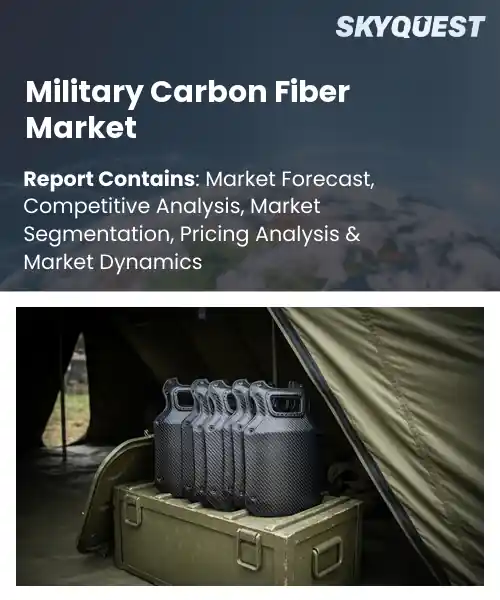
Military Carbon Fiber Market
Report ID: SQMIG15E3216
Report ID: SQMIG15E3216
[email protected]
USA +1 351-333-4748
Report ID:
SQMIG15E3216 |
Region:
Global |
Published Date: February, 2026
Pages:
157
|Tables:
149
|Figures:
78


Global Military Carbon Fiber Market size was valued at USD 2.43 Billion in 2024 and is poised to grow from USD 2.56 Billion in 2025 to USD 3.83 Billion by 2033, growing at a CAGR of 5.2% during the forecast period (2026-2033).
The primary driver of the military carbon fiber market is the relentless operational demand for lighter, stronger, and more survivable platforms, which translates into improved fuel efficiency, increased payload and enhanced mission endurance. This market comprises fibers, prepregs and composite structures used across aircraft, missiles, land vehicles and naval vessels, and it matters because material choices directly affect capability and lifecycle costs. Adoption began in aerospace for high-performance airframes and gradually spread to unmanned systems and armor as production techniques and resin chemistries matured; for example, fighter airframes and reconnaissance UAVs routinely use carbon fiber to meet stringent weight requirements.Because carbon fiber reduces weight and enhances performance, defense procurement strategies now prioritize composite-intensive designs, which creates demand for higher-volume, lower-cost fibers and vertically integrated supply chains. This demand prompts manufacturers to invest in larger tow sizes, faster layup processes and precursor production, which lowers unit costs and enables wider use in UAVs, armored vehicle components and ship superstructures where corrosion resistance and signature control matter. Consequently, governments fund domestic capacity expansion and recycling initiatives to secure supply, which opens commercial opportunities in aftermarket retrofits, modular composite kits and lifecycle service contracts that deliver rapid capability gains and export opportunities.
How is AI improving performance and production efficiency in the military carbon fiber market?
AI is improving performance and production efficiency in the military carbon fiber market by accelerating material design, tightening process control, and enhancing quality assurance. Key aspects include AI driven resin and precursor discovery, data informed curing schedules, digital twins for production lines, and computer vision for inline inspection. The current state shows wider adoption among defense suppliers as they race to supply hypersonic systems, lightweight armor, and stealth structures. These tools reduce scrap, shorten development cycles, and predict maintenance needs, so manufacturers can scale reliably. Examples include AI optimized resin formulations and model based thermal simulations that simplify scale up and improve part consistency.Cambium April 2025, announced the ApexShield 1000 resin developed using AI driven material discovery, and this innovation supports the military carbon fiber market by enabling faster carbon carbon part fabrication, reducing process complexity, and improving yield to accelerate production ramps for defense programs.
Market snapshot - (2026-2033)
Global Market Size
USD 2.43 Billion
Largest Segment
Carbon Fiber Composites
Fastest Growth
Raw Carbon Fiber
Growth Rate
5.2% CAGR
To get more insights on this market click here to Request a Free Sample Report
Global military carbon fiber market is segmented by product types, manufacturing technology, material grade, application areas, end users and region. Based on product types, the market is segmented into Carbon Fiber Composites, Raw Carbon Fiber and Others. Based on manufacturing technology, the market is segmented into Prepregs, Wet Layup, Filament Winding, Resin Transfer Molding (RTM), Automated Fiber Placement (AFP) and Others. Based on material grade, the market is segmented into PAN-Based Carbon Fiber, Pitch-Based Carbon Fiber, Rayon-Based Carbon Fiber and Others. Based on application areas, the market is segmented into Aerospace & Military Aircraft, Land Systems / Ground Vehicles, Naval Systems and Others. Based on end users, the market is segmented into Military Organizations, Defense Contractors and Research & Development Institutions. Based on region, the market is segmented into North America, Europe, Asia Pacific, Latin America and Middle East & Africa.
Prepregs segment dominates because prepreg technology provides consistently controlled fiber-to-resin ratios and superior consolidation, producing high-performance, low-void components required for military applications. This manufacturing route enables predictable mechanical properties and reliable certification pathways, which drive adoption by defense contractors and military programs. The result is widespread use in critical airframe and structural parts where strength, damage tolerance, and repeatable quality effectively reduce lifecycle risk and maintenance burden over program lifecycles.
However, Automated Fiber Placement is emerging as the fastest growing manufacturing technology because its automation and precise layup enable complex composite structures with reduced manual labor. This motivates defense manufacturers to adopt AFP for production of structural components, accelerating composite integration across air and ground platforms and unlocking sustainment efficiencies.
PAN-based carbon fiber segment leads because its balanced combination of high tensile strength, fatigue resistance, and manufacturability aligns with stringent military requirements for durable, lightweight structures. Established processing routes and supplier ecosystems favor PAN-based materials for certifiable airframe, ground vehicle, and missile components. Consequently, defense contractors prefer PAN-based fibers to meet performance specifications, ease integration into proven manufacturing workflows, and ensure predictable long-term behavior under operational stress and sustainment planning.
Conversely, pitch-based carbon fiber is witnessing the strongest growth momentum as demand rises for ultra high modulus materials in stiffness-critical naval and sensor structures. Processing advances and interest in materials that boost rigidity for survivability and stealth are spurring adoption, enabling component designs and defense applications requiring exceptional stiffness.
To get detailed segments analysis, Request a Free Sample Report
North America commands the military carbon fiber market through a combination of a mature defense industrial base, concentrated advanced composite manufacturers, and a deep R&D ecosystem that links universities, national labs, and private industry. Strong procurement practices favor high-performance materials for air, sea, and land platforms, encouraging adoption across prime contractors and subsystem suppliers. Integrated supply chains enable rapid qualification and sustainment of components while established certification and testing infrastructure reduce barriers to fielding novel composite solutions. Strategic emphasis on supply chain security and domestic production capacity supports resilient sourcing, and collaboration with allied suppliers reinforces technological leadership and market influence across defense programs and export channels.
Military Carbon Fiber Market United States benefits from a dense cluster of aerospace and defense primes that drive demand for advanced composites. The market is supported by specialized manufacturers, established certification pathways, and an ecosystem of engineering services that accelerate material adoption. Emphasis on platform survivability, weight reduction, and lifecycle support encourages integration of carbon fiber into critical structures. Domestic supply chain resilience and strong industry collaboration underpin ongoing innovation and commercialization of high-performance composite solutions.
Military Carbon Fiber Market Canada is shaped by a focused defense procurement strategy and a growing advanced materials community that serves domestic and export programs. Industry players leverage expertise in naval architecture, aerospace components, and specialty fabrication to incorporate carbon fiber into mission-critical platforms. Collaborative partnerships with international suppliers and research institutions help build technical capabilities and support qualification processes. The market emphasizes durability, maintenance efficiency, and compatibility with allied systems to meet operational requirements.
The Asia Pacific region is experiencing rapid expansion driven by defense modernization priorities, an increased focus on lightweighting for naval and air platforms, and growing domestic manufacturing capability. Regional manufacturers are investing in carbon fiber production and composite fabrication to reduce reliance on imports and capture value along the supply chain. Strategic partnerships with established global suppliers accelerate technology transfer while government incentives and industrial policy encourage capability development. Operational requirements for stealth, fuel efficiency, and enhanced survivability across a range of platforms are motivating broader material substitution, and a rising ecosystem of toolmakers, fabricators, and systems integrators supports faster adoption and scale-up.
Military Carbon Fiber Market Japan centers on precision manufacturing and high quality standards that favor specialized carbon fiber applications for aircraft, missile components, and naval structures. Domestic firms collaborate with research institutes to refine material processing and certification practices, enabling use in demanding environments. Emphasis on reliability, integration with advanced electronics, and incremental innovation supports selective deployment across defense programs. Partnerships with international technology providers complement indigenous expertise to broaden the material base and supply options.
Military Carbon Fiber Market South Korea is driven by a robust defense industrialization agenda and strong shipbuilding and aerospace sectors that demand advanced composites. Local integrators are scaling up composite fabrication capabilities and forming alliances with established suppliers to accelerate technology absorption. Operational focus on mobility, protection, and platform performance encourages substitution of traditional materials. Government support for domestic capability development and export orientation fosters an ecosystem that spans material producers, toolmakers, and systems integrators to service regional and global opportunities.
Europe is strengthening its role through coordinated industrial strategies that emphasize sovereign capability, cross‑border collaboration, and technological specialization. A network of specialized suppliers, research centers, and prime contractors is enhancing end-to-end capability from precursor production to finished composite assemblies. Joint procurement initiatives and collaborative development programs incentivize standardization and interoperability across defense systems, while investments in advanced manufacturing techniques and certification frameworks reduce time to deployment. Attention to supply chain resilience, modular design principles, and lifecycle considerations, including repairability and recyclability, is reinforcing Europe market credibility and supporting competitive positioning on the global stage.
Military Carbon Fiber Market Germany reflects a strong engineering heritage and advanced manufacturing base that supports high quality composite components for land, air, and naval platforms. Suppliers emphasize process optimization, material performance, and integration with complex systems. Collaborative industrial networks and technical institutes facilitate rapid development and certification of novel composite parts. The market stresses robustness, maintainability, and supply chain traceability to meet stringent defense standards and support exportable platforms.
Military Carbon Fiber Market United Kingdom is characterized by a focus on innovation within aerospace and naval sectors and close collaboration between primes and specialist composite firms. The market leverages expertise in lightweight structural design, mission systems integration, and advanced fabrication techniques. Emphasis on interoperability with allied systems and adoption of modular construction supports diverse platform requirements. Supportive research partnerships and a competitive supplier base enable targeted deployment of carbon fiber solutions across strategic defense programs.
Military Carbon Fiber Market France is driven by a sovereign industrial approach that integrates material producers, defense manufacturers, and research organizations to deliver high performance composite solutions. The market prioritizes structural efficiency, survivability, and system integration for naval and aerial platforms. Longstanding capabilities in aerostructures and naval architecture facilitate material adoption, while collaboration with European partners enhances scale and qualification pathways. The focus remains on maintaining technological autonomy and supporting export competitiveness through controlled industrial partnerships.
To know more about the market opportunities by region and country, click here to
Buy The Complete Report
Increasing Demand For Lightweight Aircraft
Advancements In Composite Manufacturing
High Costs Of Production
Supply Chain Disruptions and Dependencies
Request Free Customization of this report to help us to meet your business objectives.
Competitive landscape in the global military carbon fiber market is shaped by incumbent manufacturers pursuing vertical integration and defense partnerships while deep tech entrants push process control and circularity innovations to win contracts. Real strategies include supplier acquisitions, recycling and monitoring partnerships such as Hexcel’s recycling collaborations, and Rocket Lab’s expansion into carbon composite production, shifting procurement toward integrated composite supply ecosystems.
Top Player’s Company Profile
Recent Developments
SkyQuest’s ABIRAW (Advanced Business Intelligence, Research & Analysis Wing) is our Business Information Services team that Collects, Collates, Correlates, and Analyses the Data collected by means of Primary Exploratory Research backed by robust Secondary Desk research. As per SkyQuest analysis, persistent demand for lighter, stronger and more survivable platforms is the primary driver propelling the global military carbon fiber market, while high production costs remain a key restraint that limits wider adoption. North America leads the market thanks to a mature defense industrial base and integrated supply chains, and prepreg technology is the dominant segment because it delivers consistent fiber to resin ratios and certifiable performance for airframe and structural parts. A secondary driver is rapid adoption of AI and digital tools that accelerate material design, tighten process control and improve yield, helping manufacturers scale production and meet defense procurement timelines.
| Report Metric | Details |
|---|---|
| Market size value in 2024 | USD 2.43 Billion |
| Market size value in 2033 | USD 3.83 Billion |
| Growth Rate | 5.2% |
| Base year | 2024 |
| Forecast period | (2026-2033) |
| Forecast Unit (Value) | USD Billion |
| Segments covered |
|
| Regions covered | North America (US, Canada), Europe (Germany, France, United Kingdom, Italy, Spain, Rest of Europe), Asia Pacific (China, India, Japan, Rest of Asia-Pacific), Latin America (Brazil, Rest of Latin America), Middle East & Africa (South Africa, GCC Countries, Rest of MEA) |
| Companies covered |
|
| Customization scope | Free report customization with purchase. Customization includes:-
|
To get a free trial access to our platform which is a one stop solution for all your data requirements for quicker decision making. This platform allows you to compare markets, competitors who are prominent in the market, and mega trends that are influencing the dynamics in the market. Also, get access to detailed SkyQuest exclusive matrix.
Table Of Content
Executive Summary
Market overview
Parent Market Analysis
Market overview
Market size
KEY MARKET INSIGHTS
COVID IMPACT
MARKET DYNAMICS & OUTLOOK
Market Size by Region
KEY COMPANY PROFILES
Methodology
For the Military Carbon Fiber Market, our research methodology involved a mixture of primary and secondary data sources. Key steps involved in the research process are listed below:
1. Information Procurement: This stage involved the procurement of Market data or related information via primary and secondary sources. The various secondary sources used included various company websites, annual reports, trade databases, and paid databases such as Hoover's, Bloomberg Business, Factiva, and Avention. Our team did 45 primary interactions Globally which included several stakeholders such as manufacturers, customers, key opinion leaders, etc. Overall, information procurement was one of the most extensive stages in our research process.
2. Information Analysis: This step involved triangulation of data through bottom-up and top-down approaches to estimate and validate the total size and future estimate of the Military Carbon Fiber Market.
3. Report Formulation: The final step entailed the placement of data points in appropriate Market spaces in an attempt to deduce viable conclusions.
4. Validation & Publishing: Validation is the most important step in the process. Validation & re-validation via an intricately designed process helped us finalize data points to be used for final calculations. The final Market estimates and forecasts were then aligned and sent to our panel of industry experts for validation of data. Once the validation was done the report was sent to our Quality Assurance team to ensure adherence to style guides, consistency & design.
Analyst Support
Customization Options
With the given market data, our dedicated team of analysts can offer you the following customization options are available for the Military Carbon Fiber Market:
Product Analysis: Product matrix, which offers a detailed comparison of the product portfolio of companies.
Regional Analysis: Further analysis of the Military Carbon Fiber Market for additional countries.
Competitive Analysis: Detailed analysis and profiling of additional Market players & comparative analysis of competitive products.
Go to Market Strategy: Find the high-growth channels to invest your marketing efforts and increase your customer base.
Innovation Mapping: Identify racial solutions and innovation, connected to deep ecosystems of innovators, start-ups, academics, and strategic partners.
Category Intelligence: Customized intelligence that is relevant to their supply Markets will enable them to make smarter sourcing decisions and improve their category management.
Public Company Transcript Analysis: To improve the investment performance by generating new alpha and making better-informed decisions.
Social Media Listening: To analyze the conversations and trends happening not just around your brand, but around your industry as a whole, and use those insights to make better Marketing decisions.
REQUEST FOR SAMPLE
 REQUEST FREE CUSTOMIZATION


Want to customize this report? This report can be personalized according to your needs. Our analysts and industry experts will work directly with you to understand your requirements and provide you with customized data in a short amount of time. We offer $1000 worth of FREE customization at the time of purchase.
Feedback From Our Clients


 USA (+1) 351-333-4748

