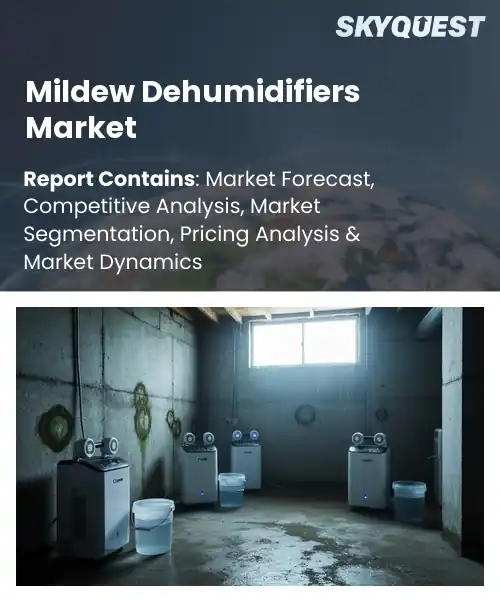
Mildew Dehumidifiers Market
Report ID: SQMIG25H2141
Report ID: SQMIG25H2141
[email protected]
USA +1 351-333-4748
Report ID:
SQMIG25H2141 |
Region:
Global |
Published Date: July, 2026
Pages:
157
|Tables:
143
|Figures:
78


Global Mildew Dehumidifiers Market size was valued at USD 512.6 Million in 2024 and is poised to grow from USD 542.84 Million in 2025 to USD 858.7 Million by 2033, growing at a CAGR of 5.9% during the forecast period (2026-2033).
The global mildew dehumidifiers market trends consists of equipment designed to extract moisture from indoor environments where the growth of fungus can pose a threat to health and property. This is because of a greater awareness of the health problems caused by mold and stricter building codes that require humidity controls for homes, businesses and industry. The market started in the late 1990s, when portable units were deployed to reduce seasonal dampness in temperate climates, and by the 2010s, the incorporation of integrated smart sensors led to greater uptake in high-value real estate and data centers. This shift from reactive remediation to proactive prevention sees dehumidifiers emerging as key players in the modern climate-management solutions for sustainable indoor environments.
The market's key growth driver is the increasing demand for energy-efficient humidity control in vulnerable locations, which creates a direct cause-and-effect relationship between extreme weather conditions and the requirement for dehumidification. With heatwaves becoming more intense, moisture levels inside buildings are going up, forcing property managers to install units that combine low‑energy compressors with IoT monitoring. In the real world, hospitals in Southeast Asia rely on networked dehumidifiers to safeguard sensitive equipment, and wineries in Europe need humidity regulation to maintain wine quality. These applications generate recurring income streams for manufacturers and create opportunities for service-based models, growing the long-term potential of the mildew dehumidifiers market growth.
How is AI Enhancing Efficiency in the Mildew Dehumidifiers Market?
Artificial intelligence is reshaping the mildew dehumidifiers market share, turning traditional units into smart systems that respond to environmental data. The ML models look at the humidity patterns and predict the risk of mold formation so that devices can adjust their capacity proactively. Sensors integrated into the system send real-time data to cloud platforms, where algorithms optimize fan speeds and heating cycles to maximize moisture removal. Users get mobile app insights and maintenance alerts, minimizing downtime and extending product life. Manufacturers use AI to streamline production, virtually test performance, and tailor features for residential and commercial use, encouraging wider adoption.
Haier, October 2025, has introduced an AI-powered dehumidifier featuring adaptive moisture sensors that automatically adjust humidity to reduce energy waste and boost mold control, a move that opens up the market to greater smart efficiency.
Market snapshot - (2026-2033)
Global Market Size
USD 512.6 Million
Largest Segment
Refrigerant Dehumidifiers
Fastest Growth
Desiccant Dehumidifiers
Growth Rate
5.9% CAGR
To get more insights on this market click here to Request a Free Sample Report
Global mildew dehumidifiers market is segmented by product type, capacity, application, distribution channel, end user and region. Based on product type, the market is segmented into refrigerant dehumidifiers and desiccant dehumidifiers. Based on capacity, the market is segmented into below 30 pints/day, 30–50 pints/day and above 50 pints/day. Based on application, the market is segmented into residential, commercial and industrial. Based on distribution channel, the market is segmented into online retail, specialty stores and home improvement stores. Based on end user, the market is segmented into household, commercial facilities and industrial facilities. Based on region, the market is segmented into North America, Europe, Asia Pacific, Latin America and Middle East & Africa.
Refrigerant dehumidifiers segment dominates because its reliance on ambient cooling cycles aligns with the core moisture removal technology required for mildew control. These units efficiently condense water vapor, delivering consistent performance in residential and commercial settings. Their mature engineering, ready made components, and established supply chains reduce cost and simplify integration, making them the preferred choice for most buyers. Consequently, they capture the majority of demand across the Mildew Dehumidifiers Market.
Meanwhile, desiccant dehumidifiers emerge as the most rapidly expanding area in the mildew dehumidifiers market. Their ability to operate effectively at low temperatures and in high humidity zones drives adoption in specialty applications such as archival storage and wine cellars. Innovation in silica gel technology and rising awareness of energy efficiency amplify their growth trajectory.
Below 30 pints per day segment dominates because its compact size and lower power draw meet the needs of typical household environments where space is limited. Consumers favor units that can be placed discreetly while still delivering sufficient moisture removal for everyday mildew prevention. The ease of installation and affordability further reinforce its market leadership, driving widespread penetration across residential niches.
Conversely, above 50 pints per day capacity is witnessing the strongest growth momentum in the mildew dehumidifiers market. Large scale facilities such as warehouses and manufacturing plants require high throughput to prevent mold spread, prompting investments in robust units. Emerging regulations on indoor air quality and the need for continuous operation accelerate demand, unlocking new expansion opportunities.
To get detailed segments analysis, Request a Free Sample Report
Asia Pacific leads the pack due to the convergence of advanced manufacturing capabilities, increased consumer awareness of indoor air quality, and strong governmental emphasis on moisture control in residential and commercial construction. The region has a deep talent pool of engineering expertise that continues to innovate product and deliver very efficient, compact dehumidification solutions. The demand is further boosted by trends in urbanization towards dense living conditions where moisture management is essential. Moreover, widespread acceptance of green building standards promotes the use of moisture control technologies, placing manufacturers in Japan and South Korea at the top of the market and export potential.
Mildew dehumidifiers market outlook in Japan reflects a sophisticated consumer base that values energy efficiency and compact design. Manufacturers leverage a culture of precision engineering to deliver devices with superior reliability, aligning with stringent building codes that promote moisture regulation. The strong distribution network and high penetration of smart home ecosystems also support product adoption across residential and hospitality sectors, reinforcing Japan’s reputation as a hub for cutting‑edge dehumidification technology.
Mildew dehumidifiers market forecast in South Korea is shaped by rapid urban development and a proactive stance on indoor environmental health. Local producers capitalize on strong research institutions to integrate smart sensors and IoT connectivity, meeting consumer expectations for controllable and responsive solutions. Government incentives for energy‑saving appliances further stimulate market growth, while the export‑focused mindset of South Korean manufacturers expands reach into neighboring markets, solidifying the nation’s influential role within the regional landscape.
The North American market is being driven by growing awareness of health concerns related to mold, stringent building codes that mandate moisture control, and an increasing demand for smart home integration. Indoor air quality is a growing concern for consumers, and both residential and commercial operators are investing in reliable dehumidification systems. Advances in technology mean simple-to-use interfaces, remote monitoring and energy-efficient operation that fits in with sustainability goals. Mature retail outlets and extensive distribution networks ensure widespread availability, and professional installation and service networks increase consumer confidence and help keep the momentum of the market alive across the United States and Canada.
Mildew dehumidifiers market regional outlook in the United States is characterized by a diverse consumer base that seeks both high performance and convenience. The prevalence of climate zones with elevated humidity drives adoption in residential, hospitality, and industrial settings. Integration with home automation platforms meets the demand for seamless control, while regulatory emphasis on indoor health standards reinforces product necessity. Strong brand presence and extensive service networks further accelerate market penetration throughout the nation.
Mildew dehumidifiers market regional forecast in Canada benefits from a climate that often confronts seasonal moisture challenges, prompting both homeowners and businesses to prioritize dehumidification. Consumers value robust, energy‑conserving designs that can operate efficiently in colder environments. Government guidelines encouraging healthy indoor conditions complement growing awareness of mold risks, fostering a market environment where advanced, reliable dehumidification solutions are increasingly sought after.
Europe is consolidating its lead with stringent environmental directives, a solid engineering tradition and growing consumer interest in health-oriented living spaces. The push for sustainability in the region is creating a market for low-energy dehumidifiers that meet strict performance standards. Working together on research projects across the continent encourages innovation, and the outcome is highly efficient, yet smartly connected products. Also, the large retrofitting of older building stock to meet moisture-control standards creates new demand channels. Well-developed distribution systems allow rapid diffusion of markets across member states.
Mildew dehumidifiers market analysis in Germany leverages a heritage of precision manufacturing and a regulatory landscape that mandates strict moisture control in construction. Consumers appreciate high‑efficiency units that integrate seamlessly with building management systems, reflecting a national emphasis on energy conservation. Strong collaborations between manufacturers and technical institutes accelerate product innovation, while a dense network of specialized retailers supports broad market reach.
Mildew dehumidifiers market penetration in the United Kingdom is driven by heightened public awareness of damp‑related health issues and a robust framework of building standards. Homeowners and commercial operators alike prioritize controllable, low‑noise solutions that align with contemporary interior designs. The rise of smart home technology encourages adoption of connected dehumidifiers, while an active service sector ensures reliable after‑sales support, reinforcing market confidence.
Mildew dehumidifiers industry in France reflects a strong cultural emphasis on indoor comfort and aesthetic integration. Consumers favor discreet, high‑performance devices that complement modern décor while delivering consistent humidity regulation. National energy policies promote the uptake of efficient appliances, and collaborative research across French engineering schools fuels ongoing product refinement. A well‑developed distribution chain further facilitates market accessibility throughout the country.
To know more about the market opportunities by region and country, click here to
Buy The Complete Report
Rising Demand for Moisture Control
Regulatory Standards Encourage Compliance
High Initial Capital Expenditure
Limited Consumer Awareness
Request Free Customization of this report to help us to meet your business objectives.
The global mildew dehumidizer market is characterized by strong competition among established appliance manufacturers and commercial humidity-control specialists that continue to expand their portfolios through smart-home integration, improved energy efficiency, and environmentally friendly refrigerant technologies. Companies are investing in Wi-Fi-enabled controls, automatic humidity sensing, quieter operation, and compact designs while strengthening their presence through e-commerce platforms and regional distribution networks. Growing awareness of indoor air quality, mold prevention, and energy-efficient home appliances continues to encourage innovation across both residential and commercial dehumidification solutions.
Top Player’s Company Profile
Recent Developments in the Mildew Dehumidifiers Market
SkyQuest’s ABIRAW (Advanced Business Intelligence, Research & Analysis Wing) is our Business Information Services team that Collects, Collates, Correlates, and Analyses the Data collected by means of Primary Exploratory Research backed by robust Secondary Desk research. As per SkyQuest analysis, the global mildew dehumidifiers market is being propelled primarily by the rising demand for reliable moisture control as extreme weather and health concerns drive owners to install energy‑efficient units, while stringent regulatory standards that mandate humidity thresholds serve as a second catalyst encouraging broader adoption. The market’s main restraint remains the high upfront cost of advanced systems, which can deter budget‑conscious buyers. Asia Pacific stands out as the dominant region, thanks to its strong manufacturing base and heightened indoor‑air‑quality awareness, and the Refrigerant dehumidifiers product type continues to capture the largest share due to its proven performance and cost advantages.
| Report Metric | Details |
|---|---|
| Market size value in 2024 | USD 512.6 Million |
| Market size value in 2033 | USD 858.7 Million |
| Growth Rate | 5.9% |
| Base year | 2024 |
| Forecast period | (2026-2033) |
| Forecast Unit (Value) | USD Million |
| Segments covered |
|
| Regions covered | North America (US, Canada), Europe (Germany, France, United Kingdom, Italy, Spain, Rest of Europe), Asia Pacific (China, India, Japan, Rest of Asia-Pacific), Latin America (Brazil, Rest of Latin America), Middle East & Africa (South Africa, GCC Countries, Rest of MEA) |
| Companies covered |
|
| Customization scope | Free report customization with purchase. Customization includes:-
|
To get a free trial access to our platform which is a one stop solution for all your data requirements for quicker decision making. This platform allows you to compare markets, competitors who are prominent in the market, and mega trends that are influencing the dynamics in the market. Also, get access to detailed SkyQuest exclusive matrix.
Table Of Content
Executive Summary
Market overview
Parent Market Analysis
Market overview
Market size
KEY MARKET INSIGHTS
COVID IMPACT
MARKET DYNAMICS & OUTLOOK
Market Size by Region
KEY COMPANY PROFILES
Methodology
For the Mildew Dehumidifiers Market, our research methodology involved a mixture of primary and secondary data sources. Key steps involved in the research process are listed below:
1. Information Procurement: This stage involved the procurement of Market data or related information via primary and secondary sources. The various secondary sources used included various company websites, annual reports, trade databases, and paid databases such as Hoover's, Bloomberg Business, Factiva, and Avention. Our team did 45 primary interactions Globally which included several stakeholders such as manufacturers, customers, key opinion leaders, etc. Overall, information procurement was one of the most extensive stages in our research process.
2. Information Analysis: This step involved triangulation of data through bottom-up and top-down approaches to estimate and validate the total size and future estimate of the Mildew Dehumidifiers Market.
3. Report Formulation: The final step entailed the placement of data points in appropriate Market spaces in an attempt to deduce viable conclusions.
4. Validation & Publishing: Validation is the most important step in the process. Validation & re-validation via an intricately designed process helped us finalize data points to be used for final calculations. The final Market estimates and forecasts were then aligned and sent to our panel of industry experts for validation of data. Once the validation was done the report was sent to our Quality Assurance team to ensure adherence to style guides, consistency & design.
Analyst Support
Customization Options
With the given market data, our dedicated team of analysts can offer you the following customization options are available for the Mildew Dehumidifiers Market:
Product Analysis: Product matrix, which offers a detailed comparison of the product portfolio of companies.
Regional Analysis: Further analysis of the Mildew Dehumidifiers Market for additional countries.
Competitive Analysis: Detailed analysis and profiling of additional Market players & comparative analysis of competitive products.
Go to Market Strategy: Find the high-growth channels to invest your marketing efforts and increase your customer base.
Innovation Mapping: Identify racial solutions and innovation, connected to deep ecosystems of innovators, start-ups, academics, and strategic partners.
Category Intelligence: Customized intelligence that is relevant to their supply Markets will enable them to make smarter sourcing decisions and improve their category management.
Public Company Transcript Analysis: To improve the investment performance by generating new alpha and making better-informed decisions.
Social Media Listening: To analyze the conversations and trends happening not just around your brand, but around your industry as a whole, and use those insights to make better Marketing decisions.
REQUEST FOR SAMPLE
 REQUEST FREE CUSTOMIZATION
Global Mildew Dehumidifiers Market size was valued at USD 512.6 Million in 2024 and is poised to grow from USD 542.84 Million in 2025 to USD 858.7 Million by 2033, growing at a CAGR of 5.9% during the forecast period (2026-2033).
Competition in the global mildew dehumidizer market is intensifying as established manufacturers Haier Smart Home, LG Electronics, Whirlpool, Honeywell and Munters broaden product lines and forge strategic distribution partnerships, while agile newcomers such as DryTech Industries pursue technology‑focused growth with portable desiccant units. This mix of portfolio expansion, alliance building and niche innovation drives market dynamics and shapes future demand. 'Midea Group Co., Ltd.', 'Haier Smart Home Co., Ltd.', 'Whirlpool Corporation', 'LG Electronics Inc.', 'Panasonic Holdings Corporation', 'Honeywell International Inc.', 'Danby Products Ltd.', 'Frigidaire', 'GE Appliances', 'De'Longhi S.p.A.', 'Condair Group AG', 'Munters Group AB', 'Bry-Air (Asia) Pvt. Ltd.', 'Aprilaire', 'Quest Climate', 'Ebac Group Ltd.', 'Meaco (U.K.) Limited', 'Wood's AB', 'Trotec GmbH', 'Dehumidifier Corporation of America'
The increasing emphasis on indoor air quality across residential and commercial buildings drives demand for effective moisture management, prompting installers and owners to seek reliable mildew dehumidifiers. This heightened awareness encourages adoption of advanced units that can maintain optimal humidity levels, reduce mold proliferation, and protect structural integrity, thereby expanding market activity as stakeholders prioritize long‑term health and asset preservation over short‑term cost considerations. Industry practitioners also value the energy‑efficient designs that align with sustainability goals, further reinforcing purchase decisions and fostering broader distribution networks.
Smart Sensor Integration: Manufacturers are embedding IoT‑enabled sensors directly into dehumidifier units, allowing real‑time monitoring of humidity levels, temperature, and device performance. This connectivity enables predictive maintenance, automated adjustments, and remote management via mobile platforms, reducing energy waste and extending product lifespan. End‑users benefit from customized drying cycles that respond to specific mold‑prone environments, while commercial operators gain actionable data for facility optimization. The seamless integration of smart sensors is reshaping product differentiation and driving demand for more intelligent, adaptable mildew control solutions.
Why does Asia Pacific Dominate the Global Mildew Dehumidifiers Market? |@12


Want to customize this report? This report can be personalized according to your needs. Our analysts and industry experts will work directly with you to understand your requirements and provide you with customized data in a short amount of time. We offer $1000 worth of FREE customization at the time of purchase.
Feedback From Our Clients


 USA (+1) 351-333-4748

