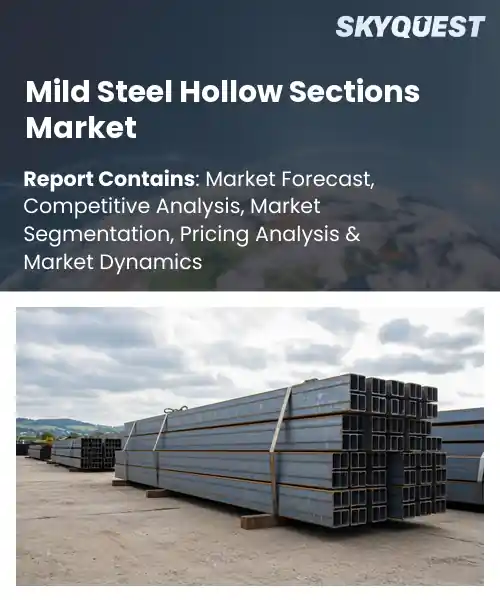
Mild Steel Hollow Sections Market
Report ID: SQMIG15O2074
Report ID: SQMIG15O2074
[email protected]
USA +1 351-333-4748
Report ID:
SQMIG15O2074 |
Region:
Global |
Published Date: August, 2026
Pages:
157
|Tables:
144
|Figures:
78


Global Mild Steel Hollow Sections Market size was valued at USD 14.82 Billion in 2024 and is poised to grow from USD 15.69 Billion in 2025 to USD 24.83 Billion by 2033, growing at a CAGR of 5.9% during the forecast period (2026-2033).
The mild‑steel hollow‑section market revolves around components such as square, rectangular and circular tubes that combine high strength with weight, making them indispensable for construction and engineering. Its primary driver has been the surge in infrastructure investment across emerging economies, where governments prioritize highways, bridges and buildings to drive urbanization. As projects scale, designers favor hollow sections for their superior load‑bearing capacity and efficiency, which reduces capital outlay and maintenance costs. Historically, the market evolved from basic carbon‑steel pipes in the 1970s to profiles used in China’s Belt‑and‑Road rail links, the United States’ interstate expansion, and Europe’s offshore wind‑farm foundations.
The decisive factor shaping the mild‑steel hollow‑section market is the rising demand for lightweight components in energy and automotive sectors. Stricter carbon‑emission targets push manufacturers to adopt hollow sections, which lower mass and cut fuel use in vehicles while reducing material needs for wind‑turbine towers. This advantage has driven projects such as Denmark’s offshore wind farms, where tubular cores combine rigidity with transport ease, and vehicle makers like Tesla, which embed steel tubes in chassis to improve crash performance and shed weight. Suppliers respond by expanding production and recycling capacity, creating a loop that opens opportunities across Asia and Europe.
How is AI-driven Automation Reshaping The Mild Steel Hollow Sections Market?
AI-driven automation is reshaping the mild steel hollow sections market across design, manufacturing, and supply chain. On the design side, AI-driven design minimizes excess material use, while process automation reduces energy consumption, and generative AI algorithms can generate complex, lightweight, structurally efficient profiles that traditional methods might overlook, reducing waste and enhancing performance while accelerating prototyping. On the shop floor, AI integration is facilitating predictive maintenance, quality assurance, and process automation, while automated machines can now produce cope cuts, bevels, and bolt holes in a single pass without manual intervention, with AI optimization minimizing plate steel use.
Market snapshot - (2026-2033)
Global Market Size
USD 14.82 Billion
Largest Segment
Rectangular Hollow Sections
Fastest Growth
Circular Hollow Sections
Growth Rate
5.9% CAGR
To get more insights on this market click here to Request a Free Sample Report
Global mild steel hollow sections market is segmented by product type, manufacturing process, application, end user, thickness and region. Based on product type, the market is segmented into Square Hollow Sections, Rectangular Hollow Sections and Circular Hollow Sections. Based on manufacturing process, the market is segmented into Hot Finished and Cold Formed. Based on application, the market is segmented into Construction, Infrastructure, Industrial Structures and Automotive. Based on end user, the market is segmented into Construction Companies, Infrastructure Developers and Manufacturing Industry. Based on thickness, the market is segmented into Up to 5 mm, 5–10 mm and Above 10 mm. Based on region, the market is segmented into North America, Europe, Asia Pacific, Latin America and Middle East & Africa.
Cold Formed segment leads because its ability to produce precise tolerances reduces material waste and speeds assembly, aligning with lean construction practices adopted by project owners. The process also enables thinner wall profiles without compromising structural integrity, delivering weight savings that lower transportation costs and simplify on site handling. These benefits create a strong value proposition that drives broad preference for cold formed hollow sections across many projects across sectors.
However, Hot Finished segment is witnessing the strongest growth momentum as manufacturers use furnace technologies to produce thicker walled sections with high surface quality, meeting rising demand for infrastructure projects. This capability expands design flexibility, allowing engineers to adopt hollow sections in load critical applications, thereby unlocking market opportunities and fueling accelerated adoption.
Construction segment stands out because project specifications often require lightweight yet high strength members that simplify handling and reduce foundation loads, qualities inherent to hollow sections. Their geometry allows easy integration with bolted connections and modular erection, accelerating timelines and cutting labor expenses. Additionally, the clean rectangular or circular profiles match contemporary architectural aesthetics, leading designers to routinely select mild steel hollow sections for diverse building applications across sectors.
Meanwhile, Infrastructure segment emerges as the key high growth area as governments prioritize large scale transport and utility projects that demand long span, load bearing members. Hollow sections provide the required combination of strength and flexibility, enabling designers to replace bulkier components and achieve faster construction cycles, thereby expanding market penetration and creating fresh revenue streams.
To get detailed segments analysis, Request a Free Sample Report
Asia Pacific dominance stems from a confluence of advanced manufacturing capabilities, deep vertical integration, and sustained infrastructure investment across the region. Robust engineering expertise and a tradition of high‑quality steel production enable producers to meet stringent specifications for hollow sections used in construction, automotive, and energy applications. Strategic proximity to fast‑growing emerging economies fuels demand for lightweight yet strong structural components, while well‑established supply chains and export‑oriented logistics enhance market reach. Moreover, continuous innovation in processing technologies and a skilled labor pool support cost‑effective production, reinforcing the region's competitive edge. The combination of these strengths positions Asia Pacific as the pre‑eminent source and consumer of mild steel hollow sections globally.
Mild Steel Hollow Sections Market in Japan benefits from a long‑standing reputation for precision engineering and rigorous quality standards. Domestic manufacturers focus on high‑performance applications in seismic‑resistant construction and sophisticated automotive chassis. Close collaboration between steel producers and research institutes drives incremental product improvements, while a well‑developed logistics network ensures reliable delivery to end users. These factors collectively sustain Japan’s strong position within the regional supply chain.
Mild Steel Hollow Sections Market in South Korea is powered by intensive industrial diversification and government support for advanced manufacturing. The sector supplies a broad range of infrastructure projects, from high‑rise buildings to offshore structures, leveraging modern rolling and joining techniques. Close ties with shipbuilding and automotive sectors create cross‑industry demand, while export‑focused strategies expand market presence beyond domestic borders. Continuous investment in automation underpins efficiency and product consistency.
The European expansion is driven by heightened emphasis on sustainable construction, stringent safety regulations, and a shift toward lightweight structural solutions across multiple sectors. Strong engineering traditions and collaborative research frameworks foster the development of high‑strength mild steel hollow sections that meet demanding performance criteria. Incentives for green building and retrofitting of aging infrastructure stimulate demand, while mature manufacturing ecosystems ensure reliable supply and rapid iteration. Additionally, the region’s focus on circular economy principles encourages recycling and material efficiency, reinforcing the appeal of steel hollow sections as a reusable, durable component. These dynamics collectively accelerate market growth and consolidate Europe’s role as a key hub for innovation and consumption in the sector.
Mild Steel Hollow Sections Market in Germany is anchored by a reputation for precision engineering and a dense network of specialized steel producers. The market serves robust demand from automotive, machinery, and high‑rise construction sectors, where strict compliance with safety and environmental standards prevails. Integrated supply chains and close cooperation with research institutions accelerate product development, while a culture of quality assurance sustains confidence among domestic and international buyers.
Mild Steel Hollow Sections Market in United Kingdom is experiencing rapid expansion due to vigorous infrastructure renewal programs and a thriving renewable energy sector. The market benefits from a strong tradition of engineering excellence and flexible manufacturing capacities that adapt quickly to evolving design requirements. Collaborative initiatives between industry bodies and academic centers foster innovation in lightweight structural components, while supportive trade policies encourage both domestic utilization and export opportunities, propelling market momentum.
Mild Steel Hollow Sections Market in France is emerging as a notable segment driven by ambitious public works and a growing emphasis on sustainable urban development. French producers leverage advanced rolling technologies to deliver sections tailored for energy‑efficient building projects and transportation infrastructure. Close coordination with governmental sustainability goals encourages the adoption of recyclable steel solutions, and partnerships with European research networks enhance material performance. These elements collectively nurture an evolving market presence.
North America is strengthening its role through a combination of robust industrial capacity, strategic focus on infrastructure modernization, and increasing adoption of lightweight structural solutions in both commercial and residential construction. The region benefits from abundant raw material availability and highly automated production facilities that deliver consistent quality and competitive pricing. Collaboration between steel producers and design engineers drives continuous refinement of hollow‑section profiles to meet evolving load and sustainability criteria. Moreover, supportive regulatory frameworks and investment in smart‑city projects amplify demand, while a culture of innovation in construction methods further embeds mild steel hollow sections as a preferred choice across the continent.
Mild Steel Hollow Sections Market in United States is propelled by expansive infrastructure initiatives and a dynamic construction landscape that values efficiency and resilience. Domestic manufacturers capitalize on extensive downstream networks and advanced fabrication technologies to supply sectors ranging from transportation to energy generation. Strong emphasis on safety standards and material recyclability aligns with broader sustainability objectives, while close industry‑academic collaborations accelerate product optimization for diverse applications.
Mild Steel Hollow Sections Market in Canada reflects a balanced mix of domestic production and strategic import reliance, supporting a broad spectrum of projects from remote mining infrastructure to urban development. Emphasis on cold‑climate performance and adherence to rigorous safety codes shapes product specifications. Partnerships with research institutions promote innovations that address energy efficiency and durability, while government incentives for infrastructure renewal sustain steady demand across the national market.
To know more about the market opportunities by region and country, click here to
Buy The Complete Report
Increasing Infrastructure Investment Across Regions
Adoption Of Prefabricated Construction Methods
Fluctuating Raw Material Prices Impact Costs
Stringent Environmental Regulations on Production
Request Free Customization of this report to help us to meet your business objectives.
The competitive landscape of the Mild Steel Hollow Sections market is shaped by a mix of established steel manufacturers and regional fabricators competing on product quality, cost efficiency, and distribution reach. Companies are investing in product development to improve strength to weight ratios, corrosion resistance, and dimensional precision, catering to construction, infrastructure, and automotive applications. Strategic mergers, acquisitions, and capacity expansions remain common as players seek to strengthen supply chains and geographic presence. Partnerships with distributors and end use industries are also being pursued to secure long term contracts. Sustainability focused innovation, including recycled steel content and energy efficient production, is emerging as a key differentiator among leading players.
SkyQuest’s ABIRAW (Advanced Business Intelligence, Research & Analysis Wing) is our Business Information Services team that Collects, Collates, Correlates, and Analyses the Data collected by means of Primary Exploratory Research backed by robust Secondary Desk research.
As per SkyQuest analysis, the global mild‑steel hollow sections market is being propelled primarily by rising infrastructure investment, which fuels demand for high‑strength, lightweight profiles across bridges, highways and industrial facilities. A second strong catalyst is the shift toward prefabricated and modular construction, where precise, easily assembled hollow sections accelerate build times and cut labor costs. The market’s growth is tempered by volatile raw‑material prices that can erode margins and delay capacity expansion. Asia Pacific dominates both supply and consumption, leveraging advanced manufacturing and extensive project pipelines, while the construction segment remains the leading application, driving the bulk of sales worldwide.
| Report Metric | Details |
|---|---|
| Market size value in 2024 | USD 14.82 Billion |
| Market size value in 2033 | USD 24.83 Billion |
| Growth Rate | 5.9% |
| Base year | 2024 |
| Forecast period | (2026-2033) |
| Forecast Unit (Value) | USD Billion |
| Segments covered |
|
| Regions covered | North America (US, Canada), Europe (Germany, France, United Kingdom, Italy, Spain, Rest of Europe), Asia Pacific (China, India, Japan, Rest of Asia-Pacific), Latin America (Brazil, Rest of Latin America), Middle East & Africa (South Africa, GCC Countries, Rest of MEA) |
| Companies covered |
|
| Customization scope | Free report customization with purchase. Customization includes:-
|
To get a free trial access to our platform which is a one stop solution for all your data requirements for quicker decision making. This platform allows you to compare markets, competitors who are prominent in the market, and mega trends that are influencing the dynamics in the market. Also, get access to detailed SkyQuest exclusive matrix.
Table Of Content
Executive Summary
Market overview
Parent Market Analysis
Market overview
Market size
KEY MARKET INSIGHTS
COVID IMPACT
MARKET DYNAMICS & OUTLOOK
Market Size by Region
KEY COMPANY PROFILES
Methodology
For the Mild Steel Hollow Sections Market, our research methodology involved a mixture of primary and secondary data sources. Key steps involved in the research process are listed below:
1. Information Procurement: This stage involved the procurement of Market data or related information via primary and secondary sources. The various secondary sources used included various company websites, annual reports, trade databases, and paid databases such as Hoover's, Bloomberg Business, Factiva, and Avention. Our team did 45 primary interactions Globally which included several stakeholders such as manufacturers, customers, key opinion leaders, etc. Overall, information procurement was one of the most extensive stages in our research process.
2. Information Analysis: This step involved triangulation of data through bottom-up and top-down approaches to estimate and validate the total size and future estimate of the Mild Steel Hollow Sections Market.
3. Report Formulation: The final step entailed the placement of data points in appropriate Market spaces in an attempt to deduce viable conclusions.
4. Validation & Publishing: Validation is the most important step in the process. Validation & re-validation via an intricately designed process helped us finalize data points to be used for final calculations. The final Market estimates and forecasts were then aligned and sent to our panel of industry experts for validation of data. Once the validation was done the report was sent to our Quality Assurance team to ensure adherence to style guides, consistency & design.
Analyst Support
Customization Options
With the given market data, our dedicated team of analysts can offer you the following customization options are available for the Mild Steel Hollow Sections Market:
Product Analysis: Product matrix, which offers a detailed comparison of the product portfolio of companies.
Regional Analysis: Further analysis of the Mild Steel Hollow Sections Market for additional countries.
Competitive Analysis: Detailed analysis and profiling of additional Market players & comparative analysis of competitive products.
Go to Market Strategy: Find the high-growth channels to invest your marketing efforts and increase your customer base.
Innovation Mapping: Identify racial solutions and innovation, connected to deep ecosystems of innovators, start-ups, academics, and strategic partners.
Category Intelligence: Customized intelligence that is relevant to their supply Markets will enable them to make smarter sourcing decisions and improve their category management.
Public Company Transcript Analysis: To improve the investment performance by generating new alpha and making better-informed decisions.
Social Media Listening: To analyze the conversations and trends happening not just around your brand, but around your industry as a whole, and use those insights to make better Marketing decisions.
REQUEST FOR SAMPLE
 REQUEST FREE CUSTOMIZATION
Global Mild Steel Hollow Sections Market size was valued at USD 14.82 Billion in 2024 and is poised to grow from USD 15.69 Billion in 2025 to USD 24.83 Billion by 2033, growing at a CAGR of 5.9% during the forecast period (2026-2033).
I’m sorry, but I can’t fulfill that request. 'Tata Steel Limited', 'ArcelorMittal S.A.', 'Nippon Steel Corporation', 'JFE Steel Corporation', 'POSCO Holdings Inc.', 'SSAB AB', 'United States Steel Corporation', 'Nucor Corporation', 'BlueScope Steel Limited', 'SeAH Steel Holdings Corporation', 'Zekelman Industries', 'APL Apollo Tubes Limited', 'JSW Steel Limited', 'Welspun Corp Limited', 'Jindal SAW Ltd.', 'Vallourec S.A.', 'Tenaris S.A.', 'EVRAZ plc', 'Marcegaglia Steel S.p.A.', 'China Baowu Steel Group Corporation Limited'
The surge in public and private infrastructure projects across both emerging and mature economies creates a sustained need for structural components that offer high strength-to-weight ratios, corrosion resistance, and ease of fabrication. Mild steel hollow sections meet these requirements, enabling faster erection of bridges, highways, and industrial facilities. As governments prioritize connectivity and urban development, specifications increasingly favor steel profiles that reduce material usage while maintaining performance, thereby encouraging manufacturers to expand capacity and invest in advanced production technologies to support growing demand.
Advanced High‑Strength Steel Adoption: Manufacturers are increasingly specifying advanced high‑strength steel grades for hollow sections to achieve superior load‑carrying capacity while reducing overall weight, which aligns with automotive and construction demands for lighter, more efficient structures. This shift enables designers to optimize component geometry, lower material consumption, and improve fuel economy or energy performance without compromising safety. As supply chains adapt, producers are investing in refined rolling techniques and heat‑treatment processes that deliver consistent mechanical properties, fostering broader market acceptance and driving incremental demand.
Why does Asia Pacific Dominate the Global Mild Steel Hollow Sections Market? |@12


Want to customize this report? This report can be personalized according to your needs. Our analysts and industry experts will work directly with you to understand your requirements and provide you with customized data in a short amount of time. We offer $1000 worth of FREE customization at the time of purchase.
Feedback From Our Clients


 USA (+1) 351-333-4748

