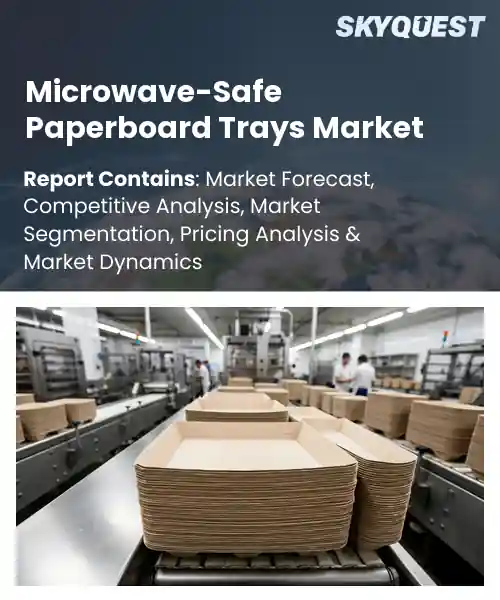
Microwave-Safe Paperboard Trays Market
Report ID: SQMIG15H2189
Report ID: SQMIG15H2189
[email protected]
USA +1 351-333-4748
Report ID:
SQMIG15H2189 |
Region:
Global |
Published Date: March, 2026
Pages:
157
|Tables:
117
|Figures:
77


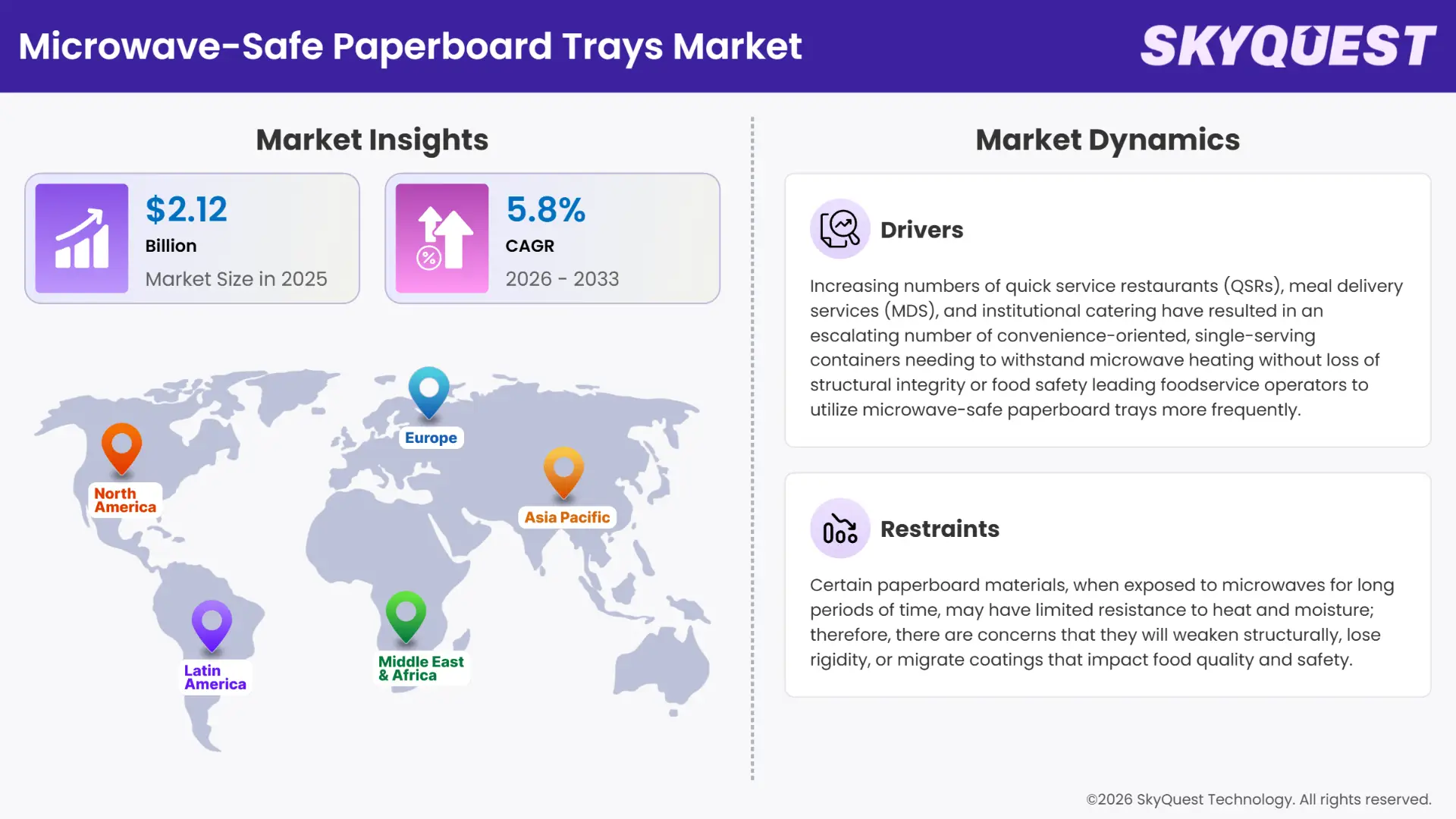
Global Microwave-Safe Paperboard Trays Market size was valued at USD 2.0 Billion in 2024 and is poised to grow from USD 2.12 Billion in 2025 to USD 3.32 Billion by 2033, growing at a CAGR of 5.8% during the forecast period (2026-2033).
Key Takeaways: Market Trends & Insights
The microwave-safe paperboard trays industry is experiencing an increase in demand due to consumers' needs for a convenient product that is also environmentally friendly. The microwave paperboard trays industry falls within the packaged food and drink industry, where manufacturers create custom-engineered paperboard materials that can be used for microwave heating while minimizing the use of plastic. This is significant, as it provides consumers with a safe way to reheat their prepared food and helps companies achieve their environmental waste reduction goals through less material being used in disposable plastic products.
There has been a shift in product development from simple uncoated cartons to more complex coated and molded containers with barrier coatings and inks. More frozen food manufacturers and airlines are starting to use paperboard trays instead of plastic trays for their products and services. The increase in use of paperboard trays has resulted from increased regulatory pressure and changing consumer preferences toward recyclable and compostable packaging products. As a result of this increase in demand for paperboard trays, the demand for functional barrier coatings, thermal stability, material innovation supplies, and the need for capacity upgrades have also increased.
These types of investments provide companies with the necessary resources to expand production and reduce their unit costs so that they can produce a paperboard tray at a price point to sell to their customers through various distribution channels like frozen food retail lines.
How is Automation Improving Manufacturing Efficiency in the Microwave-safe Paperboard Trays Market?
By implementing automated solutions for forming, sealing, and inspecting paperboard trays, the manufacturing efficiency of microwave-safe paperboard trays is greatly increased. Some of the major technologies being used in production include robotic loading and unloading, thermoforming, tray making, vision-based quality checks, and data-driven line control. Increased demand for easy to recycle ready-to-eat meal formats is driving manufacturers to invest in flexible automated production cells that result in reduced material waste, improved package integrity, and shortened time to market. Recent developments in thermoforming and tray sealing equipment will allow for continued use of recyclable films and will facilitate improved production flow.
In January 2026, Harpak-ULMA introduced the TFX thermoformer, which is designed to shorten cycle times, stabilize process variation, and accommodate recyclable packaging materials using smart automation technology. Additionally, the TFX thermoformer will allow for faster product introductions and smoother connections with inspection and data systems, enabling producers to quickly increase the quantity of microwave-safe paperboard trays they produce while maintaining consistency and reducing waste.
To get more insights on this market click here to Request a Free Sample Report
Global microwave-safe paperboard trays market is segmented into material structure, functional coating, tray configuration, application domain and region. Based on material structure, the market is segmented into solid bleached sulfate (SBS) trays, C-PET laminated paperboard and pressed paperboard. Based on functional coating, the market is segmented into polyester (PET) coated, bio-based/compostable coatings and grease & moisture resistant barriers. Based on tray configuration, the market is segmented into single compartment trays, multi-compartment and dual-ovenable. Based on application domain, the market is segmented into frozen ready-to-eat meals, institutional food service and take-out & QSR. Based on region, the market is segmented into North America, Europe, Asia Pacific, Latin America and Middle East & Africa.
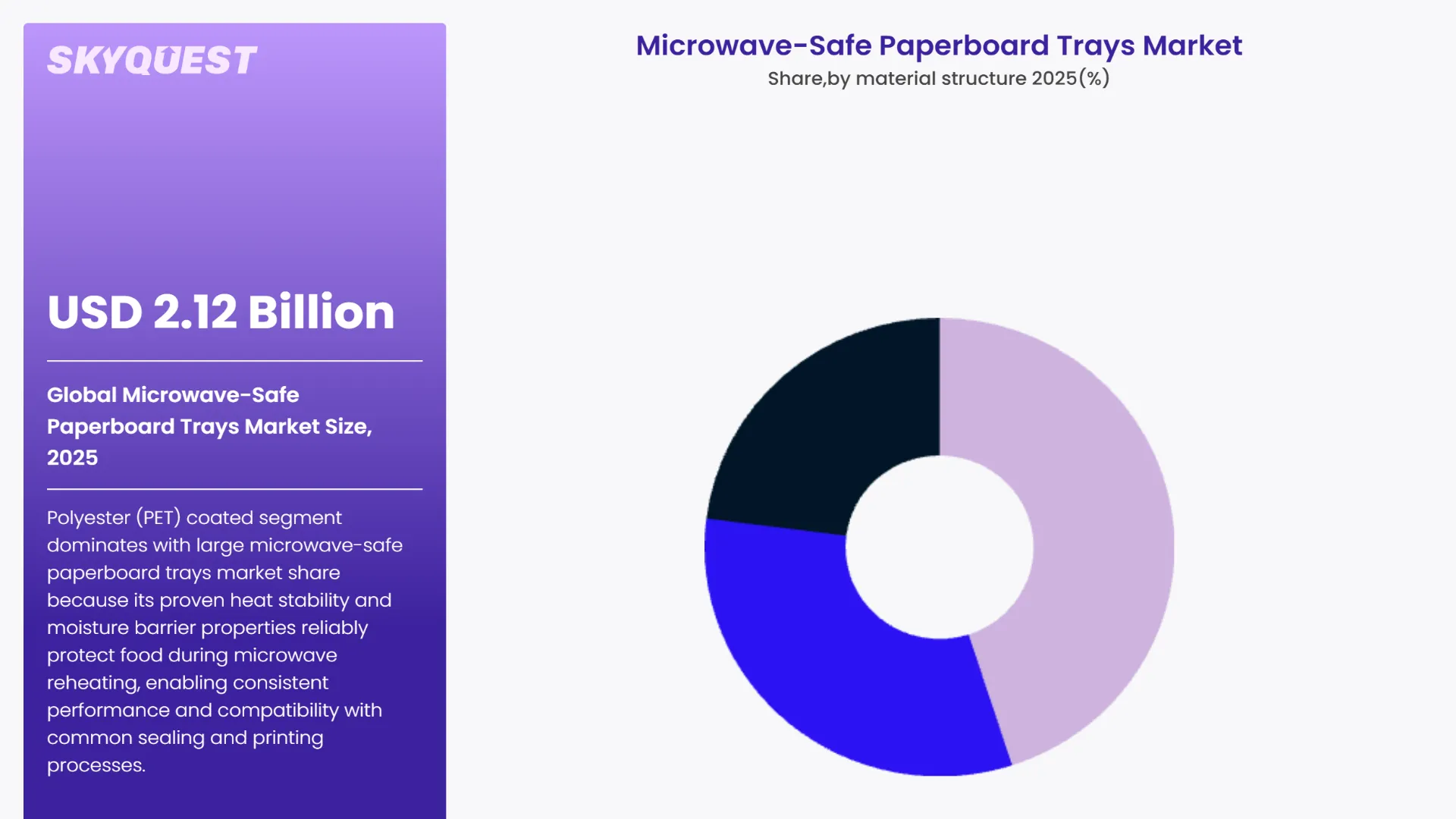
Polyester (PET) coated segment dominates with large microwave-safe paperboard trays market share because its proven heat stability and moisture barrier properties reliably protect food during microwave reheating, enabling consistent performance and compatibility with common sealing and printing processes. This allows for a reliable means of protecting food during microwave reheating, thereby providing consistent performance and compatibility with most sealing and printing processes. The existence of established manufacturing methods and supplier networks reduces the friction for converters to adopt PET, while the predictability and processing/cost efficiencies encourage brands to write specifications for PET coatings in a wide variety of products. Thus, reinforcing PET’s status as the default functional barrier in microwave-safe paperboard trays.
As per global microwave-safe paperboard trays market forecast, bio-based/compostable coatings are emerging as the fastest-growing area, driven by consumer demand for sustainable packaging and regulatory momentum favoring compostable options. Additionally, innovations in bio-polymer formulations and the certification pathway for these formulations potentially grant microwave compatibility for these coatings. Thereby creating opportunities for brands to differentiate their products, meet eco-conscious customer expectations, and create premium product listings that will generate demand as well as future market potential.
As per global microwave-safe paperboard trays market outlook, single compartment trays segment dominates because their simplicity and broad compatibility with diverse meal formats reduce manufacturing complexity while meeting core consumer convenience needs. This reduces the overall complexity of manufacturing and still meets most of the primary convenience needs of consumers. Since there is a high volume of products produced and the filling and sealing processes occur with fewer steps than multiple compartment ideas, there is less friction operationally for the food manufacturers using single-compartment trays. These efficiencies lead to being able to use single-compartment trays for a wide range of prepared takes-out meals and ready-to-eat meals, resulting in the dominant application for using this type of configuration of microwavable paperboard packaging.
As per global microwave-safe paperboard trays market analysis, dual-ovenable trays are currently the fastest-growing configuration due to the consumer's desire to use one container that can be cooked in both the oven and microwave without transferring to another container. There have been improvements in the materials and coatings utilized to manufacture dual-ovenable trays that allow for higher temperatures to be used, enabling the dual-ovens compatible containers to open the usage of these containers.
To get detailed segments analysis, Request a Free Sample Report
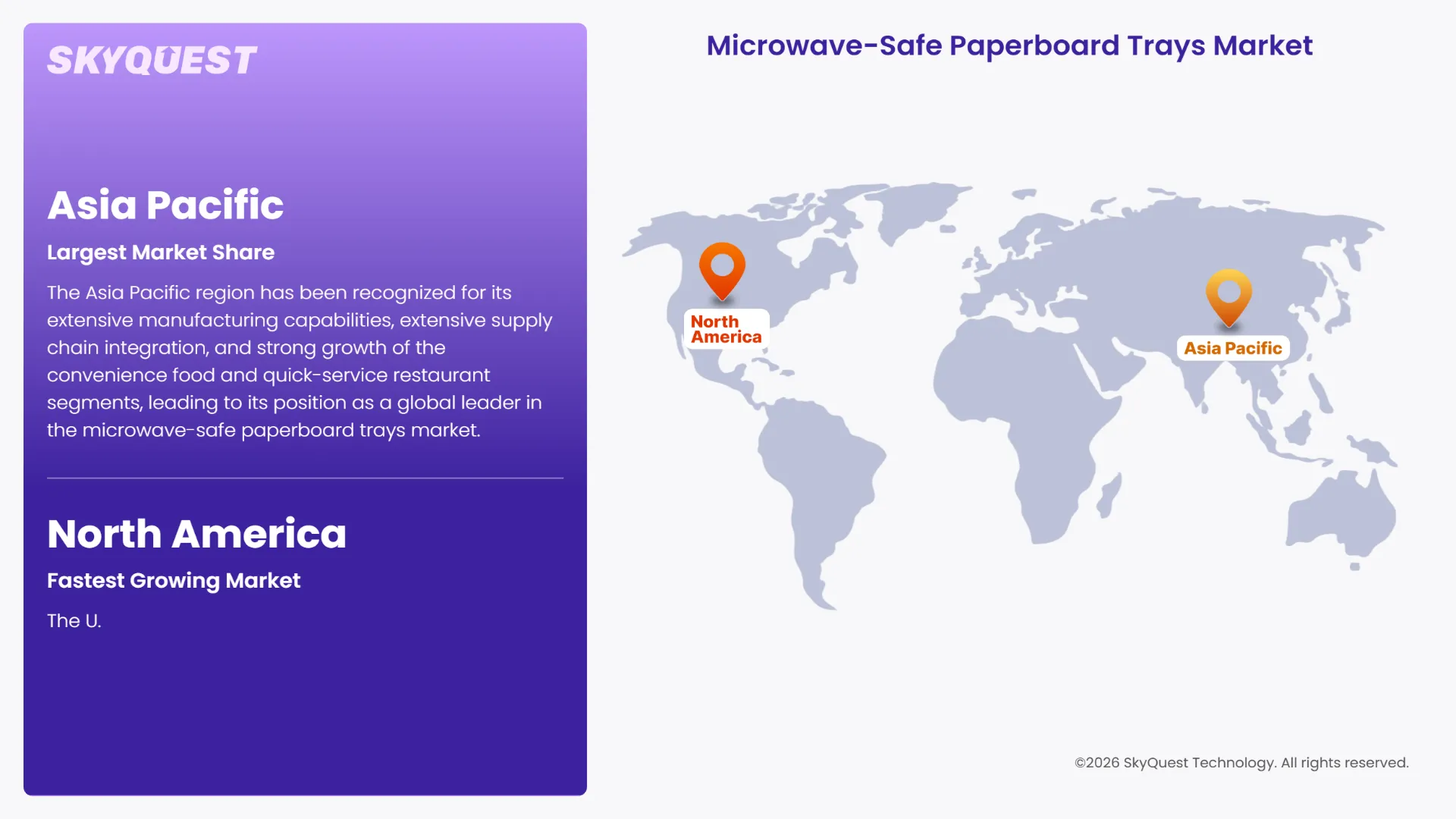
The Asia Pacific region has been recognized for its extensive manufacturing capabilities, extensive supply chain integration, and strong growth of the convenience food and quick-service restaurant segments, leading to its position as a global leader in the microwave-safe paperboard trays market. The robust raw material processing, low-cost production techniques, and fast adoption of recyclable and compostable tray designs have also played a critical role in the region's position of leadership on this product.
The microwave-safe paperboard trays market in Japan appears to be characterized by an emphasis on precision engineering and finish specifications, and very strict adherence to safety regulations that lead to improved products and ability to differentiate suppliers. The growing demand from the convenience retail segment, packaged meal kits, and urban consumers is creating demand for small and compact tray formats with an emphasis on the presentation of the tray contents. The close collaboration between packaging designers, food brands, and material converters has enabled packaging-related companies to rapidly create and produce prototypes and have been able to develop bio-degradable treatments.
The microwave-safe paperboard trays market in South Korea is primarily characterized by the rapid increase in meal replacement and meal delivery alternatives to the traditional way of preparing meals, which enhances the desirability of convenience and heat retention in the consumer's home. Manufacturers are placing a strong emphasis on rapid turnaround cycles, flexibility in tray manufacturing shapes and sizes, and advanced coating techniques to meet the requirements of retailers and food service providers. Collaborating closely with converts, suppliers, and online food services has enabled many manufacturers to develop new and improved products efficiently and to deliver them more efficiently.
North America microwave-safe paperboard trays market is growing quickly, mainly due to changing consumer behaviour, an increasing number of convenience foods, and an increasing emphasis on sustainable packaging in many markets. Microwavable products are in high demand at both retail and foodservice locations, and consumers are looking for trays that are thermally stable, recyclable, and visually appealing. As such, manufacturers are investing in new converting equipment, barrier chemistries, and supply chain efficiencies that enable them to produce locally, be responsive to microwave-market trends/customer needs and provide customization.
The U.S. microwave-safe paperboard trays market is largely driven by retailers and food service operators who seek trays with the following features: microwave durability, shelf appeal and recycling capabilities. The demand for private label products and quick service menus is driving suppliers towards greater scalability and flexibility in the manufacturing process. The partnership of converters and brand owners enables the development of the most suitable barrier solutions and tray formats for prepared meal or delivery packages.
The Canada microwave-safe paperboard trays market is influenced by a strong commitment to sustainable sourcing practices and by the availability of regionally based recycling systems that impact choices on material. While larger converters manufacture large quantities of trays for grocery, food service, and meal delivery markets; smaller converters perform shorter runs and develop localized innovation to support these same markets. Manufacturers and retailers working together advance the development of barrier technologies and performance in the microwave while supporting consumers' desire for recyclable and compostable alternatives.
The microwave-safe paperboard trays market in Europe continues to develop through increasingly focused efforts at enhancing circularity and defining common criteria for recyclability, both of which will drive the supply chain toward greater innovation in materials, as well as providing greater adoption of these new materials. Retailers have made continuing sustainability commitments, and regulatory requirements are pushing for the development of compostable products and easy to recycle tray systems with compatible barrier technologies. Barrier coating and substrate engineering specialists will leverage their technical capabilities to produce trays that will achieve microwave functionality while having meaningful environmental credentials.
The microwave-safe paperboard trays market in Germany is determined by highly technological development, converting capabilities, and emphasis on recyclability, all of which must be considered by converters to ensure their ability to provide end-users with a recyclable solution that can receive ample support from local waste management systems. Converters will utilize high-performance barrier coatings and automated machinery to satisfy their retail customers' demands for service and their food service customers' needs. There will be a collaborative effort between converters and research institutions, as well as between converters and material suppliers, to create recyclable and compostable tray solutions that meet microwave functional requirements. Retailer design requirements and sustainability initiatives will also contribute to the overall design of retail packaging and equipment used to produce it.
The microwave-safe paperboard trays market in the UK is influenced by the presence of large retail chains and the growing popularity of takeout and delivery; as well as by sustainability initiatives. Manufacturers of trays have developed lightweight, microwave-holding trays and recyclable barriers that suit delivery and reheating at home. Increased demand for private-label prepared meals and food service packaging creates a need for short production runs and distinct designs. Collaboration among industry members on recycling and certification promotes the use of compostable and recyclable tray systems.
Microwave-safe paperboard trays market in France balances upscale food service and prepared meal segment needs through premium presentation and microwave performance. As a result, converters focus on high-quality printing, tray shape, and barrier designs to preserve texture and flavor during microwaving. Co-development of differentiated tray formats with culinary companies is informed by the need for compostable and recyclable products that meet sustainability goals, and the desire of consumers to buy compostable and recyclable products. Partnerships between retailers and food service operators assist with testing microwave-safe performance and recyclability before certifying products.
To know more about the market opportunities by region and country, click here to
Buy The Complete Report
Rising Demand from Foodservice
Increasing numbers of quick service restaurants (QSRs), meal delivery services (MDS), and institutional catering have resulted in an escalating number of convenience-oriented, single-serving containers needing to withstand microwave heating without loss of structural integrity or food safety leading foodservice operators to utilize microwave-safe paperboard trays more frequently. This microwave-safe paperboard trays market trend is motivating manufacturers to expand their production capacity as well as develop new material formulations to accommodate today’s fast paced service and consumer convenience requirements. Thereby increasing their penetration into commercial markets and stimulating investments in supply chains and product development necessary to meet evolving operator specifications and end-user expectations.
Consumer Preference for Convenience
The demand for packaging that can be safely reheated is driving retailers and food brands to utilize microwave-safe paperboard trays to help improve the user experience by reducing meal preparation steps. The consumer-driven use of microwave-safe paperboard trays is encouraging brand owners to specify compliant paperboard products; supporting the development of private label products at retail; and promoting ongoing enhancements in product attributes.
Limited Heat Resistance Characteristics
Certain paperboard materials, when exposed to microwaves for long periods of time, may have limited resistance to heat and moisture; therefore, there are concerns that they will weaken structurally, lose rigidity, or migrate coatings that impact food quality and safety. This hesitancy limits the use of paperboard in applications requiring higher heat resistance, creates demand for alternative materials (or additional liners), and delays the overall transition from traditional packaging to more sustainable options.
Regulatory and Compliance Challenges
There are different types of food contact regulations across the world, and many of the food-contact safety standards continue to evolve. Therefore, it can be difficult for manufacturers who want to sell microwave-safe paperboard trays to several markets. Some of the difficulties stem from different testing methods and various certification requirements. Often, these manufacturers are required to reformulate, validate their products in different ways, or create different product lines. This adds significant time to getting the product to market and increases compliance costs for the manufacturer. Both of these issues can make it difficult for small manufacturers to grow the number of their products. Various approval processes and documentation result in a lack of speed to market and the ability to quickly develop or grow operations.
Request Free Customization of this report to help us to meet your business objectives.
Global competitive landscape for microwave-safe paperboard trays is driven by consolidation among large converters and by technology partnerships that accelerate fiber-based microwaveable solutions. Strategic M&A such as Huhtamaki acquiring full ownership of Laminor illustrates scale moves, while Pulpex’s consortium and Stora Enso tie up signal commercialization of microwave cured formed fiber and barrier innovations.
SkyQuest’s ABIRAW (Advanced Business Intelligence, Research & Analysis Wing) is our Business Information Services team that Collects, Collates, Correlates, and Analyses the Data collected by means of Primary Exploratory Research backed by robust Secondary Desk research.
As per SkyQuest analysis, the global microwave-safe paperboard trays market is propelled primarily by rising consumer demand for convenient meal formats paired with brand sustainability commitments, while a secondary driver is regulatory pressure and shifting preferences toward recyclable and compostable packaging that accelerate barrier and material innovation. Microwave-safe paperboard trays market growth is tempered by limited heat resistance in some paperboard constructions, which can restrict higher-temperature applications and slow wider adoption. Asia Pacific remains the dominant region due to concentrated manufacturing, integrated supply chains and large convenience-food channels, and Polyester PET coated trays lead the market due to proven heat stability, moisture barrier performance and established processing routes.
| Report Metric | Details |
|---|---|
| Market size value in 2024 | USD 2.0 Billion |
| Market size value in 2033 | USD 3.32 Billion |
| Growth Rate | 5.8% |
| Base year | 2024 |
| Forecast period | 2026-2033 |
| Forecast Unit (Value) | USD Billion |
| Segments covered |
|
| Regions covered | North America (US, Canada), Europe (Germany, France, United Kingdom, Italy, Spain, Rest of Europe), Asia Pacific (China, India, Japan, Rest of Asia-Pacific), Latin America (Brazil, Rest of Latin America), Middle East & Africa (South Africa, GCC Countries, Rest of MEA) |
| Companies covered |
|
| Customization scope | Free report customization with purchase. Customization includes:-
|
To get a free trial access to our platform which is a one stop solution for all your data requirements for quicker decision making. This platform allows you to compare markets, competitors who are prominent in the market, and mega trends that are influencing the dynamics in the market. Also, get access to detailed SkyQuest exclusive matrix.
Table Of Content
Executive Summary
Market overview
Parent Market Analysis
Market overview
Market size
KEY MARKET INSIGHTS
COVID IMPACT
MARKET DYNAMICS & OUTLOOK
Market Size by Region
KEY COMPANY PROFILES
Methodology
For the Microwave-Safe Paperboard Trays Market, our research methodology involved a mixture of primary and secondary data sources. Key steps involved in the research process are listed below:
1. Information Procurement: This stage involved the procurement of Market data or related information via primary and secondary sources. The various secondary sources used included various company websites, annual reports, trade databases, and paid databases such as Hoover's, Bloomberg Business, Factiva, and Avention. Our team did 45 primary interactions Globally which included several stakeholders such as manufacturers, customers, key opinion leaders, etc. Overall, information procurement was one of the most extensive stages in our research process.
2. Information Analysis: This step involved triangulation of data through bottom-up and top-down approaches to estimate and validate the total size and future estimate of the Microwave-Safe Paperboard Trays Market.
3. Report Formulation: The final step entailed the placement of data points in appropriate Market spaces in an attempt to deduce viable conclusions.
4. Validation & Publishing: Validation is the most important step in the process. Validation & re-validation via an intricately designed process helped us finalize data points to be used for final calculations. The final Market estimates and forecasts were then aligned and sent to our panel of industry experts for validation of data. Once the validation was done the report was sent to our Quality Assurance team to ensure adherence to style guides, consistency & design.
Analyst Support
Customization Options
With the given market data, our dedicated team of analysts can offer you the following customization options are available for the Microwave-Safe Paperboard Trays Market:
Product Analysis: Product matrix, which offers a detailed comparison of the product portfolio of companies.
Regional Analysis: Further analysis of the Microwave-Safe Paperboard Trays Market for additional countries.
Competitive Analysis: Detailed analysis and profiling of additional Market players & comparative analysis of competitive products.
Go to Market Strategy: Find the high-growth channels to invest your marketing efforts and increase your customer base.
Innovation Mapping: Identify racial solutions and innovation, connected to deep ecosystems of innovators, start-ups, academics, and strategic partners.
Category Intelligence: Customized intelligence that is relevant to their supply Markets will enable them to make smarter sourcing decisions and improve their category management.
Public Company Transcript Analysis: To improve the investment performance by generating new alpha and making better-informed decisions.
Social Media Listening: To analyze the conversations and trends happening not just around your brand, but around your industry as a whole, and use those insights to make better Marketing decisions.
REQUEST FOR SAMPLE
 REQUEST FREE CUSTOMIZATION
Global Microwave-Safe Paperboard Trays Market size was valued at USD 2.0 Billion in 2024 and is poised to grow from USD 2.12 Billion in 2025 to USD 3.32 Billion by 2033, growing at a CAGR of 5.8% during the forecast period (2026-2033).
Global competitive landscape for microwave safe paperboard trays is driven by consolidation among large converters and by technology partnerships that accelerate fiber based microwaveable solutions. Strategic M&A such as Huhtamaki acquiring full ownership of Laminor illustrates scale moves, while Pulpex’s consortium and Stora Enso tie up signal commercialization of microwave cured formed fiber and barrier innovations. 'Huhtamaki', 'Dart Container Corporation', 'Treated Paper Products', 'PackTech', 'Genpak', 'Pactiv Evergreen', 'Eco-Products', 'Graphic Packaging International', 'International Paper', 'Winpak Ltd.', 'Bagcraft Papercon', 'Paper Pak Industries', 'Novolex', 'Clark Paper & Packaging', 'North Pacific Paper Company', 'Earthpack', 'Sonoco Products Company', 'Berry Global', 'Biopak', 'EcoTrek'
The expansion of quick-service restaurants, meal delivery services, and institutional catering has elevated the need for convenient, single-use containers that withstand microwave heating without compromising structural integrity or food safety, prompting foodservice operators to prefer microwave-safe paperboard trays. This preference encourages manufacturers to increase production capacities and innovate material formulations to meet service speed and consumer convenience demands, thereby expanding market penetration across commercial channels and stimulating investment in supply chains and product development to satisfy evolving operator specifications and end-user expectations.
Sustainable Materials Innovation: Manufacturers are prioritizing renewable fiber sources, recycled content incorporation, and water-based barrier technologies to reduce environmental footprint while maintaining microwave safety and structural integrity. Collaboration across supply chains is accelerating development of compostable coatings and bio-based additives that meet food contact needs. Brands are using material transparency and lifecycle messaging to appeal to sustainability-conscious consumers, prompting investment in scalable processing methods and testing protocols that ensure performance under thermal and mechanical stress during distribution and reheating operations.
Asia Pacific Dominate the Global Microwave-Safe Paperboard Trays Market.
Solid Bleached Sulfate (SBS) trays currently dominate the market due to their excellent printability, structural strength, food safety properties, and widespread use in food packaging applications.
C-PET Laminated Paperboard is projected to be the fastest-growing segment because it offers enhanced heat resistance, durability, and compatibility with microwave and dual-oven applications.
Demand is primarily generated by frozen ready-to-eat meals, institutional food services, and take-out and QSR applications, where microwaveable and sustainable packaging solutions are increasingly preferred.


Want to customize this report? This report can be personalized according to your needs. Our analysts and industry experts will work directly with you to understand your requirements and provide you with customized data in a short amount of time. We offer $1000 worth of FREE customization at the time of purchase.
Feedback From Our Clients


 USA (+1) 351-333-4748

