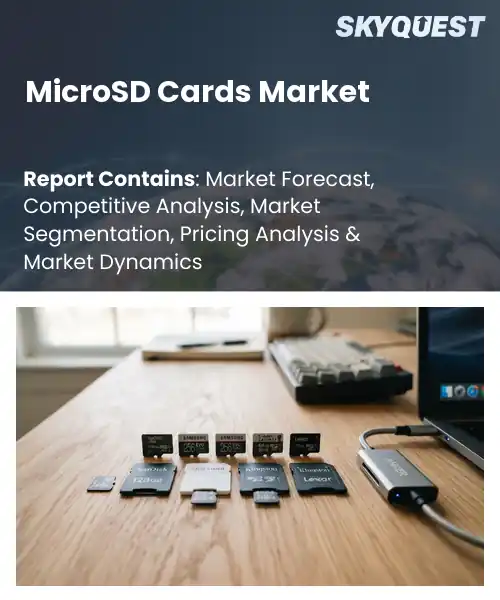
MicroSD Cards Market
Report ID: SQMIG45I2510
Report ID: SQMIG45I2510
[email protected]
USA +1 351-333-4748
Report ID:
SQMIG45I2510 |
Region:
Global |
Published Date: August, 2026
Pages:
157
|Tables:
146
|Figures:
78


Global Microsd Cards Market size was valued at USD 9.84 Billion in 2024 and is poised to grow from USD 10.46 Billion in 2025 to USD 17.06 Billion by 2033, growing at a CAGR of 6.3% during the forecast period (2026-2033).
The global microSD card market comprises flash storage devices that embed up to 1 terabyte of data in a size comparable to a fingernail, serving smartphones, IoT sensors, drones, and automotive infotainment systems. Its importance stems from the relentless demand for resolution media, longer battery life, and capabilities, which push manufacturers toward memory solutions. Historically, the market originated in the early 2000s as a successor to the original SD format, initially offering a modest 128 MB capacity; by 2023, multi‑gigabyte and 1 TB variants dominate, driven by 4K video streaming and wearables. This evolution illustrates how expanding data consumption fuels microSD adoption. The growth factor in the microSD arena is the spread of 5G devices that need on‑board storage for content such as augmented‑reality streams and ultra‑HD video. As operators expand 5G coverage, smartphones and edge cameras generate terabytes of data daily, creating a chain where limited internal memory pushes OEMs to include microSD slots. This pressure opens opportunities for manufacturers to offer UHS‑II and UHS‑III cards with read speeds above 300 MB/s, a capability already used by drone operators for inspection footage. The demand surge fuels investment in NAND fabrication, expands supply chains in Southeast Asia, and raises profit margins for vendors.
How is AI-driven automation influencing capacity and pricing trends in the MicroSD card market?
AI driven automation is reshaping the microSD card market by pushing manufacturers to prioritize higher storage capacity and faster data handling. As AI models require rapid access to large datasets, producers are scaling wafer output and integrating more advanced NAND architectures. This shift creates tighter supply as factories run near full capacity, which in turn lifts retail prices. Brands such as SanDisk, Lexar and ProGrade are competing to deliver cards that can sustain continuous AI workloads, and the market narrative reflects a blend of technical innovation and pricing pressure. Consumers notice longer lead times and a broader range of premium options as companies invest in automated assembly lines.SanDisk highlighted its new high capacity microSD series in May 2026, showcasing AI optimized performance that supports larger models while maintaining reliability. This launch demonstrates how AI driven automation enables manufacturers to expand capacity and justify premium pricing, reinforcing growth in the market.
Market snapshot - (2026-2033)
Global Market Size
USD 9.84 Billion
Largest Segment
64 GB–256 GB
Fastest Growth
Above 256 GB
Growth Rate
6.3% CAGR
To get more insights on this market click here to Request a Free Sample Report
Global microsd cards market is segmented by storage capacity, speed class, application, distribution channel, end user and region. Based on storage capacity, the market is segmented into Up to 32 GB, 64 GB–256 GB and Above 256 GB. Based on speed class, the market is segmented into Class 10, UHS-I, UHS-II and Video Speed Class. Based on application, the market is segmented into Smartphones & Tablets, Cameras & Drones, Gaming Devices, Automotive and Industrial & IoT. Based on distribution channel, the market is segmented into Online and Offline Retail. Based on end user, the market is segmented into Consumer, Commercial and Industrial. Based on region, the market is segmented into North America, Europe, Asia Pacific, Latin America and Middle East & Africa.
Smartphones & Tablets segment dominates because they generate the highest demand for portable storage, integrating MicroSD slots to expand memory beyond built in limits. Consumers constantly upgrade devices and capture high resolution media, creating a relentless need for flexible, removable storage. Manufacturers prioritize compatibility and cost effective designs, reinforcing this segment’s central role. Consequently, development cycles and marketing focus align closely with the preferences of mobile device users.
However, Cameras & Drones segment is witnessing the strongest growth momentum because emerging creators and professional videographers seek high capacity, reliable storage for 4K and 8K footage. The proliferation of aerial imaging and content platforms fuels demand for rugged cards with fast write speeds, opening new revenue streams and expanding market reach.
UHS-II segment dominates because it delivers substantially higher data transfer rates that meet the performance expectations of premium devices. The class enables seamless recording of high bitrate video and rapid file transfers, making it essential for flagship smartphones and advanced cameras. OEMs adopt UHS-II to differentiate products, while users value the speed advantage, reinforcing its leadership within the speed class hierarchy.
Meanwhile, Video Speed Class segment emerges as the key high growth area because streaming services and immersive media require steady minimum write speeds for uninterrupted recording. New standards support 8K capture and VR creation, prompting manufacturers to embed this class across more devices. This fuels market expansion and opens opportunities for differentiated product portfolios.
To get detailed segments analysis, Request a Free Sample Report
North America leads the global MicroSD Cards market due to a confluence of advanced technology ecosystems, robust consumer demand for high‑performance portable storage, and a mature supply chain that integrates design, manufacturing, and distribution. The region benefits from strong partnerships between semiconductor innovators and device manufacturers, fostering rapid adoption of newer standards. High disposable income and a culture of early adoption of digital devices drive continuous upgrades, while regulatory frameworks support seamless cross‑border trade. Additionally, extensive retail networks and e‑commerce platforms ensure wide availability, reinforcing market depth. The combination of innovation leadership, consumer purchasing power, and efficient logistics underpins the region’s dominant position. Furthermore, the presence of leading research institutions accelerates development of next‑generation memory technologies, and strategic investments in capacity expansion keep supply aligned with demand. Collaborative standards bodies headquartered in the region also shape global specifications, ensuring that North American products set benchmarks for performance and reliability.
MicroSD Cards Market in the United States is characterized by a high concentration of consumer electronics firms that drive rapid product cycles and premium feature adoption. The ecosystem benefits from close collaboration between chipset designers and device makers, fostering seamless integration of storage solutions. Strong retail presence, both physical and online, ensures broad distribution, while a tech‑savvy consumer base continually seeks higher capacity and faster performance, reinforcing market vibrancy today.
MicroSD Cards Market in Canada benefits from a well‑established supply chain that links local distributors with global manufacturers, enabling swift product availability. Consumer preferences lean toward reliable, high‑capacity solutions for both personal and professional use, encouraging manufacturers to prioritize quality and durability. Government support for technology adoption and a strong emphasis on data security further stimulate demand, while a collaborative retail environment ensures that new formats reach end‑users efficiently today.
Europe experiences rapid expansion of the MicroSD Cards market driven by a blend of strong consumer demand for portable storage, progressive regulatory frameworks that promote data security, and a vibrant ecosystem of device manufacturers embracing higher capacity standards. The region’s emphasis on sustainability encourages manufacturers to develop energy‑efficient memory solutions, resonating with environmentally conscious buyers. Collaborative research initiatives across key economies accelerate innovation, while extensive distribution networks and a mature e‑commerce landscape ensure swift market penetration. Additionally, the convergence of automotive infotainment, IoT devices, and high‑resolution imaging fuels cross‑sector demand, positioning Europe as a dynamic growth hub for MicroSD technology. The strong presence of consumer electronics hubs in Germany and the United Kingdom further amplifies adoption, while emerging markets such as France benefit from increasing digitalization in both consumer and enterprise segments. This combination of regulatory support, sustainability focus, and cross‑industry integration sustains the rapid expansion across the continent.
MicroSD Cards Market in Germany is anchored by an industrial base that integrates memory solutions into automotive, industrial automation, and consumer electronics. German manufacturers prioritize precision engineering and reliability, driving demand for high‑performance cards that meet rigorous standards. Close collaboration between research institutes and technology firms accelerates product development, while a distribution channel ensures market access. The emphasis on quality and innovation sustains Germany’s leading position in the European landscape.
MicroSD Cards Market in the United Kingdom is propelled by a fast‑growing consumer electronics sector that rapidly adopts emerging storage standards. The market benefits from a vibrant startup ecosystem and strong ties between universities and industry, fostering continuous innovation in high‑capacity and high‑speed solutions. Retail channels, both online and brick‑and‑mortar, provide extensive coverage, while a tech‑savvy consumer base drives demand for reliable, compact storage across mobile, photography, and IoT applications.
MicroSD Cards Market in France is emerging as digital adoption expands across consumer and enterprise domains. French manufacturers emphasize elegance and energy efficiency, aligning products with preferences of a market that values sustainability. Growing demand for high‑resolution imaging and mobile entertainment fuels interest in larger capacity cards, while government initiatives supporting digital transformation encourage broader integration of portable storage in education and services. This supportive environment nurtures steady market growth.
Asia Pacific is strengthening its position in the MicroSD Cards market through a combination of intensive manufacturing capabilities, rapid consumer adoption of mobile and IoT devices, and strategic investments in next‑generation memory technologies. The region hosts a dense network of semiconductor fabs that deliver high‑volume, cost‑effective production, enabling local brands to offer competitive pricing. Consumer enthusiasm for high‑resolution photography, 4K video, and gaming drives demand for larger capacity and faster cards. Government policies that promote digital infrastructure and smart city initiatives further expand usage scenarios, while collaborations between tech giants and startups accelerate innovation cycles. This synergistic environment positions Asia Pacific as a pivotal growth engine for global MicroSD adoption. The rise of streaming platforms in the region also fuels the need for high‑performance storage, while increasing demand for automotive infotainment systems creates new application niches. Moreover, regional standards bodies shape specifications, ensuring that Asia Pacific innovations influence product roadmaps.
MicroSD Cards Market in Japan is driven by a consumer base that values high reliability and performance for mobile, photography, and automotive applications. Japanese manufacturers focus on miniaturization and energy efficiency, aligning products with the country’s strong emphasis on compact, durable technology. Close collaboration between electronics firms and research institutions accelerates the introduction of advanced standards, while retail and e‑commerce channels ensure rapid market penetration across consumer and industrial segments.
MicroSD Cards Market in South Korea benefits from an ecosystem where leading semiconductor firms and mobile device manufacturers develop storage solutions tailored for data transfer and capacity needs. The market is propelled by strong consumer demand for photography, gaming, and 5G devices, encouraging rapid adoption of card formats. Efficient supply chains and competitive pricing, combined with widespread online retail platforms, facilitate swift market coverage and reinforce South Korea’s continual edge.
To know more about the market opportunities by region and country, click here to
Buy The Complete Report
Increasing Demand for Mobile Devices
Expansion of Internet of Things
High Manufacturing Cost Complexity
Rapid Technological Obsolescence
Request Free Customization of this report to help us to meet your business objectives.
Samsung Electronics, SanDisk, Kingston Technology, Western Digital, Sony Corporation and Transcend dominate the market, driving intense competition through rapid product refresh cycles and capacity upgrades. Samsung’s rollout of ultra‑high‑capacity cards and SanDisk’s focus on V90 speed class exemplify technology‑led differentiation, while Western Digital’s recent partnership with Sony to co‑develop next‑generation NAND enhances its supply chain resilience. These moves intensify rivalry and spur further innovation across the sector.
Top Player’s Company Profile
Recent Developments
SkyQuest’s ABIRAW (Advanced Business Intelligence, Research & Analysis Wing) is our Business Information Services team that Collects, Collates, Correlates, and Analyses the Data collected by means of Primary Exploratory Research backed by robust Secondary Desk research. As per SkyQuest analysis the global microSD market is being propelled primarily by the surge in mobile devices, which fuels continuous demand for removable high‑capacity storage in smartphones and tablets. A second strong catalyst is the rapid expansion of the Internet of Things, pushing manufacturers to offer rugged, high‑speed cards for edge sensors and connected gadgets. North America remains the dominant region thanks to its advanced tech ecosystem, high disposable income and mature distribution channels. The smartphones and tablets segment still accounts for the largest share of sales, reflecting consumer preference for flexible memory upgrades. However, high manufacturing cost complexity restrains broader adoption, especially in price‑sensitive markets.
| Report Metric | Details |
|---|---|
| Market size value in 2024 | USD 9.84 Billion |
| Market size value in 2033 | USD 17.06 Billion |
| Growth Rate | 6.3% |
| Base year | 2024 |
| Forecast period | (2026-2033) |
| Forecast Unit (Value) | USD Billion |
| Segments covered |
|
| Regions covered | North America (US, Canada), Europe (Germany, France, United Kingdom, Italy, Spain, Rest of Europe), Asia Pacific (China, India, Japan, Rest of Asia-Pacific), Latin America (Brazil, Rest of Latin America), Middle East & Africa (South Africa, GCC Countries, Rest of MEA) |
| Companies covered |
|
| Customization scope | Free report customization with purchase. Customization includes:-
|
To get a free trial access to our platform which is a one stop solution for all your data requirements for quicker decision making. This platform allows you to compare markets, competitors who are prominent in the market, and mega trends that are influencing the dynamics in the market. Also, get access to detailed SkyQuest exclusive matrix.
Table Of Content
Executive Summary
Market overview
Parent Market Analysis
Market overview
Market size
KEY MARKET INSIGHTS
COVID IMPACT
MARKET DYNAMICS & OUTLOOK
Market Size by Region
KEY COMPANY PROFILES
Methodology
For the MicroSD Cards Market, our research methodology involved a mixture of primary and secondary data sources. Key steps involved in the research process are listed below:
1. Information Procurement: This stage involved the procurement of Market data or related information via primary and secondary sources. The various secondary sources used included various company websites, annual reports, trade databases, and paid databases such as Hoover's, Bloomberg Business, Factiva, and Avention. Our team did 45 primary interactions Globally which included several stakeholders such as manufacturers, customers, key opinion leaders, etc. Overall, information procurement was one of the most extensive stages in our research process.
2. Information Analysis: This step involved triangulation of data through bottom-up and top-down approaches to estimate and validate the total size and future estimate of the MicroSD Cards Market.
3. Report Formulation: The final step entailed the placement of data points in appropriate Market spaces in an attempt to deduce viable conclusions.
4. Validation & Publishing: Validation is the most important step in the process. Validation & re-validation via an intricately designed process helped us finalize data points to be used for final calculations. The final Market estimates and forecasts were then aligned and sent to our panel of industry experts for validation of data. Once the validation was done the report was sent to our Quality Assurance team to ensure adherence to style guides, consistency & design.
Analyst Support
Customization Options
With the given market data, our dedicated team of analysts can offer you the following customization options are available for the MicroSD Cards Market:
Product Analysis: Product matrix, which offers a detailed comparison of the product portfolio of companies.
Regional Analysis: Further analysis of the MicroSD Cards Market for additional countries.
Competitive Analysis: Detailed analysis and profiling of additional Market players & comparative analysis of competitive products.
Go to Market Strategy: Find the high-growth channels to invest your marketing efforts and increase your customer base.
Innovation Mapping: Identify racial solutions and innovation, connected to deep ecosystems of innovators, start-ups, academics, and strategic partners.
Category Intelligence: Customized intelligence that is relevant to their supply Markets will enable them to make smarter sourcing decisions and improve their category management.
Public Company Transcript Analysis: To improve the investment performance by generating new alpha and making better-informed decisions.
Social Media Listening: To analyze the conversations and trends happening not just around your brand, but around your industry as a whole, and use those insights to make better Marketing decisions.
REQUEST FOR SAMPLE
 REQUEST FREE CUSTOMIZATION


Want to customize this report? This report can be personalized according to your needs. Our analysts and industry experts will work directly with you to understand your requirements and provide you with customized data in a short amount of time. We offer $1000 worth of FREE customization at the time of purchase.
Feedback From Our Clients


 USA (+1) 351-333-4748

