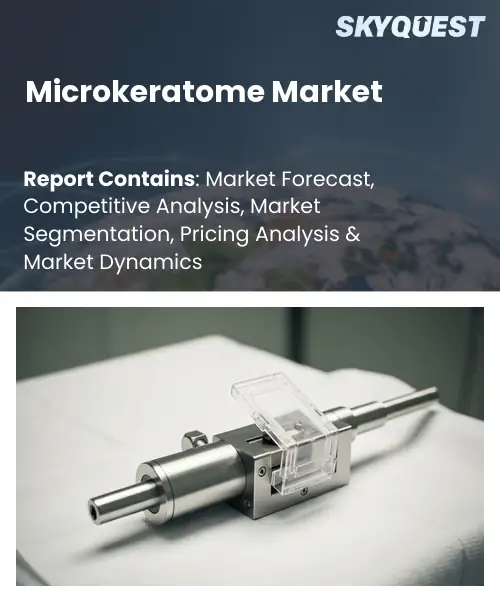
Microkeratome Market
Report ID: SQMIG35D2556
Report ID: SQMIG35D2556
[email protected]
USA +1 351-333-4748
Report ID:
SQMIG35D2556 |
Region:
Global |
Published Date: June, 2026
Pages:
157
|Tables:
178
|Figures:
79


Global Microkeratome Market size was valued at USD 301.1 Million in 2024 and is poised to grow from USD 316.46 Million in 2025 to USD 471.13 Million by 2033, growing at a CAGR of 5.1% during the forecast period (2026-2033).
The microkeratome market centers on precision blades that create corneal flaps for laser refractive procedures, a technology that has reshaped corrective eye surgery in two decades. Its primary driver is the rising global prevalence of myopia and cataract, which fuels demand for minimally invasive vision correction.
As clinics adopt hybrid systems, procedure throughput climbs, lowering per‑case cost and drawing refractive centers in markets such as India and Brazil. This efficiency, coupled with growing demand for cataract‑compatible LASIK, prompts insurers to reimburse microkeratome‑assisted surgeries, further boosting volume. Manufacturers also launch kits that remove sterilization steps, shortening turnaround time for surgery centers. These advances drive a CAGR through 2032, making the market an attractive target for investors focused on ophthalmic device growth.
How is AI-driven automation reshaping the microkeratome market's manufacturing efficiency?
AI driven automation is reshaping microkeratome manufacturing by embedding intelligent robotics into assembly lines, enabling precise component placement without human error. Machine learning algorithms monitor sensor data in real time, predicting wear on cutting blades and prompting preemptive adjustments that keep production smooth. Vision systems inspect each device for microscopic defects, instantly rejecting out of spec units and reducing rework. The integration of digital twins allows engineers to simulate process changes before implementation, shortening development cycles. As a result, factories achieve higher throughput, consistent quality and lower operational costs, positioning the sector for sustained expansion.
IntraLase in April 2026, introduced an AI controlled blade calibration system that automatically adjusts cutting parameters based on real time feedback, cutting waste and speeding up line changeovers. This innovation illustrates how intelligent automation directly boosts manufacturing efficiency and reinforces market growth. It reduces manual intervention, improves product consistency and shortens time to market for new device models.
Market snapshot - (2026-2033)
Global Market Size
USD 301.1 Million
Largest Segment
Automated Microkeratomes
Fastest Growth
Disposable Head Microkeratomes
Growth Rate
5.1% CAGR
To get more insights on this market click here to Request a Free Sample Report
Global microkeratome market is segmented by product type, component, application, end user, blade type, distribution channel and region. Based on product type, the market is segmented into Mechanical Microkeratomes, Automated Microkeratomes, Disposable Head Microkeratomes, Reusable Microkeratomes and Others. Based on component, the market is segmented into Console Systems, Handpieces, Blades, Disposable Accessories and Others. Based on application, the market is segmented into LASIK Surgery, Lamellar Keratoplasty, Corneal Transplant Procedures, Refractive Surgery Research and Others. Based on end user, the market is segmented into Hospitals, Ophthalmic Clinics, Ambulatory Surgical Centers, Academic & Research Institutes and Others. Based on blade type, the market is segmented into Single-Use Blades and Reusable Blades. Based on distribution channel, the market is segmented into Direct Sales, Medical Device Distributors and Others. Based on region, the market is segmented into North America, Europe, Asia Pacific, Latin America and Middle East & Africa.
Mechanical microkeratomes segment dominates with large microkeratome market share because surgeons favour proven reliability and tactile control, which aligns with long standing clinical protocols. The technology’s simplicity reduces maintenance complexity and allows seamless integration with existing operating tables. Clinicians also appreciate the ability to manually adjust blade depth, ensuring precise lamellar cuts across diverse corneal thicknesses. These attributes sustain strong preference among eye care providers, reinforcing the segment’s leadership in the microkeratome market.
As per microkeratome market outlook, automated microkeratomes segment is witnessing the strongest growth momentum as digital control systems enable ultra precise depth regulation and reproducible outcomes. Integration with laser platforms accelerates procedural efficiency, attracting high volume centers. Continuous software upgrades and data analytics foster personalized surgery, driving rapid adoption and expanding future market opportunities.
Automated microkeratomes segment dominates because the integration of servo‑driven mechanisms delivers consistent flap thickness, reducing surgeon workload and enhancing patient safety. Real‑time feedback loops adjust cutting parameters instantly, accommodating subtle variations in corneal curvature. This reliability builds confidence among practitioners and aligns with premium service offerings, cementing its prominent position within the microkeratome market.
As per microkeratome market analysis, mechanical microkeratomes segment is emerging as the key growth area as advancements in motor technology improve cutting speed without compromising precision. Enhanced ergonomic designs lower user fatigue, encouraging wider adoption in busy surgical suites. These innovations expand the applicability of microkeratomes beyond traditional LASIK, fostering new opportunities and driving market expansion.
Single‑use blades segment dominates because infection control concerns drive clinics to prefer sterile disposable cutting edges for each procedure. Manufacturers embed precise geometry that guarantees consistent flap thickness, reducing variability. The convenience of eliminating reprocessing steps shortens turnover time in busy surgical suites. These factors reinforce clinician confidence and align with safety protocols, sustaining the segment’s preeminent position within the microkeratome market. Such operational efficiency resonates across diverse practice models, reinforcing its appeal worldwide.
Meanwhile, reusable blades segment is emerging as the key growth area as sustainability initiatives encourage cost effective long term solutions. Advances in blade material science extend durability while maintaining sharpness, attracting environmentally conscious providers. The ability to sterilize several times also reduces per procedure expense, driving rapid market uptake and future expansion.
To get detailed segments analysis, Request a Free Sample Report
North America leads due to a mature ophthalmic ecosystem that combines advanced clinical research, robust reimbursement pathways, and a concentration of technology innovators. The region benefits from well‑established eye care networks that rapidly adopt cutting‑edge surgical tools, fostering high procedural volumes. Strong collaboration between academic centers and device manufacturers accelerates product refinement and regulatory clearance, while a patient base that values visual performance drives sustained demand. Additionally, comprehensive training programs for refractive surgeons ensure consistent procedural quality, reinforcing market confidence and reinforcing the region’s leadership position.
As per microkeratome market regional outlook, United States thrives on a dense network of specialty eye clinics and a culture of early adoption. Extensive clinical trial activity supports continual improvement of device safety and efficacy. The presence of leading manufacturers and a proactive regulatory framework encourages innovation pipelines. High physician expertise and patient willingness to pursue premium vision correction further solidify market depth.
As per microkeratome market regional forecast, Canada is bolstered by a publicly funded health system that emphasizes evidence‑based adoption of surgical technologies. Collaborative research institutions drive local validation studies, while strong professional societies promote best practice standards. The market benefits from a well‑trained cohort of refractive surgeons and a patient population that prioritizes quality of life improvements, creating a stable demand environment.
Europe experiences rapid expansion thanks to harmonized regulatory standards that streamline market entry across member states, encouraging competitive innovation. A strong emphasis on clinical outcomes and cost‑effectiveness aligns with health‑system priorities, fostering adoption in both private and public settings. Integrated research collaborations across borders accelerate knowledge sharing, while a mature network of ophthalmic societies drives continuous professional development. Patient awareness of refractive options is rising, and the presence of established manufacturing hubs supports a resilient supply chain, collectively propelling market growth throughout the region.
Germany is characterized by a high concentration of precision engineering firms that supply reliable devices to a sophisticated clinical landscape. Rigorous quality standards and deep integration of research institutions ensure continuous product refinement. Refractive surgeons benefit from comprehensive training frameworks, and health insurers increasingly recognize the long‑term value of advanced vision correction, sustaining robust demand.
As per microkeratome industry analysis, United Kingdom accelerates through a dynamic blend of academic research and entrepreneurial device development. Regulatory pathways facilitate swift market access, while professional bodies champion guidelines that promote procedural safety. Growing patient interest in minimally invasive correction methods, combined with a strong network of specialized clinics, fuels expanding utilization across the health system.
France is emerging from a foundation of strong ophthalmic research and a health system that supports innovation adoption. Collaborative initiatives between universities and manufacturers drive localized product testing, enhancing confidence among surgeons. Increasing public awareness of refractive options and a growing cohort of skilled practitioners contribute to a steadily rising market presence.
Asia Pacific strengthens its position by leveraging rapid technological adoption and expanding eye‑care infrastructure across key economies. The region benefits from a surge in refractive surgery centers that prioritize state‑of‑the‑art equipment, supported by government incentives that encourage modern medical investments. Skilled surgeon training programs, often conducted in partnership with leading global manufacturers, elevate procedural standards. Cultural emphasis on visual performance and a growing middle class willing to invest in premium health solutions further amplify market momentum, positioning the region as a pivotal growth engine.
Japan integrates meticulous engineering expertise with a tradition of precise surgical practice. Collaborative research between universities and device firms drives continual enhancements in blade performance and safety. A well‑established network of specialized clinics offers patients access to advanced refractive procedures, while insurers increasingly recognize the value of maintaining high visual acuity, fostering steady market expansion.
South Korea advances through aggressive investment in ophthalmic technology and a highly competitive clinic environment. Strong emphasis on aesthetic vision outcomes promotes early adoption of innovative microkeratome designs. Industry‑academia partnerships accelerate clinical validation, and a tech‑savvy patient base embraces cutting‑edge solutions, collectively reinforcing a dynamic and growing market landscape.
To know more about the market opportunities by region and country, click here to
Buy The Complete Report
Technological Advancements in Microkeratome Design
Increasing Prevalence of Refractive Surgery
High Cost of Advanced Devices
Regulatory and Approval Challenges
Request Free Customization of this report to help us to meet your business objectives.
The microkeratome industry is shaped by legacy OEMs such as Alcon, Bausch & Lomb and Johnson & Johnson Vision, while competitive pressure intensifies from niche innovators leveraging AI‑driven blade precision and single‑use platforms; recent M&A activity includes Alcon’s acquisition of a micro‑blade robotics firm, and a strategic partnership between Bausch & Lomb and a digital imaging startup to integrate intra‑operative OCT guidance, accelerating product differentiation and surgeon adoption.
SkyQuest’s ABIRAW (Advanced Business Intelligence, Research & Analysis Wing) is our Business Information Services team that Collects, Collates, Correlates, and Analyses the Data collected by means of Primary Exploratory Research backed by robust Secondary Desk research.
As per SkyQuest analysis, the global microkeratome market growth is being propelled primarily by technological advancements in blade precision and automated cutting mechanisms that boost surgical safety and efficiency, while the rising prevalence of refractive surgery further fuels demand as more patients seek alternatives to glasses. The market is led by North America, where a mature ophthalmic ecosystem and strong reimbursement pathways sustain high adoption rates. Mechanical microkeratomes continue to dominate the segment landscape because surgeons value their reliability and tactile control. However, the high cost of advanced devices limits uptake in price‑sensitive clinics, and may delay investments in newer platforms for some providers. The global microkeratome market trend is experiencing steady but moderate growth, supported by the increasing volume of refractive eye surgeries, rising prevalence of myopia and other vision disorders, and improving access to ophthalmic care in emerging economies.
| Report Metric | Details |
|---|---|
| Market size value in 2024 | USD 301.1 Million |
| Market size value in 2033 | USD 471.13 Million |
| Growth Rate | 5.1% |
| Base year | 2024 |
| Forecast period | (2026-2033) |
| Forecast Unit (Value) | USD Million |
| Segments covered |
|
| Regions covered | North America (US, Canada), Europe (Germany, France, United Kingdom, Italy, Spain, Rest of Europe), Asia Pacific (China, India, Japan, Rest of Asia-Pacific), Latin America (Brazil, Rest of Latin America), Middle East & Africa (South Africa, GCC Countries, Rest of MEA) |
| Companies covered |
|
| Customization scope | Free report customization with purchase. Customization includes:-
|
To get a free trial access to our platform which is a one stop solution for all your data requirements for quicker decision making. This platform allows you to compare markets, competitors who are prominent in the market, and mega trends that are influencing the dynamics in the market. Also, get access to detailed SkyQuest exclusive matrix.
Table Of Content
Executive Summary
Market overview
Parent Market Analysis
Market overview
Market size
KEY MARKET INSIGHTS
COVID IMPACT
MARKET DYNAMICS & OUTLOOK
Market Size by Region
KEY COMPANY PROFILES
Methodology
For the Microkeratome Market, our research methodology involved a mixture of primary and secondary data sources. Key steps involved in the research process are listed below:
1. Information Procurement: This stage involved the procurement of Market data or related information via primary and secondary sources. The various secondary sources used included various company websites, annual reports, trade databases, and paid databases such as Hoover's, Bloomberg Business, Factiva, and Avention. Our team did 45 primary interactions Globally which included several stakeholders such as manufacturers, customers, key opinion leaders, etc. Overall, information procurement was one of the most extensive stages in our research process.
2. Information Analysis: This step involved triangulation of data through bottom-up and top-down approaches to estimate and validate the total size and future estimate of the Microkeratome Market.
3. Report Formulation: The final step entailed the placement of data points in appropriate Market spaces in an attempt to deduce viable conclusions.
4. Validation & Publishing: Validation is the most important step in the process. Validation & re-validation via an intricately designed process helped us finalize data points to be used for final calculations. The final Market estimates and forecasts were then aligned and sent to our panel of industry experts for validation of data. Once the validation was done the report was sent to our Quality Assurance team to ensure adherence to style guides, consistency & design.
Analyst Support
Customization Options
With the given market data, our dedicated team of analysts can offer you the following customization options are available for the Microkeratome Market:
Product Analysis: Product matrix, which offers a detailed comparison of the product portfolio of companies.
Regional Analysis: Further analysis of the Microkeratome Market for additional countries.
Competitive Analysis: Detailed analysis and profiling of additional Market players & comparative analysis of competitive products.
Go to Market Strategy: Find the high-growth channels to invest your marketing efforts and increase your customer base.
Innovation Mapping: Identify racial solutions and innovation, connected to deep ecosystems of innovators, start-ups, academics, and strategic partners.
Category Intelligence: Customized intelligence that is relevant to their supply Markets will enable them to make smarter sourcing decisions and improve their category management.
Public Company Transcript Analysis: To improve the investment performance by generating new alpha and making better-informed decisions.
Social Media Listening: To analyze the conversations and trends happening not just around your brand, but around your industry as a whole, and use those insights to make better Marketing decisions.
REQUEST FOR SAMPLE
 REQUEST FREE CUSTOMIZATION
Global Microkeratome Market size was valued at USD 301.1 Million in 2024 and is poised to grow from USD 316.46 Million in 2025 to USD 471.13 Million by 2033, growing at a CAGR of 5.1% during the forecast period (2026-2033).
The microkeratome market is shaped by legacy OEMs such as Alcon, Bausch & Lomb and Johnson & Johnson Vision, while competitive pressure intensifies from niche innovators leveraging AI‑driven blade precision and single‑use platforms; recent M&A activity includes Alcon’s acquisition of a micro‑blade robotics firm, and a strategic partnership between Bausch & Lomb and a digital imaging startup to integrate intra‑operative OCT guidance, accelerating product differentiation and surgeon adoption. 'Johnson & Johnson Vision', 'Bausch + Lomb Corporation', 'Carl Zeiss Meditec AG', 'Ziemer Ophthalmic Systems AG', 'Moria SA', 'SCHWIND eye-tech-solutions GmbH', 'Alcon Inc.', 'NIDEK Co., Ltd.', 'Sonomed Escalon', 'Aurolab', 'Geuder AG', 'Katena Products, Inc.', 'Rumex International Co.', 'Medequip Ophthalmic Products', 'Appasamy Associates', 'MicroSurgical Technology (MST)', 'Surtex Instruments Ltd.', 'BVI Medical', 'Bharat Surgical Co.', 'Accutome Inc.'
Continuous innovation in blade precision, suction control, and automated cutting mechanisms enhances surgical safety and efficiency. These improvements reduce intra‑operative complications and recovery time, encouraging clinicians to adopt microkeratome‑assisted procedures more widely. As surgeons experience consistent outcomes, confidence in the technology grows, prompting increased procedure volumes and stimulating demand for newer devices. The cumulative effect of superior performance and patient satisfaction drives market expansion, prompting manufacturers to invest further in research and development, thereby reinforcing a positive growth trajectory in the global arena.
Ai-Driven Precision Cutting: The integration of artificial intelligence into microkeratome platforms is reshaping refractive surgery by delivering real-time tissue thickness assessments, adaptive blade control, and predictive wound‑healing modeling. Surgeons benefit from enhanced confidence and reduced variability, while manufacturers differentiate their offerings through smarter interfaces and data‑driven service models. This evolution also supports personalized treatment planning, enabling providers to align procedural parameters with individual corneal biomechanics, ultimately driving broader adoption among ophthalmologists seeking higher consistency and patient satisfaction and visual outcomes.
Why does North America Dominate the Global Microkeratome Market? |@12


Want to customize this report? This report can be personalized according to your needs. Our analysts and industry experts will work directly with you to understand your requirements and provide you with customized data in a short amount of time. We offer $1000 worth of FREE customization at the time of purchase.
Feedback From Our Clients


 USA (+1) 351-333-4748

