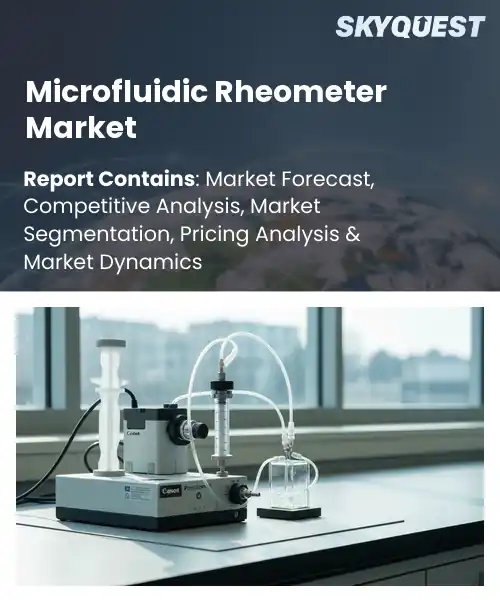
Microfluidic Rheometer Market
Report ID: SQMIG35J2195
Report ID: SQMIG35J2195
[email protected]
USA +1 351-333-4748
Report ID:
SQMIG35J2195 |
Region:
Global |
Published Date: February, 2026
Pages:
157
|Tables:
141
|Figures:
78


Global Microfluidic Rheometer Market size was valued at USD 97.5 Million in 2024 and is poised to grow from USD 106.28 Million in 2025 to USD 211.76 Million by 2033, growing at a CAGR of 9.0% during the forecast period (2026-2033).
The primary driver of the microfluidic rheometer market is the rising demand for precise, low volume rheological characterization that enables faster formulation cycles and biologically relevant measurements. Microfluidic rheometers are miniature instruments that measure fluid deformation and flow behavior using microchannels and small sample volumes; they matter because they reduce cost, accelerate R&D, and permit measurements on scarce or expensive biological samples such as blood, cell suspensions, and vaccine formulations. Over the last decade the market evolved from academic prototypes to commercialized chip based systems as improvements in microfabrication, sensor integration, and software made devices robust and scalable for industry.Building on that commercialization, a growth factor is application driven demand from biopharma, advanced materials, and quality sensitive consumer sectors because needs translate into procurement and development priorities. When formulators must evaluate vaccine stability or injectables with limited sample availability, microfluidic rheometers reduce sample consumption and permit repeated stress testing, accelerating candidate selection and lowering development cost. Similarly, manufacturers of 3D printing resins and cosmetic emulsions use chip based rheology to optimize printability and texture, reducing waste and time to market. These cause and effect dynamics open opportunities for instrument makers to bundle disposables, analytics software, and contract testing services.
How is AI enhancing accuracy and throughput in the microfluidic rheometer market?
Microfluidic rheometers depend on precise flow control and sensitive microscale sensing to measure viscosity and viscoelastic behavior. Accuracy is achieved through high fidelity sensors and robust data processing. Throughput comes from automated sample handling and real time analysis. Artificial intelligence enhances both by automating image and flow segmentation, providing model based calibration that corrects sensor drift, and enabling adaptive control that shortens setup time. These capabilities reduce manual intervention and improve reproducibility. Demand from pharmaceutical formulation testing and point of care diagnostics is increasing use of AI enabled microfluidic workflows, and recent reviews document stronger reliability and faster interpretation with AI integration.RheoSense April 2025, showcased a new instrument and application upgrades focused on automated data workflows. When combined with AI driven image and flow analysis these improvements increase measurement repeatability and throughput, helping laboratories and industrial users run more samples with greater confidence.
Market snapshot - (2026-2033)
Global Market Size
USD 97.5 Million
Largest Segment
Rotational Rheometers
Fastest Growth
Capillary Rheometers
Growth Rate
9.0% CAGR
To get more insights on this market click here to Request a Free Sample Report
Global microfluidic rheometer market is segmented by product type, end-user, application, technology, sales channel and region. Based on product type, the market is segmented into Rotational Rheometers, Capillary Rheometers and Oscillatory Rheometers. Based on end-user, the market is segmented into Pharmaceuticals, Food and Beverage and Cosmetics. Based on application, the market is segmented into Material Characterization and Quality Control. Based on technology, the market is segmented into Microfluidic Chips and Instrumentation Software. Based on sales channel, the market is segmented into Direct Sales and Distributors. Based on region, the market is segmented into North America, Europe, Asia Pacific, Latin America and Middle East & Africa.
Rotational Rheometers segment dominates because its well understood shear control and measurement principles adapt effectively to microfluidic implementations, delivering reproducible characterization for viscous and complex fluids. Established workflows and instrument robustness reduce integration risk for labs and production teams, encouraging routine adoption for formulation and process monitoring. This operational reliability and interpretability create trust among researchers and quality professionals, sustaining preference for rotational designs in microfluidic rheology use cases.
However, Oscillatory Rheometers are emerging as the most rapidly expanding area, driven by their ability to probe viscoelastic responses at micro scales critical to soft formulations and biomaterials. Improvements in microactuation and sensitive detection unlock frequency dependent insights that attract research and specialized industrial applications, creating demand for tailored microfluidic test systems and novel analytical services.
Microfluidic Chips segment stands out because chip architectures enable precise control of flow geometry and shear environments at very small scales, making measurements feasible with minimal sample volumes and delicate formulations. Advances in materials and fabrication reduce variability and ease integration with sensors and detectors, lowering experimental friction for developers. That practical enablement broadens applicability across development workflows and encourages adoption by teams seeking high fidelity rheological data with constrained sample availability.
Meanwhile, Instrumentation Software is the most rapidly expanding area, driven by demand for advanced analytics, automation, and digital workflows that convert microfluidic signals into actionable rheological insight. Enhanced modeling, real time quality monitoring and LIMS integration broaden usability beyond specialists, enabling new service models and accelerating commercial adoption of microfluidic rheometer solutions.
To get detailed segments analysis, Request a Free Sample Report
North America dominates due to a confluence of advanced research infrastructure, concentrated instrument manufacturing expertise, and strong translational pathways between academia and industry. Dense clusters of universities, specialized microfabrication facilities, and biotechnology hubs accelerate innovation and commercialization of rheometry solutions tailored for microfluidic applications. Established vendors and agile startups coexist with contract research and clinical laboratories that facilitate validation and early adoption. Favorable intellectual property frameworks, access to venture and public research funding, and a skilled workforce support product development and scale up. Robust supplier networks and close engagement with pharmaceutical and materials science end users further reinforce leadership, enabling continuous refinement of instruments, software, and service models that meet stringent application and regulatory expectations across disciplines. Collaborative networks with healthcare providers and industrial partners expedite real world feedback and iterative improvement.
Microfluidic Rheometer Market in United States is characterized by a dense ecosystem of instrument manufacturers, academic research centers, and end user laboratories that drive early technology adoption. Cross sector collaboration among pharmaceutical developers, materials scientists, and clinical researchers supports customized applications and validation. A competitive vendor landscape and availability of specialized service providers enable rapid prototyping, testing, and commercialization, reinforcing market leadership and momentum in rheological measurement for microfluidic systems.
Microfluidic Rheometer Market in Canada benefits from strong translational research networks, collaboration between research hospitals and technology incubators, and focused funding for precision measurement tools. National laboratories and university centers emphasize method development and validation tailored to clinical and industrial needs. Small and medium enterprises collaborate with larger firms to adapt instruments for niche applications, while cross border partnerships support knowledge exchange, supply chain resilience, and commercialization of microfluidic rheometry.
Europe rapid expansion reflects a combination of specialized manufacturing capabilities, collaborative research frameworks, and strong industry demand for precise micro scale rheological measurement. Regional networks link academic consortia, technology centers, and industrial users in pharmaceuticals, advanced materials, and microfluidic device development, enabling efficient translation of laboratory methods into deployable instruments. Technical excellence in precision engineering allows domestic vendors to produce high performance devices while service providers facilitate application testing and method standardization. Policy frameworks and cross border initiatives support interoperable standards and pooled resources, reducing barriers to market entry for innovative firms. The resulting environment encourages localized product adaptation, international partnerships, and a steady pipeline of application driven improvements that sustain expansion across diverse European markets. Strong university spin off activity and access to specialized manufacturing clusters further accelerate market uptake.
Microfluidic Rheometer Market Germany is driven by a strong tradition of precision engineering, instrumentation manufacturing, and close ties between research institutes and industrial users. Domestic vendors focus on high quality components, system integration, and tailored solutions for complex material and biofluid testing. Collaborative test centers and research labs support method development and validation. End user engagement from pharmaceutical and materials sectors ensures product refinement and supports adoption across industrial applications.
Microfluidic Rheometer Market United Kingdom is energized by vibrant innovation hubs, strong university spin off activity, and an expanding community of specialized startups. Focused collaborations among academia, clinical centers, and commercial developers accelerate instrument adaptation for life science and diagnostic applications. Flexible manufacturing networks and active investor interest support rapid product development and commercialization. Focused conferences and consortia promote knowledge sharing, deployments, and broader uptake across research and industrial laboratories.
Microfluidic Rheometer Market France is emerging through a blend of academic excellence, startup activity, and targeted support for translational research. Research laboratories emphasize method innovation and measurement approaches suited to biomedical and specialty materials applications. Incubators and regional technology clusters foster partnerships between instrument developers and end users, enabling studies and iterative refinement. Growing attention from industrial partners and public research programs fuels commercialization pathways and strengthens the supply chain.
Asia Pacific is strengthening its position through complementary strengths in precision manufacturing, electronics integration, and targeted research that align with microfluidic rheometry needs. Regional centers leverage advanced component fabrication, sensor expertise, and automation capabilities to produce compact, high performance instruments suited to laboratory and industrial environments. Close ties between corporate R&D, university laboratories, and specialized suppliers accelerate system integration and application adaptation. Market access strategies emphasize partnerships with global vendors, local customization, and service networks that enhance adoption. Government support for high tech platforms, growing translational research activity, and skilled engineering talent further bolster the region's ability to innovate, scale production, and address application specific challenges across life science, materials, and process control sectors. Investment in localized service infrastructure and training programs ensures sustained customer support and application expertise.
Microfluidic Rheometer Market Japan capitalizes on deep expertise in precision instrumentation, sensor integration, and automation. Established manufacturers collaborate with university research centers to develop compact, reliable instruments tailored to laboratory and industrial workflows. Strong corporate R&D and partnerships with clinical and materials science users support validation and customized solutions. Local service networks and focus on quality control facilitate adoption by research institutions and enterprises seeking robust microfluidic rheological measurement capabilities.
Microfluidic Rheometer Market South Korea leverages strong electronics manufacturing, systems integration expertise, and engineering capabilities to produce compact instrumentation and modular components. Close collaboration among industrial R&D centers, universities, and startups accelerates prototyping and application driven customization. Emphasis on automation, software integration, and supply chain responsiveness supports deployment across biotechnology and advanced materials users. Targeted support mechanisms and export strategies enhance commercial pathways and foster international partnerships for measurement solutions.
To know more about the market opportunities by region and country, click here to
Buy The Complete Report
Technological Advances In Miniaturization
Increasing Adoption In Pharmaceutical Research
High Instrumentation Costs and Complexity
Regulatory Uncertainty and Standardization
Request Free Customization of this report to help us to meet your business objectives.
The competitive landscape in the global microfluidic rheometer market is shifting toward consolidation and capability integration, driven by demand for ultra-low-volume, high-shear characterization from biologics and advanced formulations. Large instrument groups are pursuing acquisitions of microfluidic viscometer specialists and distribution partnerships to embed on-chip slit rheometry into broader platforms, while rivals pursue productization of lab prototypes into automated instruments.
Top Player’s Company Profile
Recent Developments
SkyQuest’s ABIRAW (Advanced Business Intelligence, Research & Analysis Wing) is our Business Information Services team that Collects, Collates, Correlates, and Analyses the Data collected by means of Primary Exploratory Research backed by robust Secondary Desk research. As per SkyQuest analysis, the global microfluidic rheometer market is driven by rising demand for precise, low-volume rheological characterization that accelerates formulation cycles and enables measurements on scarce biological samples. Technological advances in miniaturization further support uptake by integrating fluid handling and sensing into compact, automatable platforms. A key restraint remains high instrumentation costs and technical complexity, which limit adoption among smaller labs and in emerging markets. North America currently dominates the market thanks to concentrated research infrastructure, manufacturing expertise and strong translational networks. Within product types, rotational rheometers continue to lead due to their well understood shear control and reliable, routine use in formulation and quality workflows.
| Report Metric | Details |
|---|---|
| Market size value in 2024 | USD 97.5 Million |
| Market size value in 2033 | USD 211.76 Million |
| Growth Rate | 9.0% |
| Base year | 2024 |
| Forecast period | (2026-2033) |
| Forecast Unit (Value) | USD Million |
| Segments covered |
|
| Regions covered | North America (US, Canada), Europe (Germany, France, United Kingdom, Italy, Spain, Rest of Europe), Asia Pacific (China, India, Japan, Rest of Asia-Pacific), Latin America (Brazil, Rest of Latin America), Middle East & Africa (South Africa, GCC Countries, Rest of MEA) |
| Companies covered |
|
| Customization scope | Free report customization with purchase. Customization includes:-
|
To get a free trial access to our platform which is a one stop solution for all your data requirements for quicker decision making. This platform allows you to compare markets, competitors who are prominent in the market, and mega trends that are influencing the dynamics in the market. Also, get access to detailed SkyQuest exclusive matrix.
Table Of Content
Executive Summary
Market overview
Parent Market Analysis
Market overview
Market size
KEY MARKET INSIGHTS
COVID IMPACT
MARKET DYNAMICS & OUTLOOK
Market Size by Region
KEY COMPANY PROFILES
Methodology
For the Microfluidic Rheometer Market, our research methodology involved a mixture of primary and secondary data sources. Key steps involved in the research process are listed below:
1. Information Procurement: This stage involved the procurement of Market data or related information via primary and secondary sources. The various secondary sources used included various company websites, annual reports, trade databases, and paid databases such as Hoover's, Bloomberg Business, Factiva, and Avention. Our team did 45 primary interactions Globally which included several stakeholders such as manufacturers, customers, key opinion leaders, etc. Overall, information procurement was one of the most extensive stages in our research process.
2. Information Analysis: This step involved triangulation of data through bottom-up and top-down approaches to estimate and validate the total size and future estimate of the Microfluidic Rheometer Market.
3. Report Formulation: The final step entailed the placement of data points in appropriate Market spaces in an attempt to deduce viable conclusions.
4. Validation & Publishing: Validation is the most important step in the process. Validation & re-validation via an intricately designed process helped us finalize data points to be used for final calculations. The final Market estimates and forecasts were then aligned and sent to our panel of industry experts for validation of data. Once the validation was done the report was sent to our Quality Assurance team to ensure adherence to style guides, consistency & design.
Analyst Support
Customization Options
With the given market data, our dedicated team of analysts can offer you the following customization options are available for the Microfluidic Rheometer Market:
Product Analysis: Product matrix, which offers a detailed comparison of the product portfolio of companies.
Regional Analysis: Further analysis of the Microfluidic Rheometer Market for additional countries.
Competitive Analysis: Detailed analysis and profiling of additional Market players & comparative analysis of competitive products.
Go to Market Strategy: Find the high-growth channels to invest your marketing efforts and increase your customer base.
Innovation Mapping: Identify racial solutions and innovation, connected to deep ecosystems of innovators, start-ups, academics, and strategic partners.
Category Intelligence: Customized intelligence that is relevant to their supply Markets will enable them to make smarter sourcing decisions and improve their category management.
Public Company Transcript Analysis: To improve the investment performance by generating new alpha and making better-informed decisions.
Social Media Listening: To analyze the conversations and trends happening not just around your brand, but around your industry as a whole, and use those insights to make better Marketing decisions.
REQUEST FOR SAMPLE
 REQUEST FREE CUSTOMIZATION


Want to customize this report? This report can be personalized according to your needs. Our analysts and industry experts will work directly with you to understand your requirements and provide you with customized data in a short amount of time. We offer $1000 worth of FREE customization at the time of purchase.
Feedback From Our Clients


 USA (+1) 351-333-4748

