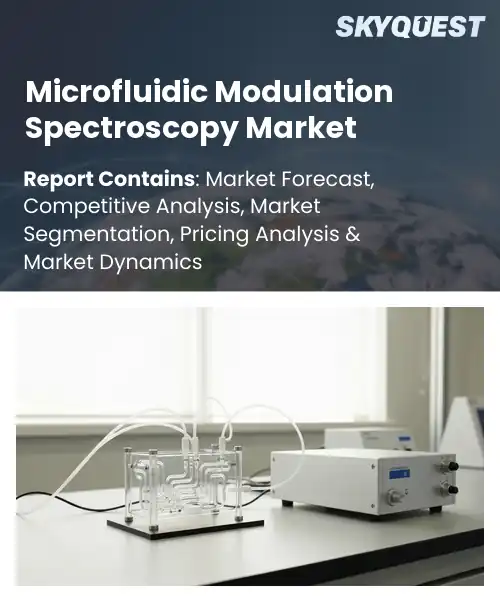
Microfluidic Modulation Spectroscopy Market
Report ID: SQMIG35A3281
Report ID: SQMIG35A3281
[email protected]
USA +1 351-333-4748
Report ID:
SQMIG35A3281 |
Region:
Global |
Published Date: February, 2026
Pages:
157
|Tables:
93
|Figures:
76


Global Microfluidic Modulation Spectroscopy Market size was valued at USD 195.40 Million in 2024 and is poised to grow from USD 211.62 Million in 2025 to USD 400.48 Million by 2033, growing at a CAGR of 8.3% during the forecast period (2026-2033).
The global microfluidic modulation spectroscopy market growth is centered on analytical platforms that combine microfluidic control with infrared spectroscopy to characterize protein secondary structure in small volumes, and this capability addresses mounting demands in biopharmaceutical development. This type of measurement was first exploited to determine settings for the formulation of therapeutic biologic products using sensitive aggregation and stability assessments to accelerate development times while reducing failures on batches. Laboratory research for the formulation of monoclonal antibody products and many early case studies demonstrating increased screening throughput of formulations highlighted the usefulness of this instrumentation in this regard.
Because regulatory emphasis on detailed characterization coincided with early adoption by CROs and QC labs, demand for microfluidic modulation spectroscopy systems has grown as manufacturers seek to prove structural integrity across development and after post-approval changes. This need pushes vendors to combine automation with analytics, producing solutions that speed formulation screening and enable comparability assessment for biosimilars while providing in-process monitoring in continuous manufacturing where small samples and rapid readouts cut time-to-release. Consequently, revenue streams expand beyond instruments into consumables, software licensing and service contracts, creating opportunities for OEM partnerships and targeted penetration of bioprocessing facilities and expanded geographic reach.
How is AI Accelerating Adoption of Microfluidic Modulation Spectroscopy in Biopharmaceutical Quality Control?
Microfluidic modulation spectroscopy is a label free infrared technique that alternates sample and matched buffer through a microfluidic cell to remove solvent background and reveal protein secondary structure using very small sample volumes. In biopharmaceutical quality control it is used to monitor higher order structure and aggregation across formulation and stability testing. Automation of structural conformational changes in materials or structures and linking spectral to processing parameters has enhanced analyst decision-making. Due to this improving technology, more companies through increased market interest in using AI as part of its routine quality control processes are adopting higher volume manufacturing.
Market snapshot - (2026-2033)
Global Market Size
USD 195.4 Million
Largest Segment
Fastest Growth
Growth Rate
8.3% CAGR
To get more insights on this market click here to Request a Free Sample Report
Global microfluidic modulation spectroscopy market is segmented by component, application, end user and region. Based on component, the market is segmented into systems and accessories & consumables. Based on application, the market is segmented into quality assurance & control, protein quantification, and others. Based on end user, the market is segmented into biopharmaceutical companies, research laboratories, chemical industries, academic research institutes, contract research organizations (CROs), and others. Based on region, the market is segmented into North America, Europe, Asia Pacific, Latin America and Middle East & Africa.
Based on the global microfluidic modulation spectroscopy market share, the systems segment dominates because complete instrumentation platforms provide the integrated hardware and software needed to realize microfluidic modulation spectroscopy workflows. Buyers prioritize turnkey analyzers that deliver sensitivity, automation, and reproducibility, which encourages vendor investment in product development. As systems set performance benchmarks, they guide method adoption across applications and create installed bases that drive service, upgrades and ecosystem development, reinforcing market leadership through practical utility.
However, accessories & consumables is emerging as the most rapidly expanding area because disposable chips and assay kits drive recurring purchases and simplify user adoption. Advances in consumable design and compatibility with automated systems broaden practical applications, creating steady revenue models for vendors and enabling faster, scalable deployment that fuels further market expansion.
Protein quantification segment dominates because demand for precise characterization of biomolecule concentration and conformational changes directly aligns with the strengths of microfluidic modulation spectroscopy. To guide stability of formulations, evaluate aggregation, and assess comparability of biosimilars, researchers and developers utilise sensitive, low-volume spectrum assays. Accordingly, this sets the requirement for optimized methods of protein analysis and hence the need for vendors to continuously improve their methods to fulfill this need.
Meanwhile, quality assurance & control is emerging as the fastest growing area because regulatory demands and process analytical technology adoption push manufacturers to integrate real time spectral monitoring. The technique's capability for inline verification and batch release supports scalable manufacturing, prompting investment in tailored solutions that open avenues for commercial deployment and broaden market demand.
To get detailed segments analysis, Request a Free Sample Report
As per the global microfluidic modulation spectroscopy market forecast, North America dominates due to a robust combination of concentrated life sciences ecosystems, advanced instrumentation manufacturers, and extensive research infrastructure that together accelerate adoption of novel analytical techniques. Strong connections exist among academic institutions, pharmaceuticals and biosciences firms, for accurate protein characterizations. The region's supportive investment environment and established regulatory/quality systems provide the basis for commercially viable (and scalable) microfluidic modulation spectroscopy solutions. Cross-sector collaborations/workforce competencies enhance integration into discovery and development as well as QC (quality control) processes supporting an innovative, fully serviced network based on a market leadership position.
Microfluidic modulation spectroscopy market regional outlook in the United States is anchored by leading biopharma clusters, major instrument manufacturers, and dense networks of service providers and contract research organizations. The demand for sophisticated analytical methods is continuously generated by strong translational research capabilities and pharmaceutical companies' early adoption. The development of collaborative programs across both university and industry supports analytic techniques' validation and application development. An ecosystem that promotes quality, scalability, and regulatory compliance will allow for the application of these analytical techniques across discovery, formulation, and quality control.
Microfluidic modulation spectroscopy market regional forecast in Canada reflects a focused blend of academic excellence, emerging biotech firms, and specialized testing laboratories that adopt advanced characterization techniques. A collaborative research environment and supportive innovation policies help translate novel instrumentation into practical applications. Service-based offerings and partnerships with global suppliers enable smaller firms to access sophisticated analytical capabilities. The market exhibits steady integration into pharmaceutical development pipelines and bioprocess optimization initiatives.
Europe is experiencing rapid expansion driven by a strong pharmaceutical and biotechnology base, comprehensive research networks, and a growing emphasis on biologics and complex modalities that require advanced analytical solutions. Realizing collaborative funding mechanisms and cross-border R&D initiatives facilitated the adoption and standardization of technology. Regional strengths in manufacturing and engineering provide instrument development and customization capabilities that meet European regulatory and quality standards. Increasingly, there is a partnership between industry and academia to accelerate method development and validation, while the combination of established companies and innovative start-up businesses drives demand throughout the discovery, development, and manufacturing process, thus creating a robust and increasingly strategically important marketplace in Europe.
Microfluidic modulation spectroscopy market analysis in Germany is characterized by strong engineering capabilities, precision instrument manufacturing, and a deep pharmaceutical industry presence that together support advanced analytical adoption. The use of advanced characterization tools is driven by a culture of high-quality and optimized processes. Research institutions working closely with industry partners will give rise to customized solutions and localized production of analytical systems. The market is enhanced by the presence of established supply chains and by focusing on industrial-scale applications in bioprocessing and diagnosis.
Microfluidic modulation spectroscopy market revenue in the United Kingdom is propelled by a vibrant translational research environment, a dense community of biotech startups, and significant clinical research infrastructure that supports rapid uptake of novel analytical technologies. Connecting publicly funded facilities with private sector capabilities allows for increased access to specialized equipment and advanced instruments, which are particularly useful for conducting research studies at early development and formulation stages. The market reflects dynamic growth driven by innovation and a focus on precision biologics.
Microfluidic modulation spectroscopy market penetration in France is emerging through growing investment in biotechnology clusters, supportive public research institutions, and an increasing number of local innovators exploring advanced analytical workflows. Due to the focus on industrial biotechnology and the provision of quality control, the demand for accurate measuring instruments will continue. Collaborative communities are encouraging methods for developing measurement instruments and adopting new technologies in pharmaceutical and biomanufacturing operations, thus providing greater opportunities for suppliers and other service providers.
Asia Pacific is strengthening its position through expanding research capacity, increased investment in biotechnology, and rising local manufacturing capabilities for analytical instruments. Numerous government and industry initiatives support the development of infrastructure, building talent, and creating path´s to commercialize new products or services. The intersection of the strength of electronics manufacturing and innovation in life sciences to provide customized solutions in regions that are based on local needs. Increased demand from contract development and manufacturing organizations, and collaboration between academia and industry, are leading to increased use of these new technologies in the areas of discovery, development & quality control throughout all industries.
Microfluidic modulation spectroscopy market trends in Japan benefits from a mature precision instrumentation industry, strong pharmaceutical and biotech sectors, and a focus on high quality and regulatory rigor that supports adoption of advanced analytical methods. One of the regional advantages is the integration between instrumentation, automation, and process control. Localized research and manufacturing facilities, as well as collaborative research centres, support the development of microfluidic modulation spectroscopy solution from both an R&D and a production point of view.
Microfluidic modulation spectroscopy market in South Korea is driven by a dynamic biotech startup ecosystem, strong electronics and microfabrication capabilities, and active public private partnerships that support innovation. The synergy between fast-paced developement organizations and domestic manufacturers enables quick creation and deployment of analytics platforms. The localized demand for both contract researchers and contract manufacturing services supports the high use of analytical platforms for formulation evaluations and quality control. This supports the development of advanced spectral applications in the region.
To know more about the market opportunities by region and country, click here to
Buy The Complete Report
Growth of Biologics and Biosimilars
Need for Higher Order Structure (HOS) Analysis
Limited Awareness Among End Users
High Equipment and Integration Costs
Request Free Customization of this report to help us to meet your business objectives.
Competitive landscape in the global microfluidic modulation spectroscopy market outlook is driven by technology differentiation and strategic distribution and collaboration moves rather than commoditized pricing. Demand for higher sensitivity and automated workflows has pushed vendors to add features such as thermal ramping, exemplified by RedShift BioAnalytics’ Aurora TX launch. RedShift has also expanded distribution in Asia and pursued technology collaborations to scale adoption, while incumbent spectroscopy suppliers broaden FTIR and complementary portfolios to contest MMS uptake.
SkyQuest’s ABIRAW (Advanced Business Intelligence, Research & Analysis Wing) is our Business Information Services team that Collects, Collates, Correlates, and Analyses the Data collected by means of Primary Exploratory Research backed by robust Secondary Desk research.
As per SkyQuest analysis, the global microfluidic modulation spectroscopy industry is propelled by rising demand for sensitive, low-volume protein characterization as a key driver and further supported by biopharmaceutical development needs as a second driver. A significant restraint is the high equipment and integration costs that slow adoption among smaller labs. North America remains the dominating region due to concentrated life sciences ecosystems and strong industry–academic linkages, while the systems segment is the dominating segment because turnkey instruments offer integrated hardware and software that enable reproducible workflows. Vendors focusing on consumables, automation and AI-enabled analytics are well positioned to expand revenue streams across services and global deployments.
| Report Metric | Details |
|---|---|
| Market size value in 2024 | USD 195.4 Million |
| Market size value in 2033 | USD 400.48 Million |
| Growth Rate | 8.3% |
| Base year | 2024 |
| Forecast period | (2026-2033) |
| Forecast Unit (Value) | USD Million |
| Segments covered |
|
| Regions covered | North America (US, Canada), Europe (Germany, France, United Kingdom, Italy, Spain, Rest of Europe), Asia Pacific (China, India, Japan, Rest of Asia-Pacific), Latin America (Brazil, Rest of Latin America), Middle East & Africa (South Africa, GCC Countries, Rest of MEA) |
| Companies covered |
|
| Customization scope | Free report customization with purchase. Customization includes:-
|
To get a free trial access to our platform which is a one stop solution for all your data requirements for quicker decision making. This platform allows you to compare markets, competitors who are prominent in the market, and mega trends that are influencing the dynamics in the market. Also, get access to detailed SkyQuest exclusive matrix.
Table Of Content
Executive Summary
Market overview
Parent Market Analysis
Market overview
Market size
KEY MARKET INSIGHTS
COVID IMPACT
MARKET DYNAMICS & OUTLOOK
Market Size by Region
KEY COMPANY PROFILES
Methodology
For the Microfluidic Modulation Spectroscopy Market, our research methodology involved a mixture of primary and secondary data sources. Key steps involved in the research process are listed below:
1. Information Procurement: This stage involved the procurement of Market data or related information via primary and secondary sources. The various secondary sources used included various company websites, annual reports, trade databases, and paid databases such as Hoover's, Bloomberg Business, Factiva, and Avention. Our team did 45 primary interactions Globally which included several stakeholders such as manufacturers, customers, key opinion leaders, etc. Overall, information procurement was one of the most extensive stages in our research process.
2. Information Analysis: This step involved triangulation of data through bottom-up and top-down approaches to estimate and validate the total size and future estimate of the Microfluidic Modulation Spectroscopy Market.
3. Report Formulation: The final step entailed the placement of data points in appropriate Market spaces in an attempt to deduce viable conclusions.
4. Validation & Publishing: Validation is the most important step in the process. Validation & re-validation via an intricately designed process helped us finalize data points to be used for final calculations. The final Market estimates and forecasts were then aligned and sent to our panel of industry experts for validation of data. Once the validation was done the report was sent to our Quality Assurance team to ensure adherence to style guides, consistency & design.
Analyst Support
Customization Options
With the given market data, our dedicated team of analysts can offer you the following customization options are available for the Microfluidic Modulation Spectroscopy Market:
Product Analysis: Product matrix, which offers a detailed comparison of the product portfolio of companies.
Regional Analysis: Further analysis of the Microfluidic Modulation Spectroscopy Market for additional countries.
Competitive Analysis: Detailed analysis and profiling of additional Market players & comparative analysis of competitive products.
Go to Market Strategy: Find the high-growth channels to invest your marketing efforts and increase your customer base.
Innovation Mapping: Identify racial solutions and innovation, connected to deep ecosystems of innovators, start-ups, academics, and strategic partners.
Category Intelligence: Customized intelligence that is relevant to their supply Markets will enable them to make smarter sourcing decisions and improve their category management.
Public Company Transcript Analysis: To improve the investment performance by generating new alpha and making better-informed decisions.
Social Media Listening: To analyze the conversations and trends happening not just around your brand, but around your industry as a whole, and use those insights to make better Marketing decisions.
REQUEST FOR SAMPLE
 REQUEST FREE CUSTOMIZATION
Global Microfluidic Modulation Spectroscopy Market size was valued at USD 195.4 Million in 2024 and is poised to grow from USD 211.62 Million in 2025 to USD 400.48 Million by 2033, growing at a CAGR of 8.3% during the forecast period (2026-2033).
Competitive landscape in the global microfluidic modulation spectroscopy market is driven by technology differentiation and strategic distribution and collaboration moves rather than commoditized pricing. Demand for higher sensitivity and automated workflows has pushed vendors to add features such as thermal ramping, exemplified by RedShift BioAnalytics’ Aurora TX launch. RedShift has also expanded distribution in Asia and pursued technology collaborations to scale adoption, while incumbent spectroscopy suppliers broaden FTIR and complementary portfolios to contest MMS uptake. 'Sartorius AG', 'Agilent Technologies', 'Illumina, Inc.', 'PerkinElmer, Inc.', 'Thermo Fisher Scientific', 'Tecan Group Ltd.', 'Bio-Rad Laboratories', 'Labcyte Inc.', 'Micronit Microfluids', 'Dolomite Microfluidics', '908 Devices Inc.', 'Corning Incorporated', 'Abbott Laboratories', 'Eppendorf AG', 'Elveflow', 'BICO Group', 'QUANTIFERON', 'Horizon Discovery Group', 'Aline Biosciences', 'ZYMO Research Corp.'
Microfluidic modulation spectroscopy is increasingly adopted in clinical research because it enables precise, label free characterization of biomolecular interactions and formulation stability within small sample volumes, reducing sample consumption and preserving precious clinical specimens. This capability supports translational studies by allowing detailed structural analysis of therapeutics, biomarkers, and patient derived samples, improving research throughput and confidence in experimental outcomes. As clinical investigators prioritize technologies that deliver robust molecular information with minimal sample requirements, adoption strengthens demand across research institutions and translational pipelines.
Lab Automation Integration: Integration of microfluidic modulation spectroscopy with automated laboratory workflows is driving adoption, improving throughput, reproducibility, and data consistency. Seamless coupling to robotic sample handlers and instrument control systems enables operation with standardized protocols, reducing manual intervention. Enhanced software interoperability facilitates centralized data management and streamlined reporting, supporting cross platform analytics and faster decision making. This trend encourages vendors to provide modular, rack compatible devices and instruments with open APIs, making the technology more accessible to research facilities and development organizations.
As per the global microfluidic modulation spectroscopy market forecast, North America dominates due to a robust combination of concentrated life sciences ecosystems, advanced instrumentation manufacturers, and extensive research infrastructure that together accelerate adoption of novel analytical techniques.


Want to customize this report? This report can be personalized according to your needs. Our analysts and industry experts will work directly with you to understand your requirements and provide you with customized data in a short amount of time. We offer $1000 worth of FREE customization at the time of purchase.
Feedback From Our Clients


 USA (+1) 351-333-4748

