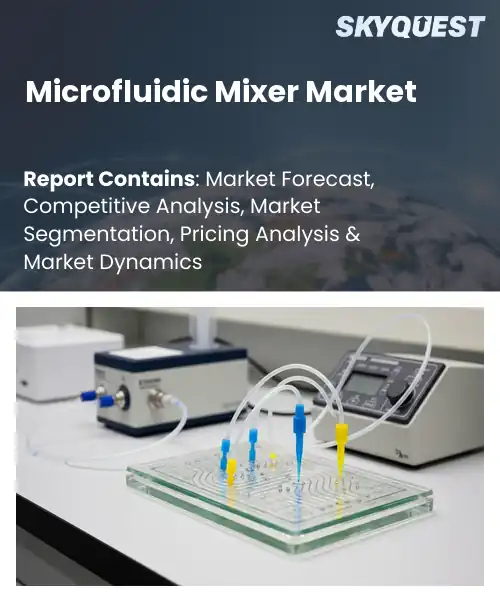
Microfluidic Mixer Market
Report ID: SQMIG35E2061
Report ID: SQMIG35E2061
[email protected]
USA +1 351-333-4748
Report ID:
SQMIG35E2061 |
Region:
Global |
Published Date: February, 2026
Pages:
157
|Tables:
117
|Figures:
77


Global Microfluidic Mixer Market size was valued at USD 1.1 Billion in 2024 and is poised to grow from USD 1.2 Billion in 2025 to USD 2.35 Billion by 2033, growing at a CAGR of 8.8% during the forecast period (2026-2033).
The primary driver of the microfluidic mixer market is growing demand for rapid, precise, low volume fluid handling in diagnostics and research, since these tools cut reagent usage, accelerate assays, and improve reproducibility. Microfluidic mixers combine streams at microliter to picoliter scales to create uniform reaction environments that enable miniaturized workflows. The market shifted from silicon and glass chips to polymer based and 3D printed platforms as proof of concept research moved into commercial instruments. For example, pandemic demand for point of care molecular assays accelerated adoption of integrated microfluidic mixers in diagnostic cartridges, expanding clinical access and supporting deployment.Building on diagnostic integration, a central growth factor for the global microfluidic mixer market is the convergence of scalable manufacturing and application performance, which creates commercial viability and adoption. When manufacturers reduce fabrication costs through injection molding and standardized designs, users can deploy mixers in cartridges and continuous flow reactors, enabling uses such as lipid nanoparticle production for mRNA vaccines and droplet based single cell sequencing that require uniform mixing. This cause and effect dynamic attracts pharmaceutical and diagnostics investment, creates markets for decentralized clinical testing and chemical production, and accelerates sensor integration with AI driven process control at scale.
How is AI improving design and performance in the microfluidic mixer market?
Microfluidic mixers rely on channel geometry flow control and material choices to mix tiny fluid volumes reliably. AI improves design by modeling complex fluid behavior and proposing novel channel shapes that human designers might not consider. Today the market sees AI applied at two levels design and operation. In design AI and machine learning speed up optimization and link simulations to manufacturable layouts while preserving reproducibility. In operation AI enables real time control and image based feedback so mixers perform consistently in diagnostics drug development and thermal management. Recent research and platform work shows these approaches shorten iteration cycles and raise device readiness for commercial use.Corintis December 2025, the company announced a generative design and manufacturing platform for direct to chip microfluidic cooling which uses computational generative design to tailor channel layouts. This AI capable approach enhances thermal mixing and flow control and supports market growth by enabling higher performance simpler scale up and faster deployment.
Market snapshot - (2026-2033)
Global Market Size
USD 1.1 Billion
Largest Segment
Passive Mixers
Fastest Growth
Active Mixers
Growth Rate
8.8% CAGR
To get more insights on this market click here to Request a Free Sample Report
Global microfluidic mixer market is segmented by product type, material type, application, end user and region. Based on product type, the market is segmented into Active Mixers and Passive Mixers. Based on material type, the market is segmented into Silicon, Poly(methyl methacrylate) and Poly(dimethylsiloxane). Based on application, the market is segmented into Biotechnology, Pharmaceuticals and Chemical Processing. Based on end user, the market is segmented into Research Laboratories, Medical Devices, Industrial and Others. Based on region, the market is segmented into North America, Europe, Asia Pacific, Latin America and Middle East & Africa.
Active Mixers segment dominates because they offer precise, tunable control over flow and mixing dynamics through external actuation, enabling consistent processing of complex fluids in demanding workflows. This controllability reduces formulation variability and simplifies integration with sensors and automation, so pharmaceutical and biotech developers prefer them. Fabrication compatibility with advanced manufacturing and the ability to handle multi-step reactions drive widespread adoption, reinforcing their leadership in high-performance microfluidic mixer applications.
However, Passive Mixers are emerging as the most rapidly expanding area due to their simplicity, low manufacturing cost and ease of integration into disposable cartridges. Their reliance on geometry rather than control systems suits point-of-care diagnostics and scalable production. Innovations in microfabrication and novel channel designs are accelerating adoption and unlocking new application niches.
Pharmaceuticals segment leads because stringent process control and reproducibility demands prioritize mixers that deliver uniform, scalable mixing for drug formulation, nanoparticle synthesis and continuous processing. Regulatory expectations push manufacturers toward validated, reliable microfluidic solutions that integrate with analytical monitoring, driving investment in mixers tailored for precise shear and residence time management. This demand for high-quality, reproducible outputs compels stakeholders to adopt advanced microfluidic mixers that align with pharmaceutical manufacturing requirements.
Meanwhile, Biotechnology is witnessing the strongest growth momentum as demand for single-cell analysis, high-throughput assays and biologics development increases reliance on microfluidic mixing platforms. Rapid innovation in assay miniaturization, coupled with academic and industrial R&D adoption, expands application breadth and creates new opportunities for specialized mixer designs that support delicate biological molecules and complex reaction workflows.
To get detailed segments analysis, Request a Free Sample Report
North America leads due to a concentrated ecosystem that combines advanced academic research, a robust pharmaceutical and biotechnology industry, and a strong network of instrument manufacturers and specialized suppliers. Flexible funding mechanisms and a mature venture capital community accelerate commercialization of novel microfluidic solutions. Clinical and diagnostic demand from large hospital systems and contract research organizations creates early adoption opportunities, while regulatory frameworks and reimbursement pathways support translation. Close collaboration between universities, research institutes, and industry fosters rapid prototyping and validation. Established service providers and contract manufacturers enable scale up and customization for complex applications. The presence of global headquarters and strategic partnerships further consolidates innovation, supply chain integration, and market reach, reinforcing North America as the primary hub for microfluidic mixer development and deployment.
Microfluidic Mixer Market in United States benefits from concentrated research hubs, extensive biotech and pharmaceutical presence, and numerous instrument manufacturers. Strong translational infrastructure and access to clinical trial networks accelerate adoption of novel mixers across diagnostics and drug development. Demand from sophisticated end users drives customization and integration with automation platforms. Proximity to major corporate research centers and active collaboration between industry and academia sustains product refinement and scale up.
Microfluidic Mixer Market in Canada is characterized by strong public research institutions, cluster initiatives that connect universities with niche manufacturers, and supportive government programs that prioritize life sciences innovation. Small and medium enterprises collaborate closely with academic labs to translate microfluidic concepts into tailored devices for diagnostics and research applications. Partnerships with global firms enable providers to serve specialized market segments and to integrate into international supply chains for export.
Europe rapid expansion stems from a convergence of precision engineering heritage, a dense network of specialized medtech manufacturers, and coordinated research programs that facilitate cross-border collaboration. Regulatory harmonization across many markets and established clinical research networks support comparative evaluation and clinical adoption. Demand for personalized medicine and advanced diagnostics in academic hospitals drives early implementation, while strong component suppliers and contract manufacturing organizations enable local production and customization. Public–private partnerships and incubators accelerate commercialization of university spinouts. Mature supply chains and export orientation allow European providers to compete globally, with regional centers leveraging engineering expertise and clinical validation to position themselves as leaders in advanced microfluidic mixer technologies. European funding initiatives and collaboration frameworks reduce barriers to scale up, while evolving standards for device interoperability encourage adoption across clinical laboratories. Strategic partnerships with multinational pharmaceutical companies enable validation in complex workflows and foster market pull for sophisticated mixer solutions.
Microfluidic Mixer Market Germany combines deep engineering expertise, a tradition of precision manufacturing, and a dense network of medical device suppliers. Large OEMs collaborate with applied research institutes to develop robust, scalable mixer technologies suited to demanding production environments. Export orientation and established quality systems support global competitiveness, while regional clusters enable rapid prototyping and validation with clinical partners, reinforcing Germany as the leading European base for mixer solutions today.
Microfluidic Mixer Market in United Kingdom is propelled by a vibrant startup ecosystem, strong translational research at universities, and a focus on clinical application. University spinouts and incubators channel innovation toward diagnostics and point of care solutions, while collaborative frameworks link biotech companies with hospital trusts for testing. An entrepreneurial environment and active investor community enable commercialization, marking United Kingdom as a rapidly expanding market for microfluidic mixers and growth.
Microfluidic Mixer Market in France is emerging through strong public research institutes, targeted industrial policy, and expanding support for medtech startups. Regional innovation clusters encourage collaboration between academic laboratories and early stage companies to develop mixers for diagnostics and bioprocessing. Partnerships with established pharmaceutical firms provide pathways for validation and scale, while government-backed programs and incubators reinforce commercialization capacity. This combination positions France as important market for microfluidic mixer technologies.
Asia Pacific is strengthening its role through a combination of advanced manufacturing capabilities, strong electronics and precision engineering sectors, and targeted public support for biotechnology and medical device development. Domestic industry players are integrating microfluidic mixers with analytical instrumentation and automation, leveraging regional strengths in component manufacturing to reduce time to market. Strategic partnerships between local firms and global suppliers accelerate knowledge transfer and validation in clinical settings. Investment in translational research and talent development ensures ongoing innovation, while export orientation and competitive production infrastructure enable rapid scale up. Focused innovation in miniaturization, materials science, and integration with digital control systems positions Asia Pacific markets as increasingly influential contributors to global microfluidic mixer advancement. Regional centers of excellence and coordinated incentive programs further strengthen commercialization pathways and encourage cross border clinical adoption across diverse healthcare systems.
Microfluidic Mixer Market in Japan is anchored by established precision engineering firms, deep expertise in microfabrication, and strong corporate research labs that prioritize device reliability. Integration with advanced electronics supports development of integrated mixer modules for analytical and diagnostic platforms. Close collaboration between manufacturers and clinical research centers enables validation, while domestic contract manufacturers provide capabilities for scale up and quality control, sustaining Japan as center for microfluidic mixer solutions.
Microfluidic Mixer Market in South Korea leverages convergence of advanced electronics manufacturing, dynamic startups, and government initiatives to accelerate product development. Contract manufacturers provide prototyping and scale up for mixer designs, while ties between technology firms and clinical institutions enable early validation. Emphasis on integration with digital control systems and export oriented strategies helps providers move from prototype to market, strengthening South Korea position in regional microfluidic technology supply chains.
To know more about the market opportunities by region and country, click here to
Buy The Complete Report
Technological Advancements Driving Adoption
Growing Demand For Point Of Care
High Manufacturing And Development Costs
Regulatory And Validation Challenges
Request Free Customization of this report to help us to meet your business objectives.
Competition in the global microfluidic mixer market is intensifying as demand for scalable lipid nanoparticle manufacturing and rapid point of care diagnostics drives consolidation and technology tie ups. Companies pursue acquisitions to secure cartridge and manufacturing capacity, partnerships to integrate digital microfluidics and product innovation in chip and cartridge design, evidenced by TE Connectivity’s targeted acquisitions, Nuclera’s acquisition of E Ink’s digital microfluidics unit and Zeon’s purchase of Edge Precision Manufacturing.
Top Player’s Company Profile
Recent Developments
SkyQuest’s ABIRAW (Advanced Business Intelligence, Research & Analysis Wing) is our Business Information Services team that Collects, Collates, Correlates, and Analyses the Data collected by means of Primary Exploratory Research backed by robust Secondary Desk research. As per SkyQuest analysis, the global microfluidic mixer market is driven primarily by growing demand for rapid, precise low-volume fluid handling in diagnostics and research and is further boosted by the convergence of scalable manufacturing with application performance that enables cost-effective cartridge and reactor deployment. Active mixers dominate the market because their tunable, high-performance control is preferred by pharmaceutical and biotech workflows, while North America leads regionally thanks to strong research clusters and commercialization pathways. A key restraint remains high manufacturing and development costs, which limit new entrants and slow scale up. Continued innovation in materials, AI-aided design and diagnostics integration will support expansion.
| Report Metric | Details |
|---|---|
| Market size value in 2024 | USD 1.1 Billion |
| Market size value in 2033 | USD 2.35 Billion |
| Growth Rate | 8.8% |
| Base year | 2024 |
| Forecast period | (2026-2033) |
| Forecast Unit (Value) | USD Billion |
| Segments covered |
|
| Regions covered | North America (US, Canada), Europe (Germany, France, United Kingdom, Italy, Spain, Rest of Europe), Asia Pacific (China, India, Japan, Rest of Asia-Pacific), Latin America (Brazil, Rest of Latin America), Middle East & Africa (South Africa, GCC Countries, Rest of MEA) |
| Companies covered |
|
| Customization scope | Free report customization with purchase. Customization includes:-
|
To get a free trial access to our platform which is a one stop solution for all your data requirements for quicker decision making. This platform allows you to compare markets, competitors who are prominent in the market, and mega trends that are influencing the dynamics in the market. Also, get access to detailed SkyQuest exclusive matrix.
Table Of Content
Executive Summary
Market overview
Parent Market Analysis
Market overview
Market size
KEY MARKET INSIGHTS
COVID IMPACT
MARKET DYNAMICS & OUTLOOK
Market Size by Region
KEY COMPANY PROFILES
Methodology
For the Microfluidic Mixer Market, our research methodology involved a mixture of primary and secondary data sources. Key steps involved in the research process are listed below:
1. Information Procurement: This stage involved the procurement of Market data or related information via primary and secondary sources. The various secondary sources used included various company websites, annual reports, trade databases, and paid databases such as Hoover's, Bloomberg Business, Factiva, and Avention. Our team did 45 primary interactions Globally which included several stakeholders such as manufacturers, customers, key opinion leaders, etc. Overall, information procurement was one of the most extensive stages in our research process.
2. Information Analysis: This step involved triangulation of data through bottom-up and top-down approaches to estimate and validate the total size and future estimate of the Microfluidic Mixer Market.
3. Report Formulation: The final step entailed the placement of data points in appropriate Market spaces in an attempt to deduce viable conclusions.
4. Validation & Publishing: Validation is the most important step in the process. Validation & re-validation via an intricately designed process helped us finalize data points to be used for final calculations. The final Market estimates and forecasts were then aligned and sent to our panel of industry experts for validation of data. Once the validation was done the report was sent to our Quality Assurance team to ensure adherence to style guides, consistency & design.
Analyst Support
Customization Options
With the given market data, our dedicated team of analysts can offer you the following customization options are available for the Microfluidic Mixer Market:
Product Analysis: Product matrix, which offers a detailed comparison of the product portfolio of companies.
Regional Analysis: Further analysis of the Microfluidic Mixer Market for additional countries.
Competitive Analysis: Detailed analysis and profiling of additional Market players & comparative analysis of competitive products.
Go to Market Strategy: Find the high-growth channels to invest your marketing efforts and increase your customer base.
Innovation Mapping: Identify racial solutions and innovation, connected to deep ecosystems of innovators, start-ups, academics, and strategic partners.
Category Intelligence: Customized intelligence that is relevant to their supply Markets will enable them to make smarter sourcing decisions and improve their category management.
Public Company Transcript Analysis: To improve the investment performance by generating new alpha and making better-informed decisions.
Social Media Listening: To analyze the conversations and trends happening not just around your brand, but around your industry as a whole, and use those insights to make better Marketing decisions.
REQUEST FOR SAMPLE
 REQUEST FREE CUSTOMIZATION


Want to customize this report? This report can be personalized according to your needs. Our analysts and industry experts will work directly with you to understand your requirements and provide you with customized data in a short amount of time. We offer $1000 worth of FREE customization at the time of purchase.
Feedback From Our Clients


 USA (+1) 351-333-4748

