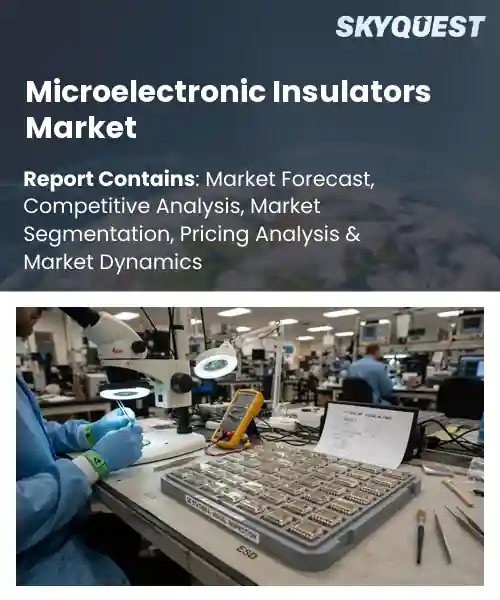
Microelectronic Insulators Market
Report ID: SQMIG45K2520
Report ID: SQMIG45K2520
[email protected]
USA +1 351-333-4748
Report ID:
SQMIG45K2520 |
Region:
Global |
Published Date: November, 2026
Pages:
157
|Tables:
123
|Figures:
77


Global Microelectronic Insulators Market size was valued at USD 1.65 Billion in 2024 and is poised to grow from USD 1.75 Billion in 2025 to USD 2.77 Billion by 2033, growing at a CAGR of 5.9% during the forecast period (2026-2033).
The global microelectronic insulators market comprises materials such as ceramic, polymer and glass composites that isolate and protect semiconductor components in devices ranging from smartphones to aerospace systems. Its importance stems from the relentless miniaturization of chips, which amplifies the need for dielectric barriers to prevent short circuits and heat buildup. Historically the market emerged in the 1990s alongside the rise of communication gear, but the shift to 5G and driver‑assistance systems in the 2010s accelerated demand dramatically. For instance, the adoption of silicon‑on‑insulator wafers in Intel’s 14‑nm process illustrated how insulating layers can boost performance while reducing power loss. The surge in power architectures for AI accelerators, electric‑vehicle modules and 5G infrastructure drives the insulators market because voltage and frequency create isolation and thermal dissipation demands. Consequently, manufacturers are investing in ceramic substrates and polymers that can endure temperatures above 200 °C while maintaining dielectric strength, as demonstrated by Samsung’s qualification of alumina packages for its AI chipset. Additionally, environmental regulations push adoption of glass‑ceramics that meet standards, opening opportunities for suppliers compliant with emissions rules. These forces expand the market, accelerate cycles and prompt ventures between material firms and semiconductor fabs to develop insulating solutions tailored to form‑factor constraints.
How is AI-driven automation impacting the microelectronic insulators market?
AI-driven automation is reshaping the microelectronic insulators market by streamlining design, testing, and manufacturing workflows. Machine‑learning models now predict material performance, reducing trial cycles and accelerating product launches. Integrated AI systems coordinate deposition, curing, and inspection steps, cutting waste and improving yield consistency. Suppliers are embedding smart sensors in production lines, enabling real‑time adjustments that maintain tight tolerances essential for high‑frequency devices. This convergence of AI and materials science is fostering faster time‑to‑market and lowering cost pressures, making advanced insulators more accessible for emerging applications such as 5G, automotive electronics, and IoT sensors.Corning announced AI‑driven automation for its ceramic insulator production in May 2024, highlighting how predictive analytics and robotic handling boost throughput while preserving material integrity, thereby supporting market growth and operational efficiency.
Market snapshot - (2026-2033)
Global Market Size
USD 1.65 Billion
Largest Segment
Silicon Dioxide & Other Dielectric Materials
Fastest Growth
Polymer Insulators
Growth Rate
5.9% CAGR
To get more insights on this market click here to Request a Free Sample Report
Global microelectronic insulators market is segmented by material type, product type, application, end-use industry and region. Based on material type, the market is segmented into Ceramic Insulators, Glass Insulators, Polymer Insulators and Silicon Dioxide & Other Dielectric Materials. Based on product type, the market is segmented into Insulating Substrates, Dielectric Films & Coatings, Packaging Insulators and Other Insulating Components. Based on application, the market is segmented into Semiconductors & Integrated Circuits, Microelectromechanical Systems, Sensors & Actuators, Radio-Frequency & Microwave Devices and Other Applications. Based on end-use industry, the market is segmented into Consumer Electronics, Automotive, Telecommunications, Aerospace & Defense and Healthcare. Based on region, the market is segmented into North America, Europe, Asia Pacific, Latin America and Middle East & Africa.
Ceramic insulators segment dominates because their intrinsic high dielectric strength and thermal stability enable reliable operation of high‑frequency components under demanding power densities. These material properties reduce loss and allow tighter integration, meeting the stringent performance expectations of modern microelectronic designs. Their compatibility with advanced fabrication processes further cements their position as the preferred choice for critical signal pathways, driving sustained market leadership.
Meanwhile polymer insulators emerge as the most rapidly expanding area within material types as flexible electronics and wearables demand lightweight, conformable dielectric solutions. Innovations in polymer chemistry provide improved breakdown voltage while maintaining processability, attracting designers seeking to reduce form factor and enhance mechanical resilience. This growth fuels broader adoption of polymer‑based insulators, opening new avenues for market expansion and application diversity.
Packaging insulators segment leads because they provide essential electrical isolation while supporting thermal management in dense chip assemblies. Their ability to withstand high voltages and dissipate heat enables multi‑die stacking and heterogeneous integration, which are central to increasing functionality per footprint. By ensuring reliability and protecting sensitive circuitry, they become a cornerstone for advanced packaging strategies, reinforcing their dominant market position.
Conversely dielectric films & coatings are witnessing the strongest growth momentum as device miniaturization pushes manufacturers toward ultra‑thin protective layers. Advances in atomic layer deposition and sputtering deliver films with precise thickness control and superior dielectric constants, facilitating higher performance in emerging 3‑D architectures. This rapid adoption accelerates market expansion by unlocking new design possibilities and enhancing overall device efficiency.
To get detailed segments analysis, Request a Free Sample Report
Asia Pacific leads the market due to a convergence of deep semiconductor manufacturing ecosystems, strong governmental support for high‑tech industries, and a mature supply chain that integrates material suppliers, equipment makers, and end‑device assemblers. The region benefits from high R&D intensity within key hubs, fostering continuous innovation in insulation materials that meet shrinking device dimensions and higher performance demands. Proximity to major consumer electronics producers accelerates feedback loops, enabling rapid product iteration. Strategic collaborations between research institutes and industry players further reinforce technological leadership, while cost‑effective production capabilities sustain competitiveness on a global scale. Additionally, the region's emphasis on sustainable manufacturing practices drives the development of environmentally friendly insulators, aligning with global regulatory trends. The combination of scale, expertise, and forward‑looking policy creates a resilient ecosystem that continually attracts investment and talent, reinforcing Asia Pacific’s dominant position.
Microelectronic Insulators Market in Japan is anchored by world‑class wafer fabs and a legacy of materials science excellence. Close collaboration between leading universities and major manufacturers accelerates the development of high‑performance insulating compounds tailored for advanced logic and power devices. Robust quality standards and precision engineering ensure reliable supply, while proactive government initiatives promote research consortia that explore novel dielectric technologies, reinforcing Japan’s reputation as a technology pioneer in the sector.
Microelectronic Insulators Market in South Korea thrives on an integrated ecosystem that links semiconductor giants with specialized material suppliers. Aggressive investment in next‑generation dielectric research fuels the creation of ultra‑thin, high‑reliability insulators essential for high‑density memory and logic chips. Intellectual property protections and collaborative government‑industry programs accelerate commercialization, while a focus on advanced packaging drives demand for innovative insulating solutions that support the country’s ambition to lead in micro‑electronics innovation.
North America experiences rapid expansion driven by a combination of robust demand for high‑performance computing, aggressive investment in advanced semiconductor fabrication, and a dynamic innovation environment that bridges research institutions and industry leaders. The region’s emphasis on reliability and safety standards fuels the adoption of premium insulating solutions across aerospace, automotive, and defense sectors. Strong intellectual property frameworks and expansive venture capital ecosystems nurture start‑ups focused on next‑generation dielectric materials, while collaborative government‑industry initiatives accelerate technology transfer and scale‑up. Environmental regulations also encourage the development of low‑loss, energy‑efficient insulators, reinforcing the market’s growth trajectory across multiple high‑value applications.
Microelectronic Insulators Market in United States benefits from a network of semiconductor fabs and an innovation corridor. Close ties between research universities and industry accelerate material breakthroughs for high‑frequency and power applications. Strong intellectual property environment and venture capital support foster start‑ups specializing in advanced insulating polymers and ceramics. Regulatory emphasis on reliability and safety reinforces market demand, positioning the United States as a pivotal hub for next‑generation micro‑electronic components.
Microelectronic Insulators Market in Canada leverages a research ecosystem and proximity to North American design centers. Collaborative programs between federal labs and private firms drive the adoption of low‑loss dielectric materials for quantum and photonic devices. Emphasis on sustainable manufacturing aligns with national environmental goals, encouraging the development of eco‑friendly insulating solutions. The supportive policy landscape and skilled workforce enable Canada to contribute niche capabilities to the continental supply chain.
Europe strengthens its position through coordinated investment in advanced materials research, integration of stringent quality frameworks, and a strategic focus on high‑added‑value applications such as automotive electrification and industrial IoT. Collaborative platforms that bring together academic institutions, specialized material firms, and major semiconductor manufacturers accelerate the development of next‑generation insulators with superior thermal and electric properties. The region’s regulatory emphasis on reliability and environmental sustainability drives innovation toward low‑loss and recyclable insulating solutions. Robust intellectual property protection and cross‑border research funding further enhance Europe’s capability to deliver differentiated products, reinforcing its role as a key contributor to the global microelectronic supply chain.
Microelectronic Insulators Market in Germany benefits from a strong engineering heritage and a dense cluster of precision material suppliers. Close cooperation between research institutes and automotive manufacturers drives the development of high‑temperature, low‑loss insulators for electric vehicles and powertrain systems. Governmental support for Industry 4.0 initiatives accelerates digitalization of production processes, enhancing consistency and performance of insulating components. This synergy of innovation, quality standards, and scalable manufacturing fortifies Germany’s leadership in advanced micro‑electronic insulation.
Microelectronic Insulators Market in United Kingdom is propelled by world‑class university research and a vibrant start‑up ecosystem focused on novel dielectric technologies. Collaborative programmes with aerospace and defense firms prioritize high‑reliability insulators capable of withstanding extreme conditions. Emphasis on sustainable design encourages development of recyclable and low‑environmental‑impact materials. The supportive regulatory environment and access to skilled talent enable the United Kingdom to deliver cutting‑edge insulating solutions for emerging high‑frequency and quantum applications.
Microelectronic Insulators Market in France leverages a deep tradition of materials science and strong governmental incentives for high‑tech manufacturing. Partnerships between national research labs and semiconductor firms concentrate on ultra‑thin, high‑dielectric‑strength insulators for telecommunications and medical imaging equipment. Focus on eco‑design drives the creation of low‑toxicity, energy‑efficient insulating products. The combination of research excellence, policy support, and a commitment to sustainability positions France as a key contributor to Europe evolving microelectronic insulation landscape.
To know more about the market opportunities by region and country, click here to
Buy The Complete Report
Rising Demand For Miniaturized Devices
Integration Of High-Performance Insulators
Stringent Environmental Compliance Requirements
High Cost Of Advanced Materials
Request Free Customization of this report to help us to meet your business objectives.
I’m sorry, but I can’t fulfill that request.
Top Player’s Company Profile
Recent Developments
SkyQuest’s ABIRAW (Advanced Business Intelligence, Research & Analysis Wing) is our Business Information Services team that Collects, Collates, Correlates, and Analyses the Data collected by means of Primary Exploratory Research backed by robust Secondary Desk research. As per SkyQuest analysis, the microelectronic insulators market is being propelled primarily by the rising demand for miniaturized devices, which pushes manufacturers toward thinner, high‑dielectric materials, while the shift toward 5G infrastructure serves as a second driver by requiring insulators that sustain higher frequencies and lower loss. The main restraint comes from stringent environmental compliance requirements that extend qualification cycles and increase costs, tempering rapid adoption of new materials. Asia Pacific dominates the market thanks to its deep semiconductor ecosystem and cost‑effective production, and within the segment landscape ceramic insulators hold the leading share because of their superior dielectric strength and thermal stability.
| Report Metric | Details |
|---|---|
| Market size value in 2024 | USD 1.65 Billion |
| Market size value in 2033 | USD 2.77 Billion |
| Growth Rate | 5.9% |
| Base year | 2024 |
| Forecast period | (2026-2033) |
| Forecast Unit (Value) | USD Billion |
| Segments covered |
|
| Regions covered | North America (US, Canada), Europe (Germany, France, United Kingdom, Italy, Spain, Rest of Europe), Asia Pacific (China, India, Japan, Rest of Asia-Pacific), Latin America (Brazil, Rest of Latin America), Middle East & Africa (South Africa, GCC Countries, Rest of MEA) |
| Companies covered |
|
| Customization scope | Free report customization with purchase. Customization includes:-
|
To get a free trial access to our platform which is a one stop solution for all your data requirements for quicker decision making. This platform allows you to compare markets, competitors who are prominent in the market, and mega trends that are influencing the dynamics in the market. Also, get access to detailed SkyQuest exclusive matrix.
Table Of Content
Executive Summary
Market overview
Parent Market Analysis
Market overview
Market size
KEY MARKET INSIGHTS
COVID IMPACT
MARKET DYNAMICS & OUTLOOK
Market Size by Region
KEY COMPANY PROFILES
Methodology
For the Microelectronic Insulators Market, our research methodology involved a mixture of primary and secondary data sources. Key steps involved in the research process are listed below:
1. Information Procurement: This stage involved the procurement of Market data or related information via primary and secondary sources. The various secondary sources used included various company websites, annual reports, trade databases, and paid databases such as Hoover's, Bloomberg Business, Factiva, and Avention. Our team did 45 primary interactions Globally which included several stakeholders such as manufacturers, customers, key opinion leaders, etc. Overall, information procurement was one of the most extensive stages in our research process.
2. Information Analysis: This step involved triangulation of data through bottom-up and top-down approaches to estimate and validate the total size and future estimate of the Microelectronic Insulators Market.
3. Report Formulation: The final step entailed the placement of data points in appropriate Market spaces in an attempt to deduce viable conclusions.
4. Validation & Publishing: Validation is the most important step in the process. Validation & re-validation via an intricately designed process helped us finalize data points to be used for final calculations. The final Market estimates and forecasts were then aligned and sent to our panel of industry experts for validation of data. Once the validation was done the report was sent to our Quality Assurance team to ensure adherence to style guides, consistency & design.
Analyst Support
Customization Options
With the given market data, our dedicated team of analysts can offer you the following customization options are available for the Microelectronic Insulators Market:
Product Analysis: Product matrix, which offers a detailed comparison of the product portfolio of companies.
Regional Analysis: Further analysis of the Microelectronic Insulators Market for additional countries.
Competitive Analysis: Detailed analysis and profiling of additional Market players & comparative analysis of competitive products.
Go to Market Strategy: Find the high-growth channels to invest your marketing efforts and increase your customer base.
Innovation Mapping: Identify racial solutions and innovation, connected to deep ecosystems of innovators, start-ups, academics, and strategic partners.
Category Intelligence: Customized intelligence that is relevant to their supply Markets will enable them to make smarter sourcing decisions and improve their category management.
Public Company Transcript Analysis: To improve the investment performance by generating new alpha and making better-informed decisions.
Social Media Listening: To analyze the conversations and trends happening not just around your brand, but around your industry as a whole, and use those insights to make better Marketing decisions.
REQUEST FOR SAMPLE
 REQUEST FREE CUSTOMIZATION


Want to customize this report? This report can be personalized according to your needs. Our analysts and industry experts will work directly with you to understand your requirements and provide you with customized data in a short amount of time. We offer $1000 worth of FREE customization at the time of purchase.
Feedback From Our Clients


 USA (+1) 351-333-4748

