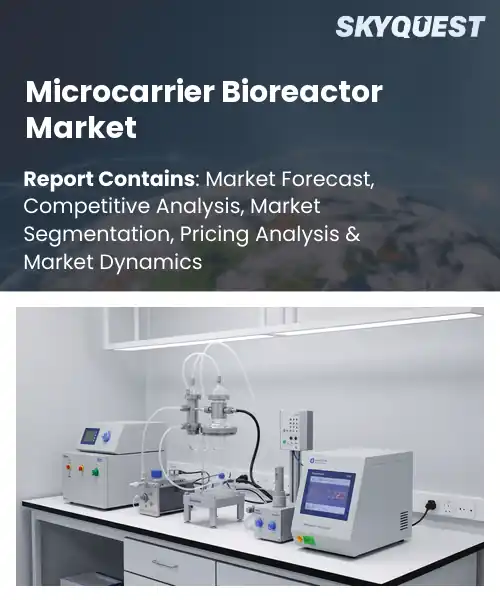
Microcarrier Bioreactor Market
Report ID: SQMIG35H2415
Report ID: SQMIG35H2415
[email protected]
USA +1 351-333-4748
Report ID:
SQMIG35H2415 |
Region:
Global |
Published Date: February, 2026
Pages:
157
|Tables:
141
|Figures:
78


Global Microcarrier Bioreactor Market size was valued at USD 1.40 Million in 2024 and is poised to grow from USD 1.54 Million in 2025 to USD 3.38 Million by 2033, growing at a CAGR of 10.3% during the forecast period (2026-2033).
Rising demand for biologics and advanced cell therapies, growing need for large-scale adherent cell culture, increasing adoption of single-use bioprocessing technologies, innovations in microcarrier design, and emphasis on scalable vaccine and viral vector manufacturing are driving demand for microcarrier bioreactors.
The fast vaccine development during emergency vaccination programs confirmed that microcarrier production systems can function at industrial scale. The implementation of advanced sensor technologies and process analytical technologies and automated monitoring technologies will lead to improved yield consistency and regulatory compliance which will result in increased use of microcarrier bioreactors in pharmaceutical and biotechnology production facilities. Advances have been made in single-use stirred tank technologies, automation technologies, and optimized microcarrier chemistries to improve scalability and reduce contamination risks. Growing demand for biologics, vaccines, and advanced cellular therapies around the world coupled with the shift from planar culture systems to scalable bioprocessing platforms is expected to primarily drive microcarrier bioreactor market growth.
On the contrary, high capital investment requirements, complex process optimization challenges, stringent regulatory validation requirements, and limited technical expertise for large-scale microcarrier-based cell culture are estimated to hamper microcarrier bioreactor market penetration through 2033.
How is AI Optimizing Cell Growth And Scalability In Microcarrier Bioreactors?
AI is helping make microcarrier bioreactor workflows more predictable and efficient by combining real-time sensor data with machine learning models. Some of the key applications include automatic monitoring of cell coverage on microcarriers, image-based methods to determine confluence of cells, and adaptive feeding strategies to minimize variability in cell growth. AI can bridge the gap in moving from small-scale development to large-scale manufacturing by facilitating faster process optimization and smoother technology transfer. This reduces failed manufacturing processes and makes the results of the manufacturing process consistent.
Market snapshot - (2026-2033)
Global Market Size
USD 1.4 Million
Largest Segment
Bioreactor Types
Fastest Growth
Microcarrier Types
Growth Rate
10.3% CAGR
To get more insights on this market click here to Request a Free Sample Report
Global microcarrier bioreactor market is segmented by product type, material type, form factor, application, end user, and region. Based on product type, the market is segmented into microcarrier types and bioreactor types. Based on material type, the market is segmented into synthetic materials and natural materials. Based on form factor, the market is segmented into single-use systems and reusable systems. Based on application, the market is segmented into vaccine production, cell therapy, and others. Based on end user, the market is segmented into biopharmaceutical companies, research institutions, and others. Based on region, the market is segmented into North America, Europe, Asia Pacific, Latin America, and Middle East & Africa.
The synthetic materials segment is estimated to lead the global microcarrier bioreactor market revenue generation in the future. Manufacturers favor their batch to batch consistency, tunable surface chemistries and predictable mechanical properties, which helps this segment hold sway over others. These traits reduce process variability, simplify validation and align with regulatory expectations, and compatibility with single use workflows lowers contamination risk and streamlines downstream integration while supporting intensified processes.
However, natural materials are witnessing the strongest growth momentum as per this microcarrier bioreactor market forecast. Increasing emphasis on biomimetic cell environments, improved purification and sourcing, and demand from sensitive cell therapy applications are creating new opportunities. Advances that reduce immunogenic risk and improve reproducibility are unlocking broader use in high value manufacturing and creating new opportunities for biologically derived carriers.
The single use systems segment is slated to account for the largest global microcarrier bioreactor market share going forward. The high degree of preference for operational flexibility, lower cleaning validation requirements, and lower risks of cross-contamination, which are characteristic of the disposable components segment, are further solidifying the position of the segment. These factors are making the process of turning around campaigns more efficient, thereby cutting down the time to production and the capital cost associated with the use of complex stainless steel systems, which are being utilized to scale up multiple product campaigns by biopharmaceutical developers.
However, the reusable segment is growing at the fastest rate, and the reasons for this include the renewed emphasis on cost optimization, advances in cleaning and sterilization technologies, and the interest in sustainability driving investments. Improvements in automation for cleaning and process control offer the possibility of high-throughput continuous production scenarios, which will be attractive to large-scale manufacturers looking for efficiency gains.
To get detailed segments analysis, Request a Free Sample Report
High emphasis on integrated innovation across industry, academia, and clinical research, supported by robust infrastructure are helping cement the dominance of this region going forward. Additionally, many established biopharmaceutical companies and manufacturers of specialized equipment provide further development of technology through refinement and diversity of applications, while networks promote rapid process optimization and scale-up. Regulatory guidelines also support quality and clarity of pathway in order to encourage the use of scalable suspension and adherent cell culture systems; this is accomplished by using contract development and manufacturing across the region resulting in rapid transition from laboratory to commercial production.
The presence of a dense network of biotechnology firms, contract development and manufacturing providers, and research institutions drives microcarrier bioreactor demand in the United States. The high focus on process development, available human resources, and established infrastructure also help drive the process forward. Collaboration between industry and academia helps drive innovation, and technology companies continue to improve their automated technology to meet regulatory and scaling needs for different therapies.
Robust academic research centers, equipment manufacturers, and focused bioprocess development teams ensure consistent demand for microcarrier bioreactors across Canada. The favorable innovation environment and partnerships are helpful in transferring knowledge and diversifying suppliers. The presence of clusters helps in accessing experienced operators and service providers to improve the development studies to manufacturing operations.
Presence of leading pharmaceutical companies, progressive research ecosystems, and strong industrial partnerships create new business scope for microcarrier bioreactor vendors. National centers of excellence and suppliers of specialist equipment play an important role in encouraging adoption of microcarrier bioreactors in both process development and scale-up. Harmonized approaches to regulations and increasing contract manufacturing capacity also reduce obstacles to commercializing microcarrier bioreactor technologies. Investments in developing talent and building infrastructure will enable the establishment of manufacturing hubs that will allow regional manufacturers to meet a broad range of therapeutic needs and make significant contributions toward enhancing their advanced cell-culture capabilities.
An established engineering and manufacturing base is responsible for shaping microcarrier bioreactor sales in Germany through 2033. The country has a strong presence of equipment suppliers and precision component suppliers to support advanced design of bioprocesses. There is close interaction with technical universities to enhance standardization of bioprocesses and large-scale solutions. Emphasis is given to engineering excellence, process control expertise, and supply chain integration to ensure efficient deployment of microcarrier bioreactors in bioprocesses.
Dynamic clinical translation, a vibrant startup ecosystem, and strong contract development capabilities are accelerating the demand for microcarrier bioreactors in the country. Growing interest in cell therapy development, networking, and flexible contract development is supporting the rapid validation and commercialization of microcarrier-based solutions in the United Kingdom. The engagement with regulatory bodies is also supporting the smooth commercialization of microcarrier-based solutions.
Robust public research institutions, translational platforms, and growing contract manufacturing capacity ensure sustained microcarrier bioreactor adoption in France. Focus on collaborative research between academia and industry helps drive validation of microcarrier technology. Development of local supplier ecosystems and workforce programs is also beneficial for gradual adoption and technology advancement across different therapeutic areas. Strategic partnerships and infrastructure investments are also helping drive adaptation of automated technology for local scalable manufacturing.
High investments in bioprocess engineering, the growth of specialized equipment manufacturers, and expanding manufacturing capabilities help boost microcarrier bioreactor adoption in Asia Pacific. Collaboration with international vendors and academic institutions will speed up the transfer of knowledge as well as provide systems tailored to regional needs. The development of strong supply chains and the formation of contracting production networks will also facilitate scale up, while the focus on training the workforce in addition to process technical support will facilitate the translation of lab innovations into reliable production practice in the region.
Microcarrier bioreactor market trends in Japan leverage a strong tradition of longstanding heritage of precision engineering, specialized original equipment manufacturers, and integration of automated control systems is shaping microcarrier bioreactor adoption in the country. There is close collaboration between academic research facilities and industry to provide solutions for regenerative medicine and biologics development. A focus on quality assurance, process optimization, and supplier quality enhances the manufacturing base for bioprocessing and utilization of microcarrier bioreactor systems in Japan.
Presence of an agile biotechnology industry, strong contract manufacturing capabilities, and targeted support for translational research boosts microcarrier bioreactor demand in South Korea. The emphasis on rapid clinical translation, process automation, and integrated supply chains helps in efficient development and commercialization. Strong university-industry relationships enable the training of the workforce and the provision of specialized services, which are key to building capabilities in the region. Companies are customizing microcarrier bioreactors for cell therapy and biologics.
To know more about the market opportunities by region and country, click here to
Buy The Complete Report
Growing Demand for Cell Therapies
Increased Focus on Bioprocess Efficiency
Complex Scale Up Process Challenges
High Cost of Regulatory Compliance
Request Free Customization of this report to help us to meet your business objectives.
Competitive dynamics center on supplier consolidation and targeted partnerships to deliver integrated upstream solutions, driven by demand for scalable adherent cell expansion for biologics and cultivated products; examples include Sartorius taking a majority stake in CellGenix and GEA partnering with Believer Meats to co develop production scale bioreactors, while startups such as Smart MCs and NouBio push edible and biodegradable microcarriers and serum replacements.
In November 2025, Aber Instruments and Sartorius integrated the BioPAT Viamass single use biomass sensor into Ambr 250 high throughput bioreactors, enabling non invasive biomass monitoring across microcarrier workflows and strengthening PAT enabled scale up and process transfer between development and commercial Sartorius bioreactor platforms to improve reproducibility and reduce manual sampling requirements.
In May 2025, Corning presented their microcarriers and Ascent fixed bed bioreactor at the ISCT conference in New Orleans, which focused on closed configurable assemblies and scale-up solutions for adherent cell expansion, indicating a renewed emphasis on integrated consumables and vessels to ease the implementation of microcarrier processes from research to manufacturing.
In February 2025, Cellevate launched its Cellevat3d nanofibre microcarriers in the US at the Viral Vector Process Development and Manufacturing Summit with its stirred tank compatible nanofibre scaffold with significantly increased surface area to increase adherent cell yields and facilitate the adoption of microcarriers for use with viral vectors, iPSCs, and regenerative medicine applications.
SkyQuest’s ABIRAW (Advanced Business Intelligence, Research & Analysis Wing) is our Business Information Services team that Collects, Collates, Correlates, and Analyses the Data collected by means of Primary Exploratory Research backed by robust Secondary Desk research.
As per SkyQuest analysis, rising demand for biologics and advanced cell therapies and increasing need for scalable adherent cell culture systems are anticipated to drive the demand for microcarrier bioreactors going forward. However, high capital investment requirements and complex process optimization challenges are slated to slow down the adoption of microcarrier bioreactors in the future. North America is slated to spearhead the demand for microcarrier bioreactors owing to the presence of advanced biopharmaceutical manufacturing infrastructure and strong investments in cell therapy development. Development of single-use bioreactor technologies and integration of advanced sensors and process analytics are anticipated to be key trends driving the microcarrier bioreactor sector in the future.
| Report Metric | Details |
|---|---|
| Market size value in 2024 | USD 1.4 Million |
| Market size value in 2033 | USD 3.38 Million |
| Growth Rate | 10.3% |
| Base year | 2024 |
| Forecast period | (2026-2033) |
| Forecast Unit (Value) | USD Million |
| Segments covered |
|
| Regions covered | North America (US, Canada), Europe (Germany, France, United Kingdom, Italy, Spain, Rest of Europe), Asia Pacific (China, India, Japan, Rest of Asia-Pacific), Latin America (Brazil, Rest of Latin America), Middle East & Africa (South Africa, GCC Countries, Rest of MEA) |
| Companies covered |
|
| Customization scope | Free report customization with purchase. Customization includes:-
|
To get a free trial access to our platform which is a one stop solution for all your data requirements for quicker decision making. This platform allows you to compare markets, competitors who are prominent in the market, and mega trends that are influencing the dynamics in the market. Also, get access to detailed SkyQuest exclusive matrix.
Table Of Content
Executive Summary
Market overview
Parent Market Analysis
Market overview
Market size
KEY MARKET INSIGHTS
COVID IMPACT
MARKET DYNAMICS & OUTLOOK
Market Size by Region
KEY COMPANY PROFILES
Methodology
For the Microcarrier Bioreactor Market, our research methodology involved a mixture of primary and secondary data sources. Key steps involved in the research process are listed below:
1. Information Procurement: This stage involved the procurement of Market data or related information via primary and secondary sources. The various secondary sources used included various company websites, annual reports, trade databases, and paid databases such as Hoover's, Bloomberg Business, Factiva, and Avention. Our team did 45 primary interactions Globally which included several stakeholders such as manufacturers, customers, key opinion leaders, etc. Overall, information procurement was one of the most extensive stages in our research process.
2. Information Analysis: This step involved triangulation of data through bottom-up and top-down approaches to estimate and validate the total size and future estimate of the Microcarrier Bioreactor Market.
3. Report Formulation: The final step entailed the placement of data points in appropriate Market spaces in an attempt to deduce viable conclusions.
4. Validation & Publishing: Validation is the most important step in the process. Validation & re-validation via an intricately designed process helped us finalize data points to be used for final calculations. The final Market estimates and forecasts were then aligned and sent to our panel of industry experts for validation of data. Once the validation was done the report was sent to our Quality Assurance team to ensure adherence to style guides, consistency & design.
Analyst Support
Customization Options
With the given market data, our dedicated team of analysts can offer you the following customization options are available for the Microcarrier Bioreactor Market:
Product Analysis: Product matrix, which offers a detailed comparison of the product portfolio of companies.
Regional Analysis: Further analysis of the Microcarrier Bioreactor Market for additional countries.
Competitive Analysis: Detailed analysis and profiling of additional Market players & comparative analysis of competitive products.
Go to Market Strategy: Find the high-growth channels to invest your marketing efforts and increase your customer base.
Innovation Mapping: Identify racial solutions and innovation, connected to deep ecosystems of innovators, start-ups, academics, and strategic partners.
Category Intelligence: Customized intelligence that is relevant to their supply Markets will enable them to make smarter sourcing decisions and improve their category management.
Public Company Transcript Analysis: To improve the investment performance by generating new alpha and making better-informed decisions.
Social Media Listening: To analyze the conversations and trends happening not just around your brand, but around your industry as a whole, and use those insights to make better Marketing decisions.
REQUEST FOR SAMPLE
 REQUEST FREE CUSTOMIZATION
Global Microcarrier Bioreactor Market size was valued at USD 1.4 Million in 2024 and is poised to grow from USD 1.54 Million in 2025 to USD 3.38 Million by 2033, growing at a CAGR of 10.3% during the forecast period (2026-2033).
Competitive dynamics center on supplier consolidation and targeted partnerships to deliver integrated upstream solutions, driven by demand for scalable adherent cell expansion for biologics and cultivated products; examples include Sartorius taking a majority stake in CellGenix and GEA partnering with Believer Meats to co develop production scale bioreactors, while startups such as Smart MCs and NouBio push edible and biodegradable microcarriers and serum replacements. 'Thermo Fisher Scientific', 'Sartorius AG', 'Merck KGaA', 'Corning Incorporated', 'Eppendorf AG', 'GE Healthcare', 'Lonza Group AG', 'Danaher Corporation', 'Bellco Glass Inc.', 'Repligen Corporation', 'ABL Europe', 'PBS Biotech, Inc.', 'CellGenix GmbH', 'Hitachi High-Tech Corporation', 'Abcellute LLC', 'R&D Systems', 'InSphero AG', 'CnBio Innovations', 'Agilent Technologies', 'BIOSIL Technologies'
Growing clinical and commercial interest in cell and gene therapies has increased the need for scalable, controlled cell expansion systems, making microcarrier bioreactors more attractive to developers and manufacturers. Their ability to support adherent cell cultures at larger volumes while maintaining process control encourages adoption in translational and commercial production. This demand motivates investment in process development, fabrication of specialized microcarriers, and integration of automated bioreactor platforms, thereby expanding supplier offerings and accelerating technology maturation across biopharmaceutical companies focused on advanced cellular therapeutics.
Adoption Of Single Use Systems: Manufacturers increasingly prefer disposable microcarrier bioreactor components to reduce contamination risk, shorten turnaround, and simplify validation. Single Use systems allow flexible batch sizes, faster changeovers, and reduced cleaning, sterilization, benefiting contract manufacturers and smaller biotechs. Suppliers expand modular offerings to accommodate varied vessel geometries and mixing needs addressing waste management and material compatibility. The move fosters collaboration across supply chains to optimize designs, secure reliable supplies, and accelerate development and commercialization of novel cell based and gene modified therapies globally.
Why does North America Dominate the Global Microcarrier Bioreactor Market? |@12


Want to customize this report? This report can be personalized according to your needs. Our analysts and industry experts will work directly with you to understand your requirements and provide you with customized data in a short amount of time. We offer $1000 worth of FREE customization at the time of purchase.
Feedback From Our Clients


 USA (+1) 351-333-4748

